I Am Kirishima (桐島です, Banmei Takahashi, 2025)

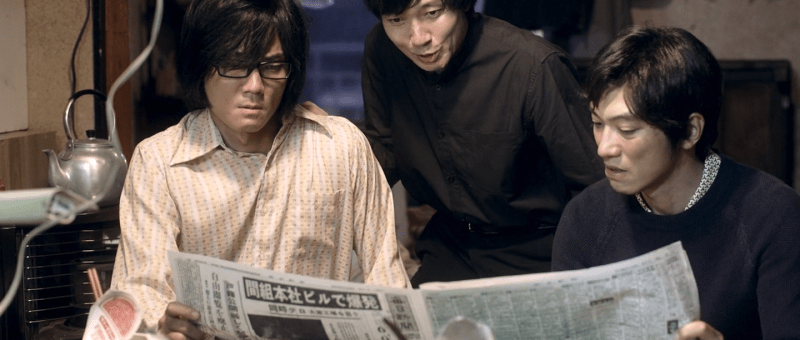
In early 2024, an elderly man made a shocking confession. He told members of the medical staff at the hospital where he was being treated that his name was actually “Satoshi Kirishima” and that he was a fugitive from justice wanted for the terrorist bombing of Mitsubishi Industries in 1974 that resulted in the deaths of eight people. Banmei Takahashi’s I Am Kirishima (桐島です, Kirishima desu) attempts to chart the course of his lifetime on the run but may prove controversial in the depths of its sympathy for a man who was party to this kind violence and to a degree found it justified even if he could not justify that his organisation threatened the lives of ordinary people rather than simply the infrastructure of companies they believed to be fuelling corporate imperialism.

Takashi has visited this era before with 2001’s Rain of Light which like Wakamatsu’s United Red Army readdressed the Asama-Sanso Incident and the failure of the student movement in early 1970s of which both directors had been a part. In February 1972, five members of the URA fleeing a purge inside the group holed up in a mountain lodge taking the innkeeper’s wife hostage. The event was one of the first news events in Japan to be broadcast live and its aftermath exposed the cult-like depths of violence and abuse to which the URA had descended forever the souring the nation as a whole on the idea of left-wing revolution. Meanwhile, the fragmentary groups that remained shifted further towards the extremes such completing bombing campaigns to disrupt the new capitalistic prosperity of the economic miracle. Kirishima and his cell believe these large conglomerates, such as Mitsubishi, to be enacting a new kind of Japanese imperialism through exploitative labour practices often targeting migrant workers in much the same way they made use of the forced labour of Korean and Chinese people trafficked to Japan during the colonial period.

To this extent, Kirishima justifies acts of terrorism but thinks they should avoid ordinary people getting caught up in the blast. The film is keen to cast him as “a man behind the times,” an foolish idealist who is exiled from the modern society because of his outdated beliefs in equality and fairness. As such, it lends an elegiac quality to the tragedy of his life in which his 50 years on the run weren’t all that much better than prison given that he had to live under an assumed identity, forever watching his back and unable to put down roots. A tentative romance with a singer-songwriter is hinted at, but Kirishima forgoes his romantic desires out of a feeling that it would be irresponsible to marry without being able to reveal his true self. 

But the film equally seems to drawn a parallel with contemporary Japan in Kirishima finds himself working alongside a middle school drop out with openly xenophobic views who makes frequent racist remarks such as implicating a co-worker when he’s taken to task for being late by insisting that it must be the other guy’s fault because he’s Korean and Koreans always lie. He also says that the migrant workers whom he claims are working illegally should be grateful to be exploited in Japan and can always go home if they don’t like it. It’s all a little too much for Kirishima who sacrificed his life for an ideal this boy repudiates while Japan has become a nation ruled by capitalism and exploitation with the labour revolution he dreamed of now a distant memory. Watching a Shinzo Abe press conference in which he discusses revising the constitution, Kirishima throws a beer can at the TV in frustration. His old comrade dies in prison leaving only a book of poetry behind, while another is released after serving his time though he obviously can’t make contact with him without risking his identity being exposed and getting picked up after all these years. 

Indeed, the film romanticises this image of Kirishima as a man from a bygone age in which another Japan was possible but did not and now presumably cannot come to pass. In doing so, it gives tacit approval to some of the actions of the extremist groups of the 1970s while simultaneously declaring the end of an era as a “case closed” card is placed over the cheerfully smiling face of a young Kirishima which had graced wanted posters all over the country for the last 50 years. His life itself becomes a failed revolution, but also kind of victory in which he managed to “beat” the police by remaining a fugitive all that time even if in the end he seems to regret the life he was prevented from living along with the isolation and loneliness of which he may now at last be free.


I Am Kirishima screened as part of this year’s Osaka Asian Film Festival.

Trailer (no subtitles)
Penguin Highway (ペンギン・ハイウェイ, Hiroyasu Ishida, 2018) [Fantasia 2018]

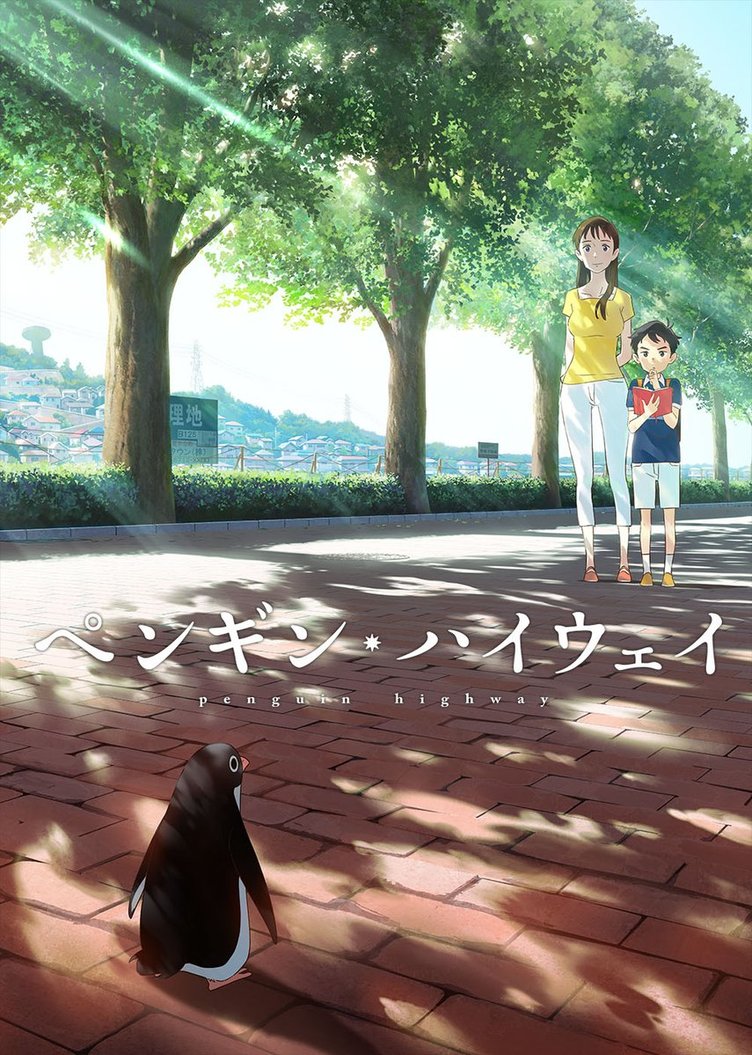
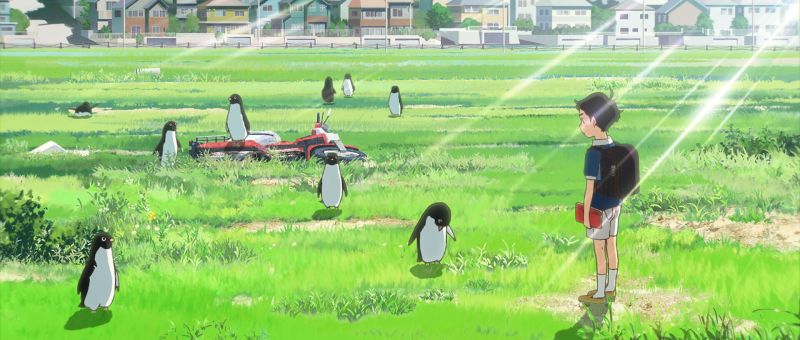
Penguin Highway posterRandom penguins might be the very opposite of a problem, but what exactly does it all mean? Tomihiko Morimi has provided the source material for some of the most interesting Japanese animation of recent times from Masaaki Yuasa’s wonderfully surreal Tatami Galaxy and Night is Short, Walk on Girl, to the comparatively calmer Eccentric Family. Hiroyasu Ishida’s adaptation of Morimi’s Penguin Highway (ペンギン・ハイウェイ) may be a far less abstract attempt to capture the author’s unique world view than Yuasa’s anarchic psychedelia, but preserves the author’s sense of every day strangeness as an ordinary primary school boy’s peaceful life is suddenly derailed by the appearance of random penguins in a small town way in land in the middle of a hot and humid Japanese summer.

Aoyama (Kana Kita) is, as he tells us, “very smart”. He thinks its OK to tell us this because unlike some of his classmates he isn’t conceited, which is what makes him so great. He’s absolutely positive that he’s going to become an important person in the future and can’t wait to find out just how amazing he’s going to be once he’s grown up. Aoyama is also sure that crowds of girls will be lining up to marry him, but they’re all out of luck because he already has a special someone in mind – the friendly young receptionist from the dentist’s (Yu Aoi) who has been coaching him at chess and just generally hanging out with him chatting about life.

Everything begins to change one day when random penguins start appearing all over town. Penguins are, after all, cold climate creatures and this is a glorious summer in Southern Japan so even if these are rogue penguins who’ve managed to escape from a zoo, it’s anyone’s guess how they’ve managed to survive. Being the scientifically minded young man he is, Aoyama becomes determined to solve the penguin mystery, especially as it seems to have something to do with the young lady from the dentist’s who he can’t seem to get out of his mind.

Aoyama is, despite his opening gambit, a fairly conceited young man who thinks himself much cleverer than those around him – not only his schoolmates but the adults too (possibly with the exception of the lady from the dentist’s who is after all teaching him how to be better at chess). With an intense superiority complex, Aoyama has few friends (not that that bothers him, particularly) and is often bullied by the class bruiser, Suzuki (Miki Fukui), and his minions, all of which he takes in his stride. He is, however, slightly thrown by the presence of an extremely bright girl in his class, Hamamoto (Megumi Han), who regularly beats him at chess and is interested in black holes among other areas of scientific endeavour Aoyama had earmarked as his own.

Despite suspecting that Hamamoto might be “even more amazing” than he is, Aoyama is not resentful or jealous but remains seemingly oblivious to her attempts to make friends with him. Aoyama, as an intensely “rational” person, is also sometimes insensitive and remains entirely unable to pick up on social cues unlike his more perceptive friend/assitant, Uchida (Rie Kugimiya), who is well aware of the reason Suzuki keeps picking on Hamamoto, but is unable to convey his instinctual understanding of human nature to the logical Aoyama. Armed with this new fragment of information from Uchida, Aoyama uses it in a predictably “rational” fashion by suddenly bringing it up in front of both Hamamoto and Suzuki in “advising” him that liking someone isn’t “embarrassing” and Suzuki should just say what he means rather than making passive aggressive attempts to get attention by being unpleasant. All of which is, ironically enough, quite awkward.

Through carrying out his investigation into the penguin phenomenon, Aoyama is forced to confront his less rational side, eventually affirming that he’ll live his life based on a “personal belief” rather than a scientific principle. Getting a glimpse of the edge of the world and coming to accept that not matter how much fun you’re having there will always come an end, Aoyama decides to live his life in haste anyway running fast towards an inevitable conclusion in the hope of a longed for reconciliation. Sadly, his discoveries don’t seem to have made him any less conceited but he is at least good hearted and eager to help even if he remains determined to walk his “Penguin Highway” all alone while concentrating on becoming a better person. Beautifully animated and tempering its inherent surrealism with gentle whimsy, Penguin Highway is a promising start for Studio Colorido, mixing Ghibli-esque charm with Morimi’s trademark surrealism for a moving coming of age tale in which a rigid young man learns to find the sweet spot between faith and rationality and pledges to live his life in earnest in expectation of its end.


Penguin Highway was screened as part of Fantasia International Film Festival 2018.

Original trailer (no subtitles)