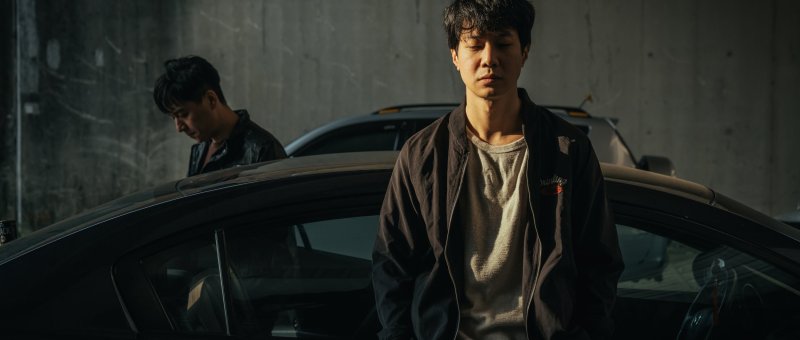
You Have To Kill Me (我是自願讓他殺了我, Chan Chun-Hao, 2021)

An earnest policeman discovers nothing is quite as he thought it to be in Chan Chun-Hao’s adaptation of the novel by Feng Shi, You Have to Kill Me (我是自願讓他殺了我, wǒ shì zìyuàn ràng tāshā le wǒ). Drawn into a dark web of intrigue which eventually points to abuse of power and a low regard for human life, he is forced into a realisation that even as a law enforcement officer he can never be certain of what is real and what is not while caught in the middle in a battle of between parents each trying desperately to protect their sons. 

About to propose to his live-in girlfriend Kai (Janel Tsai), Shing’s (Cheng Jen-shuo) world comes crashing down when he and his partner Ye-ze (Xue Shi Ling) are dispatched to the mountains and discover that she is the victim of the homicide they’ve been sent to investigate. Shing apprehends the apparent killer, Li Zi-jian (Snoopy Yu), running away from the scene, but the situation is complicated when it turns out that Zi-jian is the son of a local politician, Chairman Li (Yin Chao-Te), and while he admits to the killing claims that he did it at the instigation of Kai who was suffering from terminal cancer and wanted him to help her escape her suffering. A look at Kai’s medical records bears out his story, but on closer examination Shing realises the documents don’t add up. His suspicions are confirmed when Kai’s parents, whom he had seemingly never met, arrive and fail to identify the body claiming instead that it is another woman who had been harassing their daughter, Lin Jing. 

Shing is forced to accept that he might not have known the woman he wanted to marry and that their relationship was founded on a lie, uncertain how much of any of it might have been real. Meanwhile he runs into a series of bureaucratic roadblocks as the chairman continues to disrupt the investigation in order to protect his son, eventually having Shing taken off the case leading him to investigate all alone discovering even more uncomfortable truths that cause him to question his reality. Leaving aside the minor plot hole that it seems unusually easy to live under an assumed name in contemporary Taiwan even if you’re involved in activities which would generally require an extensive background check, Shing has good reason to be confused as he dives ever deeper into an amoral morass in which those with power are prepared to manipulate it for their own ends without much thought for the lives of others. “That’s how much a person is worth” the chairman baldly states signing a settlement agreement over something else his son may or may not have done, later claiming that it doesn’t matter if he caused someone’s death “accidentally” and he’d do it all again to save his son. 

Even so, the chairman may have limits in that his attempts to manipulate the system are bureaucratic in nature and seemingly unnecessary at least it seems as if there would be easier ways to achieve his aims without directly harming others even if they would risk lives indirectly. Meanwhile his accomplice is also seemingly involved in order to protect their family, willing to compromise themselves morally to protect their elderly relatives while believing nothing that bad would come of their actions. Then again, Shing finds himself on the receiving end of further recriminations accused of having failed to protect the woman he knew as Kai from herself leaving her with only a dark path to ensure that justice would be done and corruption exposed. 

While Zi-jian feared he was a burden to his father feeling himself unloved even as he went to such drastic lengths to protect him, Kai/Jing was also afraid to fully trust Shing fearing she’d one day disappoint him unable to move on from her traumatic past without putting it to rest. Taking aim firmly at the societal corruption that allows the rich and powerful to misuse their position for their own gain while ordinary people suffer Chan’s noirish drama situates itself in a murky world of constant uncertainty in which even an earnest policeman can be largely oblivious of the lives of those around him while the purest of motivations can lead to only darkness and misery.  


You Have To Kill Me streams in the US April 4 – 10 as part of the 14th season of Asian Pop-Up Cinema.

Original trailer (English subtitles)

The Sadness (哭悲, Robert Jabbaz, 2021) [Fantasia 2021]

“You’re just like me, violent and depraved” a crazed aggressor sneers, almost victorious in his defeat in having goaded his target into bashing his head in with a fire extinguisher. A defiantly depraved tale, Robert Jabbaz’ zombie-adjacent horror The Sadness (哭悲, Kū Bēi) as the title implies suggests that the propensity for violence and cruelty lurks within us all merely waiting for some kind of trigger, in this case a deadly virus, to set it free. 

The film opens, however, with tranquility as young couple Jim (Berant Zhu Ting-Dian) and Kat (Regina) cuddle in bed before Kat’s alarm goes off. The mood begins to sour when Jim reveals they’ll have to cancel their upcoming holiday because he’s been offered work on a film and that is apparently something that’s been thin on the ground. As he turns on the TV, a pundit and a scientist argue about the “Alvin virus” which many people apparently believe is only a cold, though those people are obviously quite wrong (sound familiar?). The virologist continues to explain that the danger is the virus contains similar genetic material to rabies and he fears it may soon mutate into something seriously worrying. In any case, he finds it suspicious the virus has fetched up on the eve of an election and hints at the dubious immorality of politicising a public health crisis. Jim first encounters the afflicted on spotting an elderly person in a bloodstained nightgown who later turns up at his local cafe to bite several members of the clientele who then turn on him seemingly consumed by a violent and irrational rage.

Kat meanwhile experiences something similar as a madman with a knife rips through the carriage of the MTR in which she is currently sitting. Yet, as we discover, the violence and sadism is not entirely indiscriminate but informed by the underlying “sadness”, resentment, and anxieties of the infected person. Kat’s day had got off to a bad start when the middle-aged creep (Wang Tzu-Chiang) sitting next to her kept trying to chat her up only to go off a rant about the entitlement of pretty women when he’s only trying to be friendly after she threatens to call the police because he’s ignored all of her polite hints and requests to be left alone. Crazed, the train creep continues to stalk her determined to get his revenge. His rage and violence is fuelled by the pre-existing condition of his misogyny. 

The fact that Kat appears to be otherwise immune to the virus may suggest that she is a fairly well-adjusted person with no underlying sadnesses or personal resentments, yet she is apparently still capable of great violence when presented with the right trigger(s), in this case being existential terror. The infected meanwhile profess themselves in a state of ecstasy as they indulge their darkest desires. Jabbaz’ gore-fuelled odyssey is in truth a little too depraved, the sickening scenes of sadistic violence accompanied by copious amounts of blood not to mention scattered innards and severed limbs. “This is my kiss, I’m kissing you to death” a woman preens while holding a circular bone saw seconds after revealing that she always had trouble making friends but is beginning to feel as if she’s finally found her crowd. 

A minor irony is that this pandemic anxiety is expressing itself in Taiwan which up until recently at least had done a stellar job of suppressing COVID-19 largely thanks to the opposite of the impulses on display here. Yet there is also something of obvious satire in certain people’s refusal to listen to the science even as the president’s head literally explodes live on TV, while Jim picks up a brochure for reasonably priced apartments only to be told that the pandemic has also “depressed” the property market. His next-door neighbour, Mr. Lin thinks Alvin is a conspiracy theory designed to create economic instability those in the know can profit from later. He seems to have a nasty cold, but refuses to go to the doctor because it seems like a lot of bother when they’re just going to tell you to stay at home and rest. Mr. Lin’s theories are in part vindicated by another scientist who also thinks the government has been ruled by political concerns, too afraid of the economic consequences of a lockdown to contemplate ordering one even while knowing not to do so endangers public health. “Everything must be politics. There’s no room for truth” he laments, though as it turns out he isn’t free of his own darkness either. 

Not for the faint of heart, Jabbaz’s absurdist satire is a depraved journey through every kind of human degradation imaginable darkly suggesting that sadistic violence is never as far from the surface in the ordinary person, or indeed in ourselves, as we’d like to believe. “It feels like I’ve finally found a purpose in life” a member of the infected dreamily explains, embracing his life of ultra violence apparently freed of the burdens of contemporary civility. 


The Sadness screened as part of this year’s Fantasia International Film Festival.

Original trailer (English subtitles)