A Dedicated Life (全身小説家, Kazuo Hara, 1994)

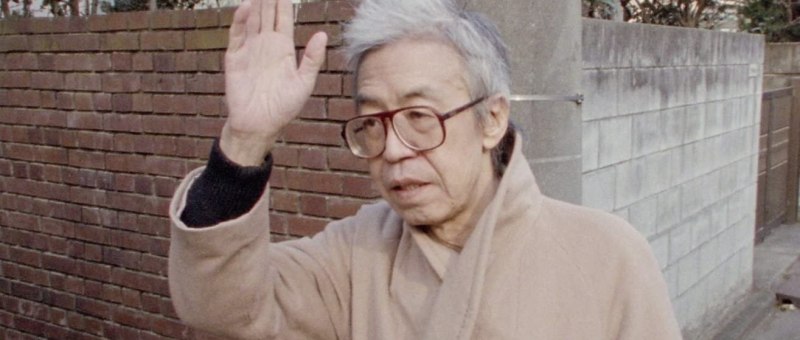
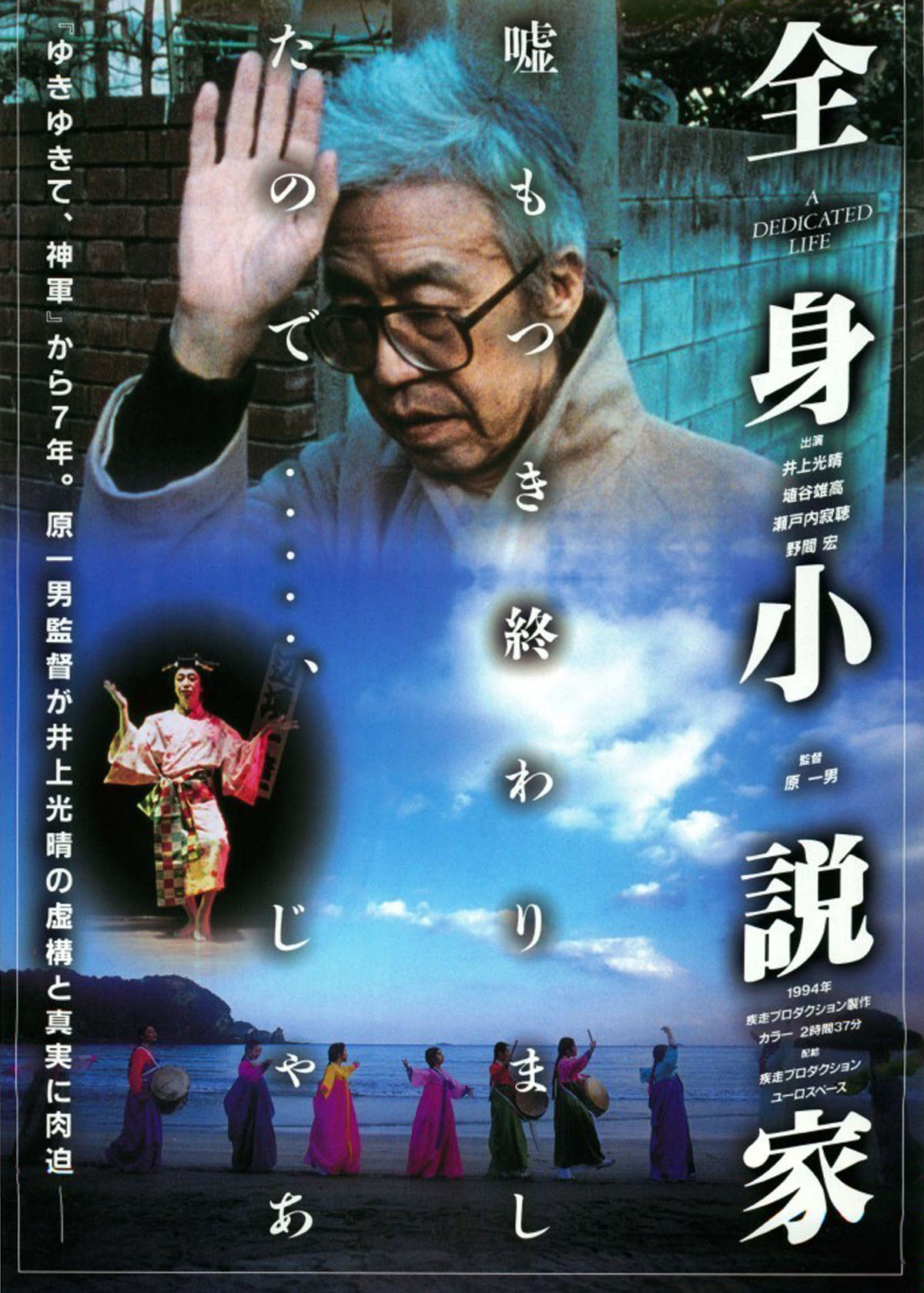
“Human beings have things they don’t want to share with others. This is the truth, but what we choose to tell from the truth is fiction” according to the elusive subject of Kazuo Hara’s probing personality doc, A Dedicated Life (全身小説家, Zenshin Shosetsuka). “Full of lies and contradictions” as a friend later describes him, Hara had apparently planned to follow controversial author Mitsuharu Inoue for a number of years only for his subject to be diagnosed with terminal liver cancer shortly after filming began. 

Even as the film opens, however, we can intuit that much of the life of Mitsuharu Inoue is performance, an adoring audience of his students and followers screaming in pleasure as he performs a striptease while dressed as a geisha to the classic enka hit Tsugaru Kaikyo Fuyugeshiki. Seconds earlier he’d told them that he longed to belong to a theatre troupe and that his grandfather had been a famous kabuki actor, a claim that later seems to be entirely untrue. Nevertheless, Inoue commands almost cult-like adoration from the mainly middle-aged women who surround him, one after another confessing their undying love for the genius author in successive to camera interviews and only occasionally hurt or frustrated in the often callous way he seems to have treated each of them. As we later realise, somewhat casually, Inoue is also married to patient and presumably very understanding wife who tenderly cares for him throughout his illness. 

To begin with, Hara presents us with a vision of Inoue at face value as a fun loving libertine living it up with his students/disciples who can also be cuttingly cruel in his criticism, humiliating one of his female followers at the podium by tearing apart her assignment in front of the class, later doing the same thing to a male author at a dinner party. After making a good recovery from his first battle with cancer he vows to go in harder with his students, reminding them that he can be friendly and charming one minute and unceremoniously cut them off the next should they disappoint him. Nevertheless, they apparently remain devoted to their mentor or at least the image of himself he seeks to project. 

Those who’ve known him many years appear to know that Inoue is a habitual liar and that even his much praised autobiography is largely an act of autofiction. An author friend and Buddhist nun later suggests that Inoue perhaps had something deep inside him he didn’t want to share and lying was his way of taking control over his life, his cultivated persona an avant-garde literary act. Having presented him as he is or claims to be, Hara eventually begins to undercut Inoue’s image by interviewing friends, relatives, and acquaintances who frequently debunk his sometimes outlandish claims while also hinting at the half-truths and mysteries at the centre of his family history. Following Inoue’s sister Tazuko who remains as clueless as her brother realising they’ve either misremembered her grandmother’s name or it was wrong on the family register, Hara uncovers a melancholy tale of marital failure and maternal abandonment once again embellished by Inoue who alternately gives differing accounts of his youthful attempt to reconnect with the mother who left him behind which are themselves disputed by the recollections of others. 

His grandiose claims go seemingly unexamined by his followers, eating up his tales of how he founded the first Communist Party in Japan only to become disillusioned by the movement and be kicked out after writing a story criticising the Party (a friend from the time describes him as more of an errand boy who was never really “serious” in his politics), or the tragedy of his first love which ended with a Korean classmate sold to a brothel where he later lost his virginity in a not quite consensual chain of events he claims left him feeling violated while she laughed from an upper window witnessing his defeated retreat. In a break from his usual observational shooting style, Hara adds a series of dramatic reconstructions tinted in a pre-war blue the unreality of which stands in stark contrast to the almost too intimate scenes of Inoue’s cancer diagnosis and subsequent operation as his liver is lifted from his belly and taken away as if presented for the camera. In a revealing moment, Inoue remarks that an alternative medical practitioner he’s just consulted going by the name “Redbeard” just like the movie is not convincing, lacking credibility because he failed to fill the gap between his words perhaps hinting at the techniques he himself uses to convince himself and others of his self-created image. Hara does not so much try to dissect it as to look quizzically at its contradictions, admiring the beauty of the enigma if in reflection of its intrinsic sadness. 


A Dedicated Life streams in the US & Canada until July 2 as part of Japan Society New York’s Cinema as Struggle: The Films of Kazuo Hara & Sachiko Kobayashi

DVD rerelease trailer (no subtitles)

Sayuri Ishikawa’s Tsugaru Kaikyo Fuyugeshiki
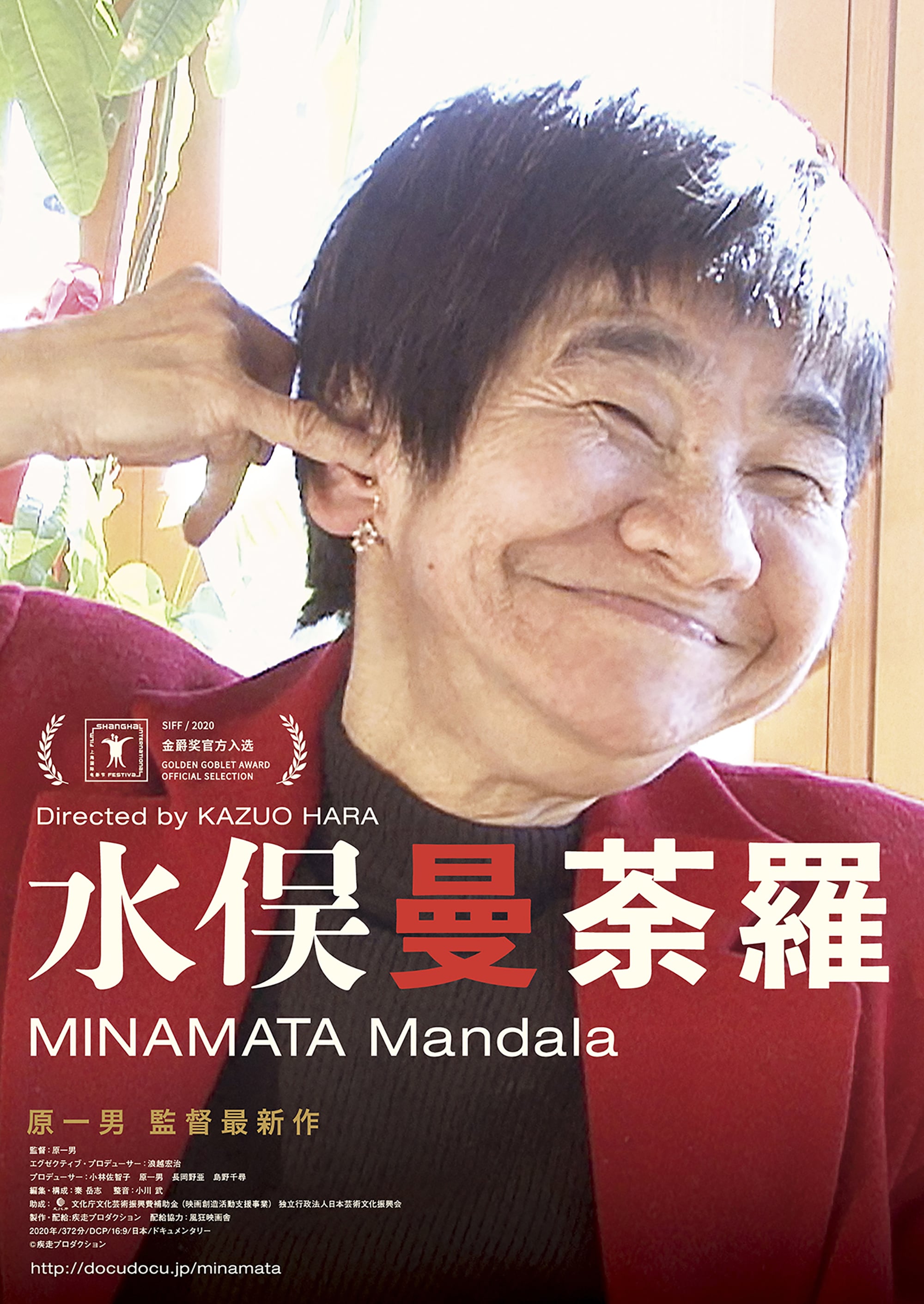
Minamata Mandala (水俣曼荼羅, Kazuo Hara, 2020)

“An Individual can never win against the government” according to a man seeking justice, “Challenging the government means risking your life”, yet he continues to fight. In his 2017 documentary Sennan Asbestos Disaster, Kazuo Hara had charted the protracted efforts of workers from the factories in Sennan to get justice from the government that failed to protect them. 15 years in the making, Minamata Mandala (水俣曼荼羅) addresses another of post-war Japan’s great industrial scandals as victims of the “Minamata disease” struggle for recognition in the face of continued governmental intransigence. 

Opened in 1908, the Chisso chemical plant was among the most technologically advanced in Japan yet it routinely expelled wastewater directly into Minamata bay. The factory had already paid compensation in 1926 and 1943 for damage done to local fisheries before a change in its production process led to the release of methylmercury into the local water system from 1951 onwards. Though some had noticed unusual behaviour in animals, it wasn’t until 1956 when a little girl fell ill with strange symptoms including difficulty walking and speaking that a widespread “”epidemic of an unknown disease of the central nervous system” was discovered in the local community and subsequently came to be known as the “Minamata Disease”. In order to cover their tracks, Chisso began discharging wastewater directly into Minamata River spreading the pollution further along the coast with additional cases arising in other villages on the Shiranui Sea. 

Hara’s justice seekers, however, take aim not directly at Chisso which still exists and is a dominant economic force in the area, but local and national governments whose continued failure to protect them has greatly exacerbated their suffering. The greatest source of their discomfort is the unfairness of criteria set down in 1977 for legal certification of Minamata Disease in order to gain access to compensation. According to contemporary researchers, the criteria, inspired by Hunter-Russell syndrome discovered after an industrial accident in the UK in the 1940s, were simply wrong leading to the vast majority of applicants being rejected. Hara shifts between the stories of various victims and a pair of scientists determined to prove that the root of the disease lies not in peripheral nerve but brain damage and that the criteria is therefore useless in certifying cases of Minamata Disease. The applicants, meanwhile, intensely resent the implication that they are not genuine, that they are undergoing a collective delusion, faking their symptoms, or suffering from an unrelated illness not the responsibility of Chisso or the government. 

One campaigner whose hair was found to contain high levels of mercury at two years old recounts his ill treatment at the hands of the legal system which implied application of the criteria could be affected by “personality” factors while passive aggressively listing his occupation as “time waster”. Though his case may at first seem mild, it’s also true that as he’s suffered from Minamata Disease his entire life it’s difficult for him to assess how severely it affects him as evidenced by the accidental severing of the top of his thumb which he barely noticed because of his reduced sensitivity to pain. Like other sufferers, he is often privy to the usual hollow apologies from politicians (including one from then Minister of the Environment Yuriko Koike), though another source of frustration is that those in power often refuse to attend meetings with Minamata patients sending underprepared underlings in their stead. One particularly heated meeting quickly goes south when a rookie civil servant allows his handwritten memo reading “no apologies” to be seen by a woman recording the proceedings from the front row while his embarrassed colleagues are able to offer little other than the standard platitudes insisting the Minamata issue has already been dealt with through the previous settlements. 

Rather than focus on the court cases and medical investigations, however, Hara is keen to remind us of the costs to the victims of industrial poisoning, one of the scientists later breaking down as he explains that the main effect of the disease is sensory deprivation leaving even those mildly affected unable to enjoy their lives fully. A rather poignant song written by a congenital sufferer reflects on her tendency to fall in love too easily and be forever disappointed while longing for a freedom and independence denied her because of her disability. For the campaigners, meanwhile, Minamata Disease has robbed them of their right to a personal life as they devote all of themselves to fighting for justice while acknowledging that even when they win it brings little improvement into the lives of those forever affected by industrial pollution. Just as Hara had expressed frustration with the Sennen campaigners he felt were overly feudal in their deference to authority, some find it difficult to support those who ultimately opted to accept a paltry settlement while simultaneously understanding the desire not to have to fight anymore especially as even those born with the disease are now approaching late middle-age. Ending on a poignant freeze-frame, however, Hara reminds us that the damage can never be undone nor can there be adequate compensation for the tremendous loss of potential even as the government continues to vacillate in the abdication of its responsibility. 


Minamata Mandala streams in the US until July 2 as part of Japan Society New York’s Cinema as Struggle: The Films of Kazuo Hara & Sachiko Kobayashi

Clip (English subtitles)

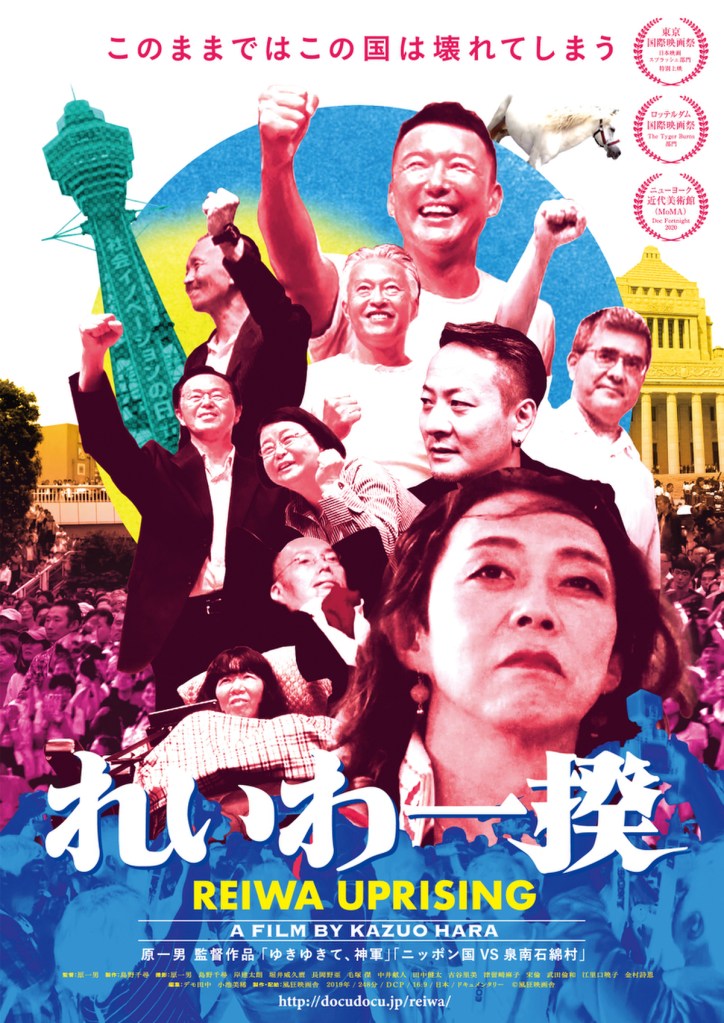
Reiwa Uprising (れいわ一揆, Kazuo Hara, 2019)

With a career spanning more than 40 years, veteran documentarian Kazuo Hara cannot exactly be described as prolific. His films can often take years to produce, his upcoming documentary on the Minamata disease apparently having been in development for the last decade and a half. Perhaps appropriately enough Reiwa Uprising (れいわ一揆, Reiwa Ikki) is then something of a revolution even within the director’s own career in that it saw him spring into action at a moment’s notice after being invited to document the imminent House of Councillors election by the documentary’s subject, Ayumi Yasutomi, making good on a joke made during an online interview. 

A transgender woman and professor at the University of Tokyo, Ayumi Yasutomi had received some previous press attention during an eccentric but unsuccessful campaign to become a local mayor. She was now one of 10 candidates selected to stand for brand new political party Reiwa Shinsengumi founded by former actor Taro Yamamoto. Yamamoto himself was already known for his unconventional political style, and Reiwa Shinsengumi was set up expressly to oppose the scandal-beset Abe administration with a series of broadly left-wing policies prioritising human rights and the environment in addition to pushing for an end to the consumption tax, nuclear power, and the controversial Henoko US military base in Okinawa. 

As a new political party, however, there was no firm organisation in place and Yamamoto chose his various candidates for their individual platforms, giving them in the main a fairly free rein to run their own campaign as they saw fit prioritising their own policy ideals. Yasutomi’s central policies revolve around the protection of children with a focus on preventing abuse and reform of the educational system, but she is also keen to encourage a return to nature and as in her mayoral campaign is regularly accompanied by a rented horse temporarily stabled in the city. Like Yamamoto she stages a series of publicity stunts including a Thriller flashmob, describing the video’s zombies as adults who have died inside after being robbed of their childhoods and have subsequently become mere machines perpetuating the systems of oppression which have made them what they are, while continuing with the musical processions which had originally caught Hara’s eye during her mayoral campaign. 

Though Yasutomi remains his main focus, Hara expands the canvas to capture the nascent revolution that Reiwa Shinsengumi is attempting to foster. As a new political party, they are not so much focussed on winning power as gaining a foothold, hoping for the 2% vote share that would grant them status as an official political party. The other candidates stand on a variety of social issue policy platforms from disability to workplace exploitation and the anti-nuclear movement with a keen focus on social equality insisting that no-one should be judged according to their “productivity” or “usefulness” to society. A sign language interpreter appears onstage next to the candidates at the central rallies, and in an impressive hustings gimmick the floor literally rises to allow his two wheelchair-using candidates access to the stage on the same level as their able-bodied colleagues. It is perhaps an unexpected candidate who makes the most impact, however, in the impassioned speeches of part-time worker and single mother Teruko Watanabe who advocates fiercely for the rights and dignities of Japan’s impoverished working class as a woman who found herself at the mercy of an inherently exploitative employment system which offers little protection to those outside of the full-time salaried employee. Her concerns are echoed in those of another candidate who once ran a 7-Eleven and has a deeply held grudge against Japan’s famous combini culture having taken the unusual position of being a boss who regularly advocated on behalf of workers. 

While passively documenting their struggle, Hara nevertheless uncovers a possible schism at the heart of the movement in that, as unconventional as he otherwise is, Yamamoto is determined to work within the system if only to change it while Yasutomi would rather destroy it completely, repeatedly insisting that the entire country is “crazy” and has never fully managed to escape from its militarist past. She resents the ruling LDP, who have been in power for almost the entirety of the period since Japan’s new post-war constitution came into effect, for perpetuating a kind of “positionism” in which all they care about is a conservative desire to maintain their own status granting only the concession that they will in turn recognise the status of others. It’s this “positionism” she seeks to counter in what she sees as the best expression of liberalism through rejecting labels, something which has apparently brought her into conflict with the wider LGBTQ+ community. Reiwa Shinsengumi managed to win two Diet seats, awarded to the two disabled candidates in a first for Japan, though Yamamoto himself did not make it back to parliament and Shinzo Abe’s administration remained comfortably in power. Nevertheless, Hara captures a political moment in which real change seems possible for the perhaps the first time since the decline of the post-war leftwing student movement in the early 1970s. As Watanabe puts it, this is just the start the starting line. The revolution starts now. 


Reiwa Uprising is available to stream in the US until July 30 as part of this year’s Japan Cuts.

Original trailer (English subtitles)

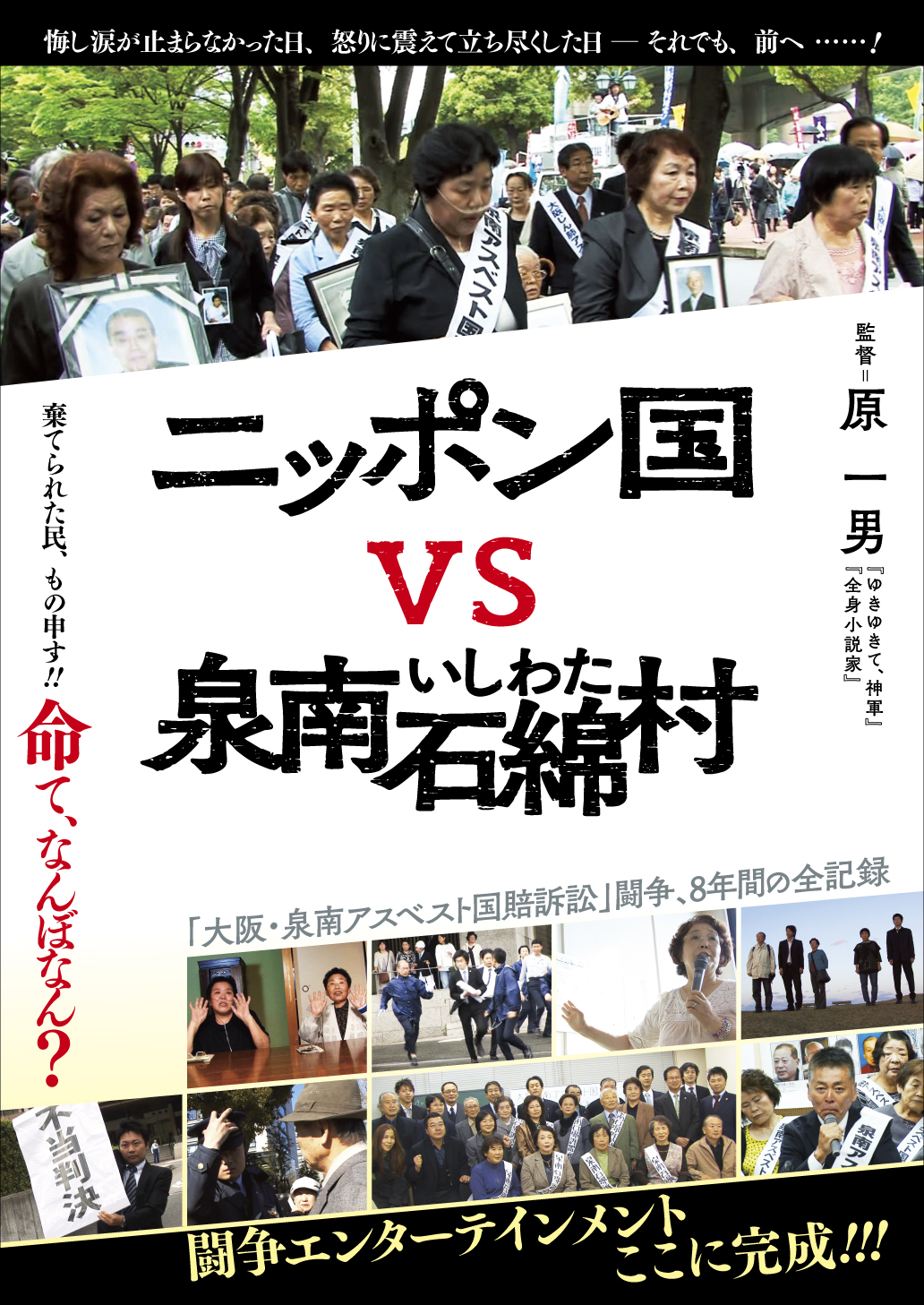
Sennan Asbestos Disaster (ニッポン国VS泉南石綿村, Kazuo Hara, 2017)

Sennan Asbestos Disaster posterIn these troubled times, many may find themselves wondering what the purpose of government really is. Is the primary duty of the state to look after its citizens or to maintain “order” and what exactly is the limit of the state’s responsibility towards those most in need of its care? Director Kazuo Hara had made a career of examining the lives of those who dared to defy the system, but his latest film Sennan Asbestos Disaster (ニッポン国VS泉南石綿村, Nipponkoku vs Sennan Ishiwata Mura) focusses not on an individual but on a group of ordinary people attempting to stand up to governmental bureaucracy after having been betrayed by successive administrations who put economic prosperity ahead of citizens’ welfare.

Asbestos was hailed as something of a wonder for its highly useful properties including sound insulation, fire proofing, strength and durability. Increasing in use throughout the industrial revolution, the harmful affects of asbestos were first discovered in the early 20th century but its use across most of the world was not banned until the turn of the millennium following long campaigns by those whose health had been adversely affected by breathing in its fibres leading to long term respiratory issues and even a risk of cancer.

In Sennan, in the South West of Japan, asbestos production was the dominant economy stretching back into the Meiji era. Concerns had been raised about the possible harmful effects of asbestos before the war and then again afterwards, but successive governments chose to do nothing while workers remained unaware of the risks even while noticing that many of their friends and family members were dying young often of respiratory conditions. Most only became aware that asbestos was dangerous in 2005 following a national scandal known as the “Kubota Shock” in which a well respected manufacturer of machinery was forced to admit that as much as 10% of its workforce had died of asbestos-related conditions.

Hara follows a collective of Sennan residents who have come together to file a class action law suit against the government for failing to ensure safety standards in asbestos production. Led by Kazuyoshi Yuoka whose grandfather owned an asbestos factory before the war, the group members are mainly older men and women who worked in the factories during the economically straitened days of the immediate post-war period. Though many point to the otherwise progressive nature of the factories which were desperate to attract workers and keen to foster a community spirit as well as offering other benefits including access to education, it is true that many of the employees were among those already facing other kinds of oppression aside from the economic – the uneducated rural poor, women, and a large number of minorities including zainichi Koreans. This information is important because it exposes the truth that the state decided these people were expendable and could be sacrificed in the name of the economic prosperity that was deemed necessary in order to rebuild the nation after its crushing wartime defeat.

Unlike the protagonists of Hara’s previous films, the Sennan campaigners are ordinary people – those assumed to have very little social power pressuring their government to take responsibility for having wilfully abandoned them. Unsurprisingly, the government is not very keen to do so. The legal case drags on eight years during which many of the sufferers die while their children or spouses continue the quest for justice. The case itself is wider than it first seems, extending not just to factory workers but to those exposed by general proximity such as famers owning land near asbestos plants and in one poignant case a woman whose parents took her to the factory while they worked when she was a child.

Forming a tightly knit community, the campaigners present a united front but come up against the wall of bureaucracy. As time wears on it’s difficult not to feel a small amount of sympathy for the junior civil servants the government trots out to deal with angry protestors, forced to repeat the same tired phrases without explanation while the group insist on seeing someone with a bit more clout, but even when the case is finally proved, progress is slow and the ritual apology as hollow as it always is. Yet even if some are angered by the perfunctory nature of professional atonement, others actively embrace it and appear grateful even for this small shred of attention from the authority. It’s here that Hara wavers in his sympathy, admiring the kindhearted solidarity of the protestors but lamenting their tendency towards feudal deference when they should be raging against a society which is often content to exploit and discard them, remaining accidentally complicit in enabling a gradual decline of democratic freedoms.

Nevertheless, Sennan Asbestos Disaster is the chronicle of a (partially) successful campaign in which a group of concerned citizens working within the law eventually force the government to concede an error, even if that concession may turn out to have no wider application. The victory, however, can’t bring back lost time nor ease past suffering and only serves to draw a line under one chapter of a struggle which is sadly far from over.


Sennan Asbestos Disaster was screened as part of a Kazuo Hara focus at Open City Documentary Festival 2018.

Original trailer (English subtitles)

The Emperor’s Naked Army Marches On (ゆきゆきて、神軍, Kazuo Hara, 1987)

The Emperor's Naked Army Marches On PosterThe relationship between a director and a subject can often be a complex one. Who is really leading who and towards what end is a difficult enough question at the best of times, but when your subject is an unhinged crackpot with a definite agenda, a natural love of the camera, and an unpredictable violent streak, it’s an inescapable conundrum. Kenzo Okuzaki, a Pacific War veteran with a deeply seated grudge against the emperor for his refusal to acknowledge his war guilt, first came to the attention of director Shohei Imamura but a second stretch in prison for firing pachinko balls at the object of his wrath put paid to his directorial hopes. 10 years later Imamura passes his subject on to Kazuo Hara who finds himself increasingly at the mercy of his mercurial campaign for truth and reconciliation.

The main thrust of Okuzaki’s current activities lies in uncovering the facts behind the deaths of two enlisted men who were executed in New Guinea three weeks after the war was over. Okuzaki believes the men were murdered and lays the blame at the feet firstly of the officers on the ground and ultimately at those of the emperor who created the circumstances in which all of this horror was allowed to bloom. To assist him in his investigations, Okuzaki ropes in the families of the victims – one a Shinto priestess who is convinced she sees her brother in her dreams and on her altar, and the other a conflicted brother who just wants to know the truth. The truth, however, may be hard to hear, as one of the men Okuzaki corners tries to tell them. Like most of the others questioned about the events of almost forty years before, he advises the family that it’s better not to know while emphasising that their relatives died through no fault of their own.

What is probably obvious to Okuzaki but not to the relatively less cynical family members is that an issue is being skirted. The soldier makes out that he doesn’t want to go into the deaths because the men were executed for desertion – something which is absurd in itself when the war was already over, and that he did not want the family to experience the shame and social stigma of being related to “cowards” who failed in their “duty”. Such notions are already out of date by the late ‘80s, but evidently still weigh heavily on the minds of veterans. Wanting to spare others the pain and shame of discovering the truth about what happened in New Guinea is a frequent excuse offered by those questioned, but perhaps a way of deflecting their own reluctance to speak of such deeply traumatic, extremely difficult events.

Getting them to open up is not Okuzaki’s first thought. Okuzaki himself is a strange man with a disturbing aura and a tendency to self-aggrandisement. When we first meet him he’s acting as a go-between at a wedding of a man he met through his “activism” which is to say a fellow combatant in Okuzaki’s campaign against “The Establishment”. A wedding speech might not be the most appropriate moment to embark on a personal history that involves going to prison for murdering someone you “did not want” to murder as well as a litany of anti-establishment acts including the pachinko ball incident and distributing “pornographic” pictures of the emperor to shoppers at a Tokyo department store. Nevertheless, Okuzaki is extremely proud of these “achievements” which exemplify how he alone has continued to fight the good fight in the post-war world. He sees his original conviction as karma not for his actions in the Pacific but the wastefulness of his life afterwards. He now believes he was saved from New Guinea in order to educate the young about the horrors of war and ensure none of this ever happens again.

Problematically, his main weapon in this fight is violence. Okuzaki’s manner is one of extreme politeness, bordering on obsequiousness, but he is also direct and aggressive, becoming violent when his subjects decline to answer his questions. The relatives are there to shame the officers into speaking the truth through being directly confronted by the human costs of their actions, but Okuzaki’s personal bluster hasn’t thought through the various ways in which his tactics might make it more difficult for them to speak. After all, Okuzaki is a veteran of New Guinea himself, if these men could feel comfortable talking to anyone about their experiences, you’d think they could turn to someone like Okuzaki if only he were not so frightening a presence. Uncomfortably enough, the violence does seem to work and Okuzaki gets his answers through intimidation which leaves his quarry broken and compliant. Despite claiming to work for world peace, Okuzaki believes that his violence is justified by the worthiness of his aims, which you have to admit is an oddly familiar mantra.

His subject’s propensity for violence places Hara in a difficult position, as do his frequent attempts at engineering the situation including roping in his wife and a couple of male friends to pose as relatives of the deceased when the original couple tire of Okuzaki’s exploitative antics. Okuzaki quite obviously has a very clear aim for what he perhaps sees as a propaganda exercise for his ongoing cause which might stand in deep contrast to that of his director who is, after all, a bystander reconstructing narrative after the fact. Okuzaki emerges as a symbol of a nation’s repressed trauma, skittering between officious politeness and belligerent violence while offering a bizarre, quasi-religious philosophy about god’s plan for us all. Hara remains caught between conflicting impulses, unwittingly complicit in Okuzaki’s personal war against war while trying to maintain control in the face of his constant manipulations. As a portrait of a madman The Emperor’s Naked Army Marches On excels, painting Okuzaki as a product of his own mad times while refusing to back away from the bitter truths his madness is so keen to expose.


The Emperor’s Naked Army Marches On (ゆきゆきて、神軍, Yuki Yukite, Shingun) was screened as part of a Kazuo Hara focus at Open City Documentary Festival 2018.

Short clip from the film (English subtitles)

Extreme Private Eros: Love Song 1974 (極私的エロス 恋歌1974, Kazuo Hara, 1974)

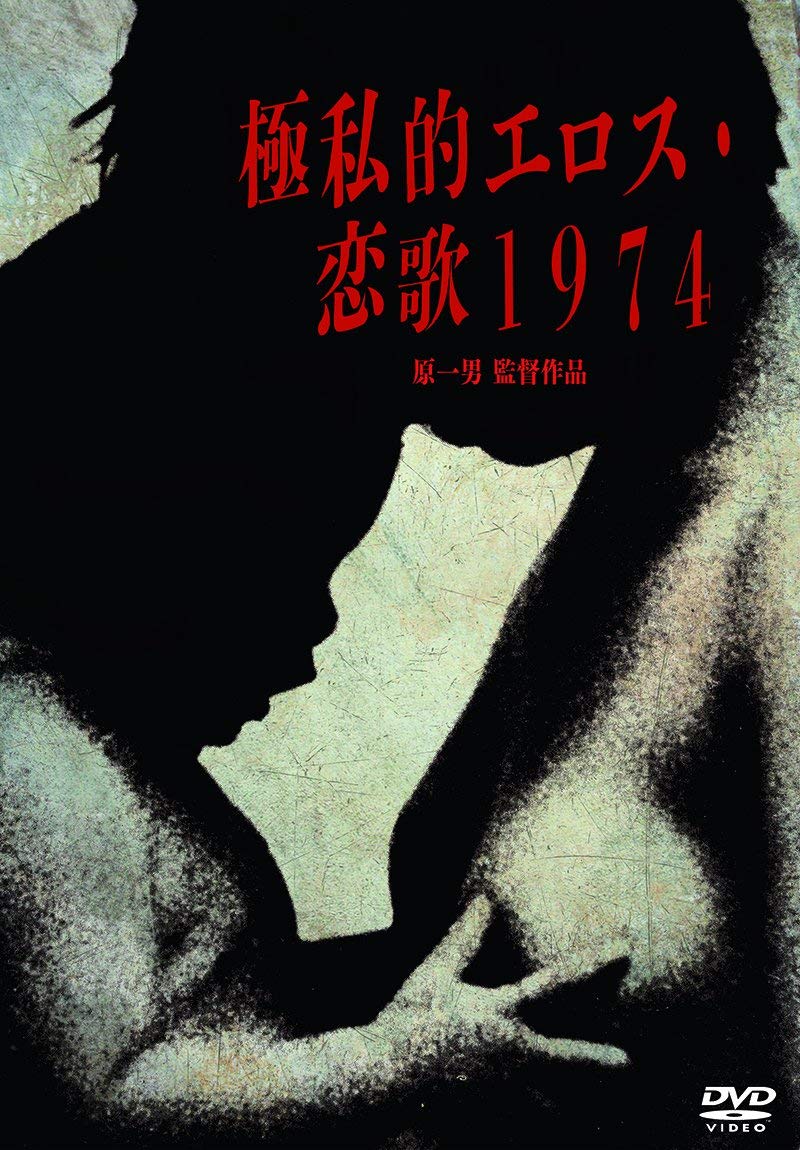
Extreme private eros 1974If you’re going to use your camera to interrogate the world, perhaps it’s only fair to let the world interrogate you by means of your own camera. Kazuo Hara’s second documentary is about as personal as its possible to get – a detached, rational examination of the interplay between the director and his subject who happens to be his former lover and the mother of his child. A thinly veiled excuse to maintain contact with a woman who had abandoned him and taken his child with her, Extreme Private Eros: Love Song 1974 (極私的エロス 恋歌1974, Gokushiteki Eros: Renka 1974) is both a tiny snapshot of a nation in flux, and a timeless exploration of the end of love.

Hara and his former lover Miyuki Takeda had lived together for three years and even had a child when she abruptly announced that she no longer wanted to live under the authority of a man or as a member of a “traditional” family and intended to leave in order to live a life of complete independence. Although the relationship was officially over, Miyuki maintained contact with Hara and visited him more or less weekly so it was an additional shock when she suddenly announced she was moving to Okinawa. However, Miyuki made a strange request of her former lover – that he film her attempt to give birth without assistance. Hoping to remain close to her or perhaps to attempt to understand better the reasoning behind her erratic behaviour, Hara agrees.

In Okinawa, Miyuki has moved in with another woman, Sugako, but the relationship between them appears strained and ill defined. Hara’s arrival, he eventually realises, is yet another disruptive influence in this already fraught environment but it’s unclear whether his camera is a deliberate or accidental witness to a series of extremely difficult, not to mention private, conversations taking place in front of a third party in which Miyuki berates her silent roommate for rejecting her desire for a full and exclusive relationship in favour of continuing to sleep with her friend Tommy.

When the relationship with Sugako breaks down, Miyuki takes up with a black GI, Paul, who later becomes the father of the child she intends to birth alone. Though interviewing Miyuki alongside Paul (who speaks no Japanese) is a mild and dispassionate affair, interviewing Miyuki alone about her new lover and the basis of their relationship sends Hara into a spiral of jealousy and despair in which he eventually cedes control of his camera to an assistant and appears on screen breaking down in tears. Wondering if Miyuki is as accidentally jealous of him as he is of Miyuki, Hara muddies the waters by inviting his own new lover, Sachiko – who is also pregnant with his child, to assist him in the making of the documentary. Hara gets his wish. Miyuki is indeed jealous, angrily barking at Sachiko while running down her former lover in every conceivable way, and yet the two women eventually end up bonding, once again excluding Hara from his own attempt at narrative.

The perspective is indeed Hara’s – his weary voiceover and occasionally passive aggressive, exasperated intertitles making plain his own confusion and continued searching for the central question of what exactly he’s trying to achieve, but Miyuki wrestles with him for overall control and to assert her right of ownership over her own story (or at least the presentation of it). Miyuki’s quest seems to be one of total independence – she rejects the world of the patriarchal family, later rejecting love entirely and resolving to live without a man or woman, but remains firmly within its standard ideological parameters in recasting herself as the embodiment of selfless motherhood. She rejects the ideas of traditional Japanese femininity, insisting that her children are raised to be aggressive rather than meek or gentle or kind and going so far as to reject these supposedly feminised qualities as she sees them in her own son as reflections of those same qualities she eventually found unappealing in Hara. She becomes obsessed with the idea of mixed-race children, perhaps as an extension of her desire for a non-Japanese idea of individualism, but later tells her new born daughter that Japan is good and America bad, and pens a damning letter of advice to the women of Okinawa warning them off deceitful GIs.

Miyuki is a woman with scant respect for boundaries and so Hara is granted near unrestricted access to the entirety of her existence as she pursues her various desires and contradictory convictions. Hara’s camera is both unobtrusive and powerfully present, privy to extremely private thoughts and conversations and only occasionally inserting itself into the narrative but unafraid to embrace taboos while perhaps also conflicted in its own defiant pursuit of emotional honesty at all costs. In attempting to capture his subject Hara illuminates both himself and his society, exposing painful truths and unwelcome prejudices but perhaps allowing them to fester unresolved in a future which is both open yet also uncertain.


Extreme Private Eros: Love Song 1974 was screened as part of a Kazuo Hara focus at Open City Documentary Festival 2018.

Trailer (English subtitles)