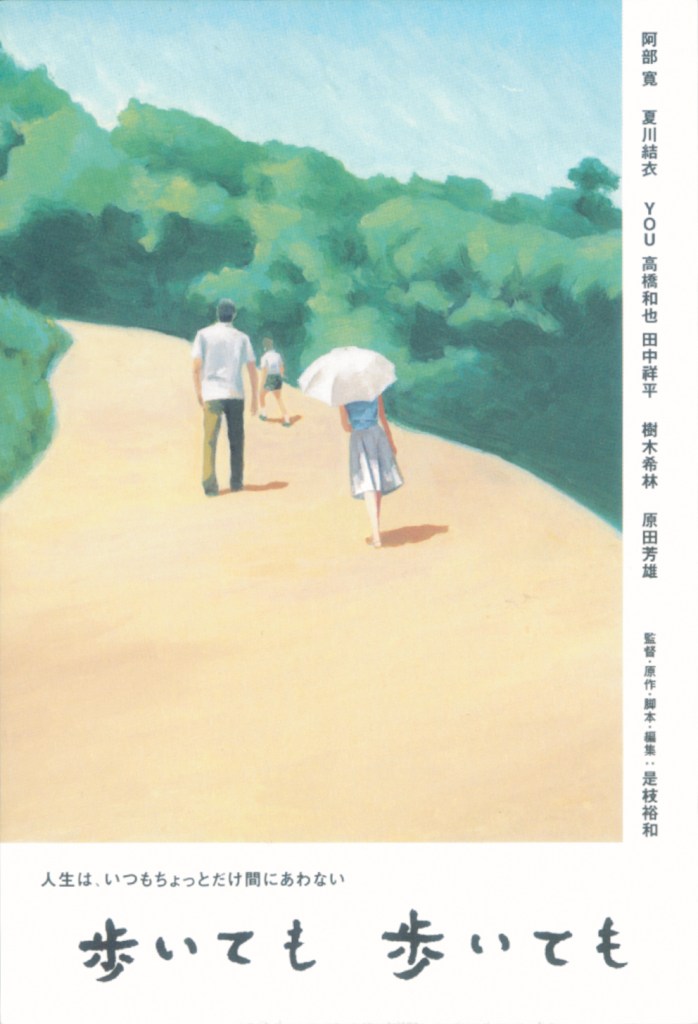
 Life is full of choices, but the one thing you can’t choose is your family. Like it or not you’re stuck with them for life and even if you decide you want nothing to do with them ever again, they’ll still be hanging round in the back of your mind for evermore. Koreeda swings the camera back around the fulcrum of Japanese society for this dissection of the fault lines and earthquake zones rubbing up against this very ordinary family.
You’d be forgiven for thinking that some kind of celebration is about to take place at the beginning of Still Walking (歩いても歩いても, Aruitemo Aruitemo) yet the event that is about to bring scattered friends and family members back home is of a more somber nature. As the matriarch Toshiko (Kirin Kiki) peels vegetables with her daughter Chinami (YOU) she seems excited at the prospect of getting the family back together again yet melancholic and perhaps a little nervous.
Younger son Ryota (Hiroshi Abe) is taking the train in with his new wife and stepson. He urges Yukari (Yui Natsukawa) that they should make their excuses and leave in time for the last train but she feels obliged to stay over. It’s clear Ryota is not looking forward to a reunion with his family and also has some current worries over his working situation which are weighing on his mind and which he definitely does not want anyone in the family to find out about.
Ryota has a particularly strained relationship with his difficult doctor father, Kyohei (Yoshio Harada) who doted on his oldest son, Junpei, drowned at sea whilst saving the life of a little boy. Increasingly grumpy that he has no heir for his medical practice, Kyohei refuses to recognise Ryota as a grown man or accept his work as an art restorer as a “real” occupation. Tensions in the family are further brought out by the mild disapproval over Ryota’s choice of wife who was previously married and then widowed and has a young son by her first husband. Toshiko for one still harbours an old fashioned stigma towards second marriages and thinks Ryota could have done better than “buying second hand”. Though seemingly accepting of her new daughter-in-law and grandson, she perhaps treats them a little more like guests than fully fledged members of the family.
Set over the course of two days, Still Walking takes on a sense of Chekovian wit and melancholy as it paints a naturalistic picture of an ordinary family with all of the petty cruelties and indignation that involves. The deceased son, Junpei, has become a virtual saint, forever bathed in golden light by his grieving parents while Ryota remains very much alive yet pushed into the shadows. Feeling himself to raise only feelings of disappointment in his family, he adopts a truculent, defensive air which sees him unwilling to engage leaving the bulk of the work for his new wife who is eager to please her in-laws despite their frequent tactlessness in dealing with herself and her son.
Of course, Ryota and his father aren’t so different at all – both gruff, defensive, grumpy. Kyohei is a difficult man sinking into a miserable old age where he can no longer busy himself with the role which has given his life meaning, that of a respected small town doctor. When bubbly younger sister Chinami mentions having seen a newspaper report which referred to painting restorers as “art doctors”, neither man is very happy with being linked with the other yet there is a certain commonality between them that oddly forces them apart rather than ties them together.
Toshiko by contrast is the long suffering yet largely silent housewife whose maternal grief is the force which now defines her. Seemingly sweet and kind on the outside, there’s a tough core in the middle which gives way to some decidedly biting remarks lightly peppering the atmosphere with ancient resentments. Perhaps feeling a strange sort of kinship with the mystery guest-cum-kicking-boy-of-the-day – Yoshio, the boy who Junpei saved but has not made good on his investment as he’s turned into a slobbish and overweight 25 year old child who can’t seem to settle on one proper career, Ryota asks why his mother insists on inviting him every year knowing how painful it must be for him to come. Toshiko coldly replies that that’s exactly the reason she intends to keep making him visit, she feels wretched inside 24/7 so for one day every year she makes someone else feel dreadful too – will anyone blame her for that?
Grief and loss play a heavy part here, not only of the literal kind, but in the feeling of time wasted and the disappearing moments which can never be recaptured. Chinami’s son and daughter team up with Ryota’s stepson Atsushi to provide a melancholic mirror of the the three Yokoyama children playing in the same fields and staring at the same fleeting flowers as their forebears did years before. Time is always passing, you think there will always be another opportunity for saying something or other, forging a connection or new memory but soon enough the sand in the glass runs through. As Ryota notes, it’s always a little later than you think but you can’t see it until it’s already too late.
Dense with naturalistic detail, Still Walking is a warm if sad look at one ordinary family dealing with the aftermath of tragedy yet offers its own comments on the nature of human connection between fathers and sons, mothers and daughters, and between the living and the dead. A timely reminder of the transience of all things, Koreeda’s most straightforward take on the family drama proves a both profound and moving experience which only deepens with repeated viewing.
I rewatched this recently at an ICA members’ screening where it screened on 35mm but the print actually had an intermission built into it even though the film isn’t all that long – strange experience!
Still Walking is available on DVD and VOD in the UK from New Wave Films and was also released on blu-ray in the US as part of the Criterion Collection.
The film’s Japanese title Aruitemo Aruitemo is taken from the song made famous by Ayumi Ishida – Blue Light Yokohama which turns out to have a surprising significance within the film:
 “Being good”. What does that mean? Is it as simple as “not being bad” (whatever that means) or perhaps it’s just abiding by the moral conventions of your society though those may be, no – are, questionable ideas in themselves. Mipo O follows up her hard hitting modern romance The Light Shines Only There by attempting to answer this question through looking at the stories of three ordinary people whose lives are touched by human cruelty.
 Windows on Worlds