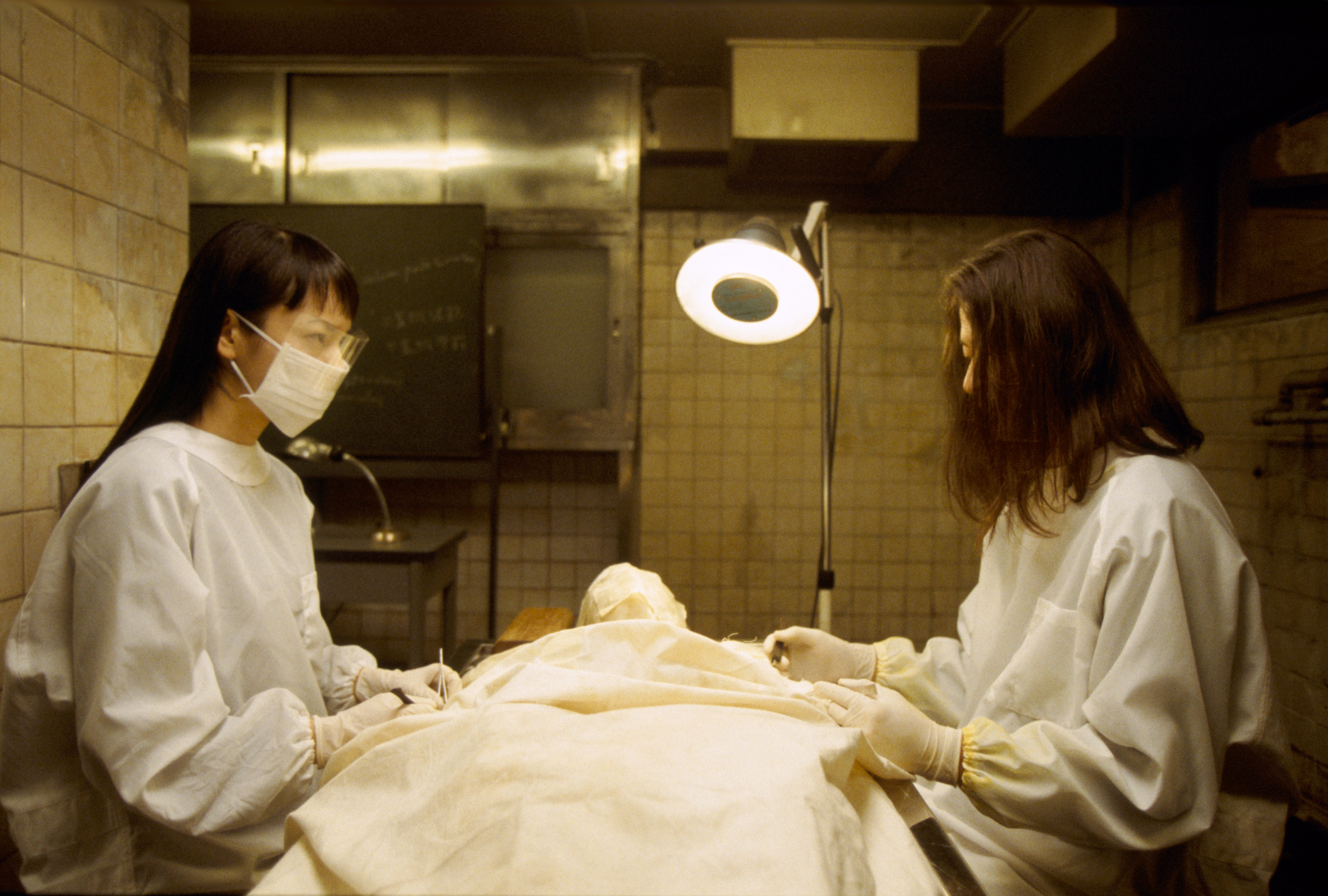
Vital (ヴィタール, Shinya Tsukamoto, 2004)

“There is the vast realm of the unconscious,” one of the professors explains to vacant medical student Hiroshi a soon-to-be physician attempting to heal himself from a trauma he doesn’t fully understand. Perhaps as the title implies, Vital (ヴィタール) sees Tsukamoto branch out from his vistas of urban alienation to find a new paradise in nature albeit one that it exists largely in the mind and that the hero can never fully return to because this place of life is also one of death which exists inside a kind of eternity.

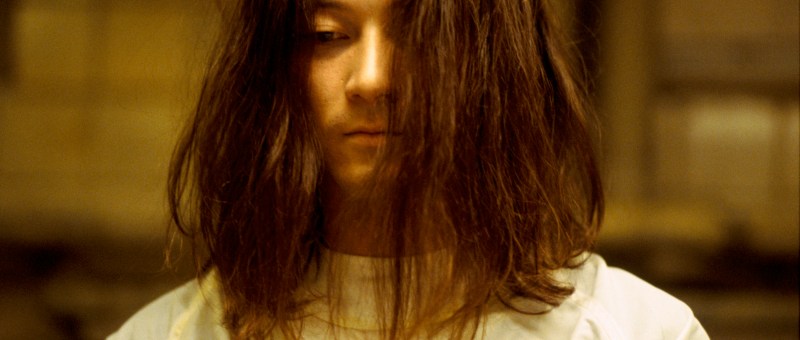
This explains to some extent Hiroshi’s (Tadanobu Asano) temporal confusion. Having lost his memory following a car accident in which he later learns his girlfriend Ryoko (Nami Tsukamoto) was killed, he shifts between “reality” and what first seems to be flashbacks of his unremembered past but are actually taking place in a kind of alternate, perhaps idealised reality in the “vast realm of the unconscious” as Hiroshi attempts to reconstruct his image of Ryoko along with that of himself. Another of his professors more philosophically asks were lies the seat of the soul in the human body and is this something that Hiroshi maybe unconsciously looking for during his anatomy classes in which he is coincidentally assigned Ryoko’s body to work on only realising when he sees her tattoo in one of his visions. 

In some ways this grim task of dissection is a bid for greater intimacy, to take Ryoko apart and then put her back together as the students diligently do at the end their studies reassembling the bodies and placing them in coffins in keeping with culturally specific death rituals. The faces of the cadavers are covered with a bag until the students are instructed to remove them, but they are always reminded to treat the dead with dignity and that their role here is one of understanding as they attempt to work out not only how these people died but also how they may have lived. Hiroshi causes conflict with some of his fellow students on just this point, seeming rather creepy in his vacant intensity over the body while also wanting to take ownership over that of Ryoko rather than work as part of the group complaining that the others are too clumsy and it’s affecting his ability to learn. 

Ryoko’s father comes to say that though he once blamed Hiroshi, his daughter had been in a way dead for a long time before she died, the light apparently going out of her eyes when she was still in high school. Only in Hiroshi’s unconscious does she say that she didn’t want to die despite an apparent obsession with death in Hiroshi’s other resurfacing memories/visions of her as symbolised in her repeated requests for him to strange her during in sex. Another of the professors had said that the suppressed desires of the unconscious could create conflict and this alternate reality is also in some senses Hiroshi’s own latent desire for death, to be with Ryoko in this new paradise that is founded on an idyllic beach rich with nature and sunshine where they are free to be together liberated from the oppressions of civilisation. 

Indeed, it’s been raining all through the film as if in expression of Hiroshi’s gloomy mental state but we later learn that Ryoko’s most treasured memory was simply standing in the rain with him and breathing in its scent. Verdant nature is aligned with the vitality that is often absent from the soulless concrete of a city in which everyone seems to exist in tiny, separate worlds which only border on but never join each other. Ikumi (Kiki), a strange female student who develops a fascination with Hiroshi, has an illicit conversation with a professor she’s apparently been sleeping with each of them speaking into mobile phones while standing steps apart. Tsukamoto often isolates the protagonists, placing them in corners or blurring the periphery as if they alone existed in this moment. In Hiroshi’s idealised alternate reality, these barriers disappear as he and Ryoko share an entire world in love and freedom. 

The irony is that he resurrects himself through the process of dissecting Ryoko’s dead body. His Da Vinci-like sketches begin to shift as do the ink-like shadows on the wall amid the reflection of the rain as Hiroshi stares vacantly trying to reassemble his past. Through accepting Ryoko’s death, he rediscovers life and is in a sense reborn insisting he will continue medicine even though his professor and parents advise him not to given what he’s just been through though his parents had also said that before the accident they didn’t really think he had it in him to become a doctor. Their disapproval may explain some of the pressures he was experiencing as perhaps was Ryoko that may have urged them to long for death. In any case, what the film presents is the archaeology of grief, a prolonged period of introspection and loneliness and a seeking of intimacy no longer really possible but discovered only in the vast realms of the unconscious.


Vital is released on UK blu-ray 30th September courtesy of Third Window Films.

Original trailer (English subtitles)
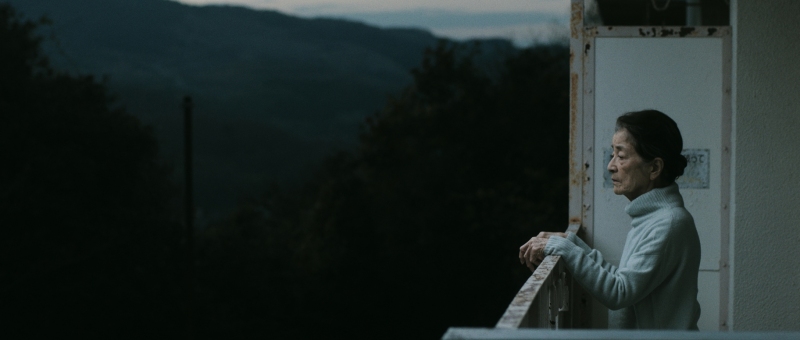
Plan 75 (Chie Hayakawa, 2022)

In 2016, a 26-year-old man went on a violent rampage murdering 19 people at a care home for the disabled claiming that he had done it “for the sake of society”. Prior to his crime, the killer had written an open letter in which he stated that he dreamed of a world in which those with severe disabilities could be peacefully euthanised, while claiming that those with no ability to communicate had no right to life and were nothing more than a drain on society. An expansion of her earlier short featured in the anthology film Ten Years Japan, Chie Hayakawa’s Plan 75 opens with a sequence which appears to directly reference the 2016 mass killing but in place of the widespread outrage and reconsideration of a social stigma towards disability that followed in its wake, the government decides to implement a “voluntary” euthanasia program for those aged 75 and over in response to the “concerns” of the young in an ageing society. 

Intergenerational resentment does indeed seem to be a motivating factory, the killer in this incident feeling himself oppressed by the responsibility of caring for the elderly while simultaneously hemmed in by a stangnant economy and heirarchical society. He points out that Japanese people have always praised self-sacrifice on behalf of the nation and alludes to the archaic tradition of ubasute or throwing out the old in which elderly people were abandoned on mountainsides to die in time of famine. There is no denying that the Plan 75 initiative has its insidious qualities in placing undue pressure on elderly people to give up their lives in order not to “burden” the young, an elderly woman attending a cancer screening remarking that she feels a little awkward as if she’s “clinging on to life”, being somehow greedy in the simple desire to continue living. 

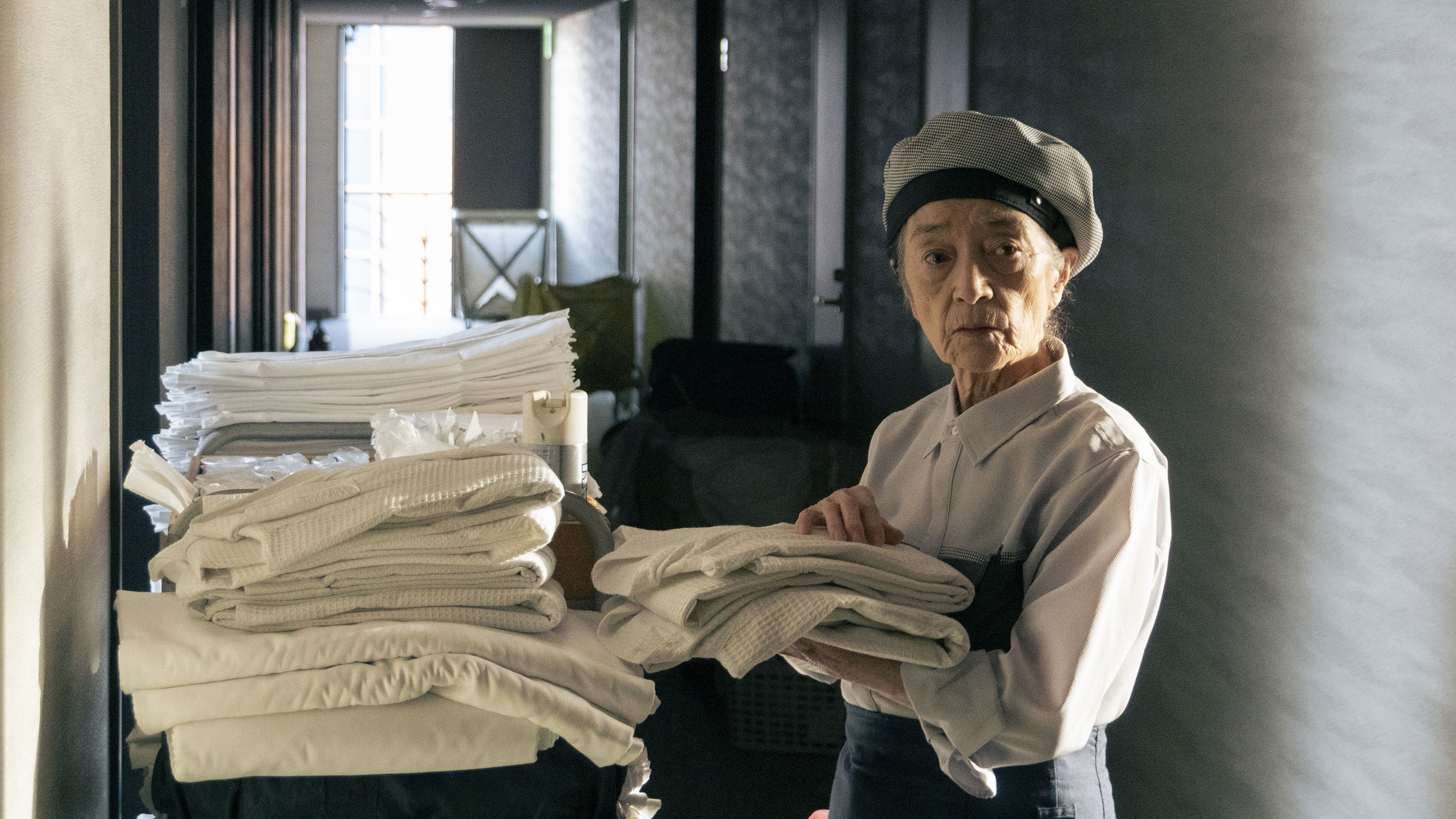
Meanwhile, their society has already abandoned them. 78-year-old Michiko (Chieko Baisho) had no children and lives alone supporting herself with a job as a hotel maid where all of her colleagues are also elderly women. When one of them has a fall at work, they are all laid off. The hotel claims that they’ve received complaints from guests about exploiting elderly people, but Michiko suspects it’s more like they don’t want one of them to drop dead in someone’s room. Not wanting to be a “burden”, Michiko is reluctant to apply for social security but even when she accepts she has few other options the desk at city hall is closed. Her building, like her now old, is set for demolition but no one is willing to rent to an unemployed 78-year-old woman nor is anyone willing to employ one. More and more Michiko is pushed towards Plan 75 if only to escape her loneliness. Being robbed of the opportunity to work also removes the opportunity for socialising especially as the other old ladies decide to move in with family and leave the area. 

This is in fact an integral part of the Plan 75 business plan with case workers specifically instructed to keep the applicants happy through regular phone calls while prohibited from meeting them in person to prevent the older person changing their minds having made new social connections that make their lives more bearable. In the quietly harrowing scenes at the processing centre, for want of a better term, it becomes obvious that the majority of those submitting to Plan 75 are women as staff members empty out their handbags, dumping their possessions into a large bin while setting aside anything of value such as watches or bracelets which are perhaps another valuable revenue stream for a callous government that sees the programme as a cost cutting exercise.  

Case worker Hiromu (Hayato Isomura) only becomes conflicted about Plan 75 after recognising an applicant as his estranged uncle and eventually discovering that despite sales claims of dignified funerals remains are often sent to landfill care of an industrial waste company. His uncle’s plight perhaps highlights the pitfalls of life in post-war Japan. Living hand to mouth working construction jobs all across the country he never had an opportunity to put down roots or save for his old age and is now living a lonely life of desperate poverty. Heartbreakingly he put his application in on his 75th birthday, an act Hiromu’s boss describes as almost heroic as if he couldn’t wait to sacrifice himself for the common good. Later a sign goes up that fixed addresses are no longer needed to apply, while the Plan 75 stand in a local park where they are in the process of putting bars on the benches so that homeless people can’t sleep there doubles as a soup kitchen. 

One has to ask, if there was money available for all of these resources to help people die why is it not available to help them live? A young woman assigned as Michiko’s handler appears to have second thoughts while bonding with her over the phone, tearfully reminding her she still has the right to withdraw (though it’s never mentioned if that means repaying the $1000 signing bonus) while Michiko’s life too has been brightened by this little bit of intergenerational friendship, itself cruelly commodified in the allotted 15-minute sessions included in the plan. Told with quiet restraint, Hayakawa’s vision of an eerily dystopian future in which human life is defined by productivity and all human relationships transactional, where loneliness is the natural condition and society itself has become little more than a death cult, is painfully resonant in our increasingly disconnected world. 


Plan 75 screens at Japan Society New York on Nov. 20 as part of The Female Gaze: Women Filmmakers from JAPAN CUTS and Beyond.

Festival trailer (English subtitles)

Images: © 2022 KimStim

Sing a Song of Sex (日本春歌考, Nagisa Oshima, 1967)

20120910022716257Aimless youth wastes its potency on repressed desires in Oshima’s avant-garde treatise on power dynamics and political fallacies. Sing a Song of Sex (日本春歌考, Nihon shunka-ko), less the bawdy romp the title promises than an irony tinged journey through music as a weapon against oppression, is the first of three films Oshima would make in the late ‘60s examining Japan’s complicated relationship with Korea. Its “heroes” however are about as depoliticised as it’s possible to get – they interrupt protests they don’t understand and obsess over a single pretty girl they fantasise about raping in an elaborate classroom based piece of erotic wish-fulfilment. All that matters to them is their craving for physical satisfaction which knows no morality or greater purpose save satiation, conquest, and implied humiliation.

Japan, spring, 1967. Four boys sit their university entrance exams with (externally at least) less seriousness than might be expected. Huddling together away from the snow they smoke cigarettes and gossip about miss 469 whose name they don’t know but caught their eye in the exam hall. The boys, along with three girls, are nominally under the care of their teacher, Mr. Otake (Juzo Itami), who takes them to a pub to “celebrate” before getting extremely drunk and kicking off on an inappropriate lecture about bawdy folk songs and their lasting legacy as the voice of the poor and the oppressed who have no other way of expressing their needs and desires. Lamenting that the young people of today lack the capacity for real feeling, Otake offers to put the kids up in a local inn, perhaps hoping to provoke some kind of awakening among his teenage charges but the loss of innocence he inspires in them is of a very different nature. Still extremely drunk, Otake falls asleep next to a faulty gas heater and dies of carbon monoxide poisoning.

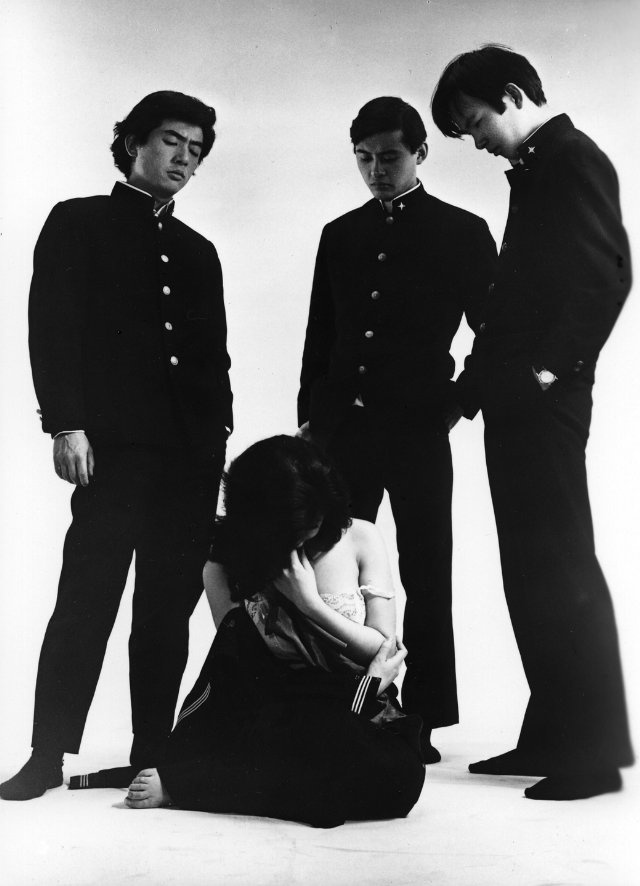
One of the boys, Nakamura (Ichiro Araki), went to see Otake during the night and saw him keeled over in a room that smelt of gas but did nothing. The girls, wailing and distraught, attempt to make their way home while the boys joke about having murdered their teacher and continue to exchange increasingly lewd and disturbing banter about their female classmates including collective rape fantasies (but only of the pretty one). The “other” girl that they collectively decide they don’t fancy, Kaneda (Hideko Yoshida), is disturbed enough by the boys’ murderous joke that she comes back to make sure it isn’t true, accidentally finding out about their dreamscape rape of no. 469 and pushing Nakamura towards paying a visit to Otake’s girlfriend, whom the boys have also been fantasising about, to apologise to her about his possible contribution to Otake’s death.

While Kaneda and the other three set off to track down 469, Nakamura splits off for Otake’s wake where he finds himself alone among a collection of former student protestors with differing views about Otake’s legacy and relation to the cause. The protestors break into a traditional Japanese leftwing anthem, but Nakamura isn’t having any of it. That’s not the Otake he knew. He resists their politicisation of his mentor’s funeral by loudly singing the bawdy drinking song Otake taught them at the pub. The song becomes something like an anthem for Nakamura and his friends who sing it at every conceivable opportunity, delighting in its inappropriateness and ironic similarity to the acts they frequently discuss but seemingly do not directly engage in. Like the peasants Otake idolised, Nakamura takes up the song as a weapon against his own oppression and the unwilling repression of his physical desires.

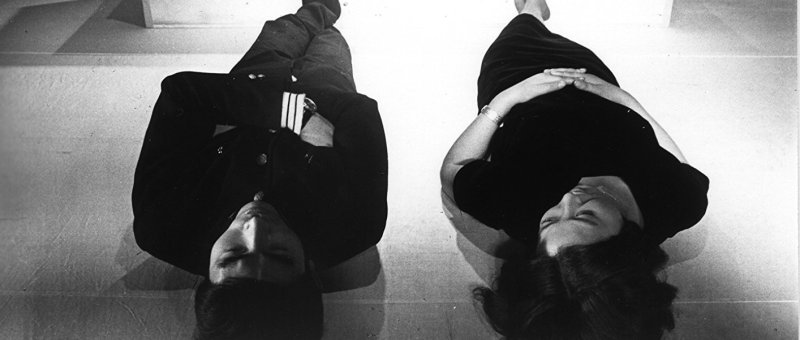
The battle becomes one of audience and agency. Nakamura sings his song over the hymn of protest being offered by the defeated left while Kaneda later attempts to counter with a female tale of exploitation, snatching a microphone away from some Americanised hippies singing Woody Guthrie and protesting the Vietnam war while dancing round the stars and stripes. Kaneda eventually gets her moment in the spotlight but she pays a heavy and ironic price for it, partly at the hands of miss 469 who re-enters the boys’ rape fantasy after it is directly revealed to her and she dares them to realise their baser desires. Suddenly back in an empty classroom presided over by Otake’s girlfriend, Miss Tanigawa (Akiko Koyama), and the silent spectre of Kaneda now dressed in a sparkly white hanbok, the boys get an intense lesson in Japanese history and more specifically the origins of the Japanese state in the royal courts of Korea.

The songs of the youthful protestors, some Japanese some co-opted from abroad, have lost their meaning and their fire. Their protest is affected and purposeless, as solipsistic as the boys’ destructive desires. On the one hand, youth embraces the pop culture of rebellion – joining the flower power revolution and adopting the Americanised protests against a foreign war and (perhaps tangentially) their nation’s complicity in it, while age fixes its sights on a recently revived imperial holiday and a rejection of the fascist past (though not a rejection of the imperial past or a recognition of its lingering legacy). Painted in tones of red and white, the rising sun occasionally replaced with the blackened flag of protest, Sing a Song of Sex is a paradoxically nihilistic condemnation of post-war youth who allow their oppression to push them into senseless acts of violence rather towards the noble causes of revolution and social change which might finally set them free.


Original trailer (no subtitles)