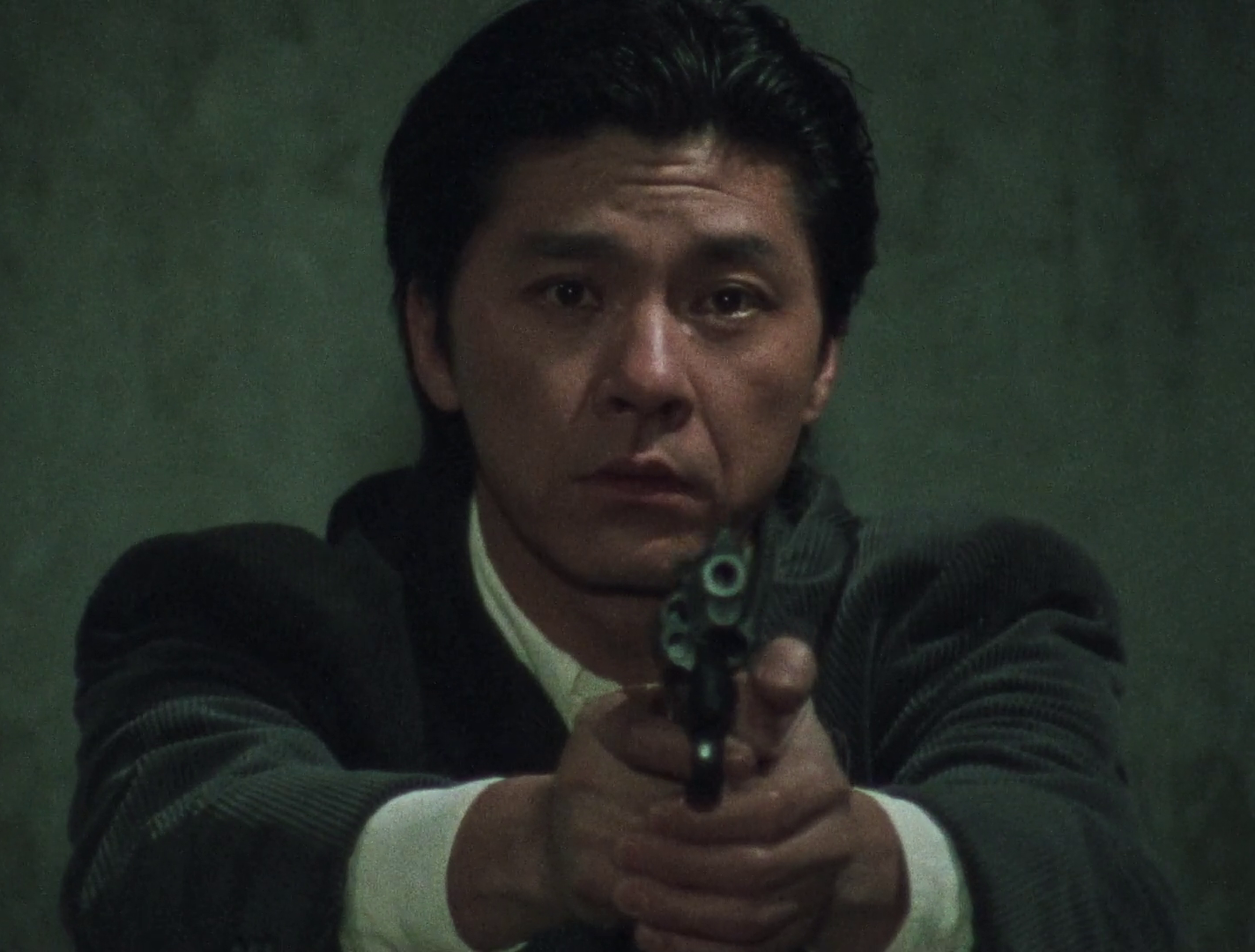
The Hitman: Blood Smells Like Roses (ザ・ヒットマン 血はバラの匂い, Teruo Ishii, 1991)

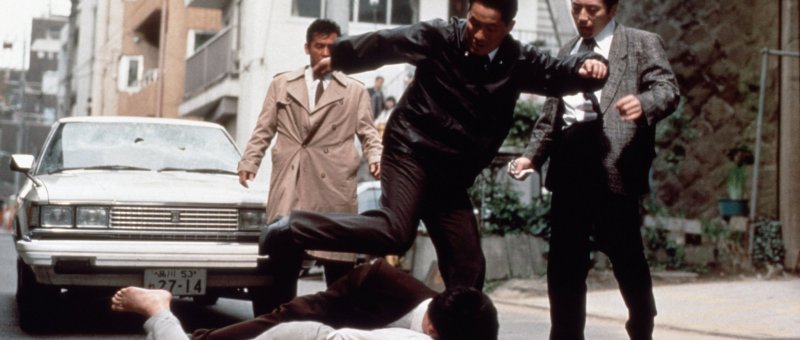
After his fiancée is killed during a yakuza shootout in a restaurant, a former spy in training plots revenge in Teruo Ishii’s Hitman: Blood Smells Like Roses (ザ・ヒットマン 血はバラの匂い, The Hitman: Chi wa Bara no Nioi). Ishii has been in retirement for 12 years before making the film but steps right into the zeitgeist with his bubble-era nightclub opening in which a yakuza goon pretends to be the son of a stockbroker to seduce a young woman he intends to press into prostitution, while looking back to classic noir and the borderless action past.

The young woman is rescued, though not soon enough to escape harm, by the titular hitman, Takanashi (Hideki Saijo), though he does not intervene to save her, only to take out the trio of yakuza who were one side of the gun battle in which his fiancée Reiko (Mikiko Ozawa) was killed. Reiko’s innocence is emphasised by her position as a teacher at a Christian school which is directly contrasted with the sleazy world of contemporary Shinjuku in which Takanashi becomes involved with a series of women. The Asia Town that he strays into is another international space with its samba bars and Filipina hostesses, while Takanashi is later sent to track a boat coming in from the Philippines which is thought to be smuggling guns. 

That’s a tip off he receives from Nakatsuka (Kiyoshi Nakajo), an old mentor from the defence academy who now works for the Cabinet Intelligence and Research Office, the nation’s primary intelligence authority. Nakatsuka is also seen meeting with the police chief who tells him that the yakuza have been complaining that police are encouraging the gang war rather than trying to stop it. So much the better, Nakatsuka says, let them massacre each other then take them all out right before the election to manipulate public opinion. If the election goes their way, the police chief will have additional budget to hire more policemen. Thus Takanashi also becomes a kind of pawn in cynical political machinations conducted by Nakatsuka and CIRO who are helping him both out of friendship and sympathy and because it is useful for him to make use of Takanashi and his desire for revenge. Only veteran policeman Uchino (Tetsuro Tanba) smells a rat, but even he later lets Takanashi go after making a moral judgement that justice has been served and Takanashi hasn’t really done anything wrong.

And so Takanashi tries to avenge Reiko by setting the gangs against each other in a recreation of the original gang war. He’s first frustrated and then aided by Shinjuku party girl Rumi (Natsumi Nanase) who steals his briefcase and gives it to the yakuza, and also be her friend Hisako (Yuki Semba) whom he meets after ducking into a soapland to escape the police. Hisako’s apartment is well furnished with even the modern convenience of an exercise bike, while Rumi’s feels empty, like a hideout with its bare floors and sparse decor. The walls are decorated with posters for Casablanca and Bonnie and Clyde that bring home and older noir past that Takanashi is echoing in his quest to avenge Reiko’s death at the hands of a crime-ridden society. We’re told that he gave up his place at the defence academy and became a truck driver when his parents objected to their marriage, but now fulfils his destiny in tackling the yakuza threat head on.

Meanwhile, as a kind of counter to Rumi, Hisako, and Yasuda’s girlfriend, Kumasa’s woman Beniko (Kimiko Yo) who is very much involved in policy decisions and actively fights back in defence of Kumasa who is otherwise a bit useless. The film is sleazy from its opening rape sequence to the soapland escapade and inexplicable closing credits which consist of a number of raunchy gravure shots backed by a power ballad that otherwise have little to do with the rest of the film, but is perhaps less cynical that it appears or at least seems to edge away from nihilism towards something that appreciates that a more emotional, poetic kind of justice is possible and valid. Takanashi is allowed to complete his quest, though it incurs additional casualties, and then leave the scene having achieved a kind of closure and brought the cycle to an end leaving the rest to Nakatsuka and Uchino who now seems to have crossed over to Nakatsuka’s side if perhaps lamenting that he may be working far too hard to a achieve a justice that now seems surprisingly easy to enact.
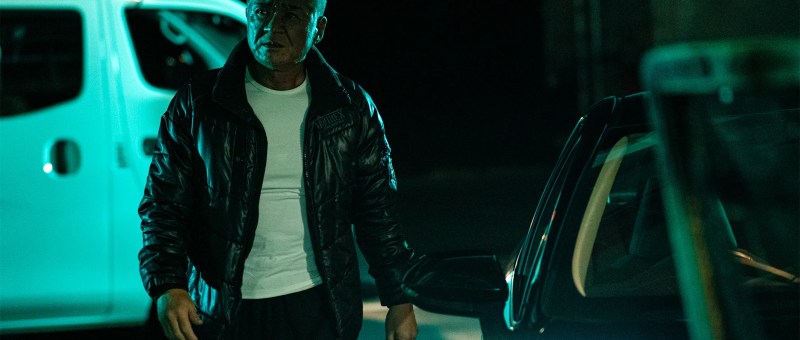
Bad City (バッド・シティ, Kensuke Sonomura, 2022)

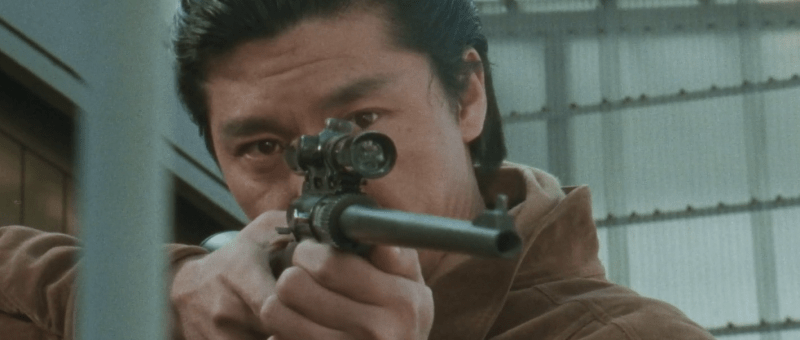
V-Cinema legend Hitoshi Ozawa returns in a tale of big city corruption helmed by Hydra’s Kensuke Sonomura. Scripted by Ozawa himself and apparently created in part as a celebration of his 60th birthday, Bad City (バッド・シティ) is a clear homage to the classic yakuza dramas of the early ’90s while boasting some of the best action choreography in recent Japanese cinema performed by the likes of Tak Sakaguchi along with Ozawa himself who performs all of his own stunts. 

According to dodgy CEO Gojo (Lily Franky) who has just inexplicably been acquitted of extortion and colluding with the yakuza, Kaiko City is riddled with crime and violence which is why he’s announcing his candidacy for mayor. Meanwhile, behind the scenes, a mysterious assassin (Tak Sakaguchi) is cutting swathes through the Sakurada gang who dominate the city’s western district which Gojo has earmarked for a redevelopment project he claims will improve the lives of citizens but is in reality just an excuse to build a massive casino complex intended to enrich himself and his company. The previous mayor had won a landslide victory thanks to his opposition to the redevelopment plan which enjoys little support from the local population but Gojo isn’t exactly interested in winning hearts and minds in the community. 

Really just another gangster himself, Gojo’s machinations are also destabilising the existing underworld equilibrium in seducing treacherous minions from other gangs including vicious Korean gangster Kim Seung-gi whose loyalty to ageing gang boss Madam Kim is clearly waning. Then again, an enemy’s enemy is a friend allowing unexpected alliances to emerge between previously warring factions especially given that the sudden offing of a high status gang boss is frowned upon in the gangster play book. 

With police and judicial collusion the only possible explanation for Gojo’s miraculous escape from justice, an earnest prosecutor sets up a secret task force under the command of Public Security agent Koizumi (Mitsu Dan) and led by veteran officer Torada (Hitoshi Ozawa) who is currently in prison awaiting trial on suspicion of offing Mrs Kim’s only son, Tae-gyun. Torada is an unreconstructed violent cop operating under the philosophy that if you beat up a good guy that’s violence but if he’s bad then it’s justice. He has perhaps learned to see the world as morally grey, not believing himself to be necessarily on the side of right so much as resisting the forces of darkness by doing whatever it takes to survive in this city which is indeed already quite corrupt. Partnered up with two veterans and a junior female officer from violent crimes who were assigned to investigate the Sakurada boss’ murder, the gang do their best to trap Gojo legally by uncovering incontrovertible evidence of his dodgy dealings they can use to nail him in court, or failing that the court of public opinion, that cannot be swept aside by his friends in high places. 

Sonomura opens as he means to go on with a series of bloody assassinations culminating the massacre of the Sakurada gang in a bathhouse, while building towards the final mass confrontation in which Ozawa and his team face off against hordes of foot soldiers trying to fight their way towards a confrontation with Kim Seung-gi. Dynamically choreographed, the action sequences are surprisingly bloody and heavy on knife action but crucially also displaying a high level of characterisation and dramatic sensibility as the earnest cops square off against amoral gangsters willing even to sacrifice their own. 

Though there might be something uncomfortable in setting up the major villain as a rogue Korean gangster, the film paints his defection in part as a reaction to Mrs Kim’s initial loathing of the Japanese while in the end allowing a kind of cross-cultural solidarity to emerge as the Sakurada gang become accidental allies and Mrs Kim receives a lost letter from her son that allows her to change her way of thinking while helping to take down the destabilising force of Gojo, restoring a kind of order at least to the streets of Bad City Kaiko. Ozawa may be an equally dangerous extra-judicial force, but at least for the moment he’s standing in the light where everyone can see him taking out the trash and leaving those like Gojo no quarter in an admittedly violent place.


Bad City screened as part of this year’s Camera Japan.

Original trailer (dialogue free)

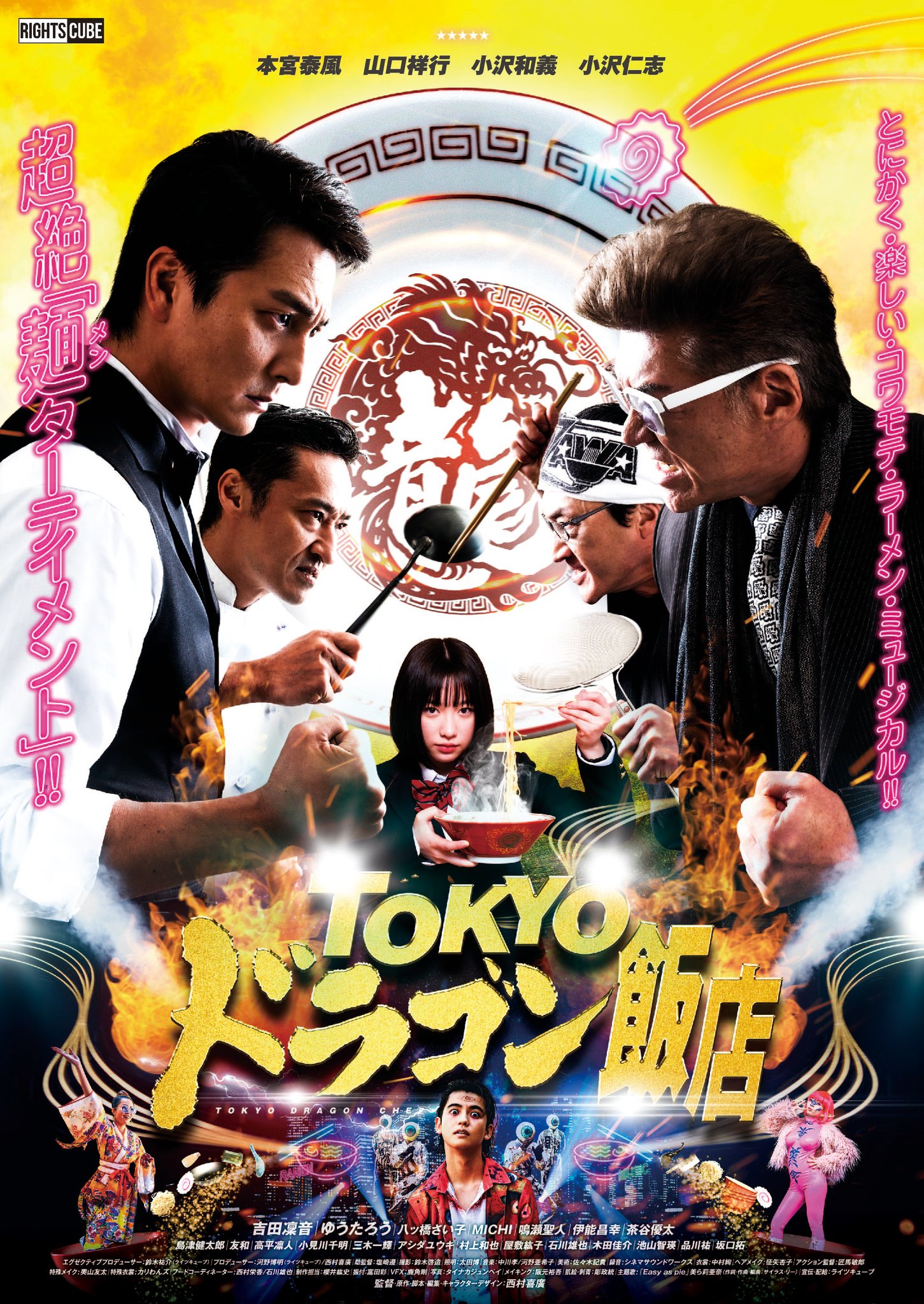
Tokyo Dragon Chef (Tokyoドラゴン飯店, Yoshihiro Nishimura, 2020)

Yoshihiro Nishimura began his career designing makeup and special effects for other directors working in the genre he would later headline, low budget splatter/exploitation primarily produced for the export market. With such legendary titles as Tokyo Gore Police, Vampire Girl vs. Frankenstein Girl, and Helldriver under his belt Nishimura’s reputation for surreal violence is already assured, but Tokyo Dragon Chef (Tokyoドラゴン飯店, Tokyo Dragon Hanten) sees him heading in a different, perhaps unexpected direction with a “family friendly” (depending on your family) musical tale of changing times, intergenerational warfare, and the wholesome soul of ramen. 

Veteran yakuza Tatsu (Yoshiyuki Yamaguchi) has just come out of prison but emerges into a world very different than he left it. His old comrade Ryu (Yasukaze Motomiya) now peddles Nata de Coco out of a tiny van, explaining that a mysterious invader with a third eye, Gizumo (Yutaro), apparently beheaded not only their gang boss but several others in the area effectively killing off the local yakuza scene. Remembering that Tatsu had a reputation as top a cook, a skill he apparently honed inside, Ryu suggests permanently retiring from the life to open a ramen bar. Meanwhile, two rival yakuza, Kazu (Kazuyoshi Ozawa) and Jin (Hitoshi Ozawa), have had exactly the same idea, setting up a van virtually outside and positioning themselves the competition by serving truly ginormous portions literally pushing quantity over quality.  

The truth is that the yakuza as an organisation has entered its twilight period, these older, Showa-style gangsters no longer have much of a place in the modern world hence why they need to find alternative ways of living. This is a fact brought home to them by the main villain who has a bizarre habit of singing Merry Christmas and is something like a youth elitist who resents the privileged status of the middle-aged and older in Japan’s ageing society, insisting that “Japan can’t survive with only old people like you” and that they should step aside to allow the young to rule. His villainy is well and truly signalled by his allegiance to fancy steak dinners which he characterises as high class cuisine suitable for righteous citizens like himself, rejecting the earthy, wholesome charms of the iconic shomin soul food that is ramen. 

The former yakuza, meanwhile, forced to work together, are an unexpected source of egalitarian solidarity. Not only do they eventually add an Okinawan soothsayer (Michi), holding a bright red crystal ball and dressed in traditional Ryukyu fashion while singing in a typical island style, to their ranks but their chief supporter closes all his YouTube videos with “kamsamnida”. Old style gangsters, they intensely resent that Gizumo has taken the battle to the streets in targeting those outside the life such as the Chinese owner of another local ramen bar and the father of their biggest fan, ramen-obsessed high school girl Kokoro (Rinne Yoshida). Yet there is something a little subversive in the irony of these multicultural nods, Kazu and Jin’s rival mascot character Mimi (Saiko Yatsuhashi), a YouTube star famous for eating giant portions who intensely resents being called an “alien”, breaking into cod Korean while the Chinese ramen guy is dressed in the full “Chinaman” outfit complete with fake pigtail. 

Nevertheless, it’s the wholesome charms of authentic ramen which eventually bring people together as the gang prepare to face off against Gizumo who apparently wants to turn the land into some kind of soulless hotel state. The final fight in which the former goons arm themselves only with ramen utensils and noren poles is also not without its share of irony as they turn Gizumo’s weird iconography back against him in despatching his henchmen who are each wearing helmets in the shape of an eyeball which would it seems be something of a handicap in hand-to hand combat even if your opponents were not fearsome gangsters, determined high school girls with vengeance on their minds, “alien” mascots, and spiritualists armed with hazardous balls. A fantastically silly affair, Tokyo Dragon Chef isn’t taking itself too seriously but has wholesome charms of its own in a tale of reformed yakuza, rebirthed communities, and the healing power of ramen as a universal unifier pushing back against snooty, youthful elitism in an ageing society.


Tokyo Dragon Chef is released on DVD & VOD on 25th January courtesy of Terracotta Distribution.

UK Release trailer (English subtitles)

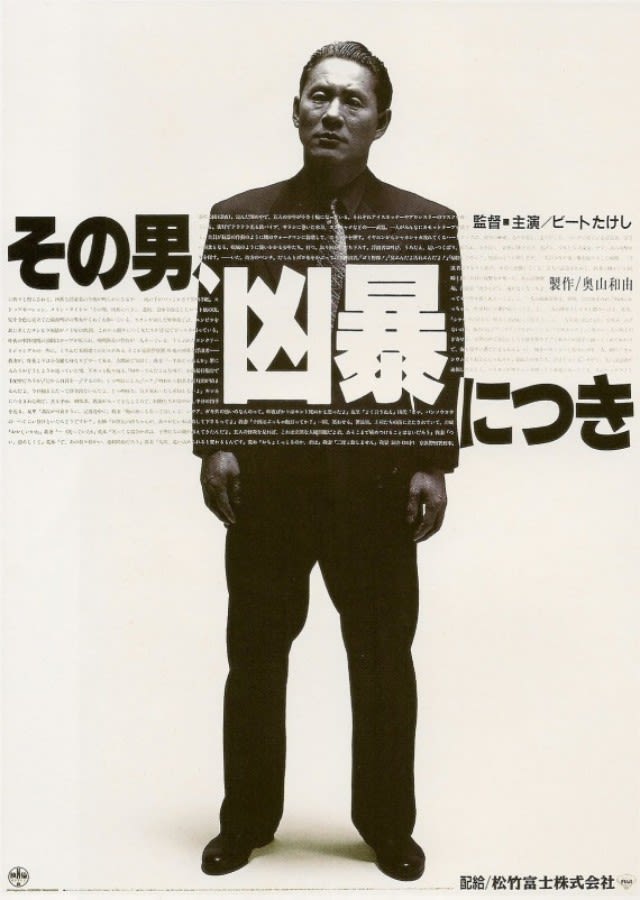
Violent Cop (その男、凶暴につき, Takeshi Kitano, 1989)

By and large, policemen in Japanese cinema are at least nominally a force for good. They may be bumbling and inefficient, occasionally idiotic and easily outclassed by a master detective, but are not generally depicted as actively corrupt or malicious. A notable exception would be within the films of Kinji Fukasaku whose jitsuroku gangster movies were never afraid to suggest that the line between thug and cop can be surprisingly thin. Fukasaku was originally slated to direct Violent Cop (その男、凶暴につき, Sono Otoko, Kyobo ni tsuki), casting top TV variety star “Beat” Takeshi in the title role in an adaptation of a hardboiled parody by Hisashi Nozawa. The project later fell apart due to Kitano’s heavy work schedule which eventually led to him directing the film himself, heavily rewriting the script in order to boil it down to its nihilistic essence while rejecting the broad comedy his TV fans would doubtless have been expecting. 

Kitano’s trademark deadpan is, however, very much in evidence even in this his debut feature in which he struggled to convince a veteran crew to accept his idiosyncratic directorial vision. He opens not with the “hero”, but with a toothless old man, a hobo beset by petty delinquents so bored by the ease of their comfortable upperclass lives that they terrorise the less fortunate for fun. Azuma (Takeshi Kitano), the violent cop, does not approve but neither does he intervene, later explaining to his boss that it would have been foolish to do so without backup. Having observed from the shadows, he tails one of the boys to his well-appointed home, barges past his mother, and asks to have a word, immediately punching the kid in the face as soon as he opens the door. Rather than simply arrest him, he strongly encourages that he and his friends turn themselves in at the police station the next day or, he implies, expect more of the same. The kid complies. 

Azuma embodies a certain kind of justice acting in direct opposition to the corruptions of the Bubble era which are indirectly responsible for the creation of these infinitely bored teens who live only for sadistic thrills. He arrives too late, however, to have any effect on the next generation, cheerfully smiling at a bunch of primary school children running off to play after throwing cans at an old man on a boat. Children always seem to be standing by, witnessing and absorbing violence from the world around them as when a fellow officer is badly assaulted by a suspect following Azuma’s botched attempt to arrest him in serial rather than parallel with his equally thuggish colleagues. But for all that Azuma’s violence is inappropriate for a man of the law, it is never condemned by his fellow officers who regard him only as slightly eccentric and a potential liability. Even his new boss on hearing of his reputation tells him that he doesn’t necessarily disapprove but would appreciate it if Azuma could avoid making the kind of trouble that would cause him inconvenience. 

That’s obviously not going to happen. What we gradually realise is that Azuma may be in some ways the most sane of men or at least the most in tune with the world in which he lives, only losing his cool when a suspect spits back that he’s just as crazy as his sister who has recently been discharged from a psychiatric institution. Azuma has accepted that his world is defined by violence and no longer expects to be spared a violent end. He smirks ironically as he slaps his suspects, connecting with them on more than one level in indulging in the cosmic joke of existential battery. To Kitano, violence is cartoonish, unreal, and absurd. The only time the violence is shocking and seems as if it actually hurts is when it is visited directly on Azuma, the camera suddenly shifting into a quasi-PV shot as a foot strikes just below the frame. The targets are otherwise misdirected, a young woman caught by a stray bullet while waiting outside a cinema or a cop shot in the tussle over a gun, and again the children who only witness but are raised in the normalisation of violence. 

Meanwhile, organised crime has attempted to subvert its violent image by adopting the trappings of the age, swapping post-war scrappiness for Bubble-era sophistication. Nito (Ittoku Kishibe), the big bad, has an entire floor as an office containing just his oversize desk and that of his secretary. These days, even gangsters have admin staff. Minimalist in the extreme with its plain white walls and spacious sense of emptiness, the office ought to be a peaceful space but the effect of its deliberately unstimulating decor is quite the reverse, intimidating and filled with anxiety. Behind Nito the ordinary office blinds look almost like prison bars. Meanwhile, the police locker room in much the same colours has a similarly claustrophobic quality, almost embodying a sense of violence as if the walls themselves are intensifying the pressure on all within them. 

Azuma is indeed constrained, even while also the most “free” in having decided to live by his own codes in rejection of those offered by his increasingly corrupt society. He walks a dark and nihilistic path fuelled by the futility of violence, ending in a Hamlet-esque tableaux with only a dubious Fortinbras on hand to offer the ironic commentary that “they’re all mad”, before stepping neatly into another vacated space in willing collaboration with the systemic madness of the world in which he lives. With its incongruously whimsical score and deadpan humour Violent Cop never shies away from life’s absurdity, but has only a lyrical sadness for those seeking to numb the pain in a world of constant anxiety. 


Violent Cop is the first of three films included in the BFI’s Takeshi Kitano Collection blu-ray box set and is accompanied by an audio commentary by Chris D recorded in 2008, plus a featurette recorded in 2016. The first pressing includes a 44-page booklet featuring an essay on Violent Cop by Tom Mes, as well as an introduction to Kitano’s career & writing on Sonatine by Jasper Sharp, a piece on Boiling Point from Mark Schilling, an archival review by Geoff Andrew, and an appreciation of Beat Takeshi by James-Masaki Ryan.

The Takeshi Kitano Collection is released 29th June while Violent Cop, Boiling Point, and Sonatine will also be available to stream via BFI Player from 27th July as part of BFI Japan.

Original trailer (English subtitles)