When I Get Home, My Wife Always Pretends to be Dead (家に帰ると妻が必ず死んだふりをしています。, Toshio Lee, 2018)

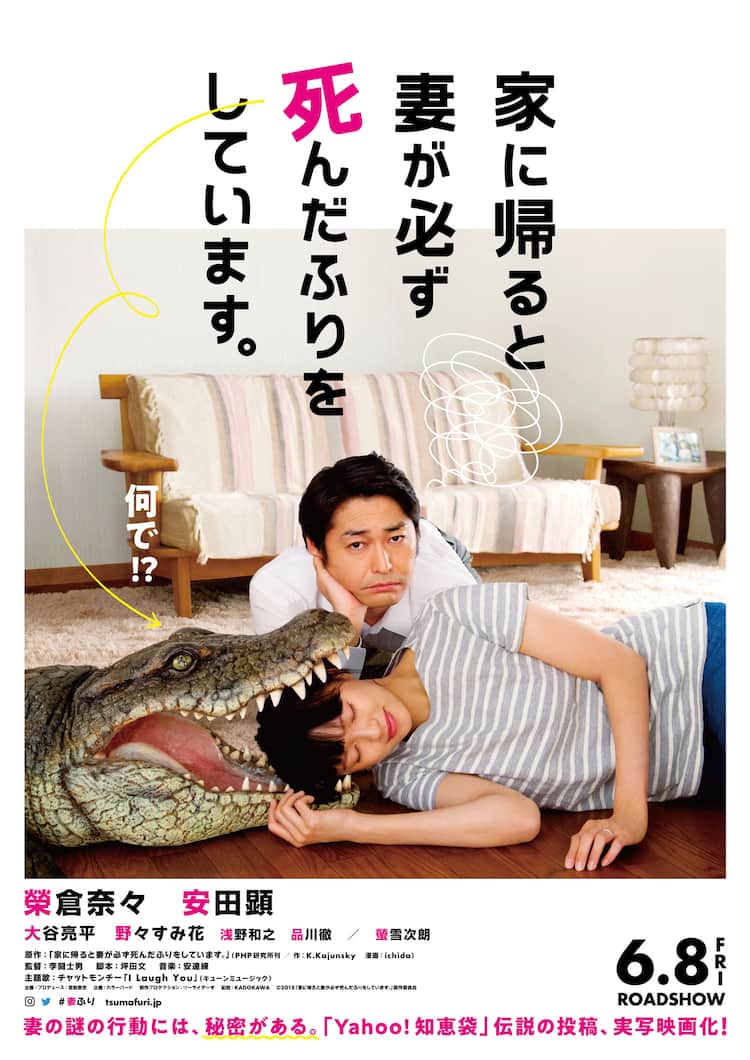
“If you give it some time it becomes just right,” according to the eccentric wife in Toshio Lee’s quirky contemplation of the modern marriage, When I Get Home, My Wife Always Pretends to be Dead (家に帰ると妻が必ず死んだふりをしています。Ie ni kaeru to tsuma ga kanarazu shinda furi wo shite imasu.). A more cheerful take on Harold and Maude, Lee’s not quite newlywed couple are heading out of their honeymoon phase and perhaps harbouring twin anxieties as they face the three year itch and start to wonder what marriage is all about and if they have what it takes to go the distance. 

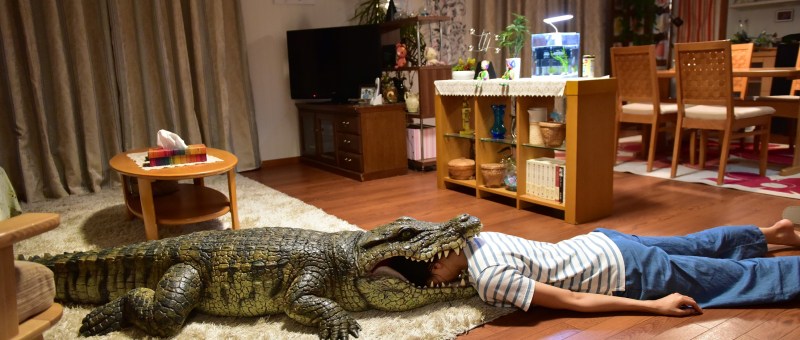
Regular salaryman Jun (Ken Yasuda) is particularly preoccupied with the “three year wall” because he was married once before and the relationship failed at the three year level which is, coincidentally, when many small businesses and restaurants fail. Perhaps unusually he has a friend at work, Sano (Ryohei Ohtani), with whom he discusses his marriage who ironically points out that Jun is essentially thinking of his marital status in the same way as a “contract renewal” as if worried he’s about to be let go. Around this time, however, he gets a nasty shock on returning home discovering his wife Chie (Nana Eikura) lying on the living room floor covered in blood. Distraught, he struggles to remember the number to call an ambulance only for Chie to suddenly burst out laughing. The same thing begins happening to him every time he goes home with the scenarios becoming increasingly elaborate such as being eaten by an alligator, for example, or being abducted by aliens. All things considered, Jun is quite a dull man, too embarrassed even to let his wife kiss him goodbye on the doorstep lest it scandalise the neighbours, so all of this fantasy is doing his head in but his rather blunt hinting that he’d prefer it Chie stop with the playing dead stuff only seems to hurt her feelings while she shows no signs of abandoning her strange hobby. 

Part of the problem is that Jun is also intensely self-involved and perhaps the product of a conformist, patriarchal society. He never reveals the reasons why his first marriage failed, only that his wife abruptly left him without much of an explanation. It never seems to occur to him that Chie may be fixating on death because she lost her mother young, possibly around the same age she is now, and is in a sense role playing demise to ease her anxiety probably grateful each time he returns home and “saves” her. For his part he insists he doesn’t “need excitement” and wants “a normal wife”, desperate to appear conventional and paranoid that Chie is going out of her mind. Rather than fully see her he keeps trying to “fix” the problem by encouraging her to take a part-time job and make new friends, worried she’s bored at home and lonely after moving away from her family home in Shizuoka.  

His friend Sano, seemingly happily married for five years, has a much more relaxed attitude to the mysteries of marriage but as the two wives begin to bond the cracks in their respective relationships are gradually revealed. Like Jun, Sano is also a conventional salaryman with traditional ideas about marriage which he somewhat rudely exposes in thinking he’s doing Jun a favour by “explaining” to Chie that her hobby is offensive to Jun because men work hard all day and want to sit down quietly without any bother when they come home. His quiet word provokes an outburst in his own wife Yumiko (Sumika Nono) who can no longer bear the irony, asking him why it is that she’s supposed to tiptoe around because he’s “tired” as if she does nothing at all day just waiting for him to come home. It’s as if they think their wives go back in the box until they ring the doorbell in the evening and wake them up again, as if the only value in their existence lies in supporting their husbands. Sano is mildly shocked on witnessing Yumiko suddenly brighten and embark on a mini lecture of crocodile facts after catching sight of Chie’s prop (bought on sale, making the most of her thrifty housewife skills), totally unaware she was into reptiles and equally stunned to learn she’s also a karate master. Five years, and it’s like they’re strangers. 

“Thinking won’t give you answers, when you don’t know, ask,” advises Jun’s boss, constantly carping about his ungrateful wife but later revealing that his deep love for her is what’s kept him going all these years. Miscommunication lies at the root of all their problems, Jun even failing to identify the most common if poetic of cliched idioms in his wife’s tendency to remark on the beauty of the moon seemingly at random. Clued in a little by Chie’s patient father, Jun begins to wake up himself, finally seeing his wife and understanding that she’s been trying to tell him something all this time only he was too self-involved to notice. “You can always find me if you look,” Chie was fond of saying, indirectly hinting that marital bliss is a matter of mutual recognition aided by empathy and a willingness to be foolish in the pursuit of happiness. 


When I Get Home, My Wife Always Pretends to be Dead is available to stream in the UK via Terracotta

Original trailer (English subtitles)

Shape of Red (Red, Yukiko Mishima, 2020)

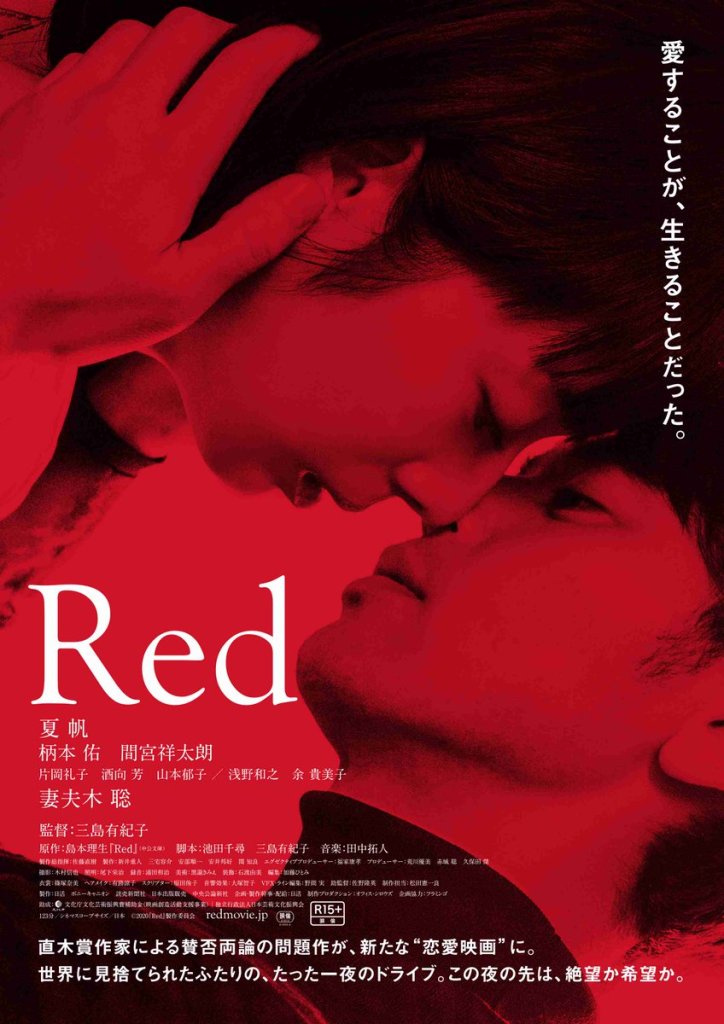
“This isn’t A Doll’s House” the heroine of Yukiko Mishima’s Shape of Red (Red) is exasperatedly told by a well-meaning colleague, only in many ways it sort of is. Adapted from the novel by Rio Shimamoto, Shape of Red proves that not all that much has changed since Nora slammed the door on the patriarchal hypocrisies of a conventional marriage as its not quite middle-aged wife and mother is confronted by the weight of her choices, wondering if a dull yet secure middle-class life is worth the sacrifice of personal fulfilment. 

32-year-old Toko (Kaho) gave up a career in architecture to marry upperclass salaryman Shin (Shotaro Mamiya) and is now a housewife and mother to six-year-old daughter Midori. The marriage is unhappy only in the most ordinary of ways, leaving Toko feeling neglected and unfulfilled, treated as a servant in her own home expected to fulfil her husband’s needs while her own go unsatisfied. That is perhaps why she wanders off from a work gathering her husband has dragged her to (in the outfit he picked out for her to wear) into a more interesting party where she re-encounters an old flame who abruptly drags her into an unoccupied room for a rough and unexpected embrace. Leaving the party together for a walk along the beach, Toko fills Kurata (Satoshi Tsumabuki) in on the past 10 years, lying through her teeth that she’s blissfully happy though admitting that she would have liked to continue with her career. 

Meeting Kurata either awakens a dormant sense of desire in the otherwise button-down Toko, or merely gives her permission to pursue it. She plucks up the courage to tell the less than enthusiastic Shin that she wants to go back to work and takes a job at Kurata’s company where the pair grow closer, but struggles to decide what it is she really wants – the “traditional” housewife life she picked when she married Shin, or the right to fulfil her individual desires. Shin, it has to be said, is an unreconstructed chauvinist from a conservative background who runs all of his major life decisions by his parents. He told Toko he was fine with her continuing to work after marriage but didn’t really mean it, coming up with excuses why she shouldn’t even though Midori is now in regular school. He tells her she can give work a go, but views it as little more than a hobby he assumes she’ll fail, later instructing her to stop because his parents want a second grandchild and, tellingly, he would like a son. Toko, meanwhile, is beginning to feel trapped but conflicted, convincing herself this is the life that she should want while simultaneously accepting that it makes her miserable. 

A third potential man at her place of work, Kodaka (Tasuku Emoto), also quite sexist and a little bit creepy but perhaps ironically so, strikes at the heart of the matter in bringing up her family background. Like seemingly everyone else, she grew up without a father because her parents are divorced, something she’s kept a secret from her conservative in-laws. Toko’s far less conventional mother (Kimiko Yo), sick of keeping up the pretence, brands her daughter’s life choices as “pathetic”, disappointed that she’s deluding herself she’s happy “living a lie” with a man she doesn’t even love.

Yet as fiercely as her newly awaked desire burns, she isn’t convinced by Kurata. Kodaka tells her that she and Kurata are two of a pair, off in their own worlds not really caring about anything, while pointing out that if Kurata has an empty space inside him he refuses to let anyone fill then the reason she sees it is that she does too. The pair work together symbolically rebuilding an imagined future through designing their idealised home, Toko eventually deciding that the windows need to be bigger because she wants to see more, literally broadening her horizons. What she’s deciding is that she wants more of life, but struggles to free herself of the old patriarchal ideas which convince her she’s betraying something by choosing herself. 

Once upon a time, a film like Shape of Red might have punished its heroine for her pursuit of passion, pushing her back towards a life of traditional respectability in forcing her to accept her maternity at the cost of her personal happiness or accept that her only freedom lies in death. Times have changed, if not as much as you’d think. You still can’t have it all, a choice has to be made and largely the choice is the same as Nora’s – stay and live the lie, or leave and accept that social censure is the price of authenticity. “I’ve a feeling we’ll be trapped like this forever” Toko exclaims driving down a seemingly endless tunnel lit by the warm red glow of security lights. Sooner or later you have to choose where you want to live, the superficially cosy show home with tiny windows and no soul, or the drafty opportunity of a room with a view opening out onto wide open vistas of infinite possibility.


Shape of Red is available to stream in Germany from June 9 to 14 as part of this year’s online Nippon Connection Film Festival. It was also due to be screened as part of the 10th season of Asian Pop-Up Cinema prior to its suspension.

International trailer (English subtitles)

The Magic Hour (ザ・マジックアワー, Koki Mitani, 2008)

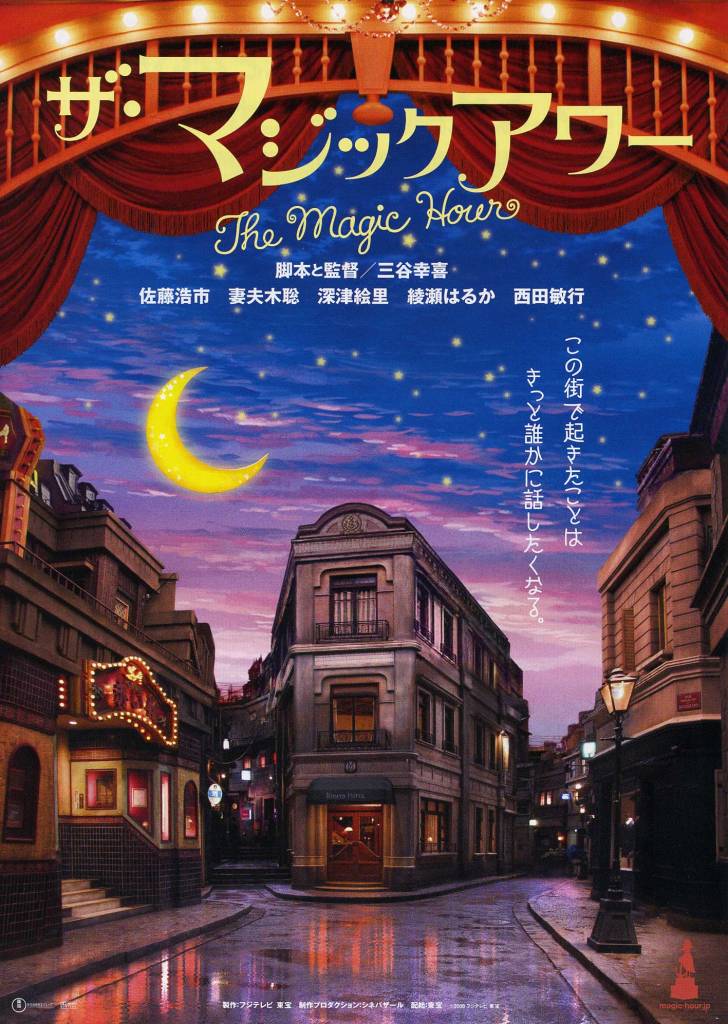
Magic Hour PosterIf there’s one thing you can say about the work of Japan’s great comedy master Koki Mitani, it’s that he knows his cinema. Nowhere is the abundant love of classic cinema tropes more apparent than in 2008’s The Magic Hour (ザ・マジックアワー) which takes the form of an absurdist meta comedy mixing everything from American ‘20s gangster flicks to film noir and screwball comedy to create the ultimate homage to the golden age of the silver screen.

In classic style the film opens with a bunch of goons chasing a scantily clad club owner out of a hotel window. Bingo (Satoshi Tsumabuki) has been hitting the jackpot with the boss’ girl, Mari (Eri Fukatsu), so the two are about to be given a new set of kicks in the latest fashion – cement. Luckily Bingo overhead some of the other guys talking about looking for another gangster, Della Togashi, so he quickly starts talking about him as if he were a long lost friend. The boss, Tessio (Toshiyuki Nishida), gives the pair a reprieve on the condition Bingo tracks down Togashi and brings him in within five days. Slight hitch – Bingo had never heard of Togashi before today and has no idea where to start. Finally, with the help  of some of his bar staff he hatches on the idea of getting a random actor to play the part, seeing as no one knows what Togashi looks like. However, the actor, Murata (Koichi Sato), plays his part a little too well and gets hired to work for the gang all the while thinking it’s just a movie! Pretty much everyone is getting a little more than they bargained for…

If you’re thinking that the oddly American looking 1920s street scene looks a little fake and everyone seems to be overacting like crazy, you wouldn’t be wrong but like everything else there’s a reason for that. What originally looks to be the primary setting for the film is a strange bubble which seems to co-exist with the modern world only its filled with people straight out of The Public Enemy or Scarface who think cement shoes is an efficient way of dealing with traitors. Murata, by contrast, is from our world and is completely oblivious to the strangeness of this movie gangster sound stage universe.

Murata is fixated on the Casablanca-esque final scene of his favourite movie in which a dyed in the wool tough guy entrusts the love of his life to a loyal friend before heading off to face certain death. His own career has not been going particularly well and even if he originally turns down Bingo’s offer as working with a first time director on a film where there’s no script sounds pretty fishy to begin with, circumstances soon find him throwing himself into the mysterious leading role with aplomb. Indulging his long held gangster dreams, Murata becomes the archetypal movie hit-man. He’s giving the performance of his life but has no idea there is no film in the camera.

The “Magic Hour” of the title refers to the twilight time near the end of the day when the light is dying but the conditions are perfect for making a movie. Mitani doesn’t fail to remind us we’re watching a film with constant exclamations of “just like a movie” or “doesn’t this look like a film set”. It’s a Barnum & Bailey world, just as phoney as it can be – but somehow it all just works despite its rather arch, meta approach. By the point we’ve hit Mari sitting on a crescent moon to give us her rendition of I’m Forever Blowing Bubbles (we’re back to The Public Enemy again) we’ve hit peak ‘20s though we scarcely mind at all.

Though he is indeed sending a lot of these classic ideas up, there’s real love here particularly for those golden age Hollywood movies with their wounded tough guys and beautiful chorus girls in need of rescue. Mitani adopts a primarily theatrical tone which meshes well with the absurdist, artificial atmosphere but always makes sure to leave us a fair few clues in the way of laughs. However, probably correctly assuming we know these films as well as he does, Mitani doesn’t give us the typical narrative that would almost write itself (or allow Bingo to write it based on his own trips to the motion picture house). The “bad” guy turns out to be not so bad, the “hero” wasn’t who we thought he was and none of our central guys winds up with a girl. Beautifully silly yet intricately constructed, The Magic Hour is another comedy masterpiece from Mitani which is filled with his characteristic warmth, mild sentimentalism and plenty of off-centre humour of the kind only Mitani can come up with.


The Japanese DVD/blu-ray release of The Magic Hour includes English subtitles.