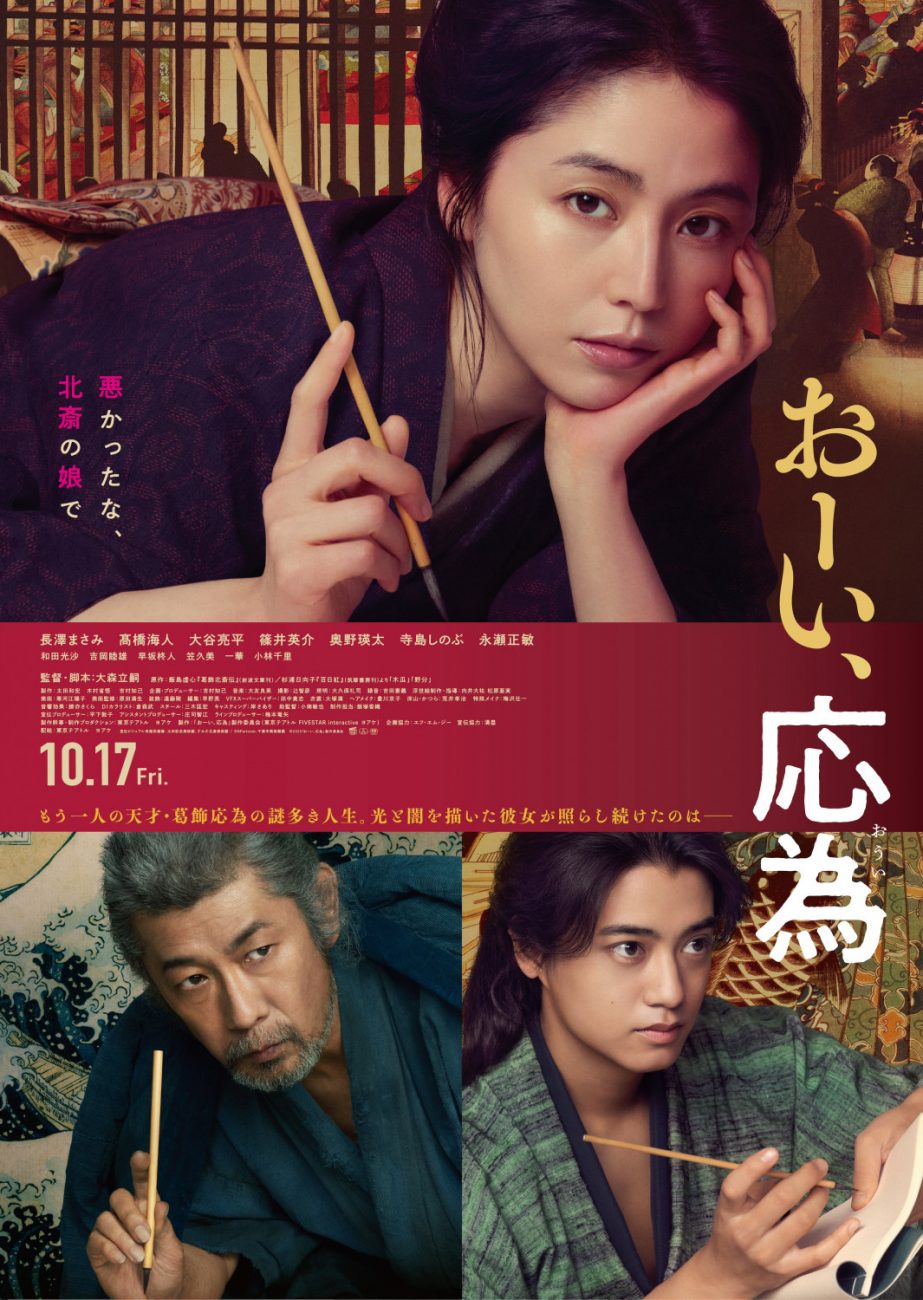
Hokusai’s Daughter (おーい、応為, Tatsushi Omori, 2025)

Is there something a little ironic about the title of Tatsushi Omori’s biographical drama, Hokusai’s Daughter (おーい、応為, Oi, Oui)? The Japanese title is a humorous allusion to how she came by her professional name, but once again the English centres her relationship with her more famous father rather than the woman herself. Yet, in a way, the film does this too in exploring the interplay between Oei’s own artistic ambitions, her father’s legacy, and the patriarchal society within which she lives.

By 1820, which is when the film begins, Oei (Masami Nagasawa) has already given up artistry to get married, but ends up leaving her husband, claiming that she couldn’t stand his terrible paintings. According to her, the reason they were so bad was because of her husband’s cynical mindset which manifested itself in dull, emotionally unengaging work, though perhaps it was more that she saw the man she had grown tired of reflected in his mediocre paintings which were never going to live up to her father’s or indeed her own. Returning to her father’s rubbish-strewn shack, Oei then faces the choice of whether to get married again or resume her artistic career. She seems to have a crush on the current top painter in Edo who is young and not bad looking, though perhaps it’s being the best artist that attracts her more than anything else. In any case, he is not romantically interested in her and tries to let her down gently, all of which just makes it worse for Oei. When her father Tetsuzo (Masatoshi Nagase), otherwise known as Hokusai, retrieves the hair pin she dropped in the well while preparing to meet the object of her affection, she tells him that she doesn’t want it back signalling her decision to give up on the idea of marriage and devote herself to painting.

Yet, the film is a little ambivalent on her decision, strongly implying that she is lying when she says she’s not lonely and must necessarily have a degree of regret in having rejected romantic fulfilment rather than allowing her to simply be fulfilled by her art. In this way, the pet dog that she adopts becomes a child substitute, rather than just a domestic companion. On the other hand, her unconventional personality and masculine behaviour mark her out as an outsider in Edo-era society who cannot really fit into any other milieu than the artistic. Tetsuzo keeps trying to kick her out because he thinks he’s stopping her from leading a more conventional life as a woman, before finally realising that wouldn’t suit her and giving Oei her own artist’s name as a seal of approval on her career as an artist.

Tetsuzo is however cantankerous and emotionally distant, unwilling to visit his younger daughter who is seriously ill seemingly because he doesn’t want to face the emotional reality of her impending death. Oei is not so diffident and more willing to confront her emotions head on as symbolised by her fascination with fire. When a samurai comes calling to commission a painting on behalf of his lord and becomes irate with Hokusai’s continued refusals, Oei calls his bluff by suggesting he attack her with his sword if he’s really serious about stabbing someone while her father looks on in silence. In some ways, the samurai is even less free than she is as he can hardly go back to his lord, tell him Hokusai said no, and expect to keep his life, so this gamble is all he really has left. Hokusai, however, resents both the samurai’s crass attempts to wave his money in his face and the entitled privilege of the samurai class in general who think they can order him about as they see fit.

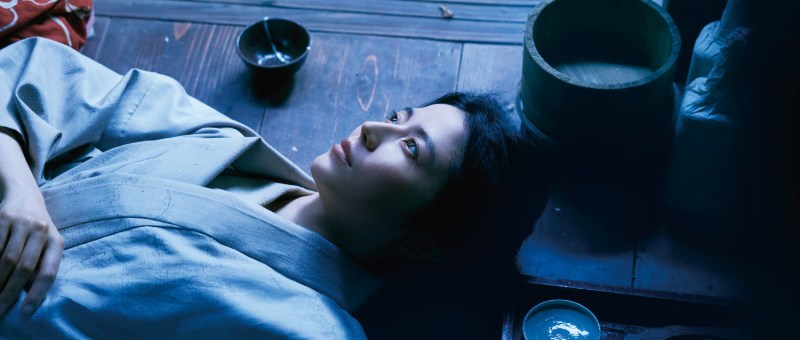
Tetsuzo’s poor business sense as an artist is another of his quirks which simultaneously sees him painting pictures of famous actors Oei thinks are not among his best work, and living in an absolute poverty that leaves him constantly moving from one rundown shack to another until leaving the city completely. Though it’s true that Oei is his longest serving disciple, it’s clear that most of her artistic development takes places while he is off on one of his travels that can last several years. When he suddenly returns as a much older man, he remarks that Oei now has her own style, perhaps as an acknowledgement that she has in some ways surpassed him in coming into her own as an artist while his time is coming to a close. Even so, the implication is that it would not have been possible for Oei to become a professional painter had she not had a famous father who approved of her talent, and that an artistic career would not have been open to her as a married woman in the repressively patriarchal Edo-era society. Using mostly natural light, Omori echoes the light and shade in Oei’s work as she begins to seek out not only a style that is distinctly her own, but a way of living as an outsider in a regimentally ordered society.


Hokusai’s Daughter screened as part of this year’s Camera Japan.

Trailer (English subtitles)
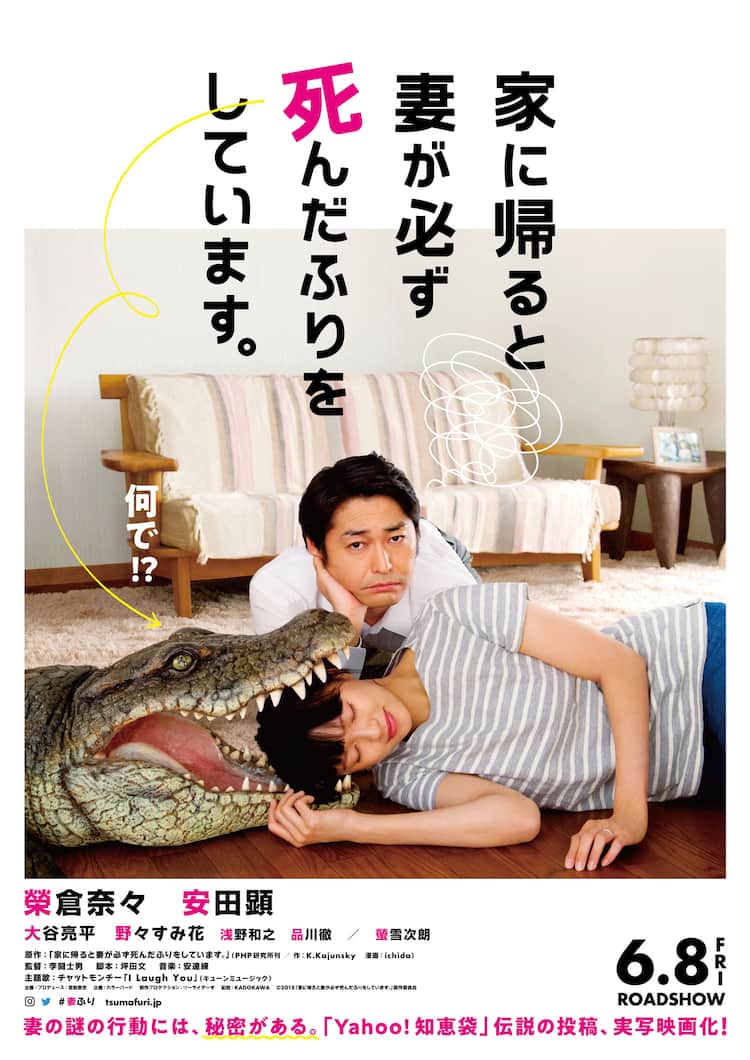
When I Get Home, My Wife Always Pretends to be Dead (家に帰ると妻が必ず死んだふりをしています。, Toshio Lee, 2018)

“If you give it some time it becomes just right,” according to the eccentric wife in Toshio Lee’s quirky contemplation of the modern marriage, When I Get Home, My Wife Always Pretends to be Dead (家に帰ると妻が必ず死んだふりをしています。Ie ni kaeru to tsuma ga kanarazu shinda furi wo shite imasu.). A more cheerful take on Harold and Maude, Lee’s not quite newlywed couple are heading out of their honeymoon phase and perhaps harbouring twin anxieties as they face the three year itch and start to wonder what marriage is all about and if they have what it takes to go the distance. 

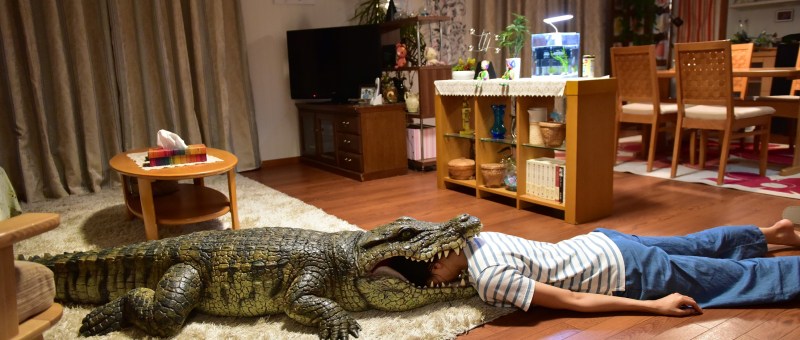
Regular salaryman Jun (Ken Yasuda) is particularly preoccupied with the “three year wall” because he was married once before and the relationship failed at the three year level which is, coincidentally, when many small businesses and restaurants fail. Perhaps unusually he has a friend at work, Sano (Ryohei Ohtani), with whom he discusses his marriage who ironically points out that Jun is essentially thinking of his marital status in the same way as a “contract renewal” as if worried he’s about to be let go. Around this time, however, he gets a nasty shock on returning home discovering his wife Chie (Nana Eikura) lying on the living room floor covered in blood. Distraught, he struggles to remember the number to call an ambulance only for Chie to suddenly burst out laughing. The same thing begins happening to him every time he goes home with the scenarios becoming increasingly elaborate such as being eaten by an alligator, for example, or being abducted by aliens. All things considered, Jun is quite a dull man, too embarrassed even to let his wife kiss him goodbye on the doorstep lest it scandalise the neighbours, so all of this fantasy is doing his head in but his rather blunt hinting that he’d prefer it Chie stop with the playing dead stuff only seems to hurt her feelings while she shows no signs of abandoning her strange hobby. 

Part of the problem is that Jun is also intensely self-involved and perhaps the product of a conformist, patriarchal society. He never reveals the reasons why his first marriage failed, only that his wife abruptly left him without much of an explanation. It never seems to occur to him that Chie may be fixating on death because she lost her mother young, possibly around the same age she is now, and is in a sense role playing demise to ease her anxiety probably grateful each time he returns home and “saves” her. For his part he insists he doesn’t “need excitement” and wants “a normal wife”, desperate to appear conventional and paranoid that Chie is going out of her mind. Rather than fully see her he keeps trying to “fix” the problem by encouraging her to take a part-time job and make new friends, worried she’s bored at home and lonely after moving away from her family home in Shizuoka.  

His friend Sano, seemingly happily married for five years, has a much more relaxed attitude to the mysteries of marriage but as the two wives begin to bond the cracks in their respective relationships are gradually revealed. Like Jun, Sano is also a conventional salaryman with traditional ideas about marriage which he somewhat rudely exposes in thinking he’s doing Jun a favour by “explaining” to Chie that her hobby is offensive to Jun because men work hard all day and want to sit down quietly without any bother when they come home. His quiet word provokes an outburst in his own wife Yumiko (Sumika Nono) who can no longer bear the irony, asking him why it is that she’s supposed to tiptoe around because he’s “tired” as if she does nothing at all day just waiting for him to come home. It’s as if they think their wives go back in the box until they ring the doorbell in the evening and wake them up again, as if the only value in their existence lies in supporting their husbands. Sano is mildly shocked on witnessing Yumiko suddenly brighten and embark on a mini lecture of crocodile facts after catching sight of Chie’s prop (bought on sale, making the most of her thrifty housewife skills), totally unaware she was into reptiles and equally stunned to learn she’s also a karate master. Five years, and it’s like they’re strangers. 

“Thinking won’t give you answers, when you don’t know, ask,” advises Jun’s boss, constantly carping about his ungrateful wife but later revealing that his deep love for her is what’s kept him going all these years. Miscommunication lies at the root of all their problems, Jun even failing to identify the most common if poetic of cliched idioms in his wife’s tendency to remark on the beauty of the moon seemingly at random. Clued in a little by Chie’s patient father, Jun begins to wake up himself, finally seeing his wife and understanding that she’s been trying to tell him something all this time only he was too self-involved to notice. “You can always find me if you look,” Chie was fond of saying, indirectly hinting that marital bliss is a matter of mutual recognition aided by empathy and a willingness to be foolish in the pursuit of happiness. 


When I Get Home, My Wife Always Pretends to be Dead is available to stream in the UK via Terracotta

Original trailer (English subtitles)