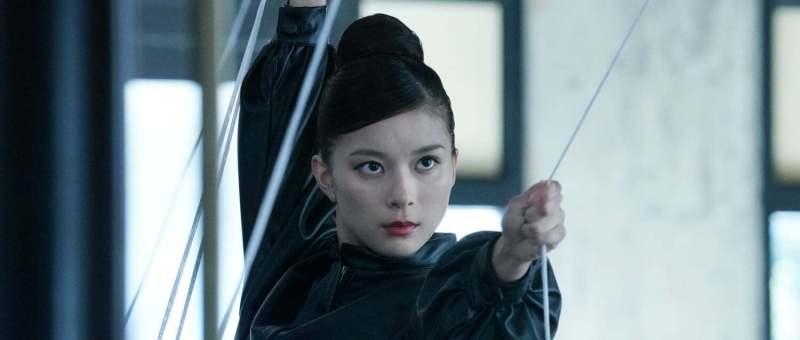
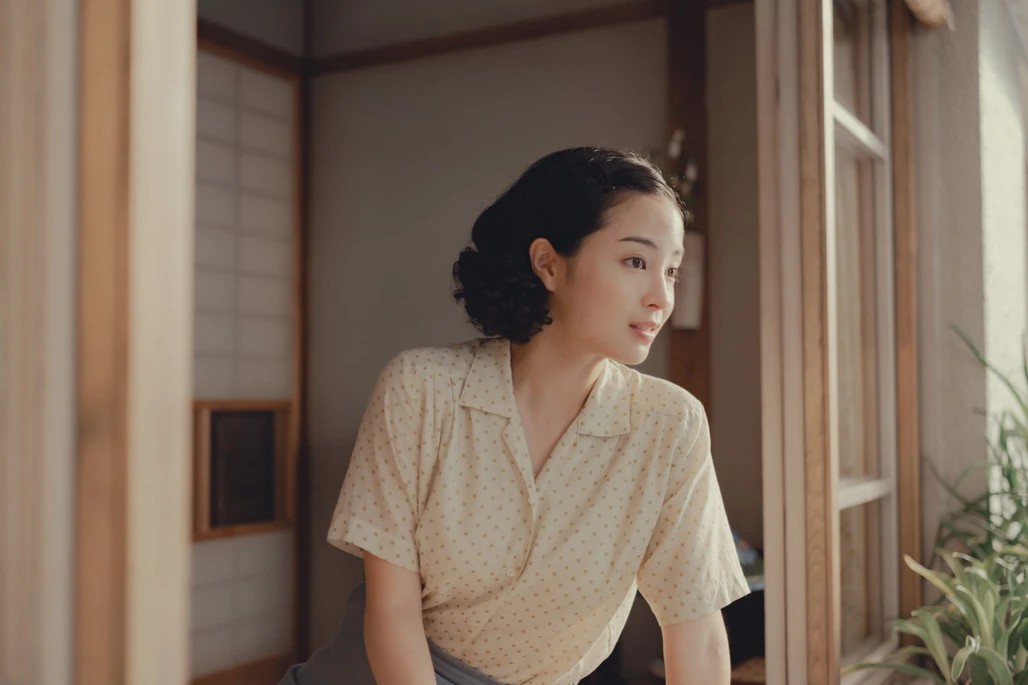
A Pale View of Hills (遠い山なみの光, Kei Ishikawa, 2025)

A young woman returns home at a moment of crisis, but finds herself with only more questions in an attempt to understand her mother and her decision to leave Nagasaki for the UK 30 years previously in Kei Ishikawa’s adaptation of Kazuo Ishiguro’s debut novel, A Pale View of Hills (遠い山なみの光, Toi yama-nami no Hikari). Set alternately in 1952 and 1982, the film positions the Greenham Common anti-nuclear protests as a point of connection between the two nations and the reason that Niki (Camilla Aiko) is currently so interested in her mother’s story seeing as there’s increased interest surrounding the atomic bomb, even if her editor keeps asking her about “Hiroshima”.

Another reason for Niki’s sudden return is that the editor is a married man Niki has been having an affair with. It seems she’s made a significant investment in the relationship by dropping out of university to work as a reporter, but despite saying he would, he has not left his wife and Niki suspects she may now be pregnant. All of which encourages her to investigate the relationship she has with her mother, Etsuko (Yo Yoshida / Suzu Hirose), and her late sister Keiko with whom she did not seem to get on, through tracing back her Japanese roots and trying to understand her familial history.

But what Etsuko, who is abruptly selling the family home, tells her is confusing and indistinct. Much of Etsuko’s story doesn’t line up, and we understand in part why later, but it seems almost as if the lacunas and contradictions are intentional and designed to hint at the ways we paper over cracks in our identities or create new mythologies for ourselves in an attempt to escape the traumatic past. Etsuko found a more literal escape in coming to the UK, but there’s something a little poignant about the way she says she thought there’d be more opportunities here and that Keiko would have had the chance to be anything she wanted which Japan would have denied her. Later she suggests that she always knew the UK wouldn’t be good for Keiko, but she came anyway. 

Now she’s selling the house, literally unpacking the past, Etsuko has begun dreaming about a woman she knew, Sachiko (Fumi Nikaido), and her daughter, Mariko, who lived near her in Nagasaki when she was pregnant with Keiko. Whereas Etsuko and her salaryman husband Jiro (Kohei Matsushita) live in a flat on a “danchi”, aspirational post-war housing estates for young families, Sachiko lives in a rundown shack across the way where the neighbours gossip about her for entertaining American soldiers who are still in the country post-Occupation because of the Korean War which is also what’s fuelling the economic recovery. Sachiko has met a man called Frank who says he’ll take her to America, but she doesn’t really believe him. 

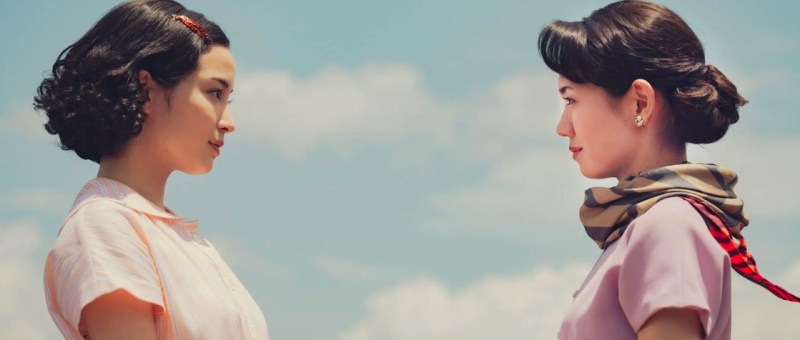
On the one level, it seems that Etsuko and Sachiko are mirror images of each other yet they are in other ways alike, while their stories share several details in common. What unites them is that they both experienced the aftermath of the bomb, though Etsuko has been careful not to disclose the extent of her exposure and is now fearful of what effect it may have on the baby along with on her relationship with her husband who appears to share some of the prevailing social prejudice against those who were exposed to radiation. Jiro, meanwhile, is a distant workaholic who criticises Etsuko for not being more “motherly” and sees her as little more than a domestic servant. He has a damaged hand from his wartime service that seems to reflect his wounds, but still rolls in drunk occasionally singing war songs with his inconsiderate friends. 

When his father, Ogata (Tomokazu Miura), announces he’s coming to stay with them, Jiro is pleased to see him but rebuffs his request that he talk to an old school friend, Matsuda (Daichi Watanabe), about an article he published claiming that it’s a good thing that teachers like Ogata were let go after the war. Ogata evidently feels hard done by, but it’s also true that the cause of his son’s animosity towards him is that he was a card-carrying militarist who cheered when he left for the front and indoctrinated children with imperialist ideology in his job as a teacher. He is the past Japan must move on from, and a representative of the wartime generation by which the young of today feel betrayed. As Matsuda tells him, it’s a new dawn. Ogata has to change, and so does everyone else including Etsuko who may not be as happy in her marriage as others might assume and may well be seeking other paths towards self-fulfilment rather than allow herself to become another miserable, self-sacrificing housewife.

Even so, the contradictory message seems to be that perhaps you can’t actually move on from this past and Keiko, in particular, may have been changed by her exposure not to the bomb but it’s aftermath, the terrible things she heard and saw amid the wreckage and the stigma she faced afterwards. The artificiality of the Japanese sets might speak to the slipperiness of Etsuko’s memory, as if she were observing a film of herself rather than recalling real events or else reimagining them differently so they play out a little more cinematically, in comparison to the concrete reality of the Sussex bungalow which perfectly captures a lived-in Britishness of the early 1980s. In many ways, Niki might not have clarified very much at all, or perhaps begun to accept the idea that not knowing doesn’t matter in coming to understanding of her relationship with her mother and along with it of herself as she too decides it’s time for change.


A Pale View of Hills screens 16/18th October as part of this year’s BFI London Film Festival.

Trailer (English subtitles)

A Man (ある男, Kei Ishikawa, 2022)

©2022 "A MAN" FILM PARTNERS

“Why was living so hard for him?” a brother remarks of man he assumed to have died in an accident after severing ties with his family, though with little sympathy in his voice and in truth should the brother be dead it would be all the better for him. Adapted from  a novel by Keiichiro Hirano, Kei Ishikawa’s A Man (ある男, Aru Otoko) asks questions not so much about the limits of identity and the existence of an authentic self, but the kinds of labels we place on others and the prejudice that often accompanies them that makes some want to run from themselves. 

Accidental detective Kido (Satoshi Tsumabuki), a lawyer who previously represented the recently widowed Rie (Sakura Ando) in her divorce from her first husband, is a case in point. He tries not to react while his wealthy and extremely conservative father-in-law runs down a case he’s just won representing the parents of a man who took his own life after being expected to work extreme overtime by an exploitative company solely to fulfil the image of the salaryman. The father-in-law sneers and complaints about the family receiving compensation before moving on to a rant about the welfare state scoffing that “real” Japanese don’t rely on such things which are only for “Koreans and people of that ilk”. 

Aside from its unpleasant xenophobia, the remark is insensitive as Kido is himself third generation Zainichi Korean, though a naturalised citizen of Japan. Throughout the film, he’s bombarded with social prejudice and racist abuse to which he chooses to say nothing, because there’s nothing he can really say, though leaving us to wonder if his decision to marry his wife (Yoko Maki), the daughter of a wealthy and conservative family, is an attempt to secure his own identity as a member of Japanese society even while bristling at her further demands, that they should invest in a more impressive, larger detached house as recommended by her father and also have another child. 

Kido’s quest to uncover the “true” identity of Rie’s husband Daisuke (Masataka Kubota) who is discovered to have been living an assumed identity when the brother of the man whose name he borrowed arrives at his memorial service, is also a quest to affirm his own identity which is in many ways as self-constructed as Daisuke’s is assumed to be. The interesting thing is that Daisuke, who said little of his past, used the other man’s backstory leaving no doubt that is not quite a case of mistaken identity that brings Kyoichi (Hidekazu Mashima) to Daisuke’s memorial service, though he is quick enough to disparage the life the deceased man shared with Rie in a rural “backwater” while making vague references to insurance policies and inheritances and simultaneously offering to pay for the funeral expenses as if reclaiming ownership over Daisuke’s legacy. 

Like Kido’s father-in-law, Kyoichi appears to be a cynical and self-interested man and it’s not difficult to see why the other Daisuke may have wished to escape his life with him. As an older man points out, everyone has things in their past and though they might not seem like much to others it’s natural enough to want run from yourself, to leave everything behind and start again somewhere else. In Japan, this is much easier to do than in some other countries and it’s true enough that changing one’s name is not that uncommon either. Rie’s young son Yuto, now old enough to question his own identity, took his mother’s maiden name after the divorce, then Daisuke’s surname Taniguchi when he married his mother. Now he wonders what his name should be if it is not Taniguchi and who he really is underneath it. 

In essence, we give people names as a kind of label to describe our relationship to them as a means of mapping out the world. These labels also come with prejudices such as that directed towards Kido as a Zainichi Korean and to another of the “disappeared” men who struggled to emerge from the shadow of his father’s crime as a death row felon. The projection of an identity can be harder to live with than the identity itself. When Kido’s wife tells him that he doesn’t seem himself and she wants him to go back to the way he was before, it’s a rejection of the new identity that has begun to surface through his quest to identify Daisuke and an instruction that he conform to the image of him she has constructed for herself as a typical Japanese salaryman not so different from her father in their affluent, middle-class existence.

Having satisfied himself that he understands the man Daisuke came to be, Kido’s self-image and sense of identity seem to be reaffirmed. He is happier with his wife and son, and has fewer doubts about his place in the world, but then he’s suddenly confronted with an unexpected revelation that undermines his new sense of security in causing him to doubt the veracity of the image he has of others, and consequently of their relationship with him which again leaves him unanchored unable to affirm his image of himself without its reflection. Rie’s final acceptance that in the end she never needed the “truth” (now that she has it) points to the same answer, that in the end Daisuke’s name was irrelevant because he was the man he was to her at the time that she knew him and this is all we can ever really know of each other in a continual act of faith in interpersonal connection. A man can be many people at once, or in quick succession, and none of them any less “real” than another. “It’s nobody’s life but your own,” Kido is reminded even as he struggles to reorient himself in a merging of identities self-constructed or otherwise but perhaps destined to remain forever a stranger to himself.


A Man screens in Chicago March 18 as part of the 16th season of Asian Pop-Up Cinema.

International trailer (English subtitles)

Arc (Arc アーク, Kei Ishikawa, 2021)

Does something have to have an ending to be meaningful or could eternity be the point? Inspired by Ken Liu’s short story, Kei Ishikawa’s near future tale Arc (Arc アーク) envisages a world without death if perhaps not for all in which bodily immortality has been achieved, but what would that mean for humanity no longer faced with mortal anxiety, how should it reorient itself in the absence of sickness or old age while the possibility of endlessness for the self has removed the urge for immortality through childbirth? These are all of course questions which have no one answer, though what the heroine finally discovers is that in the end it may be the choice itself of when to live or when to die that may lend her life at least its meaning. 

Even so, hers is a particular anxiety bound up with frustrated maternity having abandoned a baby she gave birth to at 17, too afraid of the responsibility to accept it. At 19, Rina (Kyoko Yoshine) is spotted at a club by a mysterious middle-aged woman, Ema (Shinobu Terajima), who runs a revolutionary cosmetics company which has pioneered a new way of preserving the bodies of the dead turning them into uncannily lifelike mannequins with a new process known as plasticisation. To Ema’s mind, true liberation comes from accepting transience, that once life has left it the body is just an object which might be repurposed for her art but then at the same time perhaps she is attempting to hold on to something that should be released, interfering in a natural process and while intending to offer comfort to those bereaved preventing them from letting go or moving on with their lives. Her much younger brother Amane, meanwhile, actively wants to stop time while alive utilising a similar technology to halt the ageing process and overcome the tyranny of death. 

In a strange way, Ema’s desire to restore a body which is no longer alive to ideal condition is also an acknowledgement of death which she believes is not the opposite of life but a necessary part of it. In overcoming the fear of death, she claims, a transcendental beauty will reveal itself. Amane meanwhile seeks to overcome death physically, but as Rina is warned his health revolution may not bring happiness to mankind not least because it exposes a persistent inequality in which eternal youth is available only to those with the means to acquire it, creating a new underclass not only of the poor but those whose bodies are not able to accept the treatment. Amane sees his creation as a dividing line in human history which will necessarily divide humanity into two groups, those who choose to join his revolution and those who do not (though interestingly he does not consider a third group who actively opposite it). Even so he sees it as a choice and accepts the right to reject immortality even going so far as to build a dedicated centre where those who choose to live a “natural” lifespan can do so in dignity and comfort. 

The concept of personal choice appears to be key, Ema too replying that her decision to stick with plasticisation rather than Amane’s treatment is her right though she too eventually hits a wall in the imperfection of her craft and the depths of her grief. She tells Rina to live her life freely encouraging her to live fully in the moment, while she too is quick to remind others that the decisions are theirs to make as regards their life and death. It’s not death nor the fear of it that are the problem, but the inability to choose as Rina finally acknowledges in remarking that the ability to decide its end point gives her the means to carve the arc of her life overcoming death through full existential control having in a sense closed a circle in facing her own sense of maternal failure. Shifting from the warmth and natural beauty of a beach in summer to the dark and brutalist environments of the BodyWerks lab, and from the muted colour of Rina’s youth to the black and white of her youthful old age, Ishikawa’s near future sci-fi-inflected tale suggests it’s not so much death that frightens you but helplessness and as in all things the answer lies in autonomous choice. 


Arc screens in Chicago on April 3 as part of the 14th season of Asian Pop-Up Cinema.

Original trailer (no subtitles)

Ten Years Japan (十年 Ten Years Japan, Chie Hayakawa, Yusuke Kinoshita, Megumi Tsuno, Akiyo Fujimura, Kei Ishikawa, 2018)

Ten Years Japan posterBack in 2015, five aspiring Hong Kong filmmakers came together to present a collection of shorts speculating on the fate of their nation in 10 years’ time. Coinciding with if not directly inspired by the Umbrella Movement, Ten Years was a deliberately political project which tapped into the nation’s unique preoccupations almost 20 years on from the end of British rule and a little more than 30 before One Country, Two Systems expires. The film proved an unexpected box office hit and has gone on to become an unconventional franchise with a host of other Asian nations creating their own omnibus movies musing on what may or may not have occurred in a decade’s time.

Unlike the original Hong Kong edition, Japan’s vision (十年 Ten Years Japan) is decidedly less political, perhaps reflecting a greater level of stability. Nevertheless, taken as a whole there are a number of recurrent themes running through each of the segments from the ageing population to the increasing power of the state and the dark possibilities of technology.

In Chie Hayakawa’s Plan 75, the first and darkest of the shorts, a conflicted salaryman (Satoru Kawaguchi) makes his living selling the titular “retirement” plans to those who have reached the age of 75 and decided enough is enough. Japan’s population is ageing faster than any other and caring for the elderly has placed a significant strain on the young. The old and infirm are therefore encouraged to think of themselves as burdensome, that they should do the decent thing and relieve the pressure on their loved ones by going gracefully at the right time. So far so Ballad of Narayama, but age isn’t quite the issue – the rich are excluded because they’re still spending their money and therefore economically useful. The government would rather roll out the invitations to the “unproductive”.

Ironically enough, a little girl who wants to be a vet in Yusuke Kinoshita’s Mischievous Alliance is advised to become a doctor instead and specialise in elder care which is in fact a growth industry. Unlike the elderly in Plan 75, the kids of Mischievous Alliance are not quite so willing to sit back and conform despite being fitted with invasive headsets connected to a monitoring program which “corrects” their bad behaviour whenever they try to break the rules. The hero rejects his oppressive schooling by self identifying with a stabled horse previously used for medical experimentation, longing to run free if only for a few moments.

If the “promise” system at the centre of Mischievous Alliance presented a vision of a future in which privacy and individual agency have all but disappeared, Data asks us if we have the right to reconstruct someone’s identity after they’ve gone by examining their digital footprint. A high school girl (Hana Sugisaki) tries to adjust to the idea of her widowed father’s (Tetsushi Tanaka) new girlfriend by opening up her mother’s “digital inheritance” but learns more than her mother might have wanted her to know. High school videos and pictures of old boyfriends jostle with beautiful flowers and private anxieties, but when it comes right down to it the organic memories are the only ones that count and the only things to make sense of the cluttered imagery in an uncurated personal museum of random digital moments.

Youth’s desire for knowledge and freedom is also at the heart of Akiyo Fujimura’s The Air We Can’t See which is the only one of the shorts to address nuclear anxiety in the post-Fukushima world. After some kind of event has made the surface uninhabitable, humanity has survived underground. A curious little girl, however, is fascinated by the idea of the outside. Longing to hear the birds and feel the rain, she imagines herself an exterior world but also comes to wonder if her home is a kind of prison born of fear and maybe it’s all alright up top if only you have the courage to look.

Meanwhile the apocalypse is still a little way off in Kei Ishikawa’s For Our Beautiful Country which hints obliquely at the growing threat of North Korea as missiles fly overhead with increasing frequency. The references, however, are older. A cynical ad man (Taiga) oversees a campaign promoting Japan’s remilitarisation but is later charged with letting the elderly, eccentric graphic designer (Hana Kino) know her poster is being “substituted” with something more “powerful”. After spending the day with her and coming to understand the subtle act of rebellion which has made her poster unusable for its propaganda purposes, the ad man gets a new a mission. It’s all up to the young now who have both an opportunity and a duty to ensure their country does not fall into the same kind of ugliness that sent young men off to die in the name of beauty.

Bookending the piece, Hayakawa and Ishikawa present the bleakest visions in which the descent into cruel authoritarianism may have already passed the point of no return. The children, however, seem to disagree and universally turn away from oppressive social codes, preferring to find their own truths and committed to exploring their own freedoms. Ten Years Japan may shed the overtly political overtones of its Hong Kong inspiration but finds brief rays of hope in the midst of despair in a child’s ability to break the programming and strive for a better, fairer world free of adult duplicity.


Screened as part of the 2018 London East Asia Film Festival.

Original trailer (no subtitles)