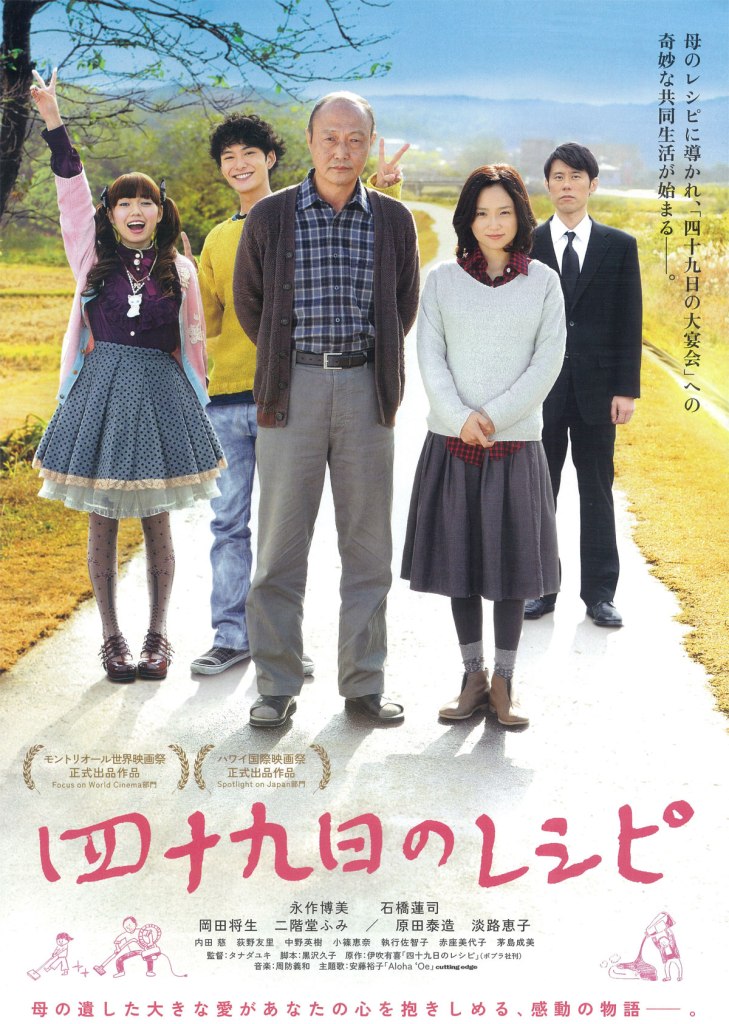
 When everything goes wrong you go home, but Yuriko, the protagonist of Yuki Tanada’s adaptation of Yuki Ibuki’s novel might feel justified in wondering if she’s made a series of huge mistakes considering the strange situation she now finds herself in. Far from the schmaltzy cooking movie the title might suggest, Mourning Recipe (四十九日のレシピ, Shijuukunichi no Recipe) is a trail of breadcrumbs left by the recently deceased family matriarch, still thinking of others before herself as she tries to help everyone move on after she is no longer there to guide them. Approaching the often difficult circumstances with her characteristic warmth and compassion, Tanada takes what could have become a trite treatise on the healing power of grief into a nuanced character study as each of the left behind now has to seek their own path in deciding how to live the rest of their lives.
Beginning in pitch darkness, housewife Yuriko (Hiromi Nagasaku) answers the phone to the voice of another woman requesting that she separate from her husband who is apparently the father of her unborn child. This double sting hits Yuriko hardest as the couple had been trying for a baby for quite sometime with little success. Thinking a divorce is for the best, Yuriko packs her bags, leaves the papers and her ring on the table, and heads for her father’s house. When she gets there she finds an oddly bubbly young girl, Imoto (Fumi Nikaido), washing her father’s back. Apparently, Imoto has been charged with looking after the house during the 49 day mourning period for Yuriko’s step-mother, Otomi – the upcoming memorial service something Yuriko had forgotten all about in the midst of her personal crisis. When Imoto presents the pair with a book that Otomi illustrated before she died listing everything they should do to prepare for the big party she wants everyone to enjoy rather than solemnly chanting sutras for her 49th day memorial, it prompts Yuriko and her father into a reconsideration of themselves, their pasts and futures, and who exactly should be making those decisions for them.
Yuriko’s position may seem like a straightforward one, betrayed by her husband her decision to leave seems inevitable but it’s complicated by the intricate web of duties and obligations Yuriko feels herself to be a part of. Reconsidering various turning points of her life, Yuriko makes plain that her marriage to the mild mannered salaryman Hiroyuki (Taizo Harada) had been under considerable strain due to the couple’s difficulty conceiving a child. Owing to the intense pressure placed on women to bear children, Yuriko internalises a sense of shame at having failed in this most basic of wifely tasks, leading her husband (she believes) to replace her with a model more fit for purpose. This point of view is rammed home by Yuriko’s insensitive aunt who continues to interrogate her about her lack of children and encourage her to return home to her husband and fix the problem rather than “giving up” and settling for the “shameful” option of divorce as young people are want to do. Aunt Tamako (Keiko Awaji) also points out that neither of her daughters bothered with university or work or any of that nonsense and now have fulfilled their duties by bearing bright and bonny grandchildren with no trouble at all. Heartbroken and blaming herself, Yuriko has to listen to the ongoing lecture whilst keeping her composure right until its gloomy conclusion.
Motherhood becomes the film’s biggest theme as mothers, non-mothers, and bad mothers swirl around the childless Yuriko, still trying to find her place in the world if the path society seems determined to set her on has been well and truly blocked off. Yuriko’s biological mother died when she was only little but happily her father fell in love with and married Otomi – a truly good woman who, like Yuriko, had no children of her own, but lived her life trying to make a difference and help other people to be happy. Little Yuriko didn’t always see it that way and found it difficult to bond with her new mother, settling for the nickname “Okka” – a combination of Otomi’s name and the word for mother, rather than straightforward “mum”.
Reinvestigating Otomi’s life in order to plan for her 49th day memorial, Yuriko truly gets to know her step-mother for the first time, discovering just how big of a difference she made in the lives of those around her. Imoto is just one of the young people Otomi went out on a limb for volunteering at a local rehabilitation centre for young people experiencing problems with addition. She then introduces them to a young Brazilian/Japanese migrant (Masaki Okada) who found himself feeling all alone in a foreign land until Otomi handed him the keys to her car and insisted he get out and about and meet new people. Otomi might not have had children of her own, but she became a mother to the world, reaching out and helping those who most needed it, becoming the springboard so that they could fly far away from her happier and healthier than before.
In learning from Otomi’s book, Yuriko regains her sense of self and a desire to find her purpose, knowing that the ability to bear children is not the be all and end all of a woman’s existence. Indeed even if a woman can give birth to a child, that’s not to say she’ll be a good mother as Imoto points out in reference to the toxic relationship she has with hers which feeds back into the insensitive way Hiroyuki’s mistress talks about her plans in front of her young son.
Given all of these epiphanies and mini realisations, Yuriko’s final decision may seem like an odd one, sending her back into a conservative world bound by all of the same duties and obligations the film spent so long undermining. Nevertheless, Yuriko emerges from her 49 days of mourning with a better understanding of herself and the way she should be living her life. Filled with wit and warm humour, Mourning Recipe neatly skirts its melodramatic nature to present a genuinely moving examination of the true nature of family, motherhood, and the necessity of individual freedom. Otomi’s final springboard action was for the ones she left behind, even if, once again, she won’t be able to see them fly.
Original trailer (English subtitles)
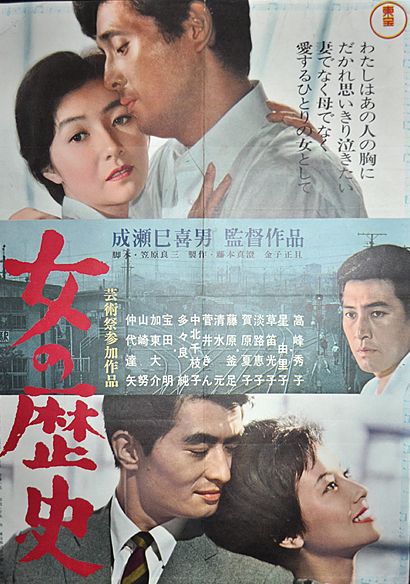 Mikio Naruse made the lives of everyday women the central focus of his entire body of work but his 1963 film, A Woman’s Story (女の歴史, Onna no Rekishi), proves one of his less subtle attempts to chart the trials and tribulations of post-war generation. Told largely through extended flashbacks and voice over from Naruse’s frequent leading actress, Hideko Takamine, the film paints a bleak vision of the endless suffering inherent in being a woman at this point in history but does at least offer a glimmer of hope and understanding as the curtains falls.
 A Japanese tragedy, or the tragedy of Japan? In Kinoshita’s mind, there was no greater tragedy than the war itself though perhaps what came after was little better. Made only eight years after Japan’s defeat, Keisuke Kinoshita’s 1953 film A Japanese Tragedy (日本の悲劇, Nihon no Higeki) is the story of a woman who sacrificed everything it was possible to sacrifice to keep her children safe, well fed and to invest some kind of hope in a better future for them. However, when you’ve had to go to such lengths to merely to stay alive, you may find that afterwards there’s only shame and recrimination from those who ought to be most grateful.
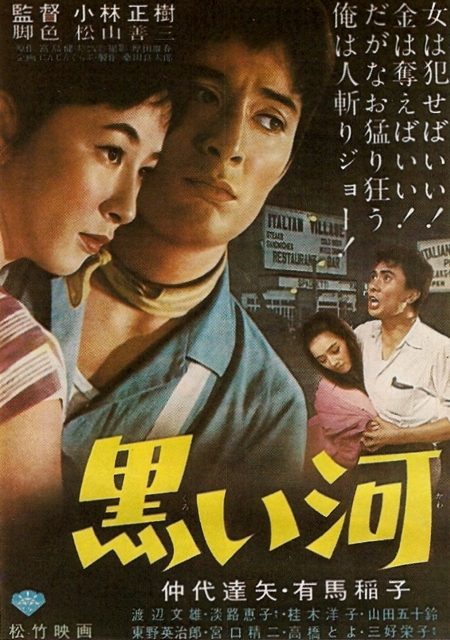 Masaki Kobayashi is still not enamoured with the new Japan by the time he comes to make Black River (黒い河, Kuroi Kawa) in 1957 which proves his most raw and cynical take on contemporary society to date. Set in a small, rundown backwater filled with the desperate and hopeless, Black River is a tale of ruined innocence, opportunistic fury and a nation losing its way.
 Windows on Worlds