Drunken Angel (酔いどれ天使, Akira Kurosawa, 1948)

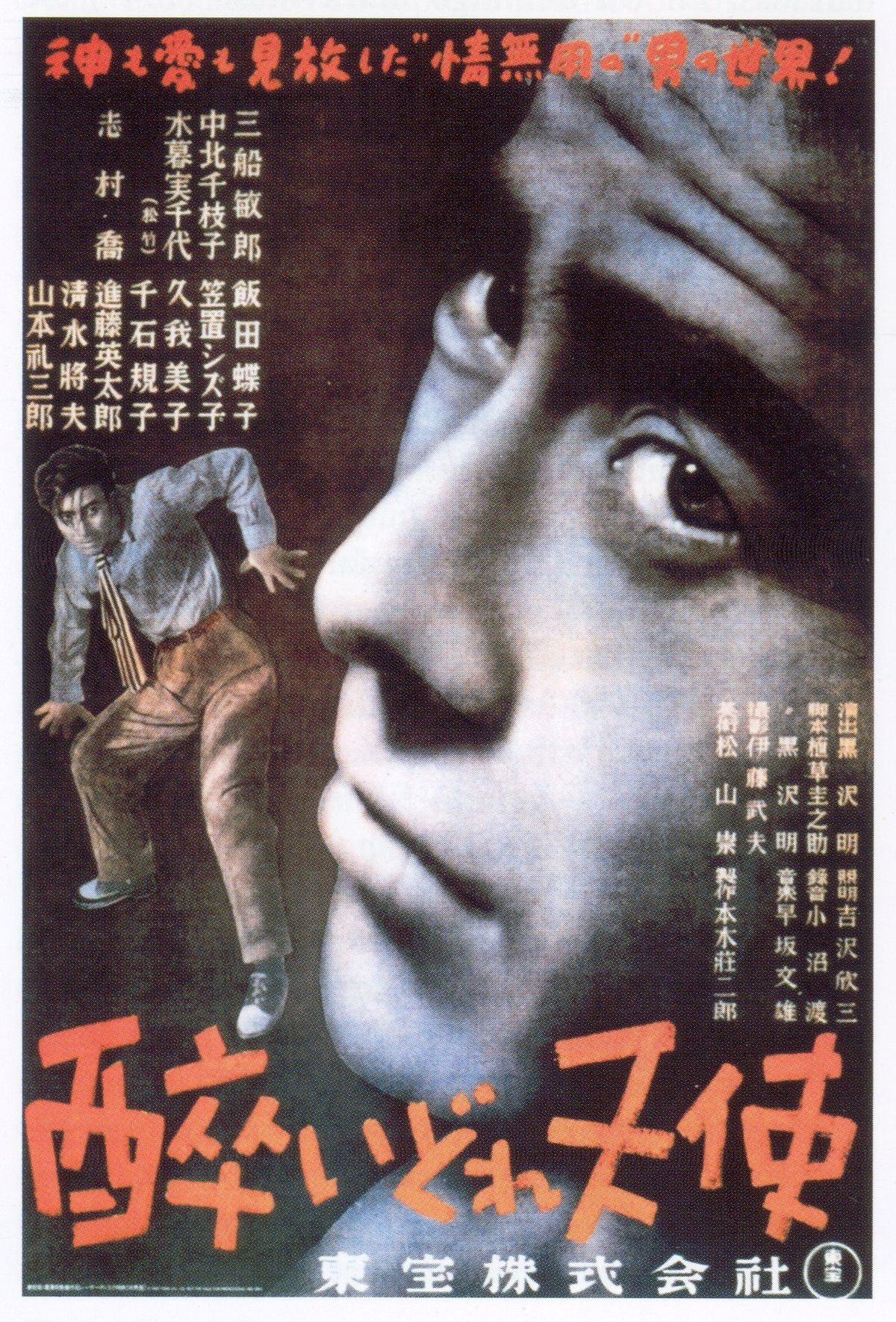
A gruff yet well intentioned doctor does his best to cure the ills of post-war Japan in a rundown slum on the edge of a fetid swamp in Akira Kurosawa’s noir tragedy, Drunken Angel (酔いどれ天使, Yoidore Tenshi). The doctor is most obviously the drunken angel of the title though it could equally apply to the unhappy yakuza he tries so hard to redeem whom most agree is not suited to that kind of life and trapped by the feudalistic thinking of the pre-war past.

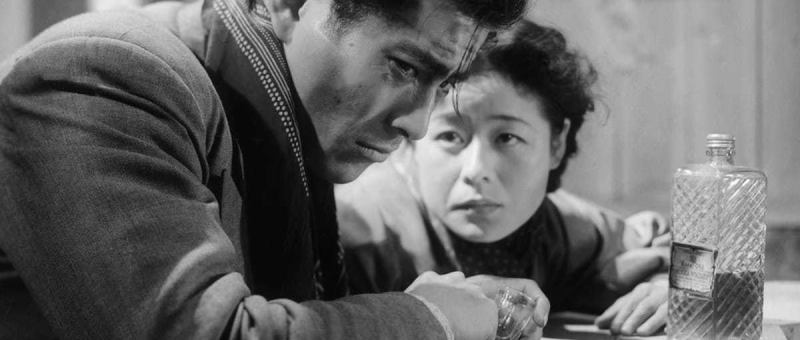
Matsunaga (Toshiro Mifune) is the big man around town, but jaded physician Sanada (Takashi Shimura) sees straight through him. “He acts tough and swaggers around but I know in his heart he’s incredibly lonely,” Sanada tells his assistant, Miyo (Chieko Nakakita), a young woman he took in to help her escape the clutches of the violent yakuza ex who left her with syphilis. Miyo bemoans Sanada’s terrible bedside manner and tendency to bully his patients but praises his dedication and remarks that few doctors go as far for those under their care as he does especially ones like these who don’t often have the money to pay. This is a little ironic given Matsunaga’s original objection that he doesn’t trust doctors because it’s not in their best interests to cure you, something which Sanada jokingly acknowledges while expressing the futility he feels in the face of the mass sickness that confronts him. 

When Matsunaga first comes into his office, Sanada remarks that’s its not just his lungs that are sick, he’s sick to the core. But still he seems to think that Matsunaga can be saved, not just physically but spiritually redeemed if only he can coax him away from the yakuza underworld. Matsunaga is suffering from tuberculosis, a common disease of the post-war era and closely linked to the squalid conditions in which he lives which are themselves symbolised by the swamp in the centre of town onto which Sanada’s clinic backs. Sanada tries to warn the local children not to play in it because of the risk of typhus not to mention the mosquitos it attracts but the kids don’t really listen to him and shout back that he’s “just a drunk”. Yet the swamp represents a world upside-down, the neon sign for the No. 1 cabaret bar constantly reflected in its bubbling waters while as the film opens we see a trio of sex workers preparing to head into the red light district and a pair of petty thugs fighting while a young man plays Spanish guitar on the ruins of a bomb damaged building. 

It’s as if it were this world that is slowly consuming Matsunaga, an old-school yakuza who insists “we still believe in things like honour and loyalty” certain that the big boss will side with him against the returned upstart Okada (Reizaburo Yamamoto), Miyo’s yakuza ex, even as Sanada tells him it’s money that matters and Matsunaga no longer makes any. Everyone tells him that he already looks like a ghost, his appearance increasingly gaunt in his parallel decline as the illness takes hold and he begins to lose his status to Okada only to overhear his boss call him an “amateur” that he was only keeping around as a potential sacrifice. In the end, Matsunaga is too good for this world. Naively believing in things like honour and loyalty which no longer mean anything in the dog-eat-dog post-war society he is left with nothing other than a nihilistic bid for vengeance and a desire to repay Sanada’s faith in him if only in the most ironic of ways. 

Like Matsunaga, Sanada sometimes says the opposite of what he means claiming that he doesn’t care what happens to Matsunaga but is determined to wipe out the TB inside him to stop it spreading it to others. He’s on a mission to “sterilise this contaminated town” by eradicating the twin threats of disease and the yakuza, calling Matsunaga a coward for failing to face his fear and loneliness succumbing to the quick fixes of his hedonistic yakuza lifestyle. He’s not perfect either, a doctor who drinks his medical ethanol supplies and berates his patients when he them catches out them out drinking when he told them not to, but is also very at home with who he is and doing his best with it. His disappointment in Matsunaga is mainly in his swagger, the false bravado that masks his human frailty and unwillingness to face his fear of death which manifests itself in a hauntingly expressionistic dream sequence. Using silent cinema composition and canted angles Kurosawa conjures a world of constant uncertainty amid the vagaries of the post-war society in which the only sign of salvation is a drunken doctor and his “rational approach” to the sickness of the age.


Drunken Angel screens at the BFI Southbank, London on 2nd & 10th February 2023 as part of the Kurosawa season.
One Wonderful Sunday (素晴らしき日曜日, Akira Kurosawa, 1947)

A young couple attempt to have a nice day out in Tokyo for only 35 yen but eventually discover something much more valuable in Akira Kurosawa’s surprisingly upbeat voyage through the backstreets of the post-war city, One Wonderful Sunday (素晴らしき日曜日, Subarashiki Nichiyobi). Though it may begin with frustration and progress to abject despair, the film allows its dejected heroes to find renewed hope for the future in the ashes of their defeat if only through the power of make-believe. 

Yuzo (Isao Numasaki) and Masako (Chieko Nakakita) are a young(ish) couple who’ve been together since before the war but are unable to marry because their precarious financial situation prevents them from finding a home in which they can live together. Though they are each in full employment, Masako currently lives with her sister and Yuzo with a friend. They can only spend Sundays together, but this particular Sunday Yuzo is fulled with frustration and resentment. He has only 15 yen, not much of a date as he tells Masako with irritation explaining that she’s had a wasted journey. She reveals that she has 20, but Yuzo has his male pride and is reluctant to take “a woman’s money” while internally humiliated not to be able to take her out on the town. Just before she had arrived, Yuzo had stared at an abandoned cigarette butt on the pavement. His desire soon overcame his shame. He picked it up and smoked it, only for Masako to bat it out of his hand as if insisting that he’s better than that. 

For her part, Masako is defiantly upbeat. Perhaps she’s putting on a brave face for Yuzo, but does her best to buoy his spirits so they can have a nice day together. It may be her only nice day all week. While she looks forward, he cannot move beyond the dissatisfying present. Masako begins by suggesting they check out a show home advertised on a billboard as a new kind of residence which is cheaper to build and available for only 100,000 yen for the first 100 buyers. She imagines how their life might be together in this space, while Yuzo merely sulks in the corner and points out the shoddiness of the build amid declining modern standards. It’s advertised as affordable, but they can’t afford it. Meanwhile, another man wanders in with a woman who is clearly his mistress. She exclaims that the place is a dump, “I hate matchbox houses”, while he agrees that it’s cheap for a reason and you get what you pay for. Presumably he already owns a home where his wife and family live and is about to drop a small fortune on a discreet love nest while his mistress, not unreasonably, attempts to haggle her way up to something a bit more fancy. Yuzo knows he won’t ever be able to afford even this “inexpensive” home that a wealthy man disdains as not worthy of his bit on the side. They’ve just come from seeing a crummy flat a few streets away which Masako asks directions to only to be put off by the doorman who warns them that the flat isn’t even really habitable and the landlord is heartless but they couldn’t afford that either even on the assumption they would both keep working (which depending on Masako’s job might not possible once she marries).

The landscape around them is in ruins. Yuzo and Masako wander through a bombed out city not yet ready for reconstruction looking for somewhere to stay out of the cold without eating into their 35 yen. He wants to give up and go home, but she convinces him to attend a concert of the music they heard on their first date before the war only when they get there all the cheaper tickets have been bought up by touts who sell them on at 50% markup. Beaten up for challenging the touts’ uncompromising cynicism, Yuzo hits rock bottom returning to his flat in a rundown tenement where a woman mopping the corridor gives Masako serious side eye. Frustrated, he tries to pressure her into premarital sex, her rock bottom coming a few minutes later when she firstly leaves in outrage and then returns as if admitting that their situation will never improve. 

“The war destroyed that dream” Yuzo had said of Masako’s attempt to rekindle his hopes for the future in the plan they made to open a cafe together after they married, but the reality of their mutual defeat finally seems to inspire defiance in the face of the world’s hostility. On their journey through the city, they’d encountered a ragged street kid who thought them fools after they refused his offer of ten yen for one of their rice balls and simply gave it to him out of human kindness. Yuzo felt himself a fool after trying to visit an old friend who’s done well for himself with a swanky cabaret bar only to be rebuffed and see his own image reflected in a mirror with his threadbare overcoat and battered hat juxtaposed with the image of a fine young couple eyeing him with disdain and suspicion. In the end Masako can only appeal to us, breaking the fourth wall in a moment reminiscent of Peter Pan asking us to clap if we believe in fairies as she tries to revive Yuzo’s sense of naive possibility to conduct an unfinished symphony of their imagined life together in a happier future of post-war Japan. Refusing to give in to their baser instincts, to become cynical and selfish or else simply to give up, this wonderful Sunday does seem to have given them a childish sense of hope that better days are on their way and until then there’s always next week. 


One Wonderful Sunday screens at the BFI Southbank, London on 3rd & 15th January 2023 as part of the Kurosawa season.
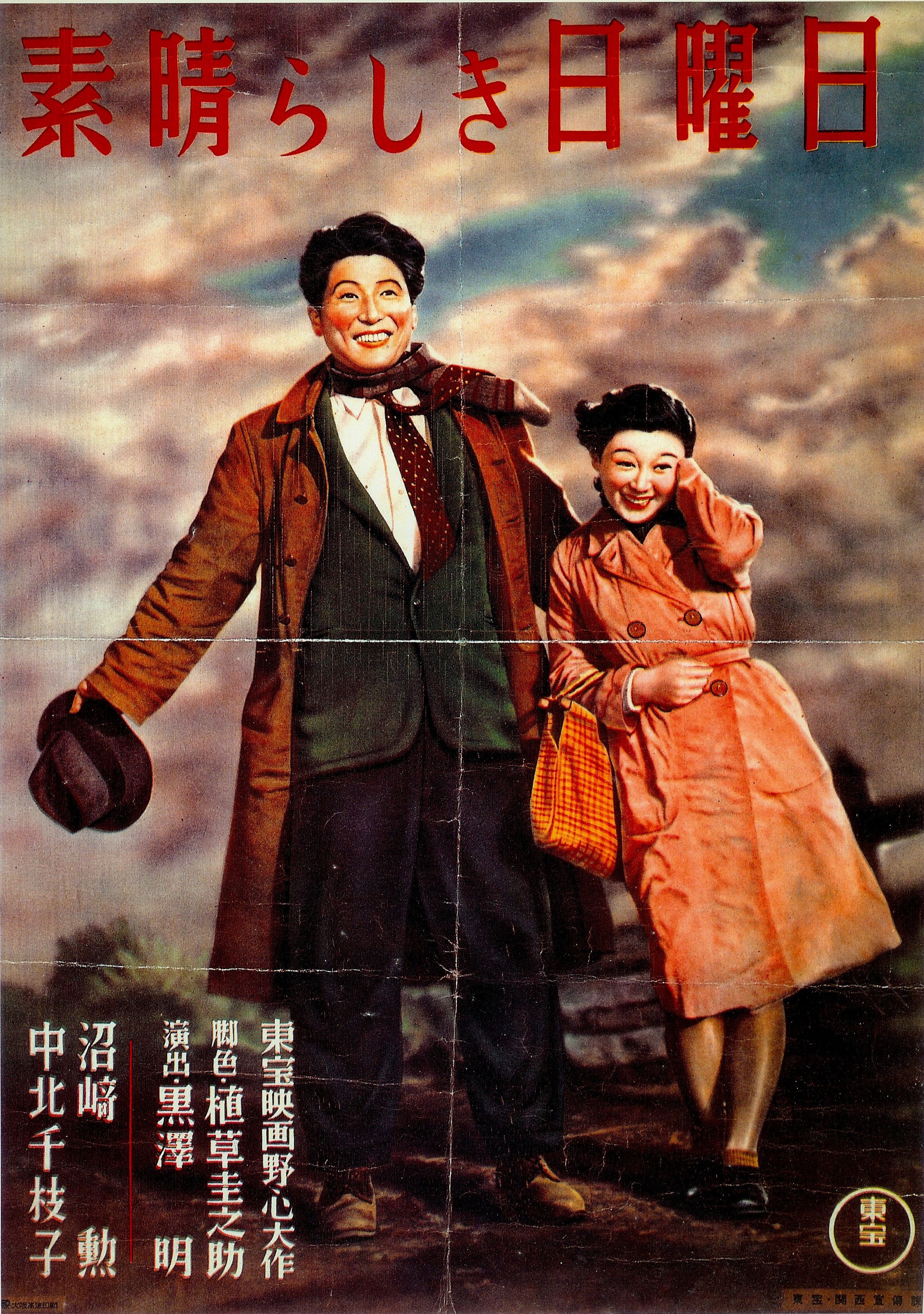
Once More (今ひとたびの, Heinosuke Gosho, 1947)

(c) 東宝

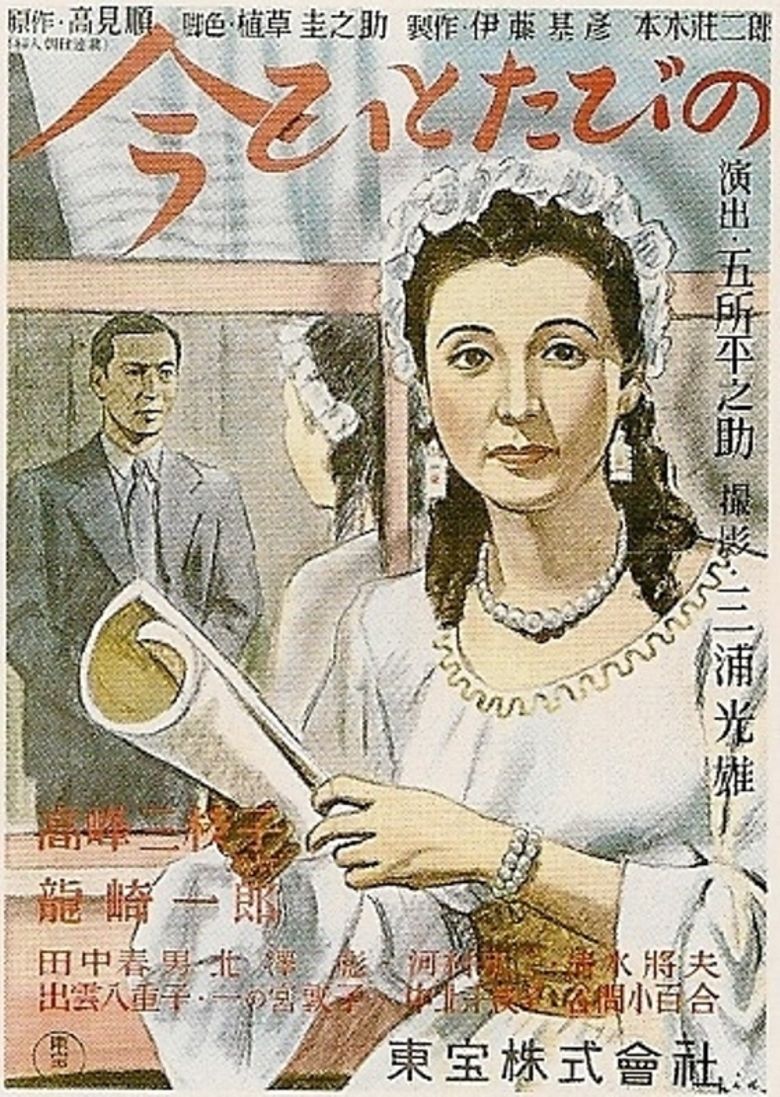
Gosho once more posterOf the Japanese golden age directors, there were few who’d “happily” gone along with the requirements of making films under a militarist regime. Heinosuke Gosho, however, must rank among the most recalcitrant in his unwavering refusal to compromise his convictions in order to preserve his career. Most of the scripts he submitted to the censor’s board were rejected in the preliminary stages though he was able to ruffle a few feathers with the few films he did manage to make if only for his skilful ability to skirt around the promised propagandistic overtones. It also “helped” that Gosho had become seriously ill with tuberculosis in 1937 which perhaps protected him from official interference and, in any case, removed him from the film industry for three years while he recovered. Nevertheless, he felt keenly that he and others had a duty and an opportunity to turn the tables in the post-war era, advancing the ideology of humanism to create a better, fairer world than the one which had descended into so much ugliness and chaos.

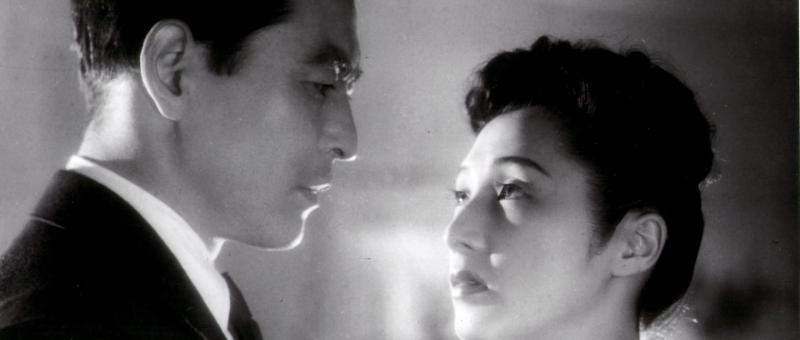
In fact one of the reasons Gosho decided to film Once More (今ひとたびの, Ima Hitotabi no) in 1947 under the American occupation was to counter the view held among some young people that there had been no active opposition to militarism. Gosho and his screenwriter Keinosuke Uekusa chose to adapt a heavily political novel by Jun Takami which painted itself as a romantic tragedy of resistance in which its leftist heroes find themselves carrying the legacy of defeat onward into the post-war world. Gosho depoliticises Takami’s tale and reconstructs it as a romantic melodrama with a more positive resolution, but is careful to preserve the fierce idealism of the conscientious students relentlessly protesting Japanese Imperialism whilst trying to advance the course of social justice in an increasingly oppressive environment.

The tale begins in 1936 as a group of students prepares to graduate. Nogami (Ichiro Ryuzaki), a doctor, has turned down a lucrative university post to minister to the poor. Unlike his friends Tanaka (Koji Kawamura) and Kambara (Hyo Kitazawa), Nogami is not an activist or left wing agitator but has a strong belief in humanistic socialism and a conviction that he has a duty to ensure his skills are available to those who need them most. Invited to a play directed by Kambara which is being performed to raise money for socialist causes, Nogami accidentally wanders into the dressing room of the leading lady – Akiko (Mieko Takamine), a wealthy socialite, and falls in love at first sight. Akiko too takes a liking to Nogami and invites him to her birthday party despite his rather odd behaviour after the play, but he finds it impossible to get on with her upperclass friends and eventually leaves. The pair advance and retreat, but their romance is frustrated by the times in which they live, politics, and their own senses of personal integrity which encourage them to willingly sacrifice their happiness in acknowledgement of living in an unhappy world.

Despite their original, electric attraction the obstacles surrounding the love of Akiko and Nogami may seem insurmountable, chief among them being the obvious class difference between the pair. Nogami, somewhat contrary to his humanistic ideals, has a mild prejudice against the bourgeoise, believing them to be selfish, unfeeling, and existing in their own bubble hermetically sealed away from the kind of suffering he sees everyday at the clinic. Yet he cannot forget Akiko who harbours no prejudice towards him because of his humble origins (though her friends and family make no secret of theirs) and feels similarly about her own social class, overcome with guilt that she lives in such comfort while others suffer. Eventually Akiko joins the cause, becoming a left-wing agitator and even getting herself arrested and branded a “Red Lady” in the papers (further annoying her very confused social circle). Unlike Nogami she is also subject to a kind of social and gender based oppression in which she is under constant pressure to marry her longstanding fiancé, Sakon (Haruo Tanaka), and conform to the requirements of her position. Nogami is “free” to choose to live a life of selfless altruism in a way that Akiko is not and will struggle to be throughout the rest of the picture.

Yet time and again it is the times which frustrate their romance. Akiko and Nogami repeatedly make plans to meet, but one of them is arrested and prevented from arriving leaving the other assuming the worst – that they have been abandoned, romantically and ideologically. Matters aren’t helped by Nogami’s natural diffidence and awkwardness coupled with his rigid code of honour which makes it impossible for him to pursue Akiko in any normal way, leaving her confused and later at the mercy of her controlling family. In the end it is their own senses of personal integrity which prevent their union, as a friend bound for the front points out when he, essentially, tells them to get over themselves and embrace happiness rather than overthinking an emotional response and ruining it in the process.

As much as Gosho’s central tenet could be boiled down to “don’t think, feel”, he does argue for compassionate rationality and considered fairness and understanding between people. Thus he removes the Marxist overtones from the original novel because his conflicts aren’t “political” but between justice and injustice; he simply sees unfairness and opposes it, placing his faith in the absolute truth of positive emotion and human connection to eradicate the false barriers of rational civility and irrational oppression. For Gosho, love wins, every time.