Young Black Jack (ヤング ブラック・ジャック, Kentaro Otani, 2011)

The Black Jack of Osamu Tezuka’s classic manga is a morally ambiguous figure who cultivates an image of callousness through asking for exorbitant sums to cure often desperate people, but in reality will usually treat seriously ill patients if touched by their plight or is content to collect the money from another source ensuring a kind of social justice is done. A spin-off manga written by Yoshiaki Tabata and illustrated by Yugo Okuma, Young Black Jack (ヤング ブラック・ジャック), was published from 2011 to 2019 and was set in the 1960s when Black Jack was gifted young medical student living through a politically turbulent era. 

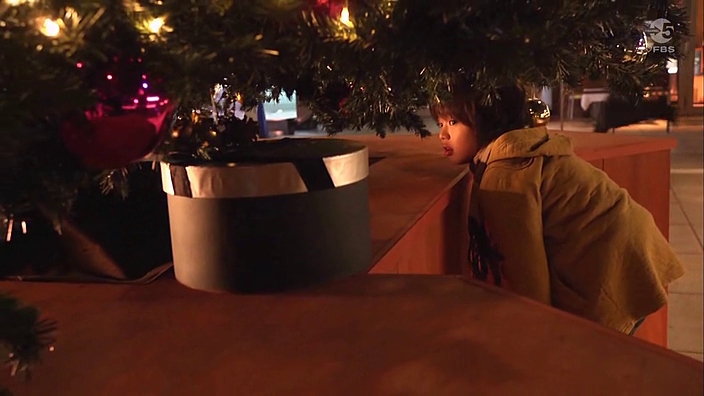
Broadcast in 2011, this television special meanwhile updates the action to the present day while acting as a kind of double origin story if one set in a more realistic world. As a nine-year-old boy, Black Jack asks his mother to meet him by the Christmas display in a local shopping mall. Not having had enough money to buy his mother a red rose, he patiently sits and draws one under the tree while otherwise oblivious to the news being broadcast on a large screen explaining that there has been a series of bombings in the city and the next target is this very mall. Black Jack’s mother has become mute after a traumatic incident but tries to call out to him only for the pair to be caught in the blast. Touched by their story, the genius doctor Honma (Masachika Ichimura) manages to save Black Jack by transplanting his organs and giving him a skin graft while his mother remains in a coma.

The story then jumps to the present day with Black Jack (Masaki Okada) a medical student with an underground lair where he keeps his comatose mother (who hasn’t aged at all in 15 years) and operates as a backstreet doctor treating undocumented migrants and yakuza. Aside from emphasising his contradictory nature as someone who both treats anyone who requires treatment no matter of their social status yet simultaneously demands incredible sums of money for doing so, associating with these kinds of people also places Black Jack among the lower ranks of society which is something that niggles at snooty doctor Naoki (Yukiyoshi Ozawa). Naoki is sort of betrothed to Yuna (Riisa Naka), the daughter of the chief doctor at a prestigious university hospital who is herself in the middle of taking her final exams to become a doctor. 

Familiar to fans of the manga, Naoki is Black Jack’s opposite number. As he tells Yuna, there are two kinds of doctors. Those who save lives and those who kill. In the manga, Naoki was a doctor traumatised by his wartime experiences who often wants to euthanise the patients that Black Jack is trying to save believing that there is no way to save them. Having encountered Black Jack cooly saving a patient who collapsed in the street, Yuna asks Naoki what he thinks makes a good doctor and he tells her it’s the belief that medical science has no limits and the doctor is omnipotent. Yet he later says just the opposite, telling Yuna that she is being childish and of course there are limits to what medical science can achieve so in effect he’s giving up. Black Jack meanwhile does believe in his own omnipotence, even if that’s not always such a good thing, and is confident he can save any patient even if in the end he cannot save the one most close to him (perhaps because she wanted him to stop trying). 

The film does not however go into very much detail and only gives brief snippets of backstory such as Black Jack’s mother going mute after a shadowy man enters and leaves their home while hinting at potential future stories in his opposition to Naoki who objects to him partly out of snobbishness, and a potential romance with Yuna who has now shifted away from the elitism that coloured her family towards a more altruistic kind of medicine represented by Black Jack even in his aloofness. Nevertheless, the film makes no real attempt to transcend its origins as a television movie, not that it has to, and is hampered by an uninspired script and low production values which contribute to its relatively more naturalistic setting yet sit awkwardly with the more outlandish parts of the narrative such as Black Jack’s keeping his mother in cryogenic status for 15 years or being able to transplant all of someone’s organs at once and in under 10 minutes. Still, as a minor outing for the iconic character it’s entertaining enough for fans of the franchise. 


Gold Kingdom and Water Kingdom (金の国 水の国, Kotono Watanabe, 2022)

After centuries of conflict, two feuding countries finally begin to put the past behind them to work for a common future in Kotono Watanabe’s animated fantasy romance, Gold Kingdom and Water Kingdom (金の国 水の国, Kin no Kuni Mizu no Kuni). Adapted from the manga by Nao Iwamoto, this is very much a story of coming together to create a better future for all in which it’s always better to follow the most difficult path if it leads to longterm peace rather than opting for a quick fix like a dynastic marriage that won’t take place for another fifty years. 

In this case, the dynastic marriage actually works out but only because romantic heroes Sara (Minami Hamabe) and Naranbayar (Kento Kaku) end up meeting by chance and falling in love organically despite the class disparity and cultural differences between them. The kingdoms of Alhamit and Balkari had been feuding in part for the petty reasons of a dog and cat respectively doing their business on the wrong side of the border wall erected after previous war. Neither nation being very much interested in the dynastic marriage proposed by the previous generation in which Alhamit would give its most beautiful woman as a wife to Balkari’s cleverest man, Alhamit sent a cat instead while Balkari sent a dog. Poor Balkari engineer Naranbayar simply laughed off his new “bride” while Princess Sara of Alhamit decided to go along with the ruse knowing that to kick up a fuss would likely send both nations back to war. 

They happen to meet when Sara transgressively ventures beyond the wall in search of her dog, Lukman, who has fallen in a hole in the forest. With her pretty sisters needling her, Sara asks Naranbayar to pretend to be her new husband, little realising that he is the man she is intended to marry. The youngest of four sisters, Sara has always felt inferior and fears that she cannot live up to the title of Alhamit’s most beautiful woman but begins to fall for Naranbayar who is in fact very clever but also kind in the way most of her family aren’t. Naranbayar genuinely cares about the people of Alhamit and quickly works out that in this incredibly wealthy, “golden” desert city they will run out of water within 50 years while water is something the poor nation of Balkari has in abundance. 

An alliance will save the lives of people in Alhamit, but also also benefit those of Balkari in boosting its economy but not everyone is motivated towards a diplomatic solution with many in the court clearly agitating for war in which they would simply conquer Balkari to capture its resources. The King is under pressure in thinking of his historical legacy, not wanting to be seen as a weak monarch as his namesake earlier was in having restored with relations with Balkari rather than seeking to dominate it militarily. Under the sway of potentially corrupt shaman Piripappa (Chafurin) he rules with an authoritarian fist, while his haughty daughter Leopoldine (Keiko Toda) has appointed a handsome actor as an advisor to signal her opposition. 

Only through the genuine love which emerges between Sara and Naranbayar can the country be saved in turning away from pointless acrimony towards a more open future marked by mutual cooperation and friendship between two equal nations. Through falling in love with Naranbayar, Sara grows in confidence and learns to see herself as beautiful no longer inferior to her sisters but playing a full part in the life of the court as they work together to solve the water issue and return life to their arid land. Beautifully designed with its Middle-Eastern aesthetics and strong contrast between the desert kingdom of Alhamit and the beautiful forests of Balkari, the film also features charming paper art bookends and a watercolour credits sequence depicting a happier future for both nations as they forge a new society together. Heartfelt in its central romance, Watanabe’s charming love story positions cross cultural connection as the best means of overcoming centuries of pointless conflict along with allowing each of its heroes to become more of themselves as they work together to create a new world of love and peace in which all can prosper and live in happy harmony. 


Gold Kingdom and Water Kingdom screened as part of this year’s Nippon Connection.

International trailer (English subtitles)

From Today, It’s My Turn!! (今日から俺は!! 劇場版, Yuichi Fukuda, 2020)

The high school fighting manga has long been a genre mainstay but perhaps hit peak popularity in terms of the big and small screen during the Bubble era with such well known hits as Sukeban Deka and Beb-Bop High School. More recent treatments have frequently bought into the genre’s inherent absurdity such as the contemplative and melancholy Blue Spring, or the anarchic Crows Zero series helmed by Takashi Miike to which Blue Spring’s Toshiaki Toyoda later added a sequel. Which is all to say, that a genre so deliberately puffed up and obsessed with macho posturing is near impossible to parody. Leave it Yuichi Fukuda to try with the retro nostalgia fest From Today, It’s My Turn!! (今日から俺は!! 劇場版, Kyo kara ore wa! Gekijoban), a theatrical sequel to the TV drama series adapted from the manga by Hiroyuki Nishimori. 

Set in the genre’s heyday of the 1980s, the action takes place in a small town in Chiba with an improbably large number of high schools. Nerdy high schooler Satoru (Yuki Izumisawa) floats the idea of transferring somewhere else, fed up with all the delinquents at his school disrupting his studies with their constant violence but then it seems like everywhere else is the same. The big problem is that their two top guys have recently been deposed during a conflict with rival school Nanyo leaving a power vacuum while their school is temporarily merging with Hokunei from the next town over seeing as they’ve already burnt their school building down. 

While many high school fighting manga focus on the hierarchy within one particular institution, From Today, It’s My Turn!! is much more concerned with the battle between rival schools even if some of the more antagonistic fighters are in fact secretly friends. The first fight that breaks out is between bleach blond Mitsuhashi (Kento Kaku) and blue-suited Imai (Taiga Nakano) over a juice carton he bought for Mitsuhashi’s aikido-trained girlfriend Riko (Nana Seino) which Mitsuhashi sees as an affront to his masculinity, though in truth the two guys seem to get along well enough in the long run. Most of this fighting is in essence performative posturing, something made plain by the unexpected cowardice of supposed top guy Mitsuhashi who it turns out frequently runs away when challenged even relying on Riko to get him out of trouble. 

Though there are female gangs and female lone fighters, this is largely a male affair as the women, excepting Satoru’s cousin Ryoko (Maika Yamamoto), are expected to perform their femininity as the boys perform their masculinity through fighting. The supposedly evil head of the girl gang from Seiran High, Kyoko (Kanna Hashimoto), turns into a walking embodiment of kawaii when encountering crush Ito (Kentaro Ito) who begins acting in an equally lovey-dovey fashion, but breaks right back into her delinquent tough girl persona as soon as he’s off the scene. Aikido expert Riko meanwhile is largely reduced to trying to keep Mitsuhashi out of trouble while adopting an air of nice girl refinement. Only Ryoko who determines to take revenge on behalf of the bullied Satoru with the aid of a bamboo sword is allowed to stay firmly within the confines of the sukeban

Nevertheless, despite their treatment of each other most of the gang members can’t abide bullying which is why they eventually turn on Hokunei realising that they’re the sort of guys that befriend vulnerable people only to betray them later. Yet like Mitsuhashi, Hokunei boss Yanagi (Yuya Yagira) is also an under-confident coward so insecure in his fighting prowess that he has to cheat by taping throwing knives to the inside of his blazer. Legitimate authority is it seems largely absent, parents either unseen or oblivious while the teachers are unable to offer much in the way of help, wandering round the town with a toy police car and a loudspeaker trying to fool the guys into dispersing. 

Fukuda’s brand of humour is nothing if not idiosyncratic and largely inspired by TV variety show sketch comedy which explains the random nature of many of the gags along with the absurdist manga to the max production design. He further amps up the incongruity by casting prominent actors clearly far too old for high school and then saddling them with ridiculous costumes to the extent that Taiga Nakano looks oddly like Frankenstein’s monster with his too broad shoulders and overly bouffant quiff. While action choreography leaves much to be desired, fans of Fukuda’s previous work will most likely have a ball though others it has to be said may struggle. 


From Today, It’s My Turn!! streamed as part of this year’s New York Asian Film Festival.

Original trailer (no subtitles)

Psychic Kusuo (斉木楠雄のΨ難, Yuichi Fukuda, 2017)

psychic kusuo posterMany may bristle at an attempt to label director Yuichi Fukuda an auteur, but you can’t argue with the fact that he’s developed something of a house style. That house style may have just catapulted him to the top of the box office with two successful movies inspired by the gag filled Gintama, but outside of his big budget studio efforts he’s something of an acquired taste. Take Hentai Kamen, for example. For some a hilariously perverse super hero adventure comedy. For others one childish joke stretched out for 90 minutes. Psychic Kusuo (斉木楠雄のΨ難, Saiki Kusuo no Sainan), coming from the same general area as the phenomenally successful Gintama in adapting an absurdist gag manga only this time one by Shuichi Aso, undoubtedly belongs in the latter category.

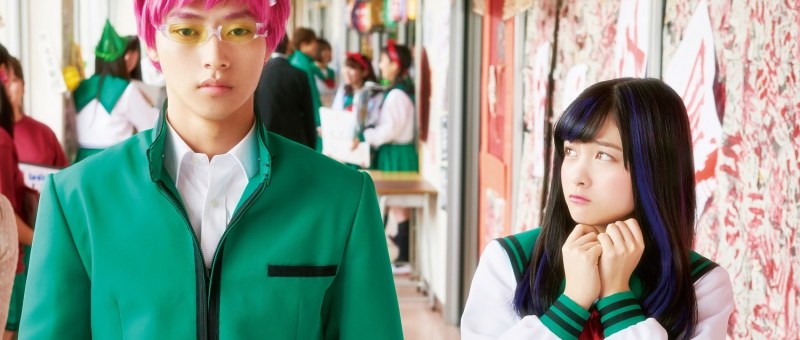
16-year-old Kusuo Saiki (Kento Yamazaki) is the most powerful esper on Earth. Seeing as he was born to a lovely, hippyish couple who didn’t mind that he was a bit strange, Saiki grew up appreciating his superpowers for what they are but also mindful that they could cause him a problem if they got out of hand. He uses his powers to hypnotise those around him so that they don’t notice his neon pink hair or the antennas in his head which keep his emotions in check and prevent him accidentally destroying all of Tokyo. Nevertheless, it is quite a bother to be burdened by unnatural abilities especially in that it makes life extremely dull not to mention a little stressful when you can hear everything everyone is thinking in every tiny detail.

The big problem is that Saiki is coming up on his first high school culture festival. Saiki is not big into celebrations and hanging out with other people so what he likes about festivals is that no one’s going to miss him so he can escape for a little me time. The last few festivals, however, have each descended into chaos and if it happens again this year they’re going to be cancelled for good. In order to save his precious haven of relaxation, Saiki will have to forgo it this time to make sure no one starts any trouble.

Fukuda began his career writing skits for TV variety shows and the humour in his films is indeed very specific and of the kind familiar to fans of Japanese television comedy, which is to say it is extremely broad and somewhat meta with frequent breaking of the fourth wall. The major antagonist of Psychic Kusuo is conceited high school classmate Kokomi (Kanna Hashimoto) who is accounted by all as the school’s number one beauty and knows it. As he’s able to read minds, Saiki knows she’s in no way as pretty on the inside and makes a point of ignoring her. Of course, this only ends up attracting her attention because she’s incapable of accepting that there’s a boy who doesn’t instantly sigh on catching sight of her. In keeping with Fukuda’s over the top approach, Kokomi becomes little more than a collection of preening looks alternating between calculated cuteness and outright bunny boiler villainy.

Meanwhile, Fukuda throws in a series of in jokes and random references to other franchises from Assassination Classroom to Dragon Ball, piling absurdity on top of absurdity through a series of possible crises as yankees from another school threaten to cause a ruckus and the Dark Reunion turn up to prosecute their conspiracy on school grounds. Meanwhile a creepy stage magician and his surprisingly sprightly mother/assistant take credit for all the strange goings on and Saiki accidentally ends up marooned in space.

Yet the problem is that it just isn’t very funny or particularly interesting. It comes to something when the most entertaining part of the movie is Saiki’s extremely nice parents and their unflappable acceptance of the strange goings on which often befall their family. Over reliant on reaction shots and schoolyard humour, Psychic Kusuo may play well to Fukuda’s many fans, those familiar with the anime or manga, and lovers of TV variety skits but anyone else may find themselves scratching their heads at its decidedly lowbrow, scattershot attempt at humour and longing for an end to its considerably dubious charms.


Original trailer (no subtitles)

https://www.youtube.com/watch?v=UApe_k1Db_A

700 Days of Battle: Us vs. the Police (ぼくたちと駐在さんの700日戦争, Renpei Tsukamoto, 2008)

700days-of-battleThose golden last few summers of high school have provided ample material for countless nostalgia filled Japanese comedies and 700 Days of Battle: Us vs. the Police (ぼくたちと駐在さんの700日戦争, Bokutachi to Chuzai-san no 700 Nichi Senso) is no exception. Set in a small rural town in 1979, this is an innocent story of bored teenagers letting off steam in an age before mass communications ruined everyone’s fun.

In the summer of 1979, a group of teenage high school students get their kicks pulling pranks around the neighbourhood. They finally meet their match when a new policeman, Chuzai (Kuranosuke Sasaki), arrives in town intent on actually enforcing the law. When one of the boys is fined for speeding after coming down a steep hill on his bicycle, the guys decide to make Chuzai their new enemy, virtually daring him to arrest them with their constant trolling.

However, things take a turn when the boys move their prank planning meetings to a local cafe and discover the beautiful waitress working there, Kanako (Kumiko Aso). Instantly smitten the boys step up their romance game (donning some fancy outfits in the process) and semi-forget about their mission. Unfortunately Kanako is a married woman and worse than that she’s married to Chuzai! This whole thing just got real.

Chuzai, for all his uptight authoritarianism is onto the boys and their generally innocent mischief. Finding it all very irritating rather than actually dangerous, Chuzai gradually starts playing them at their own game by attempting to prank them back such as in one notable incident where he makes them attend a public behaviour seminar but gives the entire lecture through a ventriloquist’s dummy called Taru-kun. As a slightly older man, Chuzai can see the boys are just hopelessly bored in their backwater town. Breaking with his hitherto austere persona, Chuzai drops the authoritarian line to offer some fatherly advice to the effect that these summers are precious times,  soon the boys’ high school lives will be over and they’ll most likely leave their pleasant small town for the bustling metropolis of Tokyo so they’d better make the most of these aimless days while they can.

Idyllic as it is, the nature of the boys’ mission changes in the second half as the war against Chuzai takes on a slightly more affectionate quality. At this point they decide to use their pranking powers for good to help a little girl who’s stuck in the hospital finally enjoy the summer fireworks she’s been longing for even though the doctors won’t let her out to go to the festival. With the fireworks heist hovering in the background the guys get into various romanctic difficulties while enjoying archetypal teenage summer adventures.

Infused with period detail, 700 Days of Battle: Us vs. the Police has an authentically ‘70s soundtrack with some of the biggest hits of the era running in the background. Frequent cultural references such as a brief appearance from Ultraman add to the atmosphere which has a kind of retro, nostalgic innocence behind it as these kids live in a golden era of friendship and bike riding when the sun is always shining and graduation is still a long way off.

Director Tsukamoto keeps things simple though the production values are high and visual gags are spot on. Somewhat episodic in nature, the tale is split up into various chapters by means of title cards which helps to break up the seemingly endless summer as the boys attempt to fill their otherwise empty days. Apparently this was only the beginning of the “war” against the police, occupying only 108 days of a “conflict” which would finally run to 700. Presumably the guys have finished up their high school days by that point but at least they’ve succeeded in making some amusing memories of their elaborate and sometimes fiendishly clever schemes to take revenge on the surprisingly patient Chuzai-san. Filled with innocent, witty and whimsical comedy 700 Days of Battle: Us vs. the Police offers no great leap forward even within the realm of quirky teen comedies but still manages to provide some old fashioned, wholesome summer themed fun.


Original trailer (English subtitles)