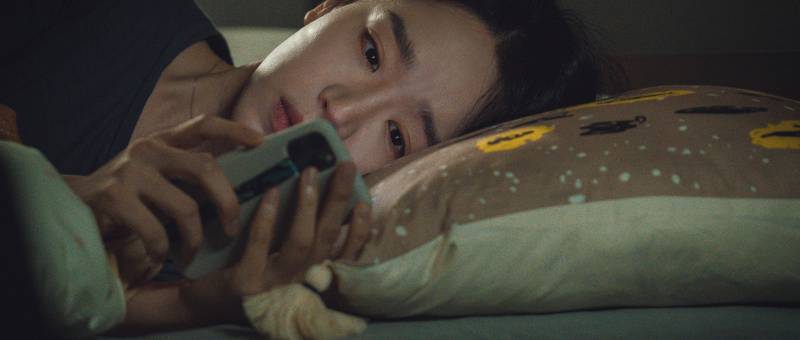

“Why do you always overreact?” a petulant craftsman eventually asks Soo-hyun, though Soo-hyun hasn’t overreacted so much as dared to assert herself in a world that often doesn’t listen to women. The irony at the centre of Park Hee-kon’s cybercrime thriller Don’t Buy the Seller (타겟, Target) is that it seemingly all unfolds because of a faulty washing machine, but like similarly themed films such as Door Lock, it soon becomes clear that Soo-hyun (Shin Hye-sun) isn’t really safe anywhere and there’s nothing this world objects to more than a woman who answers back.
In any case, it’s clear that Soo-hyun is not safe at work as her relentlessly creepy boss (Im Chul-soo) continues to sexually harass her while telling her off for taking things too personally when she finally complains. All he ever seems to do is yell at her for failing to enact his ludicrous demands while the guys at the construction site obviously don’t pay attention to her even though she’s the one managing this project. “Think he wants to work after being yelled at by a young lady?” one of the guys asks when one of the others doesn’t show up for his shift though Soo-hyun hadn’t actually yelled at him so much as asked him to please do his job and follow her instructions rather than ignore her in favour of his own judgement.
She encounters a similar dismissiveness at the police station where she’s initially fobbed off as just another silly woman despite the younger policeman’s more sympathetic attempts to address her complaints even as his colleague leans over and explains there’s a four month backlog of fraud cases and they won’t even start to look for the guy who scammed her until then. Maybe he has a point, there are lots of victims of crime, but that only means they have lost the ability to enforce the law because the scammers know the police won’t catch them until they’re among the small number of unlucky criminals they do manage to get a lock on. Realising the police won’t help her, Soo-hyun vents her anger by tracking down the scammer on the reselling platform she tried to buy a washing machine from and leaving warnings not to buy on all his listings. Of course, this earns the stalker’s wrath because he too is another man who doesn’t like it when a woman answers back.
But Soo-hyun has bitten off more than she can chew. This guy is seriously dangerous and into way more than just scamming people online by selling them broken appliances. We can see he has some kind of cyber lair and offers similar services to other men in which he agrees to provide a woman’s phone number, passwords, social media accounts and social security details to any man that wants them, for the right price. If he wants porn or videos posted, that’s extra. But it’s clear that a man with money can ruin a woman who says no with relative ease. Deep into his campaign, the stalker offers Soo-hyun the opportunity to end all this by paying him a large amount of money though as Soo-hyun knows there’s no guarantee he’ll keep his promise. Still after months of terror and constant harassment, she’s on the brink of giving in.
In this way, the stalker becomes an avatar of patriarchal male violence that slaps Soo-hyun right down in her place. She begins to feel insecure in the domestic environment as the stalker sends her nuisance deliveries of fast food at all hours of the day and night along with strange men who’ve been told to visit her for a good time and have evidently been given the code for the door lock. She’d only moved in here a week ago and moving out will incur a financial penalty she’s not well equipped to pay having been scammed in the first place. But the police seemingly can’t do anything while Soo-hyun is plagued by a sense of threat and unease that this person has so much control over her life and could turn up to cause her harm at any moment. Suddenly, she’s not a woman who answers back anymore but a timid and nervous zombie who can barely speak at all.
Of course, this is exactly what the stalker wanted and what many of the men around Soo-hyun want too. They tell her to stop overreacting or that she brought this on herself by goading the scammer. They imply that she’s made herself an easy target by living alone and that buying goods second hand through apps which involve any kind of personal handover is inherently dangerous, but really they mean that like her friend Dal-ja (Lee Joo-young) she should have got married, chalked up getting scammed to experience, and above all kept quiet about it. Which is to say let her sleazy boss get away with making her feel uncomfortable as a kind of appeasement rather than challenge his behaviour or remind him that he does not have the right to make her feel this way, to abuse his position to interfere with her career, or otherwise oppress her. The message is, you don’t have to buy what they’re selling, faulty goods are after all not worth all this hassle.
International trailer (English subtitles)


 Windows on Worlds