The Target (표적, Chang, 2014)

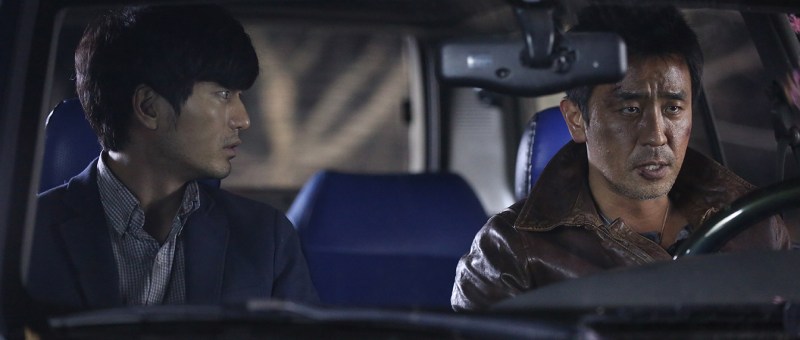
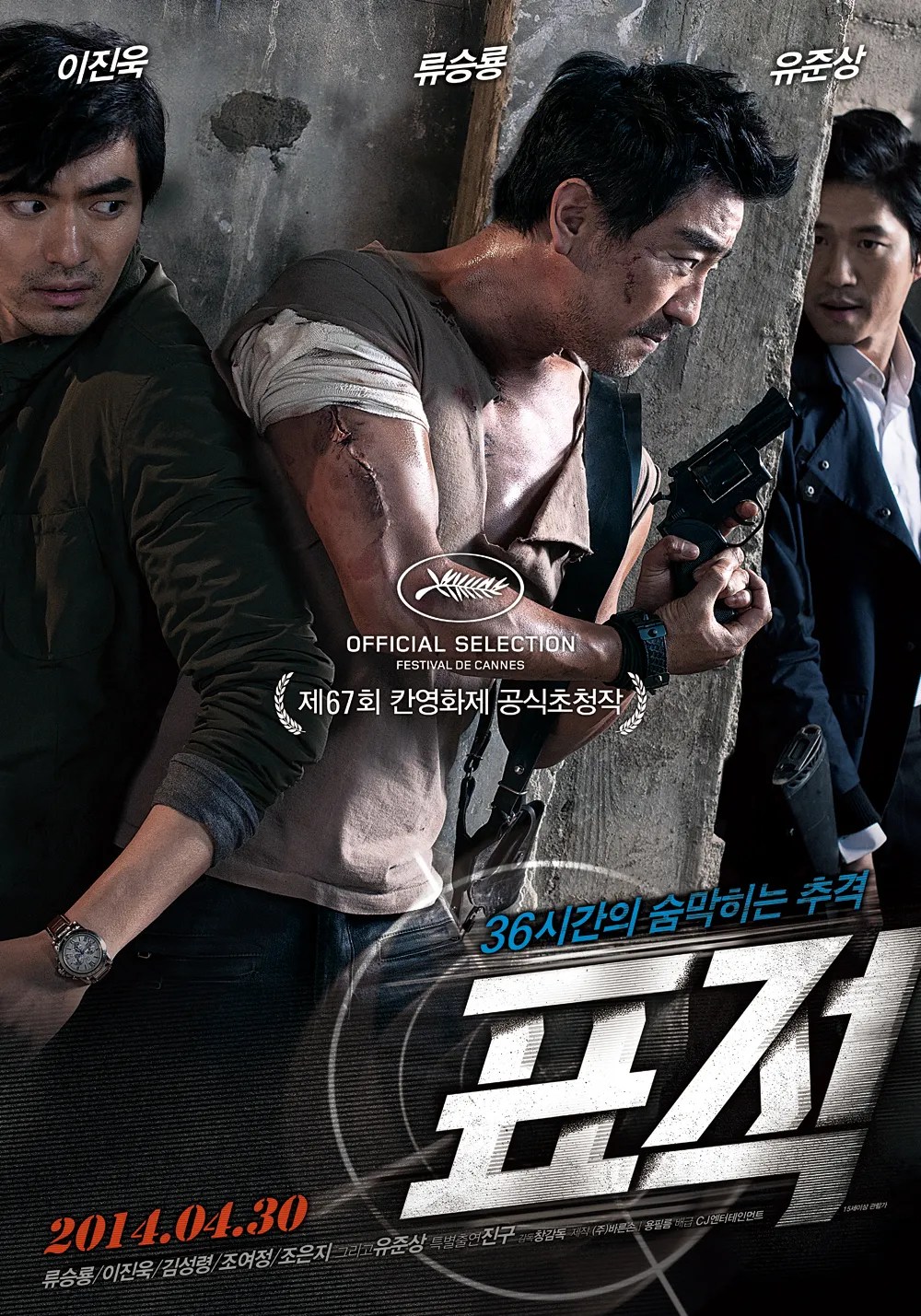
A doctor finds himself dragged into conspiracy after saving the life of a man framed for murder in Chang’s South Korean remake of the French action thriller Point Blank (표적, Pyojeok). Despite having seen off an assassin, Tae-jun (Lee Jin-wook) doesn’t take too long wrestling with his medical ethics when his pregnant wife is kidnapped and immediately decides to give up his patient to whoever is looking for him, but just like the bad guys, he’s picked the wrong man to mess with because Yeo-hoon is a former mercenary with nothing but revenge on his mind.

Tae-jun’s determination does however make it clear the extent to which people are prepared to compromise their morals when something important to them is threatened. The person that kidnapped his wife thought he no choice either and is only trying to protect someone close to him. They are all at the mercy of a corrupt system. It turns out that Yeo-hoon has been framed for murdering a businessman who manipulated the market to buy an apartment building at a cheaper price, but his partner would rather have all the money for himself so decided to knock him off. Corrupt police officer Song (Yoo Jun-sang) has been running a side business as a hitman aided by his team of equally compromised subordinates and decided that Yeo-hoon’s brother, who has learning difficulties, would make a good fall guy because they assumed he was an orphan with no family to go asking questions. What they didn’t bargain for was dealing with a ruthless and highly trained opponent like Yeo-hoon.

Tae-jun didn’t really bargain on that either and is originally unsure how far he can trust Yeo-hoon (Ryu Seung-ryong) though technically, they’re on the same side. The loyal police officers have the same issue, resentful of Song because he’s pinched their case rather than realising he’s only done so to cover up his own corruption. Nevertheless, like Tae-jun and Yeo-hoon, policewoman Soo-jin (Jo Eun-ji) is also after revenge for the loss of someone close to her. In truth, her tearful distress and inability to dispose of female superior’s belongings hints at a deeper connection than simple loyalty to her fallen comrade. Her need for revenge is as hot as Yeo-hoon’s, though she too originally believes Song’s version of events and is only motivated to look deeper precisely because it matters to her how her friend died.

There is then a theme of frustrated familial reunions that runs under that of the overriding corruption that surrounds them. Yeo-hoon returned home to reunite with his brother but is too late to stop him being drawn into Song’s web, while Soo-jin wants vengeance for her friend, and Tae-jun to save his wife and unborn child. Though not everything can be repaired, there is a final restoration of the family in the closing scenes in which Yeo-hoon is reunited with his dog and is symbolically adopted as a brother to Tae-jun and a new member of his family. To that extent, the film suggests that familial bonds are the ultimate defence and rebellion against the corruption of men like Song whom, one of his subordinate says, would even sell his parents for money.

Nevertheless, the real focus is propulsive action and Chang keeps the tension high as Ryu Seung-ryong shows off his skills as an action with several high-octane hand-to-hand combat scenes, along with shootouts and explosions even before the police station finale in which Yeo-hoon must attack the very structure of law enforcement to clear out its inherent corruption. Tae-jun, meanwhile, is more of a hapless stooge left with little other choice than to follow along behind Yeo-hoon while trying to weaponise the righteousness of the good police officers to locate and rescue his wife before the bad guys can take care of what they see as a loose end. For her part, Hee-joo (Cho Yeo-jeong) is mostly reduced to a damsel in distress, but at the same time in her role as a psychologist and is able to extend sympathy to Sang-hoon helping him see the error of his ways and further emphasising the film’s familial themes. Though incomplete, justice of a kind at least is served in the exposure of the corruption and the final moment of healing which exists outside the system in the reinforcing of the simple bonds between people.


Trailer (English subtitles)

The Call (콜, Lee Chung-hyun, 2020)

The call is coming from inside the house. It’s a final revelation intended to chill, the idea that the source of threat is located in the very place where you ought to feel safe, protected, invulnerable. Of course, there are many reasons someone might not feel completely safe at home, those who perhaps live with hidden threat every day, a hidden darkness that lies at the centre of twisty Korean thriller The Call (콜). Another in a small series of time travelling communication, The Call makes connection through outdated technology, an almost literal ghosting in a voice from the past that, like an inverted Strangers on a Train, offers the tantalising promise of mutual salvation only to prove extremely unreliable. 

28-year-old Seo-yeon (Park Shin-hye) has just returned to her rundown country home because her mother, whom she intensely resents blaming her for the death of her father in a fire, is suffering with a brain tumour. Though her strawberry farmer uncle Sung-ho (Oh Jung-se) describes the place as the most desirable property in town, the home in which Seo-yeon finds herself is cold and austere, a creepy old mansion decorated in an outdated style and filled with gothic furniture. To make matters worse, Seo-yeon has left her phone on the train but unexpectedly assures Sung-ho that she’ll be fine with the landline, later calling herself and getting through to a woman who claims to have found it but asks for a reward and then hangs up presumably to assess her options. Then, the landline starts ringing with calls from a young woman trying to reach a friend and claiming that her mother is planning to set fire to her. Though obviously disturbing, Seo-yeon assumes the calls are a simple wrong number until she discovers a hidden room with what looks to be some sort of tiled experimentation area along with a box of memorabilia which lead her to think the phone is somehow connecting her to the girl who lived in her room at the turn of the millennium. 

Also 28 only born 20 years earlier, Young-sook (Jeon Jong-seo) claims to be at the mercy of a wicked shamaness step-mother convinced that she has a dark destiny. The two women engage in a strange act of intergenerational bonding between two people who are the same age, Seo-yeon mystified by the meaning of the word “Walkman” while Seo-yeon struggles with the concept of the multifunctional smartphone. The force which unites them is parental dissatisfaction as Seo-yeon claims a hatred for her mother she does not perhaps really feel and cannot in any case compare with that of Young-sook for the religiously abusive stepmother who fully believes she is possessed by the devil. In in this the time difference proves useful, Seo-yeon realising that Young-sook has the power to prevent her father’s death, but only latterly that she also even from the future has the ability to change her new friend’s fate. 

Essentilally a Strangers on a Train scenario, the two women agree to save each other, Young-sook dutifully restoring Seo-yeon’s imagined fairytale future, the creepy mansion transformed into an elegant modern dwelling, her mother and father now both healthy and happy. Seo-yeon, however, begins to neglect her promise, too busy enjoying her repaired family life to remember that Young-sook is imprisoned in the house suffering horrifying abuse. Young-sook is, in a sense, the embodiment of Seo-yeon’s familial trauma, the violent resurfacing of a long buried memory that threatens to tear to her life apart but also has the ability to repair it in revealing the truth that allows her to reconnect with her mother who, we learn, has repeatedly sacrificed herself for her daughter’s sake. Nevertheless, you begin to wonder if the shamaness had a point and the lid was best left on Young-sook as her hurt and resentment in being neglected by her new friend eventually take a turn for the dark. 

In essence, Seo-yeon’s decision to interfere with the past engineers a chain of disastrous events robbing her of her illusionary happiness while eventually landing her right back where she started if perhaps with a little more insight and having healed her relationship with her mother. Part tale of millennial anxiety, part gothic nightmare, The Call may not always be internally consistent but charts a dark tale of trauma and response as a haunted young woman finds herself stalked by the psychopathic embodiment of her buried guilt only to discover that a call from the past is always hard to ignore. 


Original trailer (English subtitles)

Believer (독전, Lee Hae-young, 2018)

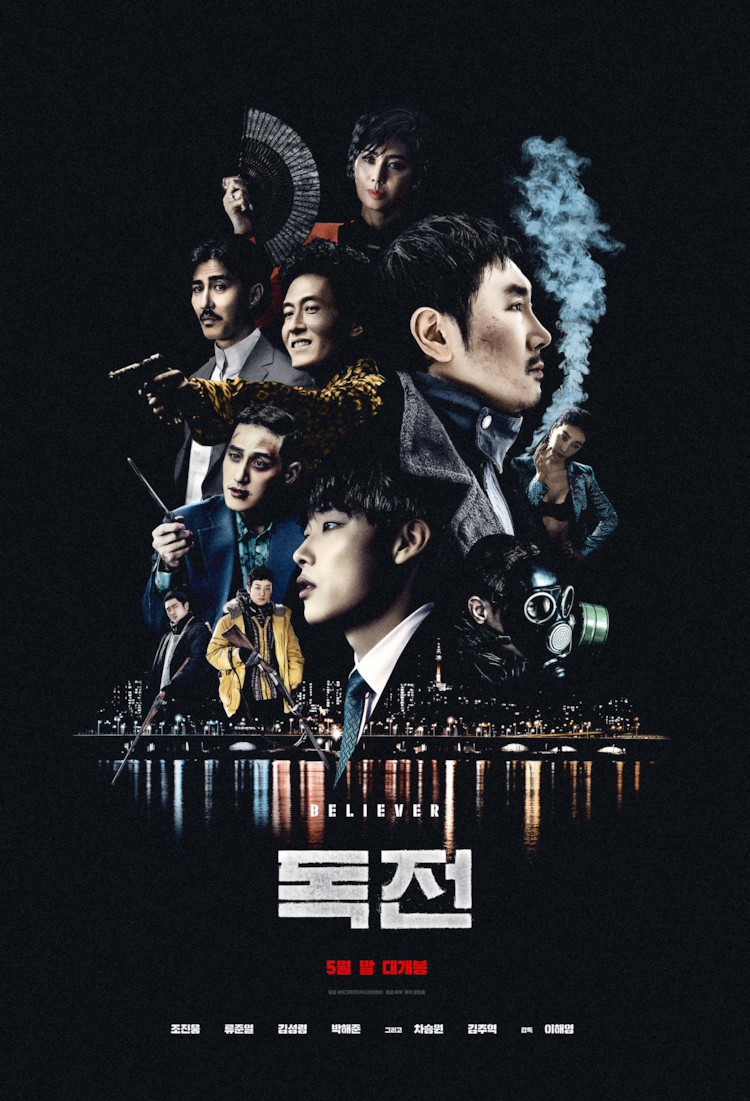
Believer posterJohnnie To’s darkly comical tale of a weaselly meth cook with an extremely strong survival instinct and the austere policeman who can’t resist taking his bait might seem perfectly primed for a Korean remake in its innate pessimism and awkward bromance. Lee Hae-young’s Believer (독전, Dokjeon), however, merely borrows the bones of To’s Drug War while doubling down on its central conceit as reckless obsession leads to the undoing of both our heroes, each forced to confront the futility of their respective, mutually dependent quests.

Obsessed with tracking down a mysterious drug lord known only as “Mr. Lee”, narcotics cop Won-ho (Cho Jin-woong) asks a favour from an old informant only to see her murdered, leaving him only a vague clue by tracing an infinity symbol on a crumpled receipt moments before passing away. Warned off the Mr. Lee case, Won-ho finally gets a lead when an explosion at a drug lab brings scorned righthand woman Oh (Kim Sung-ryung) into his office promising to spill the beans in return for protection and immunity. Sadly, Won-ho couldn’t protect her either, but there was another unexpected survivor in the form of low level middleman Rak (Ryu Jun-yeol).

Traumatised by the death of his mother in the same explosion, Rak initially says nothing under interrogation but suddenly wakes up on learning that the lab’s dog also survived and has been rescued by the police. Unlike the “hero” of To’s film, Rak is small fry (if well connected) and is not looking at anything more than significant prison time. Rak may not be fighting for his life but he has a number of reasons for switching sides, especially once Won-ho fills him in on Mr. Lee’s backstory and long history of abrupt purges.

Despite working for the organisation, neither Oh nor Rak had ever met “Mr. Lee”. No one knows anything about them – gender, nationality, name, or location. In fact, there may not even be a Mr. Lee. Perhaps “Mr. Lee” is merely the “god” of drug dealers – an abstract idea almost given flesh but existing in a spiritual sense alone. Nevertheless, the idea of a Mr. Lee has completely captured the heart of compassionate police detective Won-ho whose all encompassing need to find him has already severely destabilised his life. After failing to protect his informant, Won-ho’s complaint against Mr. Lee is now a personal as well as professional one. Not so much out of vengeance (though there is that too), but a need to make the deaths count and his mounting losses meaningful.

Yet as another Mr. Lee contender later puts it, salvation may not be a matter of faith and if your faith has been misplaced, death may be a healing. In believing so deeply in the idea of “Mr. Lee”, Won-ho has given him form and created an idol to be worshipped through devotion. “Brian” (Cha Seung-won), a higher ranking gangster and former preacher chased out of the US for getting his congregation hooked on cocaine, has his own particular brand of faith based problems but subscribes to much the same philosophy. He may really be Mr. Lee (as may anyone), but if he isn’t he’s determined to convince himself he is in order to see himself as something more than the failed son of a chaebol dad who couldn’t hack it in the family business or in the pulpit. Brian would be happy to die as Mr. Lee rather than going on living as “himself”. Won-ho, unable to understand why kids do drugs asks his informant who explains it’s mostly because life is rubbish. Later someone says something similar to Brian, that he’d rather delude himself with the belief that he’s “someone” rather than face the emptiness.

Despite himself, and as Rak is eager to remind him, Won-ho is dependent on his informant for the pursuit of his case. Won-ho is reluctant to trust him even though Rak seems to be actively working to protect him in this extremely dangerous and largely unfamiliar world. Rak, by contrast, is aware he hasn’t won Won-ho’s faith, but assures him that’s OK because Rak trusts him. Rak does indeed seem to have the upper hand along with mysterious motivations and a fishy backstory, but Won-ho’s desperation to get close to Mr. Lee leaves him wide-open, unwilling to trust his guide but too invested to consider cutting him loose. “Belief” becomes its own drug, a transformative ritual act which gradually erodes all other needs and leaves only emptiness in their place. Won-ho can’t even remember why he started chasing Mr. Lee, but all that remains of him is the chase – a true believer suddenly bereft of a cause. Lee Hae-young takes To’s nihilistic cynicism and subverts it with a focus on the personal as both men fight self created images of their individual demons but find themselves unable to escape from their mutually assured identities.


Believer was screened as part of the 2018 BFI London Film Festival.