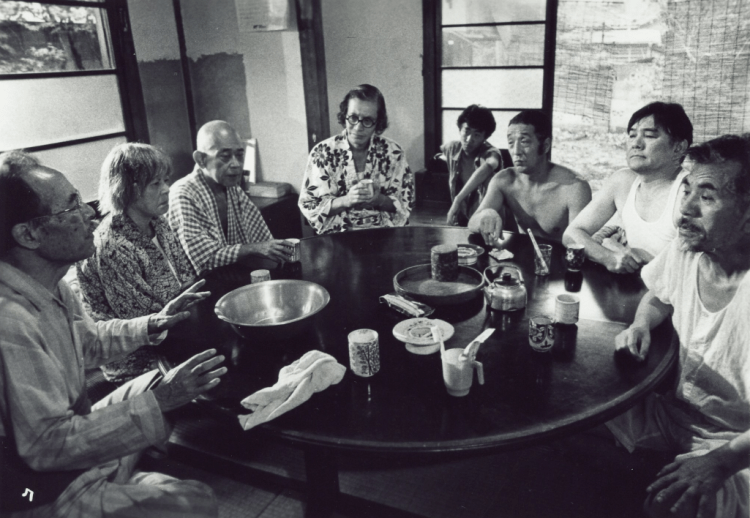
At This Late Date, the Charleston (近頃なぜかチャールストン, Kihachi Okamoto, 1981)

At this late date, the charlestonKihachi Okamoto first made his name with his samurai movies but his output was in fact far more varied in tone than the work most often screened outside of Japan might suggest. Marked by heavy irony and close to the bone social commentary, Okamoto’s movies are nothing if not playful even in the bleakest of circumstances. He first teamed up with Japan’s indie power the Art Theatre Guild for The Human Bullet in 1968 which recounted the absurd final days of the war in true Okamoto fashion and then bounced back to the Edo era for Battle Cry before deciding on the very contemporary satire At This Late Date, the Charleston (近頃なぜかチャールストン, Chikagoro Nazeka Charleston) in 1981.

Shot in 4:3 and a stately looking black and white, At This Late Date, the Charleston begins when Jiro – a slightly strange younger son of a wealthy family, punches out a girl’s boyfriend whilst the pair are sitting on a bench and subsequently chases her through the park util he eventually gets himself arrested on a charge of “attempted rape”. He then gets thrown into a cell with a gang of crazy old guys who took the decision sometime ago to secede from the state of Japan and create their own independent nation known as the land of Yamatai. Consequently, they all refer to each other by their “cabinet titles” such as Foreign Minister and Army Minister etc each inspired by their former lives which is why they have a minister for mail (he used to be a postman). They’re in jail because they tried to make a “state visit” to the Diet building and whilst there enjoyed some of the canteen food but as this was an official event they didn’t see why they should pay for any of it (and their Finance Minister was busy at the races).

Soon enough everyone gets released – the old guys when the Finance Minister turns up to pay their bill and Jiro when he’s bailed out by his older brother and the family housemaid (who quickly realises the “victims” aren’t quite what they seem). However, in a fantastically weird coincidence it turns out that the government of Yamatai have commandeered a house on the estate of Jiro’s father for their sovereign territory. Jiro’s brother is desperate to evict them but there’s also the problem that their multimillionaire dad has been missing for months and no one’s quite sure what might have happened to him…

Crazy old guys (and gal) who’ve become so disillusioned with their nation that they’ve started a new one on their own, missing industrialists, a Lupin III-like policeman who’s so obsessed with looking cool that the suspects always run away while he’s left striking a pose – Okamoto really knows how to pile on the strangeness, but somehow it all seems to make perfect sense. Madcap doesn’t even begin to do justice to crazy cartoon world Okamoto has created but it’s all so effortlessly funny that it hardly matters what you’d call it.

After initially being captured and branded a spy when he marches on over to Yamatai to ask them about his father, Jiro finds himself defecting to become “Minister of Labour” (this seems to involve doing all of the old guys’ menial tasks). As the youngest member of the group, he becomes the repository for their stories which mostly date back to the days of their youth from the fun loving Charleston era to the rise of militarism and eventually the war itself. This comes to the fore even more as the events take place in August, meaning that there’s both the anniversary of the atomic bomb and of the end of the war raising painful memories for this group of older folks, even if not quite so relevant to the younger contingent. The gang are planning a special trip to a hot spring on the 15th, but first they have to defend their micro-country against the onslaught of gangsters and bailiffs who are trying to “invade” their sovereign territory.

The old folks are pacifists, more or less (they didn’t really want an “Army Minister” but it was argued that no one would take them seriously without means of defence) but are still determined to protect their ideal state of Yamatai all the while clamouring for a silent kind of diplomatic immunity. They have some very unusual ideas but they know what’s what and having made an unlikely ally in the form of an unhappily married and soon to be retired policeman, have even managed to expose a little corruption and evil corporate shenanigans in the process of defending their own freedom. A vote for dancing cheerfully over a military march, At This Late Date, The Charleston is a warm and funny tale of eccentric oldsters who’ve seen it all before and finally decided it’s all kind of ridiculous anyway which can’t help but get your own toes tapping, whatever age you are.


Several unsubtitled trailers for the price of one:
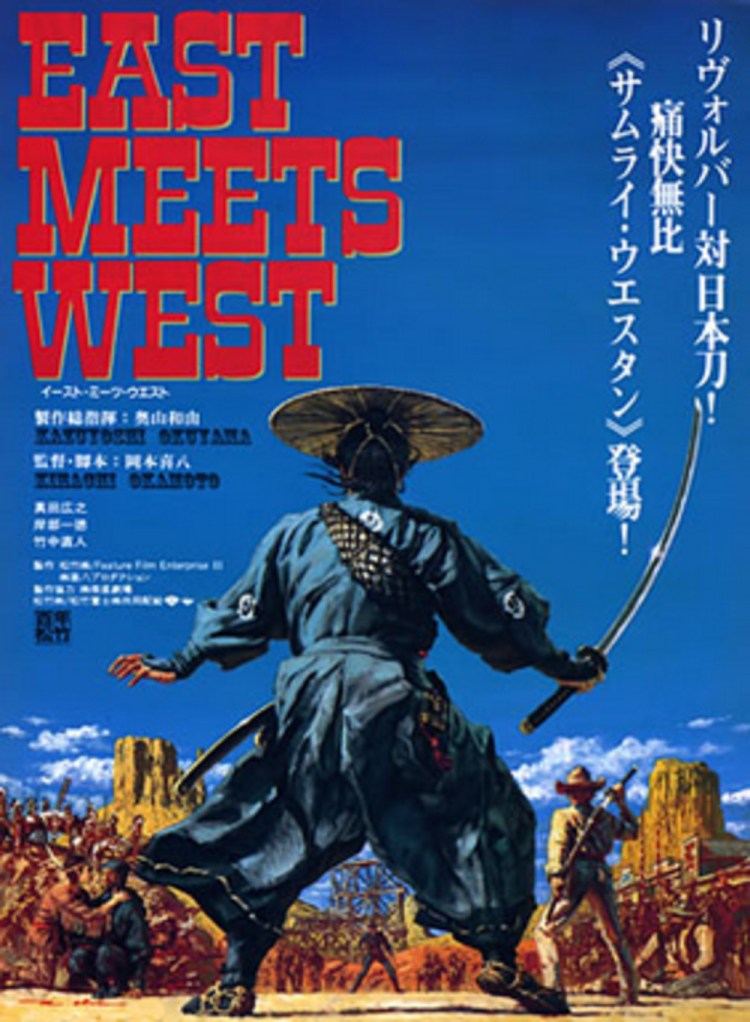
East Meets West (イースト・ミーツ・ウエスト, Kihachi Okamoto, 1995)

East_Meets_WestEast has been meeting West in the movies from time immemorial and though it’s often assumed that the traffic is only running in one direction, in reality the river runs both ways. Kihachi Okamoto was always fairly open about his love of Hollywood westerns, particularly those of John Ford, and even mixed a fair amount of wild west style action to his 1959 Manchurian war movie, Desperado Outpost. Returning to the theme almost 40 years later in East Meets West (イースト・ミーツ・ウエスト), Okamoto retains his wry, ironic eye but adopts a tone much more in keeping with the slightly silly exploitation cowboy movies of the ‘70s.

The tale begins with an American voiceover explaining the intricacies of the time period. It’s 1860 and America has been putting pressure on the recently opened Japan to agree to a trade deal. A delegation of two ships is shortly to arrive in San Fransisco which has also undergone many changes in the last few years after the influx of hopefuls during the 1848 goldrush transformed it from a peaceful fishing town to a dangerous prospector’s paradise. The situation in Japan is also turbulent and those who object to the recent foreign influences have a number of plots in motion. Once the boats leave a band of former samurai will assassinate the remaining official. The men on the boat will not hear of this until they return and the revolutionaries have also placed an assassin amongst those who will travel to America with the ultimate aim of assassinating the diplomat in charge of the delegation who was also responsible for the deaths of a number of “resistance” members in Japan.

However, everything gets derailed when a gang of bandits rob the bank just as the Japanese are about to deposit the money they’ve brought to seal the trade agreement. The group’s interpreter, Kamijo (Hiroyuki Sanada), takes advantage of his samurai training to cut down some of the bandits saving his own life but is unable to prevent them making off with the money. Taking to the road in the company of the young son of one of the bystanders who was killed, Kamijo becomes every inch the cowboy, standing apart ready to take his revenge. However, his mission is at times aided or hindered by an ace ninja working as a servant to the delegation, Tamejiro (Naoto Takenaka), who has accidentally ended up with a Native American wife.

East Meets West is a very silly film, it has very little in the way of serious intent but offers a fair amount of zany fun as its fish out of water samurai try to adapt to the ways of the Wild West. In many ways, it’s the classic cowboy movie as a bunch of strangers arrive and proceed to clean up the area which has become threatened by out of control bandit gangs. You have your mainstays like the lazy sheriff, meek vicar, and drunken doctor-cum-undertaker, the only difference is that the strangers are Japanese adventurers who fight with samurai swords and out of ideals of honour and justice rather than of survival or frontier values.

Indeed, it’s a little strange that East Meets West turned up in 1995 just a few years after Hollywood itself began to re-examine the western, re-injecting it with a little more realism and the grittiness and cruelty which filled frontier life but had been all but erased from the sanitised, romantic vision of the movie cowboy duelling pistols world. East Meets West references the classic western with its associated myths and tropes of clearly defined good guys taking down clearly defined bad guys to save the townspeople from moral and physical ruin. There are plenty of horse stunts and gunfights all offered with a kind of good natured (if sometimes black) humour that’s much more John Wayne than it is Clint Eastwood.

That said, there is a degree of cross cultural critique as the guys try to get used to their New World lives. Because English speakers have a problem with foreign names, Kamijo quickly becomes “Joe” and Tamejiro “Tommy” with Kamijo ending up with a little blond surrogate son and Tamejiro an enterprising Native American wife with whom he seems to develop quite a bond despite sharing no common language. Kamijo may have come to America with one singular mission in mind but once under the wide open skies he finds a kind of individual freedom that he hadn’t previously experienced and gradually loses his adherence to the rigid social codes of the samurai, exchanging them for the seemingly endless vistas of the ever expanding frontier.

Okamoto mines the dualities for all their worth – the chaos of the Meiji era contrasted with the organised lawlessness of the Wild West, yet East Meets West never quite transcends its western pastiche origins. With plenty of inventive and keenly observed comedy plus some nicely choreographed action scenes and excellent performances from the committed cast from both the English speaking American side and the Japanese actors, East Meets West proves an often entertaining experience but perhaps fails to offer the same level of social critique found in Okamoto’s previous work.


http://www.youtube.com/watch?v=EHpv6QA3UfU

The Elegant Life of Mr. Everyman (江分利満氏の優雅な生活, Kihachi Okamoto, 1963)

81zKsQWUtKL._SL1442_Kihachi Okamoto might be most often remembered for his samurai pictures including the landmark Sword of Doom but he had a long and extremely varied career which saw him tackle just about every conceivable genre and each from his own characteristically off-centre vantage point. The Elegant Life of Mr. Everyman (江分利満氏の優雅な生活, Eburi Man-shi no Yugana Seikatsu) sees him step into the world of the salaryman comedy as his hapless office worker reaches a dull middle age filled with drinking and regret imbued with good humour.

The film opens with an exciting, strangely edited setup of young people having fun singing, dancing and playing sports on a rooftop while a middle aged man sits apart from them looking gloomy with his head in his hands. Eburi is a depressed ad exec who laments that nothing really interests him anymore. It’s all so crushingly dull that he’s taken to drink, only he’s not very good at it so no one wants to join him. When Eburi drinks, he tends to go off on long and often non sensical rants which is probably quite funny for the first half hour but perhaps less so at 3am. One day he runs into some people from a magazine and gets so roaring drunk that he accidentally promises to write them the best magazine serial they’ve ever seen. Only problem being Eburi’s a copywriter, not a novelist, so he’s no idea what he’s doing. Going with “write what you know” he turns his everyday life into a humorous exposé of modern society and ends up becoming one of the most popular writers around.

The Elegant Life of Mr. Everyman is based on the prize winning magazine serial by Hitomi Yamaguchi which was also inspired by the author’s own life. Yamaguchi and Eburi are both of the generation who came of age around the end of the war, spared the front lines but not the post-war chaos. Somehow, they were the ones who were supposed to rebuild their nation whilst trying to make a life for themselves in the difficult post-war economic environment. Eburi spins a humorous yarn about how he ended up marrying his wife for reasons of financial necessity and the pair didn’t even get a proper honeymoon because they hadn’t bothered to book ahead so all of the inns in the resort town they ended up at were full. Eburi also lost his job twice when the companies he worked for went under and seems a little mystified that he has this pretty good position in the ad agency (even if he doesn’t like it much and no one seems to think he’s very good at it).

There’s an awful lot of social comedy here as the Eburis try to lead their “elegant” lifestyle on his relatively modest salary. The family – Eburi, his wife, son, and father, all live in “company accommodation” which is a complex of small homes where all the employees live close to each other. Eburi’s neighbour works in his office and is a much younger man who’s been married for six months and, in contrast to Eburi, comes straight home at 6pm to have dinner with his wife whom he adores. Eburi is wearing army surplus suits, cheap underwear from the thrift store and a vest which is full of holes in contrast to his neighbour who is wearing swanky sports underwear and fashionable outfits including unshined shoes – unthinkable to Eburi (though his own footwear is in such a state that the shoeshine boys send him packing). Eburi’s wife is also quite excited when she realises their garden might just be a little bigger than next door’s, something which also gives Eburi a lot of pleasure.

In keeping with the source material, Okamoto opts for a first person narrative style with Eburi narrating his life in the manner of his book only employing a fair few other devices in addition to the wild and radical editing. When Eburi goes further back into the past to tell the story of how his no good father became a rich man by exploiting the populace during the years of militarism, the film suddenly becomes a chaplin-esque silent comedy complete with over emphasised acting and pantomime-like painted sets before turning into a full on cartoon. He mixes montage with onscreen graphics which appear way ahead of their time considering this is a film from 1963 and a fairly mainstream comedy at that.

The Elegant Life of Mr. Everyman is also extremely funny. Obviously owing a lot to its source material, the script is one of the wittiest ever written and even if it’s talking about early 1960s social mores, the humour has barely dated at all. Much of the success of this is owed to the committed performance of the leading man, Keiju Kobayashi, who is able to give Eburi a sort of soulful weariness as his cynical rants take on an odd quality of warmth, appearing both strangely energetic and endlessly tired.

Whatever else he says and does, Eburi loves and has a duty to his family that proves extremely stressful for him as he feels the pressure to provide though he only wants the best for them (even at one point lamenting that he’s had to give up thinking about suicide because of the responsibilities he now has). These simple things must have struck a cord with the men of Eburi’s age who found themselves in a similar position of feeling eclipsed by the younger generation coupled with resentment towards their parents who had lead Japan into the folly of war and left the mess for their kids to clean up. Keenly observed, hilariously recounted and brilliantly brought to the screen, The Elegant Life of Mr. Everyman might just be one of the funniest films ever made and an unjustly neglected masterpiece of early 1960s Japanese cinema.


Reviewed at the Japan Foundation Touring Film Programme 2016 at London’s ICA 10th February 2016.

http://www.youtube.com/watch?v=20SCQYPoJ6Y


Human Bullet

Human Bullet (Nikudan) is a powerfully absurd antiwar satire. Set in the very last days of the second world war, when most can see the writing on the wall but don’t want to admit  that their situation is hopeless, the film attempts to capture the bewilderment and confusion as people start to comprehend the situation. An unnamed soldier of about twenty years old is training to be an officer and is repeatedly subjected to ridiculous tasks and ideas sent from high command.

Whilst in charge of the food store, it’s discovered that three packets of biscuits have gone missing. Whilst being question about this the soldier remarks that himself and the other men have become cows, that is they’ve learnt to ruminate – a skill which he then demonstrates to the non plussed superior officer. They stole the biscuits because their rations are pitiful and they lack the strength for their training. Pointing out the obvious that this warehouse is full of food whilst the men are collapsing from malnutrition,  the superior angrily tells him the food is for the final battle. Pointing out that there won’t be a final battle if they’ve all died of starvation further annoys the officer and our hero is reprimanded for his defeatist attitude by being forbidden to wear any clothing until further notice.

This further notice only comes when the squad is abruptly designated an anti-tank suicide squad, they will basically run into tanks whilst carrying explosives. Given one day of freedom before being expected to make the ultimate  sacrifice, the soldier finds love after a few wrong turns and a strange meeting with an armless bookseller (a noticeably odd late performance from Chisu Ryu). He also develops a strange friendship with some orphaned children and ‘saves’ a suicidal woman.

Alas his orders are abruptly changed again and having failed to meet up with his unit he ends up, in the most absurd image of the film, a man in a barrel strapped to a torpedo. When you hear about lost Japanese soldiers years later not knowing the war is over and you wonder how that can happen, well it’s because of things like this. Aimlessly drifting and bemoaning the ridiculousness of his situation, his feelings of helplessness and bewilderment perfectly sum up the events of the summer of 1945.

Okamoto’s trademark dark humour prevent this from being as bleak as the subject matter might suggest, although the finality of its ending is still incredibly powerful. Like Catch-22 or Dr Strangelove the film beautifully sends up the absurdity of war, and especially of an authoritarian win at all costs philosophy. It’s a shame this film isn’t currently available on DVD anywhere with English subtitles as it’s a very unusual film even by the standards of the Japanese Wave. Human Bullet is unforgettable and really deserves to be better known in the West.