The Great Flood (대홍수, Kim Byung-woo, 2025)

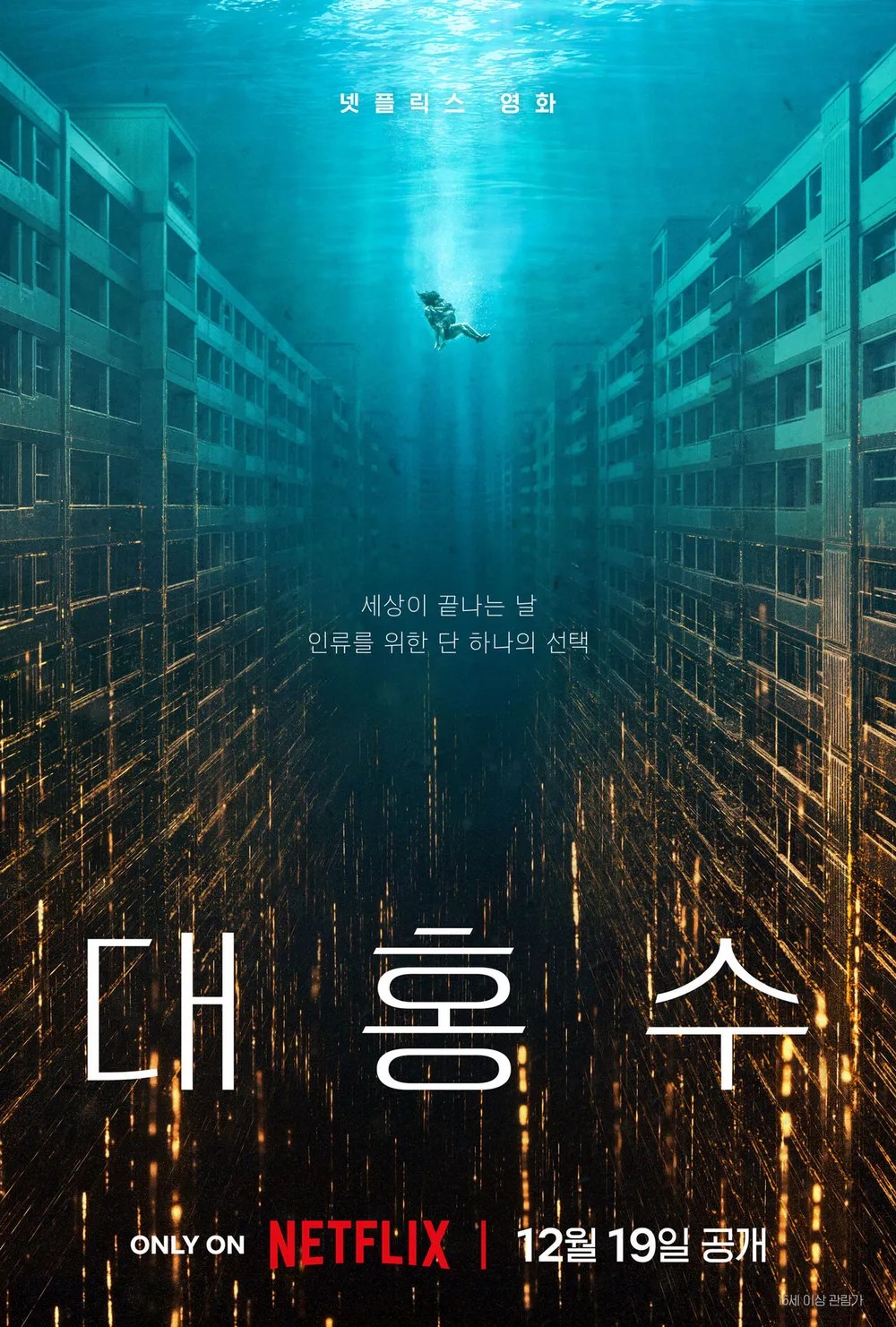
Humanity survived a great flood once before, or so we’ve been led to believe. The mysterious forces at the centre of Kim Byung-woo’s The Great Flood (대홍수, Daehongsu) believe we can survive it again, albeit in an altered form. Or then again, maybe not. What begins as a disaster movie soon shifts into speculative fiction exploring the nature of “human emotion” and whether such a complex thing can ever really be replicated synthetically.

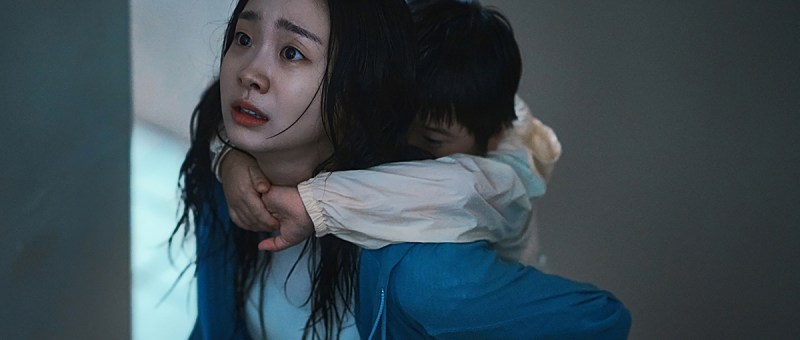
After their apartment is surrounded by floodwaters slowly climbing past their third floor flat, An-na (Kim Da-mi) tries to make her way to higher floors with her often uncooperative six-year-old son Ja-in (Kwon Eun-seong). As in recent similarly themed films, the apartment block becomes a microcosm of the contemporary society with An-na encountering stairs that have been blocked and neighbours who aren’t happy about those from lower floors encroaching on their space. Religious maniacs block access and insist this is God’s will. The only way out is a human sacrifice. Meanwhile, thuggish looters rob abandoned flats despite the fact that all of these previously valuable items are probably worthless now that no one knows when the waters will stop rising let alone when they will recede. 

It turns out, however, that An-na is an important person because she works for the Emotion Engine Development Team at the Darwin Center which has apparently known about this all along and has planning ways for humanity to survive for quite some time. It’s soon revealed that Ja-in is not An-na’s biological son but an experimental AI child she’s been developing to create the Emotion Engine. After the initial flood, An-na and Ja-in become separated and she is plunged until a looping series of simulations structured like a video game in which she must reunite with her son to give the Engine maternal instinct and save humanity.

Whether intentional or not, this is all incredibly sexist. Though apparently a top researcher, An-na’s worth is now entirely defined by her ability to become a mother. A flashback reveals An-na asked her boss if she could give Ja-in back because motherhood isn’t for her, while in flashbacks to her time with him she’s shown repeatedly hurting his feelings by neglecting him for her work. He asks to use her work iPad to do his drawings because she doesn’t look at them otherwise, while she’s irritated by his badgering when she’s obviously busy. The conceit is that she can’t find Ja-in because she doesn’t understand why he left her. She worries that he might not want to go with her anyway because she “abandoned” him to go with the men from the Darwin Centre to be saved from the flood and continue her research to save humanity.

The man sent to save her, the unemotional Hee-jo (Park Hae-soo), was also abandoned by his mother and is cynically looking forward to seeing what decision An-na will make. He’ll feel reassured in some way if she chooses to leave Ja-in behind because it will mean that it wasn’t just him, this is the way “human emotion” works. An-na obviously has an opportunity to recast “human emotion” than just recreate it, if that weren’t perhaps against the spirit of what she’s doing. In any case, the earlier part of the film is full of these dilemmas as Hee-jo encourages her to leave struggling people behind so they can make it to the roof for the helicopter. Even so, she comes across people who haven’t abandoned their humanity such as an old man continuing to feed his wife who seems to have dementia with the waves approaching and a man who stays with his pregnant wife who has gone into labour. In the end, An-na can only complete this quest by embracing her humanity by saving the little girl who is trapped in the lift and helping the pregnant lady rather than by abandoning them to survive alone.

This is also true of overcoming her maternal anxiety to believe she can be a mother to Ja-in which is also positioned as becoming a mother to all mankind as a kind of eve in a new digitised world. The apartment blocks are shaped like datacentres and the water reinterpreted as fire as if this is where people live now. Even so, we can’t be sure whether any of this, even the first flood, was ever really “real” or part of the AI-training scenario in which the Engine must be trained by “real” experiences, or if the An-na who accepts her motherhood and asks to be the test subject sent with Ja-in is the “real” woman or the model from the simulations. In any case, is humanity really surviving by being recreated as AI or bringing about its own demise? In our world at least, the waters may already be rising.


Trailer (English subtitles)
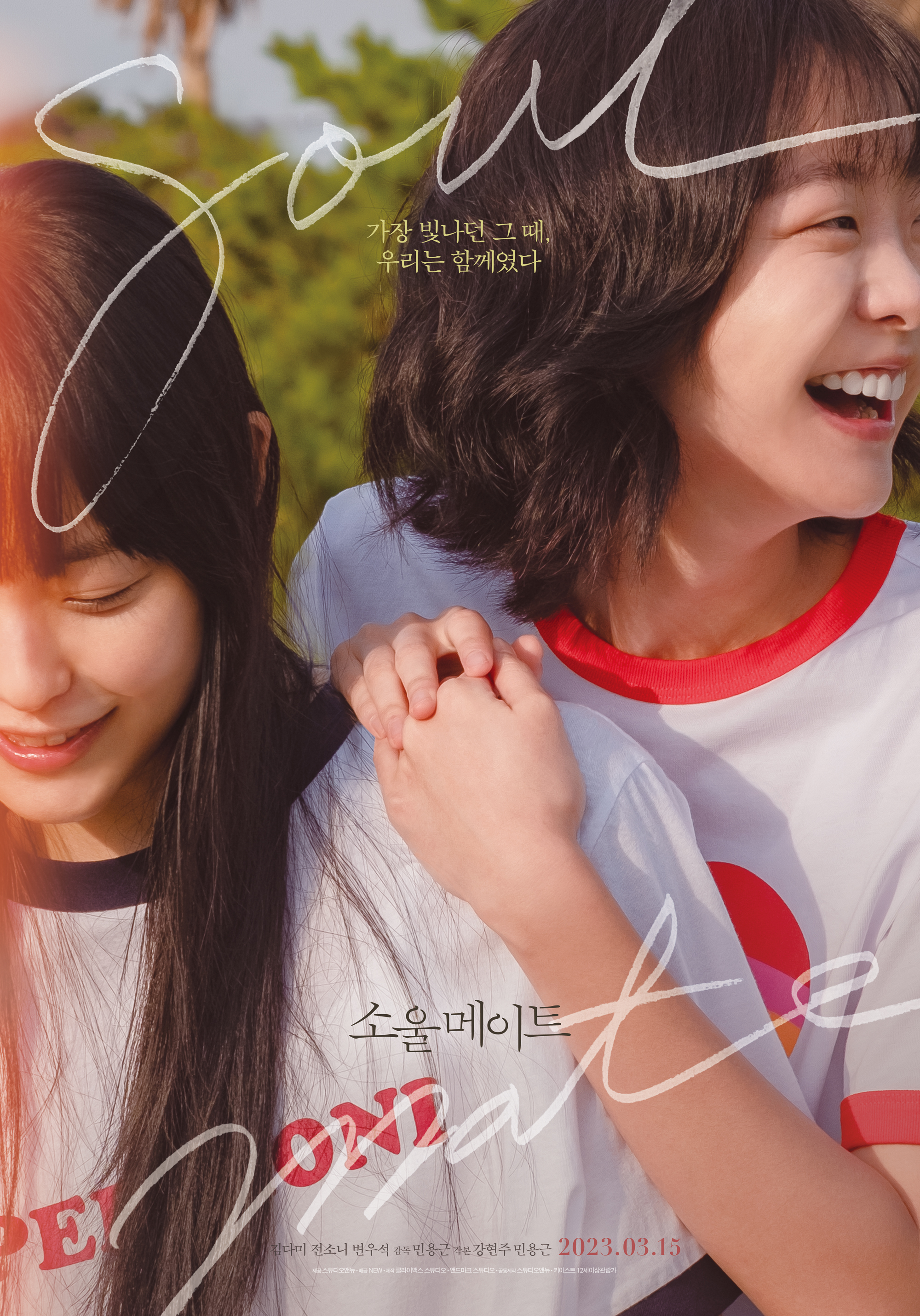
Soulmate (소울메이트, Min Yong-keun, 2023)

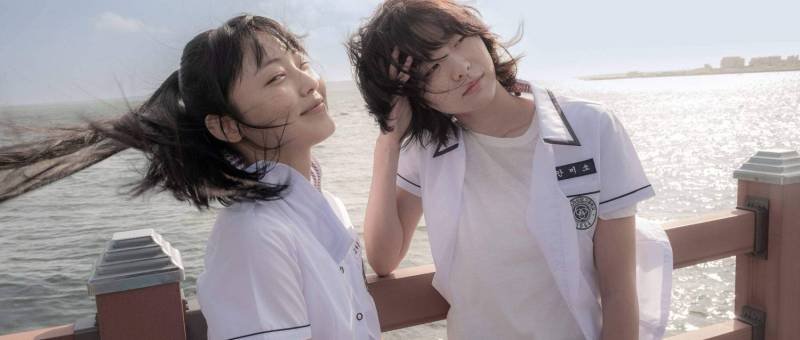
“Why should you step out for him?” one friend asks another, seemingly cutting to the quick of the fracture point in their relationship though ultimately unwilling to carry the conversation to its natural conclusion. A remake of Derek Tsang’s Soul Mate, Min Yong-keun’s frustrated love story is warmer and shorn of the icy angst which defined the original if also less certain in its implications and in the end profoundly melancholy in the missed opportunities and awkwardness of an unspoken affection. 

In the present day, a near 40-year-old Mi-so (Kim Da-mi) is called to a gallery to witness a giant and intricately drawn photorealistic portrait of herself attributed only to “Ha-eun.” The gallery owner has reason to believe the two women are friends and asks Mi-so to help her contact the reclusive artist, though she says that she knew only briefly in childhood and hasn’t been in contact with her for many years. This surprises the gallery owner as she’s uncovered a lengthy blog that outlines the entirety of their friendship in sometimes painful detail. 

The portrait staring back at her with her own gaze which is also the gaze of Ha-eun (Jeon So-nee) the artist confronts her with the painful realities of her past and the continuing absence of Ha-eun from her life. All we can know for the moment is that at some point they were separated and that Ha-eun has seemingly disappeared, though the Mi-so we see now seems so different from the one we encounter in childhood who is as Ha-eun describes her “free and also very delicate”. 

Inseparable for much of their youth, the relationship between the two women begins to fracture in adolescence as their paths begin to diverge. Ha-eun meets a boy, Jin-woo (Byeon Woo-seok), which necessarily disturbs their friendship by disrupting its dynamic. Unlike Tsang’s original in which it becomes clear that perhaps neither woman was in the end very interested in the boy who was himself a kind of proxy for the mutual attraction they could not articulate, Min presents him as a more conventional romantic rival albeit one who represents the sense of conventionality that the more conservative Ha-eun continues to cling to in contrast to the free spiritedness represented by Mi-so and her love of Janis Joplin. 

Ha-eun is confronted by the darker sides of Mi-so’s unconventionality during a trip in which she witnesses Mi-so get a bottle of wine out of a collection of drunk businessmen by offering to mix them drinks. An argument about money and power dynamics soon returns them to the fault line in their relationship, Jin-woo and their complex feelings for each other. Wilful misunderstandings lead to irresolvable resentments, each believing they are somehow in the way while equally hurt by the dissolution of their friendship and too proud to say so.

Min’s drama decreases the homoerotic undertones of Tsang’s original and opts instead for the defence of a deeply felt platonic friendship that may have developed into an unconventional family unit if given the opportunity. An exchange of earrings on two separate occasions seems much more convincing as an act of marriage than the more literal union between Ha-eun and Jin-woo. Yet maybe that’s the message the portrait was trying to deliver, a sign of an unspoken love that reunites Mi-so with the childhood self who knew it was possible to draw one’s feelings while seeing herself as Ha-eun saw her, Ha-eun’s own eyes reflected back at her. The two women in a sense switch places, becoming one while split in two and eternally connected if physically separated. 

The irony is that it’s the fear of losing it that erodes their relationship, and pride more than shame that divides them even if it’s ultimately the unwillingness to confront their feelings and the inability to articulate them that keeps them apart. Nevertheless, they eventually come to an acceptance of themselves as sun and moon, two halves one whole continually incomplete happiest only in each other’s company. Then again, there are some very unreliable narrators in play and perhaps we can’t be sure that everything we’ve been told is true yet even if not literally so still speaks of a deeper emotional truth and the deepening wound of lost love comforted only by memory and the act of recapturing it. 


Soulmate screened as part of this year’s London Korean Film Festival.

Trailer (English & Korean subtitles)

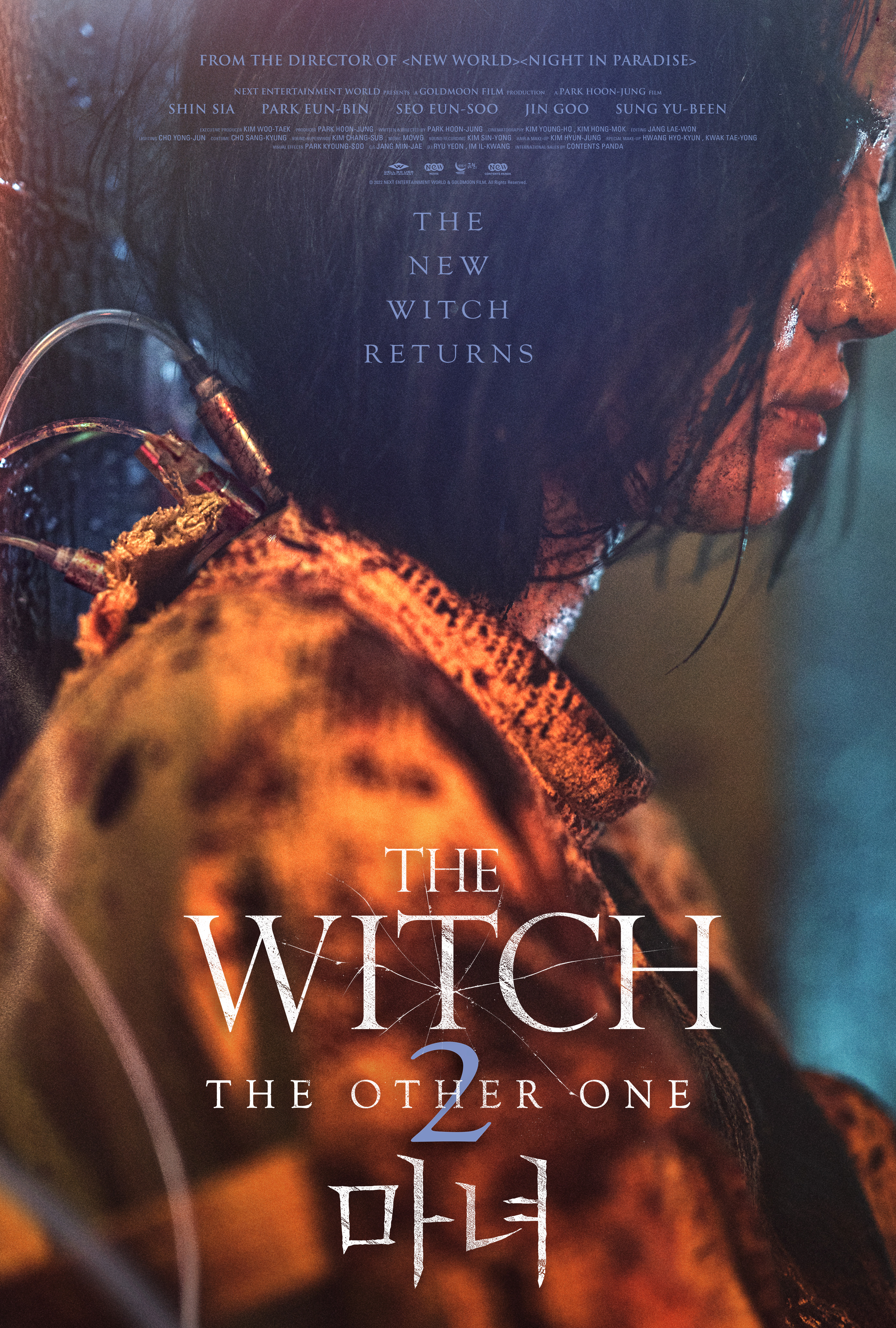
The Witch: Part 2. The Other One (마녀 2, Park Hoon-jung, 2022) [Fantasia 2022]

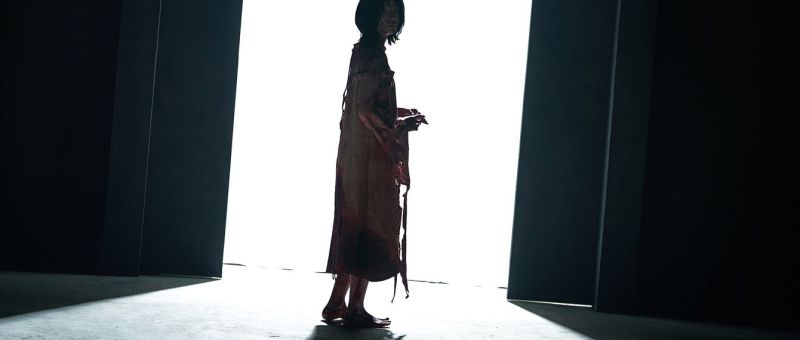
In Park Hoon-jung’s The Witch: Part 1.The Subversion, a young woman managed to escape a shady research facility to live as a regular high schooler while her adoptive parents wondered if their love for her could cure the violence with which she had been nurtured. Four years on, Hoon returns with Part 2: The Other One (마녀 2, Manyeo 2) which as the title implies follows another girl who similarly escapes her captivity and fetches up on a farm where she forms a surrogate family with a brother and sister in immediate danger of displacement. 

Unlike the first film’s Ja-yoon (Kim Da-mi) who rebuilt a life of “normality” after seemingly losing her memory, the unnamed girl emerges into a confusing and unfamiliar world in which everything is new to her. Challenged by a shady gang of guys on a highway, she’s bundled into a car which is where she encounters Kyung-hee (Park Eun-bin), a young woman kidnapped by a former associate of her late father who plans to murder her and steal her land for a lucrative construction project. Realising what might be in store for her, Kyung-hee tries to protect the girl and urges the gangsters to let her go before the girl decides to protect Kyung-hee in return by using her special abilities to total the car and set them both free. The girl is just about to finish off one of the mobsters when Kyung-hee tells her that she doesn’t need to, starting her on a path to questioning the indiscriminate violence with which she has been raised even as she determines to continue protecting Kyung-hee and later her brother Dae-gil (Sung Yoo-bin) who are now caught between the venal gangsters and an international conspiracy with various groups of people intent on either kidnapping or eliminating the escaped test subject. 

As had been hinted at in the previous film’s conclusion, there is a definite preoccupation with twins but also with internal duality. The shady corporation hints that the girl may be an upgraded edition, the “perfect model” of transhumanism, yet she appears less amoral than the unmasked Ja-yoon almost always seeking to incapacitate rather than kill while determined to protect Kyung-hee at any cost. To begin with, she is largely unable to speak but reacts with wide-eyed wonder to outside world visibly stunned by the wide open spaces on her way to the farm and develops a fascination with food eager to try anything and everything charging round a supermarket eating all the free samples while piling the trolley high with snacks. 

Like Ja-yoon however and in a superhero cliché she finds refuge on a farm and helps to complete the family which had been ruptured by absence but her new happiness is fragile on several levels not least of them that the farmhouse is under threat from venal gangster Yong-du (Jin Goo) who wants the land to build a resort. In an undeveloped plot strand, it seems that Dae-gil has lingering resentment towards his sister for leaving for America and returning only when their father died with the intention of sorting out the estate while it otherwise seems clear that their father was himself a gangster who may have used his ill-gotten gains to buy the farm in the first place. This is no ordinary rural backwater, but one brimming with darkness as the backstreet doctor turned drunken vet makes clear. 

In another duality, the girl is chased by a series of opposing forces split between “union” and “transhumanism” and represented by mercenary Sgt. Cho (Seo Eun-soo) and her South African partner (Justin John Harvey) and a gang of Chinese vigilantes from the Shanghai lab who are looking for the girl to get her to join them. Like the girl, the mercenaries appear to act with a code of ethics, trying their best to avoid civilian casualties while viewing death as a last resort while the ruthless vigilantes rejoice in violent brutality. In any case Park leaves the door open for a further continuation of the series in which the two women search for their shared origins in the hope of a literal, physical salvation but also perhaps the answer to a mystery long withheld from them. With a series of large scale and well choreographed action sequences, Park builds on the first film’s success and quite literally tells a sister story as “the other one” pursues her mirror image destiny while ironically finding beauty in the fireworks of a volatile society. 


The Witch: Part 2. The Other One screened as part of this year’s Fantasia International Film Festival and is released in the US courtesy of Well Go USA.

International trailer (English subtitles)

Images: Courtesy of Well Go USA Entertainment

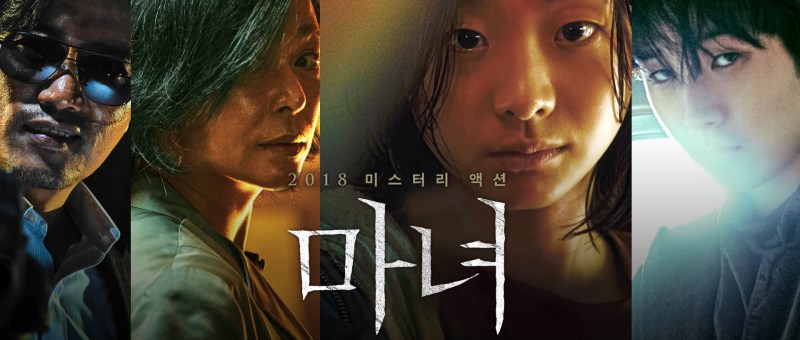
The Witch: Part 1. The Subversion (마녀, Park Hoon-jung, 2018)

There’s probably something quite profound to be said about the folkloric tradition of the foundling child and untold destiny, that exiled nobility can salvage the best qualities of the place they escaped in a rural paradise before returning to make their restoration. Superheroes do indeed seem to find frequent refuge in the wholesome plains of farm country where the salt of the Earth raises them into upstanding people with the right kind of values to couple with their “unnatural” powers to enable them to “save the world” in ways both literal and metaphorical. Perhaps there is darkness in that idea too, that we need such people to save us rather learning to save ourselves or that we secretly long to believe in our latent specialness and hidden destiny, and of course those rightful values may also be inherently conservative in that they aim to preserve a particular vision of “goodness”. In any case, the heroine of Park Hoon-jung’s The Witch: Part. 1. The Subversion (마녀, Manyeo) is not so much out to save the world as engaged in a war to save herself and that particular vision of goodness she’s been gifted by good people (or, then again, perhaps not).

Park begins with blood as a little girl manages to escape a massacre at some kind of shady facility before passing out in front of an idyllic farmstead where she is eventually taken in and nursed back to health by a kindly older couple, the Koos. 10 years pass. The little girl is now the teenage Koo Ja-yoon (Kim Da-mi) and an archetypal farm girl albeit an extraordinarily pretty one with straight A grades and fierce love for her now struggling adoptive parents. With the farming industry in crisis and Mrs. Koo suffering with Alzheimer’s, Ja-yoon finds herself bullied into taking part in a televised singing competition by her boisterous best friend Myung-hee (Go Min-si), which is not the best idea if you’re trying to hide from shady government forces. Sure enough, the past begins to resurface leaving Ja-yoon with a series of difficult choices.

Like many other recent Korean action dramas with female leads, The Witch steps back into the familiar territory of “good” mothers and “bad” while uncomfortably asking if childhood corruption can be cured by love alone. Living as Ja-yoon, the unnamed little girl has been reset. Given a “normal” childhood, she seems to have become a “normal”, perhaps ideal, young woman who does well at school, is confident and self possessed, and dearly loves her family and friends. When we finally meet the woman responsible for her corruption, Professor Baek (Jo Min-su) who presents herself again as a maternal figure and Ja-yoon’s “creator”, we learn that Ja-yoon is a creature born of icy violence, raised without compassion or love for no greater purpose than destruction.

Mr. Koo (Choi Jung-woo), perhaps understanding Ja-yoon a little better than she understands herself, often tells her not to go out “like that” which seems like slightly archaic paternal sexism but is also an attempt to soften those “male” instincts towards violence which are so much a part of her early life and of her essential nature. Frightened by her “unnatural” cruelty, Mr. Koo wasn’t sure if they should keep Ja-yoon with them but his wife (Oh Mi-hee) disagreed, believing they could heal her by raising her in love. The choice Ja-yoon faces is whether to embrace her persona as Koo Ja-yoon as raised by her adoptive parents, or the psychopathic killer which lies underneath.

Park leaves the dilemma very much in the air with “Ja-yoon” a vacillating cypher whose internal divisions seem to become ever more stark as she begins to wall off her various personas. “The Witch”, as the title implies, may itself have its misogynistic overtones in pointing directly at Ja-yoon’s transgressive femininity, both innocent farm girl and unstoppable killing machine, but as the subtitle hints Ja-yoon is also attempting to subvert herself in service of a greater mission which (for the moment) remains unclear. Park opens the door to a sequel in which subversion might not be the aim, sending Ja-yoon further along the path of dark self exploration which promises still more violence and mayhem before her bloody work is done.


The Witch: Part 1. The Subversion is released on Digital HD in the UK on April 22nd courtesy of Signature Entertainment.

UK release trailer (English subtitles)