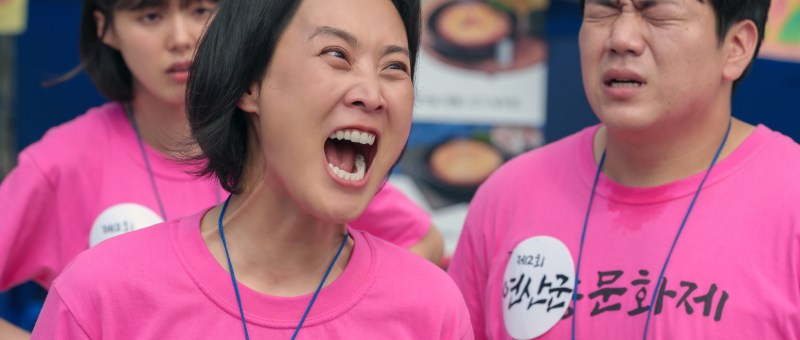
Just about everything that could go wrong does go wrong for an embattled CEO of an events planning startup organising a local cultural event on short notice in Kim Hong-ki’s provincial comedy Extreme Festival (익스트림 페스티벌). Then again, according to one unexpectedly happy customer it’s the mess that makes them fun and it’s the very fact that’s not everything has gone to plan that has accidentally led to a pair of festival enthusiasts apparently having the best day of their lives.
The first problem Hye-soo (Kim Jae-hwa) has is one that will largely be lost on international audiences. One week before the festival’s opening, the mayor decided to change its name from Jeongjong festival to Yeonsan-gun festival on the grounds that Jeongjong, the second ruler of the Joseon dynasty, is so little known that not even Hye-soo can correctly recall his full name. Yeonsan-gun is a lot more famous but largely because he was a tyrant remembered by history for all the terrible things he did during his reign like having his own mother executed and forcing huge numbers of women from across the country to serve as palace entertainers. As he does not share the same local connections as Jeongjong, the festival has to create a series of diagrams giving exact travel distances in an attempt to claim that Yeonsan-gun is “local” after all. In any case, Hye-soo has only agreed to handle the event to curry favour with the mayor in the hope of landing the contract for the much more lucrative salted sardine festival, which might go some way to explaining just how “local” all of this really is.
Another problem is that Hye-soo was hired in part because of her business partner/boyfriend’s fame as a literary figure which is fast fading anyway because he’s been repeatedly publishing the same book in different editions for years. The relationship is on the rocks and Sang-min (Jo Min-jae) barely shows up leaving her embarrassed in front of their clients while he later rehires screenwriter Leo (Park Kang-sup) who had previously been let go under circumstances he finds confusing. Sang-min also goes ahead and hires the festival’s only volunteer, Eunchae (Jang Se-rim), as an intern without clearing it with Hye-soo first despite knowing the company has no money to pay her because its survival is dependent on landing the salted sardine contract.
Eunchae represents a certain kind of small-town youth longing for escape and not least from her oppressive family environment where her brother appears to be king. Willing to do just about anything to be able to move out even if it’s not to the capital, Eunchae is excited about the new job opportunity but tragically thinks that Hye-soo’s company must be an established and successful place rather than a one woman operation with an “office space” full of boxes and electrical equipment.
Meanwhile, Hye-soo is also affected by the vagaries of local politics in being subject to the whims of the mayor who suddenly demands that her performance artist son be added to the bill and that a group of actors hired to perform a historical piece inspired by the Literati purges which occurred under Yeonsan-gun’s reign should instead incorporate a bit about the end of the pandemic and “execute” the omicron virus instead before the king declares that herd immunity has been achieved. As expected, this doesn’t go down well with the actors who later stage a protest boycotting the festival on learning that their application for a grant from the local council has been turned down.
It is all, as Hye-soo admits, a mess and one not helped by an ongoing clash of personalities not to mention goals between the mayor’s office and Hye-soo’s staff. A sub-plot revolving around a washed up Japanese popstar apparently trying to escape his sense of failure by hiding out in a random Korean village only adds to the crushing sense of defeat that marks the festival. Even the “celebrity” MC admits the reason he’s not been on TV for ages is that he’s not getting hired which is why he’s here, slumming it in the provinces as a virtual has been ringing the death knell on his career. But in the end it’s personal relationships and people learning to get over themselves that save the day. Hyesoo gains some much needed clarity on the directions of her personal life and business, willing to make a fool of herself to get back on track while others too readjust their expectations. A kind of warmhearted take down of the absurdities of local government events, the film is really a celebration of perseverance and the spirit of never giving up even if nothing seems to be going your way.
Extreme Festival screened as part of this year’s New York Asian Film Festival.
Original trailer (Korean subtitles only)





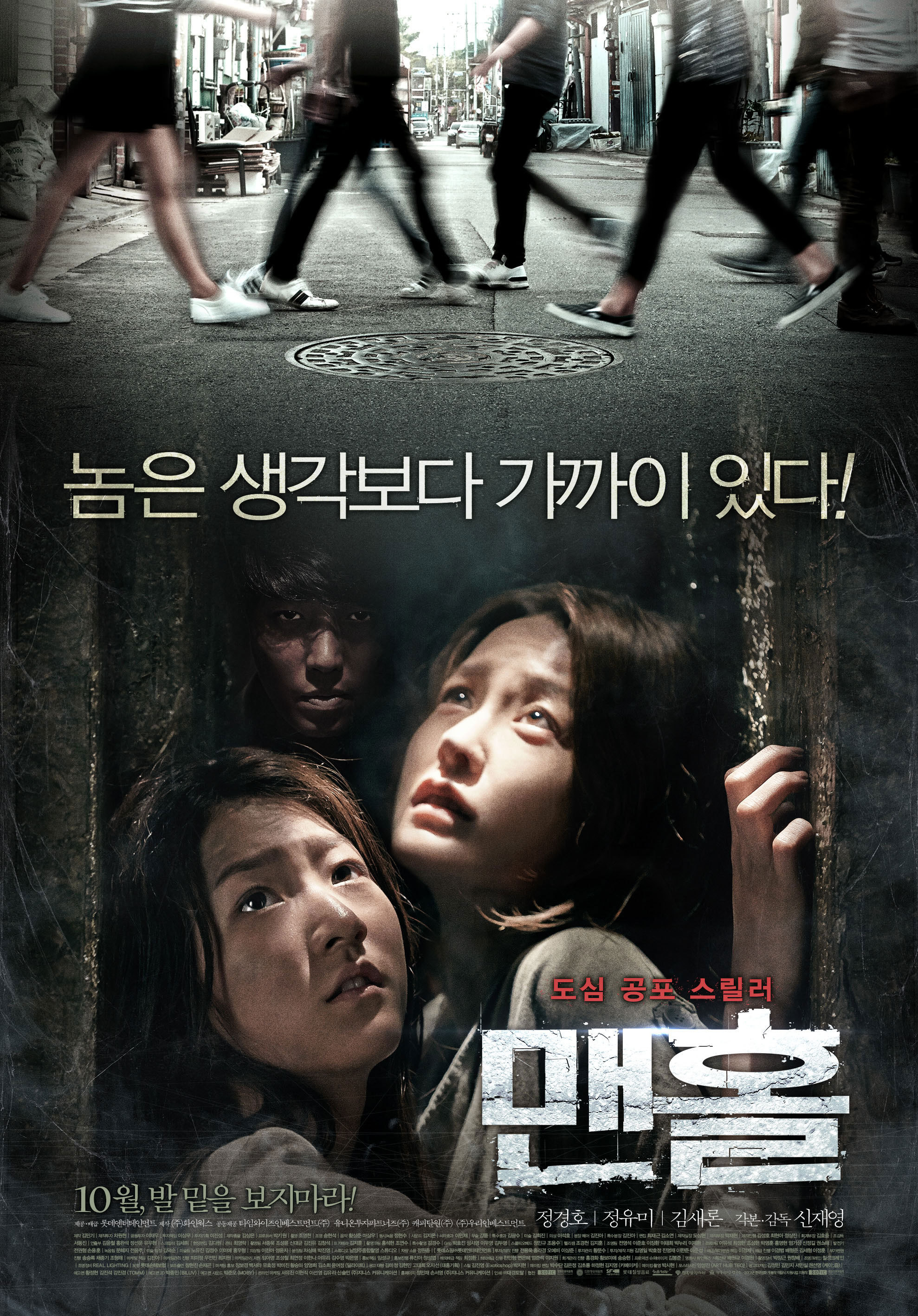 Finding the sinister in the commonplace is the key to creating a chilling horror experience, but “finding” it is the key. Attempting to graft something untoward onto a place it can’t take hold is more likely to raise eyebrows than hair or goosebumps. The creators of Korean horror exercise Manhole (맨홀) have decided to make those ubiquitous round discs the subject of their enquiries. They are kind of worrying really aren’t they? Where do they go, what are they for? Only the municipal authorities really know. In this case they go to the lair of a weird serial killer who lives in the shadows and occasionally pulls in pretty girls from above like one of those itazura bank cats after your loose change.
 Windows on Worlds