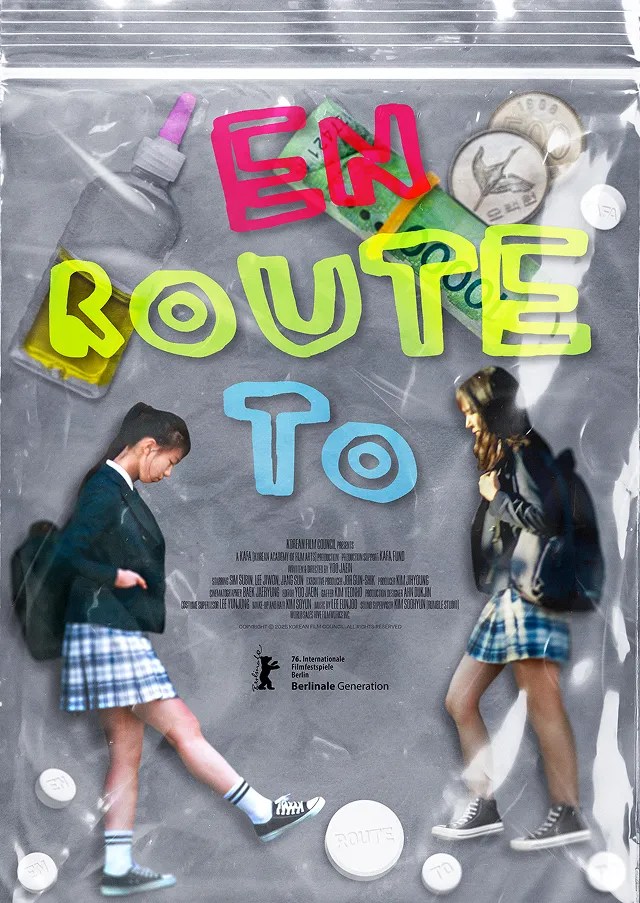
En Route To (지우러 가는 길, Yoo Jae-in, 2025)

“Give only what you can take responsibility for,” Yoon-ji (Sim Su-bin) is advised by an apparently compassionate older man trying to explain to her that sometimes you end up causing further pain while trying to be kind. Yoon-ji’s problem might be that no one seems to want to take responsibility when it comes to her and she herself is struggling to do so while faced with an unexpected pregnancy. Not only has the father disappeared off the face of the earth, but he was also her 36-year-old high teacher and is obviously not going to take any sort of responsibility for his conduct, certainly not for the baby, but not for the false expectations and unresolved emotions with which he’s left Yoon-ji, either.

Much of Yoo Jae-in’s graduation film En Route to (지우러 가는 길, Jiureo ganeun gil) takes place against the backdrop of the only recent decriminalisation of abortion in Korea, but explores the ways in which young women like Yoon-ji are still left with few options when deciding what to do about an unexpected pregnancy. Though she wanted to keep the baby, she is pressured into an abortion assuming that Mr Han has disappeared because she refused to get one and will return once she has. This rather childish thinking demonstrations both her naivety and her desperation, little understanding the situation she is in. It doesn’t seem to occur to her that Mr Han may have done this before and probably doesn’t see her as a long-term romantic prospect. After all, he has a wife already, even if they’ve been living separately with the implication that he’s ended up being transferred to this school in flight from allegations at his previous place of work.

To try to keep it secret, Yoon-ji orders abortion pills off the internet without any sort of guarantee of what she’s actually taking which could be actively harmful to her health in other ways or perhaps just be chalk that won’t help her to end the pregnancy. After finding out what Yoon-ji has done because she borrowed her savings to pay for the pills, Yoon-ji’s roommate Gyung-sun (Lee Jiwon) asks her why didn’t go to a hospital, but as they find out, Yoon-ji would need parental approval in addition to the money to pay for the procedure and as she was abandoned by her father, there is no one she can ask to sign even assuming that the situation allowed her to involve her guardians and she felt comfortable doing so. A friend knows of a vet who is willing to provide backstreet abortions as a hangover from the era in which it was a criminal offence to end a pregnancy, leaving Yoon-ji at the mercy of potentially dangerous medical interventions.

Meanwhile, she can’t really tell anyone about what’s happened to her as Mrs Han has begun to figure out that her husband may have been a serial offender but is intent on saving his reputation, perhaps as a means of saving her own so that she would not have to accept the fact not only that her husband had sexual relations outside of the marriage, but that he did so with underage girls whose trust in him he willingly betrayed while abusing his position as a teacher. She uses her relative wealth to cow Yoon-ji and Gyung-sun into silence by dangling the prospect of a scholarship, ironically in Mr Han’s name as a means of whitewashing his reputation.

Gyung-sun is particularly upset about this, partly because her own mother gave birth to her very young and Gyung-sun has always felt a little guilty about all her mother missed out on to raise her like going to university and getting a better job, or getting married and starting a bigger family. Without explaining why, she pushes Yoon-ji towards ending the pregnancy in part because she experienced bullying and exclusion simply for being the child of a young single mother and does not think it’s fair for Yoon-ji to have a child when she has not really thought about the realities of raising it by herself or what she will tell them about their father when they’re old enough to ask. Both Yoon-ji and Gyung-sun are somewhat outsiders, though Yoon-ji continues to yearn for a family of her own, while Gyung-sun has been selling under the table vape cartridges at school to fund a working holiday visa in Australia specifically to set out for her own independence.

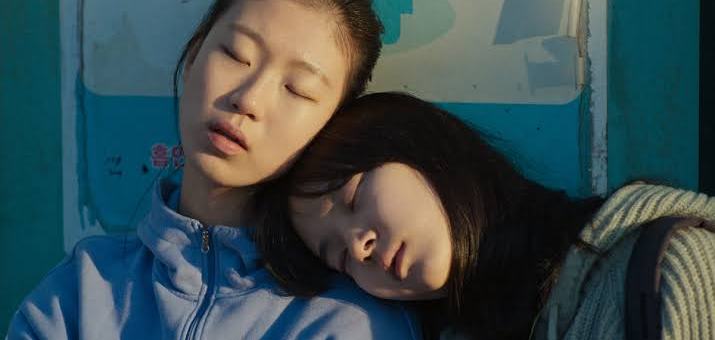
Nevertheless, it’s really in each other that they begin to find a new sense of ”family” as they bond over the question of what to do for the best when it comes to Yoon-ji’s future and the baby’s. They  do indeed take responsibility for what they give to each other, and though left to handle all of this largely on their own, offer mutual support through this difficult time before allowing a conclusion to be reached that will enable them to move on. Warm and empathetic while refusing to moralise, Yoo’s humorous drama is a testament to the power of female friendship which can in some ways at least overcome the constraints of the world around it.


En Route To screened as part of this year’s London Korean Film Festival.

Trailer (English subtitles)
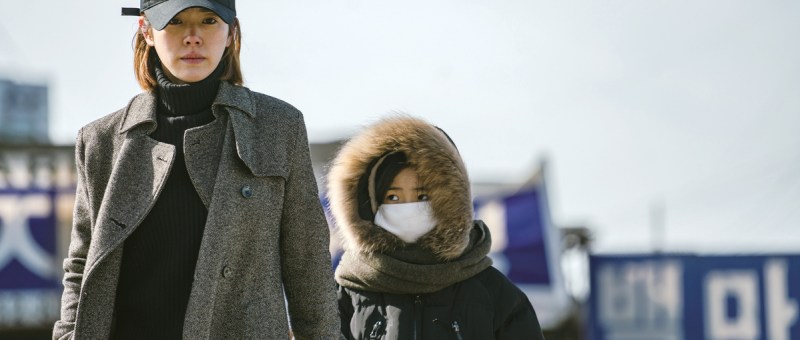
Miss Baek (미쓰백, Lee Ji-won, 2018)

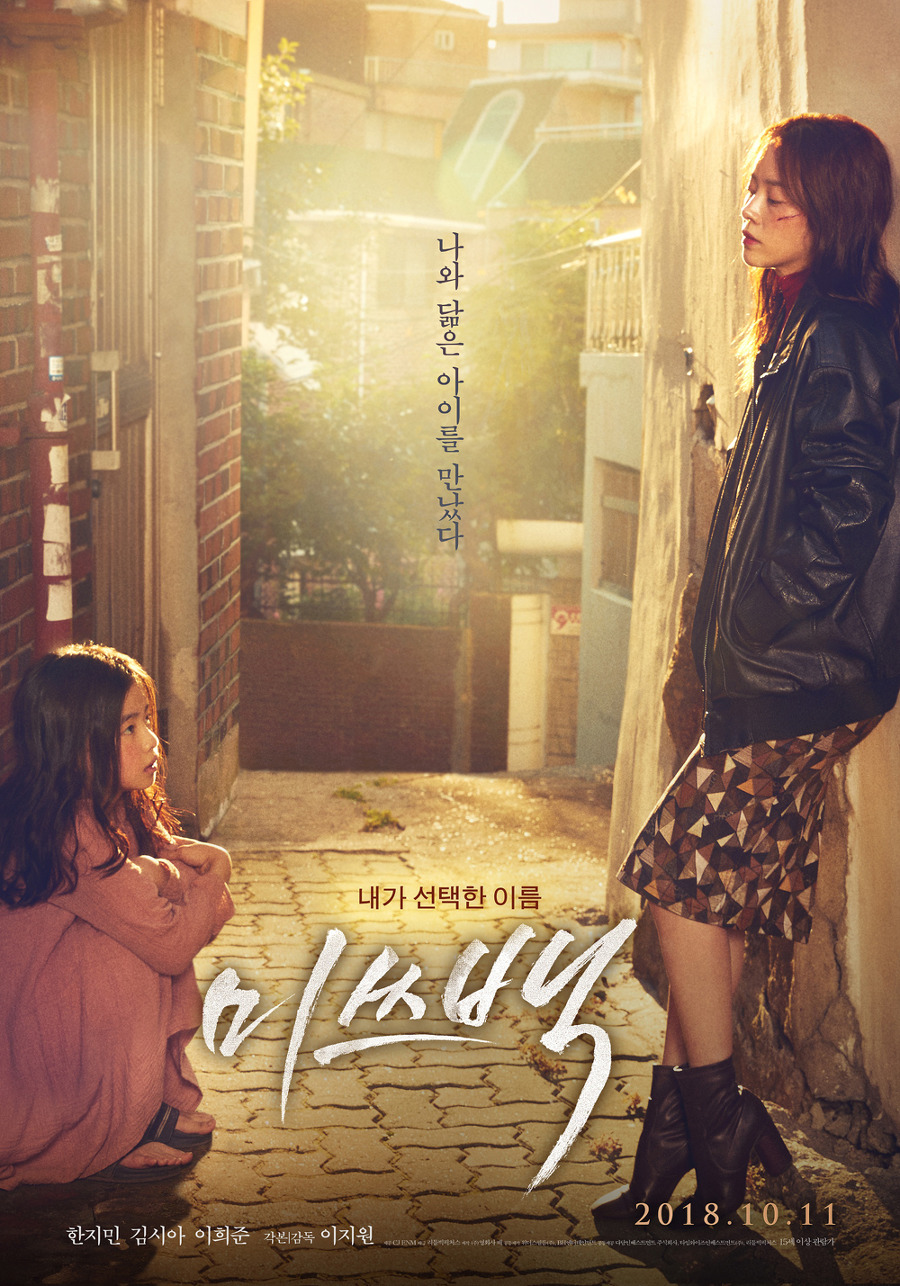
Miss baek posterIn one sense we’ve never been more connected to one another, but our tendency to remain inside our own solipsistic bubbles has never been higher. We ignore those in need, confident that “someone” will do something, that it isn’t our responsibility. Then again perhaps we don’t even notice. It’s freezing cold in director Lee Ji-won’s debut feature Miss Baek (미쓰백) and a little girl is sitting outside in her nightie. No one takes very much interest her even though it’s far too late for a child to be out alone. That is, until the titular Miss Baek (Han Ji-min) overcomes her own sense of alienation and decides to look back.

Now in her mid-30s, Baek Sang-ah is an aloof, near silent woman who ekes out a living through a series of casual jobs from car washing to massage. She is in a kind of relationship with a kindly policeman, Jang-sub (Lee Hee-joon), who wants to marry her, but Sang-ah has long ago ruled out the idea of marriage and family. She never wanted to be someone’s wife or mother. Sang-ah says this not (entirely) because she values her independence, but because of a legacy of trauma and abandonment born of the physical abuse she suffered at the hands of her mother who fell into depression and alcoholism following the loss of her husband. Fearing becoming another link in a long chain of abuse passed from parent to child, Sang-ha has kept herself isolated, avoiding all intimate relationships and vowing to continue on alone causing harm to no one.

One winter day, however, she can’t walk past the girl in the nightie anymore. Taking her to a nearby food stall, Sang-ha finds out the girl’s name is Ji-eun (Kim Si-a) and she’s nine years old. Just as Sang-ha is beginning to ask about the cuts and bruises on Ji-eun’s hands and feet, a well dressed woman who turns out to be her father’s girlfriend arrives and whisks the girl away. Sang-ha tries to forget about her and go on with her life, but she can’t seem to do it. Buying Ji-eun some proper winter wear, she resolves to try and help the girl the way that no one tried to help her.

There is something particularly insidious in the continuous stream of injustice and mistreatment Sang-ha and Ji-eun find themselves subject to precisely because of their lack of social power. Children, most obviously, have no mechanism to defend themselves besides their parents and should they try to speak out against them, they may not be listened to. Managing to escape, Ji-eun tried to tell the police what her parents were doing to her but they sent her home with only a mild warning to her smirking step-mother that she’d best ease back on the “discipline”. Understandably, Ji-eun doesn’t have much faith in the authorities as a source of salvation. Sang-ha experienced much the same but her oppression continued on into adulthood when she was arrested for violently defending herself against a would-be-rapist who happened to be the son of a wealthy and connected man who used his status to do as he pleased while Sang-ah went to jail. Sang-ha’s prison record comes back to bite her again when she tries to talk to the police on Ji-eun’s behalf only for them to lay into her when they eventually run her file.

Meanwhile, Ji-eun’s step-mother Mi-kyung (Kwon So-hyun) is well turned out and scrupulously polite. She has a plausible answer for everything and a talent for middle-class respectability, even crying during church services. Her father Il-gon (Baek Soo-jang), by contrast, is addicted to video games and rarely leaves the house while little Ji-eun is often locked in the bathroom where she cowers under the sink, or cast out onto the balcony in the mild hope that she’ll freeze to death. The only reason Mi-kyung has been keeping her around is the welfare payments, but they’re about to stop. Both “parents” project all of their personal resentments onto the face of a nine year old girl whom they beat, starve, and torture for no discernible reason other than they don’t know any other way to behave.

Ji-eun’s father was also beaten as a child. He wonders where the police were then and what sort of life they think Ji-eun is going to have when she too grew up like this. Sang-ah’s desire to save Ji-eun is also a desire to save herself as she contemplates maternity from both sides in revisiting the complicated relationship with her own mother while wondering if she is a fit person to care for a child with such poor models to follow. She doubts she can break the chain and free Ji-eun from a seemingly inescapable system of abuse and violence but through her deepening attachment to the little girl Sang-ha begins to find a way through her inertia and fear of intimacy to a deeper and more positive connection. A gritty yet always open and empathetic look at an all too often hidden social problem, Miss Baek is a promising and important debut from Lee Ji-won which refuses to look away from the dark and unpalatable but finds hope in the power of simple human kindness against cruelty and indifference.


Screened as part of the 2018 London East Asia Film Festival.

Original trailer (no subtitles)

Steel Rain (강철비, Yang Woo-suk, 2017)

Steel Rain posterA little way in to Steel Rain (강철비, Gangchulbi), one of its heroes – a Blue House official, gives a pointed lecture on Korea’s past to some students of Geopolitical History. Fiercely critical of Korea’s previous subjugation by Japan, he laments that his nation was not able to free itself from the Japanese yoke and was awarded its freedom with the end of a wider political conflict which saw the Japanese “empire” collapse. According to Kwak Cheol-u, Korea has never quite lost its cultural admiration for its former colonisers which is why its most prominent corporations – Samsung, Haeundae etc, are all direct competitors with similar Japanese firms (and are only now pushing past them in terms of global market penetration and technological innovation).

Switching tack, he wonders why it is that Japan lost a war and Korea got cut in two by two new “colonising” forces. In his oft observed mantra, Kwak (Kwak Do-won) insists that the citizens of a divided nation suffer more from those who seek to manipulate the division for their own ends than they do from the division itself, which is where we find ourselves in the contemporary era of my button’s bigger than his button in which “capitalist pig dogs” face off against “dirty commies”. Adapting his own webcomic, Yang’s action thriller is among the most recent in a long line of North/South buddy movies and even if its cold-war paranoia feels distinctly old hat, it just goes to prove that everything old is new again.

Eom Cheol-u (Jung Woo-sung), a former North Korean special forces agent, is called back into the fold by his old commander for a very special mission. Tensions are about to boil over in the perpetually precarious state and the Dear Leader’s life is under threat from a suspected coup. Eom is to silence one of the conspirators in return for which he will be given elite status and his family will be well looked after. Unfortunately, the mission does not go to plan and Eom ends up witnessing a missile strike on a welcome meeting at a Chinese managed factory in which the (mostly young and female) employees are murdered in cold blood. Managing to escape with the Dear Leader himself who is seriously wounded, Eom travels over the border along with two young girls. From this point on he’s in conspiracy thriller territory trying to work out just what’s going on and who he can really trust.

The symbolism is rammed home by the fact that our two heroes, Kwak and Eom, have the same first name – Cheol-u, only one uses the characters for “strong friendship” and the other “bright world”. Taken together they paint a pretty picture, brothers in arms despite the political difficulties which place them on differing sides of an arbitrary line drawn up by a foreign power without much consideration for those divided by it. As in many North/South buddy movies of recent times, the North Korean agent displays the best qualities of his nation in his essential “goodness” – a caring husband and father, he executes his mission with maximum efficiency but bears no ill will towards those outside of it and is keen to protect the people of North Korea from almost certain doom should a nuclear war break out between the two peoples. Kwak, by contrast, is more of a schemer whose moral universe is much less black and white. A fluent Mandarin speaker he’s in tight with a North Korean official who keeps trying to talk him into taking a research post at a Chinese university while his family life is somewhat complicated thanks to a divorce from his plastic surgeon wife.

Meanwhile, the film is at pains to point out that Korea became the focus point of the first East/West proxy war and, in Kwak’s view at least, remains insufficiently important in the eyes of its “allies” to merit much direct consideration. Thus our boardroom squabbles are often reduced to the looming face of the American President “advising” the Korean officials on the best course of action while others worry about what Japan is going to think and wonder if the US secretly values the opinion of the Japanese more than the Koreans on the ground. The situation is further complicated by the fact that the government is in a transitionary phase in which a new president has been elected but not sworn in. The crisis may well play out entirely within the old president’s final hours which means that diplomatically he has little to lose and as he is a conservative, might as well milk the situation for all it’s worth. In short, he’s as keen to ruffle diplomatic feathers and bring the situation to a head as everyone else is and war looks more likely than not. The central message is that, as Kwak is fond of implying, governments care little for their people or that millions may die when idea of division is so easily manipulated, especially if it’s not “their” people who will be doing the dying.

Not for nothing is the new president seen reading copy of Willy Brandt’s book on successful reunification, even if he begs his outgoing predecessor to consider the economic impact of any possible change in relations with a Northern neighbour. The North Korean official also warns that China is not keen on the idea of a war seeing as that will necessarily mean an influx of North Korean refugees no one wants to take responsibility for. The cold war may be about to turn hot, but the heroics that cool it down turn out to be of a much less gung-ho nature than might be expected, relying on personal sacrifice and a perhaps outdated code of honour. Nevertheless, the crisis is averted not through macho posturing but through “diplomatic channels” and a careful balancing of powers. Perhaps not so farfetched after all.


Streaming worldwide via Netflix.

Steel Rain will also receive its international festival premiere as the opening night gala of the Udine Far East Film Festival on 20th April.

Far East Film Festival trailer (no subtitles)

How to Steal a Dog (개를 훔치는 완벽한 방법, Kim Sung-ho, 2014)

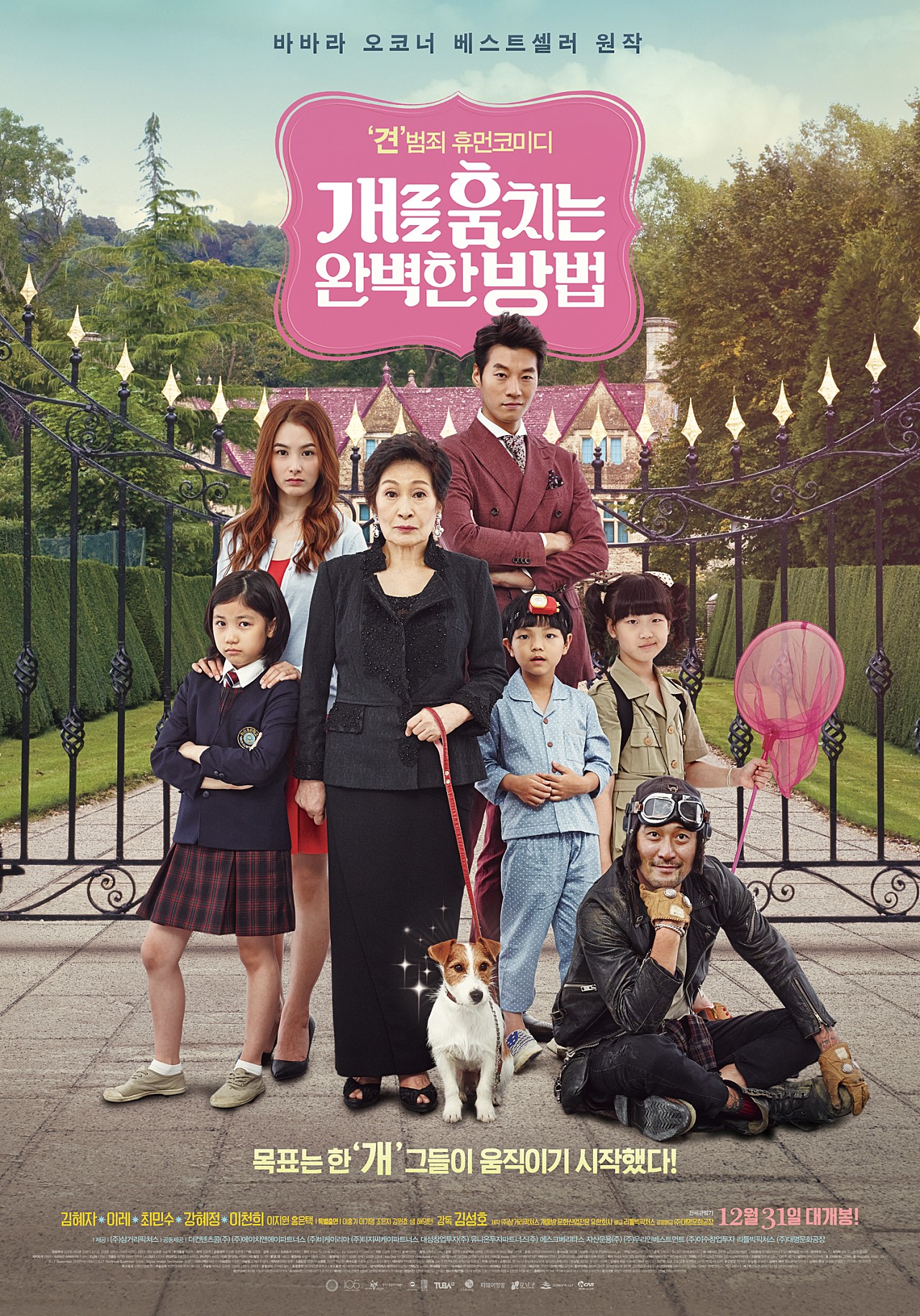
how to steal a dog posterEverything seems so simple to children. The logic maybe surreal, but it is direct. Problems have solutions and there are clear pathways to achieve them even if they seem odd to a more adult way of thinking. Perhaps we’d all be better off if we thought about social issues in the same way children do, though naivety and innocence often prove blindspots in otherwise solid plans. How to Steal a Dog (개를 훔치는 완벽한 방법, Gaereul Hoomchineun Wanbyeokhan Bangbub) is basically a heist movie in which two adorable little girls plan to kidnap a beloved pooch from a rich old lady who will then be only too happy to part with her millions to get it back but it’s also a subtle social satire on class relations and the economic causes of family breakdown in modern Korea.

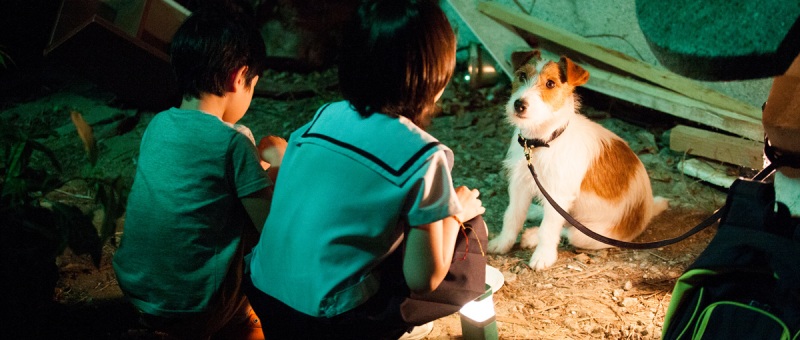
Little Ji-soo (Lee Re) tries her best to put brave face on it, but at home everything’s gone wrong. In fact, they don’t even have a home any more – Ji-soo’s dad’s pizza business failed and he’s run off and left them. Evicted, the family have been living in the old pizza van while Ji-soo’s mum (Kang Hye-jung) has convinced an old flame (Lee Chun-hee) to give her a job as a waitress in a posh cafe. It’s approaching crunch time because Ji-soo’s birthday is coming up and the other kids are expecting to be invited to a party at a house Ji-soo doesn’t have. When she spots an ad for a lost dog which promises a reward, Ji-soo strikes on an idea. Together with a new found friend (Lee Ji-won), she hatches a complicated plan to steal the beloved dog of the grumpy old lady (Kim Hye-ja) who owns the cafe where her mother works and extort enough money to buy a lovely new house for her family where she can have her birthday in style.

Ji-soo’s worldview is both cheerfully innocent and extremely cynical. Sad and lonely with her dad gone, she blames her mother’s fecklessness for their present plight, berating her lack of practicality and failure to get her kids into a proper home in good time. Playing the sensible one for her family of three, Ji-soo is always on the look out for scams and trickery, assuming most people are up to something especially when it comes to innocent little girls. Hence she quickly has the number of the local pizza boy (Lee Hong-ki) who takes orders for family size pizzas but writes regular on the order slips and then pockets the difference from the unsuspecting customer. When she spots an ad in an estate agent’s window for houses at 5 million won she becomes fixated on gaining exactly that amount of money, thinking “per three square metre” is the name of an area and little knowing that 5 million won won’t even buy you a front porch in Seoul let alone an entire house.

Though living in a van is not exactly pleasant, Ji-soo’s problem is more one of social shame than it is of actual discomfort. All the kids at school have already been indoctrinated with class competitiveness and everyone is still talking about the last birthday party, the subject of which is getting a little nervous in case Ji-soo’s house turns out to be nicer than his. No one knows Ji-soo’s dad has run off and they’re living in a van, even the teacher seems curious enough about Ji-soo’s putative birthday party to actively remind her about it and enquire when she plans to make some kind of announcement to her schoolmates.

Thankfully, Ji-soon does eventually learn that money and status aren’t everything. The mean old lady turns out just to be sad and lonely, filled with regrets about a mistake made in her past. The scary homeless man (Choi Min-soo) turns out to be a goodhearted free spirit, and Ji-soo’s mum finally finds her feet after buckling down in an honest yet low paying job which requires a lot of early morning starts. From Ji-soo’s point of view, adults are still a bit rubbish but everything seems to be working out for the best. Oddly pure hearted for a story about dognapping, How to Steal a Dog is a charming, whimsical adventure in which a little girl’s faith in the goodness of the world is finally rewarded, even if not quite in the way she imagined.


Original trailer (no subtitles)