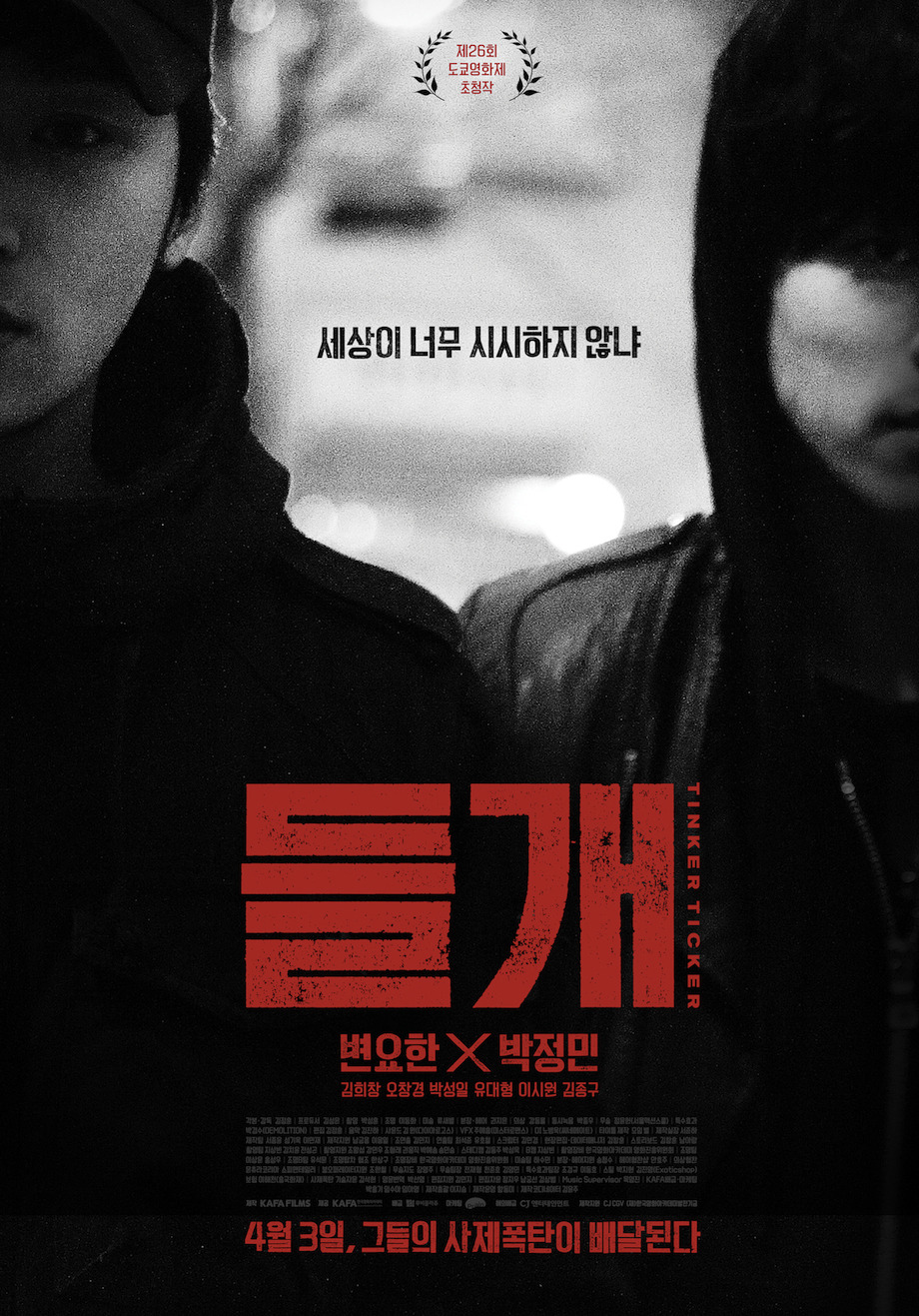
Tinker Ticker (들개, Kim Jung-hoon, 2013)

A jaded young man finds himself torn between continuing to fight the system and a total capitulation to it in Kim Jung-hoon’s explosive debut feature Tinker Ticker (들개, Deul-gae). Fit to explode, Jung-gu (Byun Yo-han) takes his revenge on a bullying culture by literally blowing it to hell but after a spell in juvenile detention emerges meek and mild, lacking in resistance and apparently willing to undergo whatever degradations are asked of him in order to achieve conventional success. 

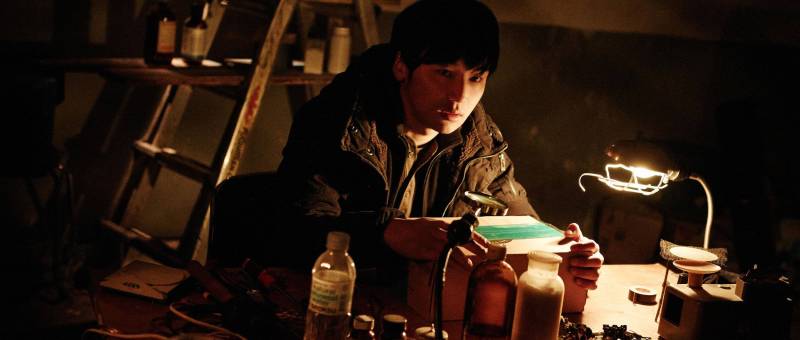
Having placed a bomb in the car of a teacher who was abusive towards him, Jung-gu was caught and sent to prison with the unfortunate consequence that he can no longer study chemistry as he’s been banned from using dangerous substances. He repeatedly attends job interviews where he is asked bizarre and invasive questions, but can only find work as a post-graduate teaching assistant to a marketing professor who, like his teacher, largely abuses his position to humiliate him. To ease his frustrations, Jung-gu makes bombs at home but offers to send them out on the internet for free on the condition that the recipient actually use them.

His life changes when he runs into rebellious drop out Hyo-min (Park Jung-min) who is done with capitulation and fully committed to bucking the system. Seemingly from a wealthy family, he’s cut ties with his parents and lives a squalid life in a bedsit while continuing to attend university lectures despite having been expelled. Jun-gu sends one of the bombs to him to see what would happen and though Hyo-min seemed like he was going to simply throw it away he ends up blowing up a van which ironically has the CJ Films logo on the side.

Hyo-min in a sense represents Jung-gu’s rage and resentment towards the system that oppresses him along with a desire for anarchic autonomy while he conversely leans closer to a conventional corporate existence by willingly debasing himself before his sleazy boss Professor Baek (Kim Hee-chang) who asks him to act unethically by “revising” the results of his research so they can secure funding and do a back door deal with his long-standing contact Mr. Kim. Baek also forces him to drink beer that’s been drained through his sock as part of a bizarre hazing ritual while otherwise running him down or insulting him at the office. 

Hyo-min tries to goad Jun-gu into blowing up his attempts at conventionality by taking out Baek, but he continues to vacillate apparently still interested in becoming a corporate drone whatever the personal cost. “I don’t want you to become dull,” a slightly spruced up Hyo-min later insists in trying to push Jung-gu into killing Baek, while Jung-gu isn’t sure which life he wants torpedo. In any case, he seems incredibly ashamed of his criminal past and wary of others finding out about it not just because of its practical consequences for his employment but on a personal level. If he wants to transition fully to the life of a soulless salaryman he’ll need to kill the Hyo-min within him and remove all traces of resistance and individuality.

Despite having promised to do so, none of the other men who request the bombs actually use them perhaps like Jung-gu lacking the ability to follow through but enjoying the power of having the ability to burn the world even if they’ll never use it. Jung-gu’s bombing fixation is indeed in its way passive, a vicarious thrill in the ability to cause havoc for no real purpose but not really doing anything with it all while his resentment grows in parallel with his desire to be accepted by mainstream society. Hyo-min eventually comes to the conclusion that nothing really changes, and it both and doesn’t for Jung-gu who finds himself succumbing to the consumerist desires of a capitalistic society willing to debase himself, and later humiliate others, to claim his rightful place on the corporate ladder. Kim takes aim at the pressure cooker society, implying that these young men are in themselves almost ready to explode in their twin resentments and jealousies while ultimately complicit in their own oppression in wilfully stepping in to a corporate straitjacket even at the cost of their freedom and individuality. 


Tinker Ticker screened as part of this year’s London Korean Film Festival.

International trailer (English subtitles)
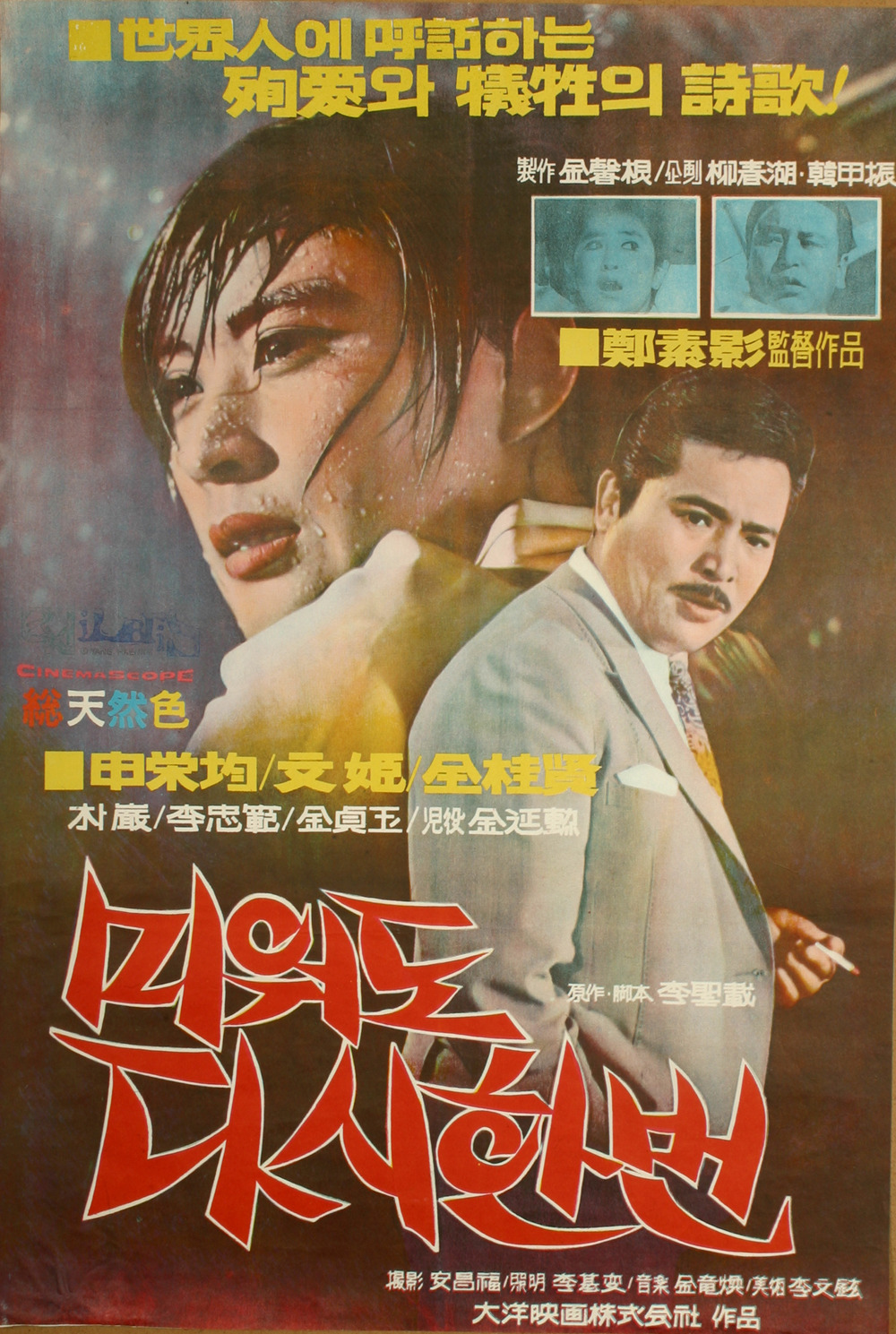
Love Me Once Again (미워도 다시 한번, Jung So-young, 1968)

love me once again posterBy the late 1960s, Korean society was caught in a moment of intense social change. Though under the oppressive authoritarian regime of Park Chung-hee, the strict censorship regulations of the early 1970s had not yet taken effect and the 1962 Motion Picture Law which encouraged a shift towards commercial cinema intended for mass entertainment created a fertile ground for melodrama which itself enabled subtle commentary on modern society. The first in what would become a long running series with two sequels and a number of remakes stretching into the 1980s, Love Me Once Again (미워도 다시 한번, Miweodo Dasi Han Beon) is a prime example. A box office hit and pop culture phenomenon, Love Me Once Again is a somewhat unusual entry the melodrama canon in its broadly sympathetic treatment of adultery and attitude towards children born out of wedlock.

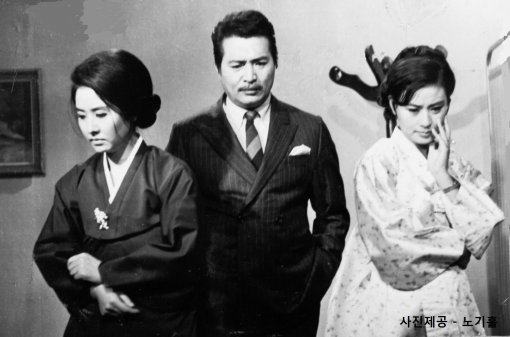
The film begins in the present as family patriarch Shin-ho (Shin Young-kyun) enjoys a pleasant family Sunday fishing with his son and picnicking with his wife (Jeon Gye-hyeon) and daughter but the scene is quickly interrupted by a servant who comes to fetch Shin-ho to greet an urgent visitor to the house. The visitor turns out to be an old friend of Shin-ho’s who has a distressing message for him – Hye-young (Moon Hee), a young woman with whom he had an affair eight years previously, is back in town and would like to meet.

Flashing back eight years, Hye-young is a young kindergarten teacher living in the lodging house where Shin-ho is staying while working away from home. The pair become friends and everyone seems to assume they are a couple, though Shin-ho insists Hye-young is just a friend. Nevertheless, he eventually begins an affair with her leading Hye-young to turn down a marriage arranged by her parents. Though Shin-ho discourages her to do this, Hye-young has no idea he is already married with two children and believes he will marry her at some point in the future. Shin-ho plans to tell Hye-young about his wife but can’t bring himself to do it, allowing her to find out in the worst possible way when his wife arrives with both kids in tow. Realising she’s been duped and feeling in the way, Hye-young takes off without warning leaving only a letter wishing Shin-ho well and letting him know that she is pregnant with his child and intends to raise it alone.

Hye-young is certainly a very “modern” forward thinking woman though she is also morally upright, only embarking on a relationship with Shin-ho because she believes he is the man she will spend her life with. Her family had arranged a marriage for her and express their frustration with Hye-young for not returning home immediately in a letter which also makes plain that they will suffer embarrassment if she refuses the marriage altogether – which she does. When she returns home pregnant with Shin-ho’s child, her brother (who seems to be the head of the family), throws her out. Hye-young’s mother seems more sympathetic, but is powerless to help. Hye-young will have to manage on her own without the assistance of friends or family.

Eight years on she has a lovely little boy, Young-shin (Kim Jung-hoon), whom she has raised alone in hardship but not unhappiness. Encouraged by her brother and seeing how Young-shin looks on enviously at other little boys playing with their fathers on the beach, Hye-young begins to wonder if it might not be better to have Shin-ho raise Young-shin alongside his other two children in a middle-class family home. As Shin-ho’s son he would have a life of material comfort, a paternal input, and be free of the stigma of being the illegitimate child of an unmarried single mother.

Though the situation is difficult, it is handled with calm and maturity on all sides, not least from Shin-ho’s wife who takes a while to think hard on the situation and then agrees to look after Young-shin but only as a full adoption. She asks that Hye-young refrain from writing to or seeing her son, leaving him entirely in the family’s care. Hye-young has made her decision and agrees that may be for the best, even declining the offer of written updates from Shin-ho’s best friend. Once Young-shin has become a part of Shin-ho’s family, his wife truly does her best to make him feel at home as the third of her children, treating him kindly and taking the older two to task for teasing their “baby brother”. The children however are not quite so accepting with Shin-ho’s eldest son particularly hostile, bullying little Young-shin mercilessly even though he has done nothing to provoke his anger other than try to be friends with him. Getting a new little brother is perhaps particularly hard for the children who now have to share everything with a virtual stranger, but despite the efforts of Shin-ho’s wife, she just can’t seem to make them accept him.

Shin-ho, feeling awkward and guilty, is not quite as committed as his wife is to making the new family work. He tries to treat Young-shin as his son, but never quite connects with or makes him feel at home. The major problem is that the family all insist Young-shin must forget about Hye-young and commit fully to his new family as they are committing to him but that’s a lot to ask for an eight year old boy who quite fairly misses his mother and does not understand why he is not allowed to see her. A crisis occurs when Shin-ho angrily confiscates a locket Hye-young had given Young-shin containing her photo as a memento, sending him off on a long journey trying to find a way back to his mother. Being only eight, Young-shin has no idea how to go about finding her bar knowing the name of the town where he used to live. Roaming around the city all alone calling his mother’s name, Young-shin stays out all night. Shin-ho and his wife are sick with worry, searching for him in the pouring rain, but when he finally returns drenched and miserable, Shin-ho treats him only with anger and not with tenderness.

Meanwhile, Hye-young is struggling to come to terms with her decision to “abandon” her son, having bad dreams that Young-shin is being mistreated or is miserable, missing her as much as she misses him. Obeying the family’s request to stay away, Hye-young cannot resist coming to visit and observing from far away, hoping to catch a glimpse of her son and find out if he is well and happy. Unfortunately she turns up just as he’s gone out looking for her and spots him cowering outside Shin-ho’s house, drenched in the rain. Afraid to go near him she urges him to go inside, calling out from the shadows only to be spotted by Shin-ho as she makes her escape.

Rather than wallow in misery, Jung does not refuse the inherent melodrama of the situation but addresses it realistically and with a degree of maturity and patience most real life situations can only aspire to. Hye-young believes that Shin-ho hates herself and her son and will never be able to accept them as members of his family, but even so he does appear to have developed at attachment to Young-shin and hopes that he can maintain contact with him even if it remains clear Young-shin cannot remain in their home. Shin-ho’s wife too makes a point of not blaming Young-shin for her husband’s mistake and displays compassion for Hye-young who meant her no harm and has incurred only suffering as a result of her involvement with Shin-ho. Where most melodramas would punish Hye-young for her transgressions, Jung is kinder to her, never condemning her for her “immoral” behaviour in sleeping with Shin-ho before marriage and making it clear that her decision to live independently as a single woman and raise Young-shin alone is not only valid but correct and to be supported. A controversial attitude for the Korea of 1968 but one which declares itself on the side of modernity rather than adherence to traditions which more often than not create more problems than they solve.


Available to stream for free via the Korean Film Archive’s YouTube Channel.

Petty Romance (쩨쩨한 로맨스, Kim Jung-hoon, 2010)

petty-romanceKorea is quite good at rom-coms. Consequently they make quite a lot of them and as the standard is comparatively high you have to admire the versatility on offer. Korean romantic comedies are, however, also a little more conservative,  coy even, than those from outside of Asia which makes Petty Romance (쩨쩨한 로맨스,  Jjae Jjae Han Romaenseu) something of an exception in its desire to veer in a more risqué direction. He’s too introverted, she’s too aggressive – they need each other to take the edges off, it’s a familiar story but one that works quite well. Petty Romance does not attempt to bring anything new to the usual formula but does make the most of its leads’ well honed chemistry whilst keeping the melodrama to a minimum.

Manhwa artist Jeong Bae (Lee Sun-kyun) is not having much success with his latest project. In fact, his publishing house has been using his submitted drafts as scrap paper. He’s also got a problem in that a gallery owning friend of his late father has been the caretaker of a precious painting left to him in his father’s will but now wants to call in a loan or sell it to get the money back and so Jeong bae is in desperate need of fast cash.

Across town, Da-rim (Choi Kang-hee) has managed to bag a writing gig on her friend’s woman’s magazine but finds herself out of her depth working on a sex advice column when she has no direct experience of love or dating. Given the axe by her friend and living with her moody twin brother to whom she owes money, Da-rim is also in need of something to sink her teeth in to.

When a friend of Bae’s lets him know about a new competition with a $100,000 cash prize it sounds like just what he needs. The only snag is the competition is for “adult” manhwa which has not generally been Bae’s thing. Taking his editor’s advice, Bae decides to work with a writer but most of his interviewees are not exactly what he’s looking for. Da-rim with her “experience” in translation and publishing, as well as her unusual forthrightness concerning the subject matter very much fits the bill.

Kim doesn’t waste much time in getting the two together though their love/hate relationship is a definite slow boil as both Bae and Da-rim spend most of their partnership playing each other to try and get the upper hand. Bae’s trouble, according to his editor, is a talent for action but a failure with narrative – hence the need for a writer. Da-rim, by contrast, has altogether too much imagination coupled with the kind of arrogance which masks insecurity. Having blagged her way into the job, Da-rim spends most of her time ensuring that she’s in a superior position to Bae so that he will have to do most of the work while she enjoys freshly made coffee ordered to distract him from the fact that she has no idea what she’s doing.

Despite coming up with a promising storyline about a sex obsessed female assassin, Da-rim’s naivety is palpable in her attempts to come up with a suitably “adult” atmosphere. Disney-esque scenarios of handsome princes and desert islands, even if spiced up (in the most innocent of ways), isn’t quite striking the tone for the kind of prize winning raunchy manga that the pair are aiming for. Pushed further, Da-rim’s extrapolations from “research” are so unrealistic as to set Bae’s alarm bells ringing but offered with such insistence as to have him momentarily doubt himself.

Kim makes good use of manhwa as a visual device allowing him to include slightly more erotic content than usual in a Korean romantic comedy in an entirely “safe” way. Refreshingly he keeps the usual plot devices to a minimum though there is the “sibling mistaken for lover”, “mistimed job offer,” and “aggressive rival” to contend with, even if the major barriers are entirely centred around the personalities of the protagonists who are each fairly self involved in their own particular ways. Despite making good use of the chemistry generated by previous collaborators Lee Sun-kyun and Choi Kang-hee, Petty Romance lives up to its name in providing enough low-key drama to keep rom-com fans happy but never quite moves beyond the confines of its genre.


Available to stream on Mubi (UK) until 15th March 2017 courtesy of Terracotta Distribution.

Original trailer (English subtitles)