Brave Citizen (용감한 시민, Park Jin-pyo, 2023) [Fantasia 2024]

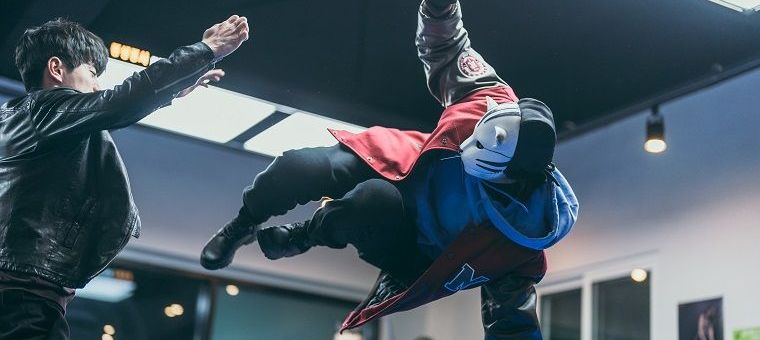
There’s an intentional irony in the mantra teacher Si-min (Shin Hae-Sun) is fond of repeating that “If you do nothing, nothing will happen,” in that on the one hand it means that until people decide to act a dissatisfying status quo will continue, but on the other it may also seem threatening implying that if only you keep quiet nothing will happen to you. The main thrust of Park Jin-pyo’s webtoon adaptation Brave Citizen (용감한 시민) does seem to be that abuses of power take place because so few people are willing to challenge them or indeed to stand up for those who cannot stand up for themselves.

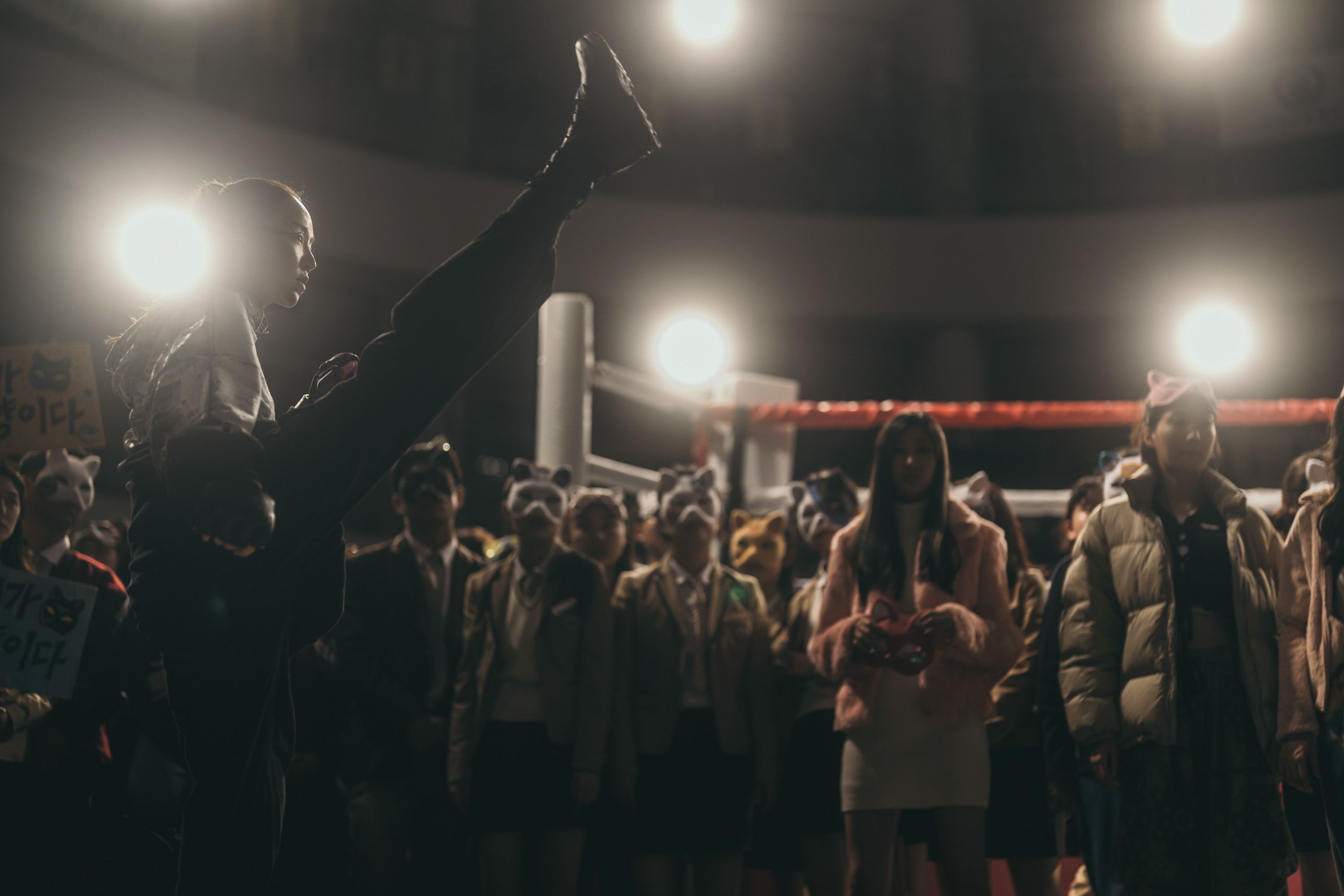
That’s something Si-min discovers when a student comes to her and says he’s being harassed by notorious bully Su-kang (Lee Jun-Young). A former boxer/martial artist, Si-min is on a temp contract and evidently waited quite some time to be offered a position so takes it to heart when her boss, Mrs Lee (Cha Chung-Hwa), warns her not make waves and jeopardise her hopes of being hired full-time. Somewhat cynical she tries to talk herself out of standing up for him, talking herself into turning a blind eye to injustice as nothing to do with her but at the end of the day she isn’t someone who can just sit by and take it nor watch as others are harmed while Su-kang goes unchallenged. 

He’s unchallenged largely due to the socio-economic conditions of contemporary Korea in which the wealthy and well-connected are able to live above the law. When one of Su-kang’s victims tries to report him to the police, they are the ones who end up accused of making a false report while Su-kang gets off scot free because he counts judges and prosecutors among his relatives while his mother is a prominent lawyer. His family apparently also donate large amounts of money to the school, which has won a series of “anti-bullying awards,” which is why he can’t be expelled. Si-min’s predecessor took her own life because of Su-kang’s bullying while pretty much everyone is scared stiff of him.

It’s for these reasons that Si-min turns to violence in the hope of giving Su-kan a little “off-site education” and perhaps you can’t blame her when faced with such intransigence from compromised authority. Yet standing up for the students is also a way of learning to stand up for herself, not to succumb to turning a blind eye to injustice simply because it’s more convenient. It’s this wilful suppression of one’s rage towards the persistent injustices of society that ends up spreading them, a continuous chain of abuse in which people take out their frustrations on those unable to defend themselves like the drunk man who yells at Si-min in the street and comes to realise he’s picked on the wrong person. 

Then again, when questioned why he behaves this way Su-kang only answers that “it’s fun”. It’s difficult to believe he would be insecure in his status, yet he persistently mocks those he sees as socially inferior, “nobodies” and ”hobos”, as opposed to elites like himself. The suggestion is that he and his friends have become this way because of a lack of boundaries and a sense of invincibility, which is partly what annoys him so much about an intervention from an authoritarian figure such as Si-min over whom he has no authority because she has decided not to grant it to him. 

This might be what makes her a “brave citizen,” the name of an award granted to ordinary people working in favour of justice that her father had once won after otherwise ruining his life through unwisely guaranteeing a loan and being left on the hook for paying it back. Embracing the absurdity of the webtoon, Park goes big and bold painting the inequalities of the contemporary society in stark relief while injecting a sense of catharsis into Si-min’s attempts to smack some sense into the bullies while rediscovering her own desire to challenge injustice rather than remain complicit with it even if it is personally inconvenient. Her rebellion encourages others to do the same while robbing the bullies of their privileged position and exposing them to the consequences of their actions. Of course, fighting violence with violence may not be the best solution but does at least allow Si-min to make the most of what she has and to recover the self that had been beaten down and defeated but is now capable of fighting back both for herself and others.


Brave Citizen screened as part of this year’s Fantasia International Film Festival.

International trailer (English subtitles)

I Have a Date with Spring (나와 봄날의 약속, Baek Seung-bin, 2018) [Fantasia 2018]

I have a date with springIf the world was going to end tomorrow, which of your many anxieties would you most like to ease before you go? I Have a Date with Spring ( 나와 봄날의 약속, Nawa Bomnalui Yaksok) is, as its name suggests, a hopeful tale despite its apocalyptic pretence as its lonely film director hero learns to accept the looming presence of death in order to move beyond his creative block. He may need aliens and the promise of knowledge from beyond our world to do it, but in contemplating the many ways in which modern life is unsatisfactory, he can perhaps begin to envisage a world in which it might not be so bad to live.

Depressed director Lee Gwi-dong (Kang Ha-Neul) hasn’t made a film in 10 years. The last decade has seen him struggling with the same script, an apocalyptic tale of the end of the world in which three unhappy individuals are visited by omniscient aliens to help them celebrate their birthdays which happen to fall on the day before the Earth will be destroyed. Sitting in a forest on his own birthday, reminding us that he came here to work and not to die, Gwi-dong is shocked to receive a visitation from four mysterious campers, one of whom claims to be a fan of his earlier work.

The picture Gwi-dong (and by extension Baek Seung-bin) paints of modern Korean society is one marked by extreme loneliness and existential isolation. The death obsessed director is currently sporting a large cast on his arm apparently a result of an act of self harm committed in frustration regarding his own sense of disconnection and personal failure. The three “heroes” of his tales within a tale are all also shy, lonely, and increasingly withdrawn, no longer interested in finding escape from their personal imprisonment. A dreamy high school girl longs for the destruction of the world while a middle-aged professor laments his missed opportunities for romance and a harried housewife feels both guilt and regret in remembering she was once the leader of a militant feminist movement back in college.

Each of them is, like Gwi-dong, “celebrating” a birthday but due to their specific personal circumstances they are each celebrating alone as those close to them are either absent or have entirely forgotten. The aliens, not revealing the imminent destruction of the planet, promise each of them something special in return for trust and time but the gifts they deliver are perhaps not altogether welcome despite their original appearance. The lonely high school girl bonds with the middle-aged alien over a shared sense of childish glee in monsters and adventure, relieved simply to hear the word “friend” but still unsure whether she should trust him and follow his instructions. Meanwhile the housewife, ignored at home by her noisy child and indifferent husband, is glad to be recognised once again and have the power of her youth literally returned to her in the form of a gun but remains unsure if she should use it. The professor, on the other hand, is corrupted by his original encounter but grateful for his “mother’s” gift and commits himself to living fully and finding love despite the potential risks.

As the mysterious older lady at the campsite tells Gwi-dong, we’re all doomed anyway so we might as well go nicely, beautifully – if we can. Through each of his various stories, Gwi-dong learns to see the presence of death, the end of all things, as not such a bad thing after all. It will come, bidden not, and so there seems little point in worrying about it now. Suddenly his creative world expands. No longer thinking only of death he conjures hundreds of other universes each filled with their own stories, certain that one day “spring will come”. Oddly optimistic for a film about the end of the world, I Have a Date with Spring makes the case for reaching out in a sometimes cold world even if it risks being devoured by strange space crabs or suddenly developing painful boils (tiny bubbles of love?) all over your body. You have to go sometime, so you might just as well sit back and see what happens. The Earth is a beautiful place, enjoy it while it lasts.


I Have a Date With Spring was screened as part of Fantasia International Film Festival 2018.

International trailer (English captions/subtitles)

The Truth Beneath (비밀은 없다, Lee Kyoung-mi, 2016)

10_06_15__574b920705d42Politics in South Korea has never been exactly drama-free, though recent times have seen a multitude of storms engulf its top brass running from the national to the personal. Frequent Park Chan-wook collaborator Lee Kyoung-mi’s followup to her acclaimed 2008 debut Crush and Blush, The Truth Beneath (비밀은 없다, Bimileun Eobda) begins as if it’s going fit into the ‘70s dark political thriller mould but gradually shifts gear to present both a bleak family drama and the story of one woman’s descent into the near madness of grief as she attempts to uncover the true circumstances behind her private tragedy even as it plays out on a national stage.

Married to a prominent candidate in a tightly contested electoral race, Yeon-hong (Son Ye-jin) is perfect first lady material save that she’s from an inconvenient home town. Two weeks before the big day, Yeon-hong’s daughter Min-jin (Shin Ji-hoon) does not return from school as expected which, aside from the obvious distress, is not ideal for her father as his political campaign has largely been run on Min-jin’s face and the slogan “I will protect your children”. Jong-chan (Kim Ju-hyeok), Min-jin’s ambitious father, is reluctant to report her disappearance for fear it will hurt him politically and, after all, Min-jin has “disappeared” at times before. Yeon-hong is deeply worried and unable to understand her husband’s indifference to their daughter’s mysterious absence. As time passes, Yeon-hong steps up her investigation becoming ever more suspicious of those around her.

On the surface of things, Yeon-hong had the ideal life with a wealthy, handsome husband, and a nicely turned out, studious teenage daughter. The first glimpse we catch of them is a celebration of the campaign’s launch in which Yeon-hong is furiously cooking away, a motif which is to be repeated with an entirely different sense of celebration some time later. Yet there’s something slightly artificial about the setup even in its beginning as the conversation between the men takes on a barbed, guarded quality while Min-jin lies to her mother even whilst pledging to straighten up now that the campaign is in full swing.

The more Yeon-hong investigates, the more she realises how much of the life she’d been living was careful artifice. Min-jin had gone off the rails before, though perhaps no more than any other teenage girl and given her father’s position, she’d been under a considerable amount of strain. The “friend” Min-jin had claimed to be meeting does not seem to exist and on visiting her school, Yeon-hong finds out that Min-jin had been ostracised by the other girls, even experiencing violent treatment at their hands.

Min-jin had, in fact, eventually embraced her outsider status by forming a performance art-influenced, punk-inspired rock band with a similarly “uncool” girl, Mi-ok. Mi-ok may have been one of the last people to have contact with Min-jin before her disappearance and quickly becomes a person of interest in Yeon-hong’s investigations but whatever it is she’s hiding, it’s clear that there was a whole side of Min-jin’s life that her mother was entirely unaware of.

As Yeon-hong becomes increasingly desperate, she starts entertaining the idea of conspiracy. Her first thoughts turn to her husband’s rival, Noh, an unscrupulous man who may just be capable of kidnapping Jong-chang’s poster girl in order to punch a hole through his opponent’s ill-advised slogan by demonstrating that he can’t even protect his own child, let alone anyone else’s. Then again, how far would her husband be prepared to go in the quest for power? Would his campaign team really kidnap his own daughter to cast suspicion on Noh and win public sympathy? Jong-chang’s ongoing indifference could be easily explained if he already knows the score, but the more Yeon-hong finds out the more she begins to doubt everything she thought she knew about her family.

Son Ye-jin turns in a career making performance in capturing Yeon-hong’s increasingly volatile emotional state. A once elegant political wife, Yeon-hong’s disintegration is manifested in her untidy hair and progressively relaxed dress sense as she becomes ever surer that there is something larger at play than a runaway teen. Yeon-hong defiantly rejects the entirety of her experience through her appearance at a funeral wearing a bright and colourful floral dress almost as if demanding to be seen, remembered, and addressed. No longer will she remain Jong-chang’s silent partner, Yeon-hong’s grief-stricken, maternal fury requires answers and will not rest until the whole of the truth is known.

Lee’s composition is simply stunning making frequent use of dissolves, superimpositions, and a subtle floating of time periods to underline Yeon-hong’s precarious mental state. When Yeon-hong discovers a particularly unpleasant truth, the previously balanced camera suddenly slides into a canted angle, leaving the ordered world of a political thriller behind for a new kind of noir-ish murkiness. Yeon-hong is, literally, unbalanced, wrong footed and wild as she enters into a desperate quest to understand not only the truth beneath the events which have engulfed her, but the essential truth beneath her life. Playing out almost like an inverted The World of Kanako, the Truth Beneath is a similarly bleak tale filled with coldness and duplicity, yet its distressing finale carries with it a fragmentary warmth and the slightest glimpse of hope in the embrace of a motherless child and childless mother.


Reviewed at the 2016 London Korean Film Festival.

International trailer (English subtitles)