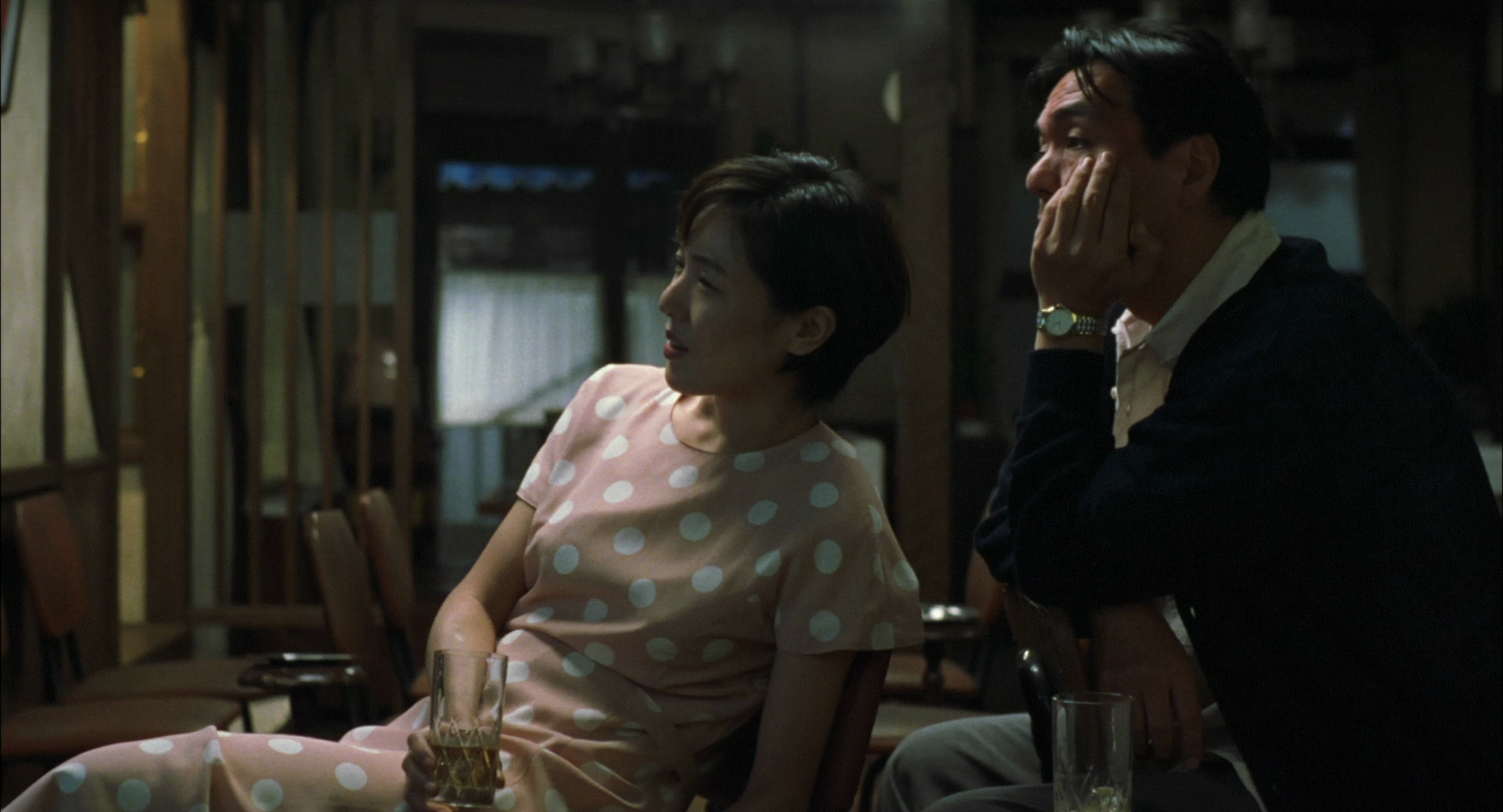
Tokyo Lullaby (東京夜曲, Jun Ichikawa, 1997)

A meditation on lost love and middle-aged regret, Jun Ichikawa’s Tokyo Lullaby (東京夜曲, Tokyo Yakyoku) weaves a melancholy path through a lonely city but finds in it a sense of comfort or perhaps serenity in the gentle rhythms of ordinary lives that somehow become something greater. A diffident translator in love with an unhappily married middle-aged woman slowly uncovers a deep well of unresolved longing largely thanks to those around him who will remember for those who do not wish to speak. 

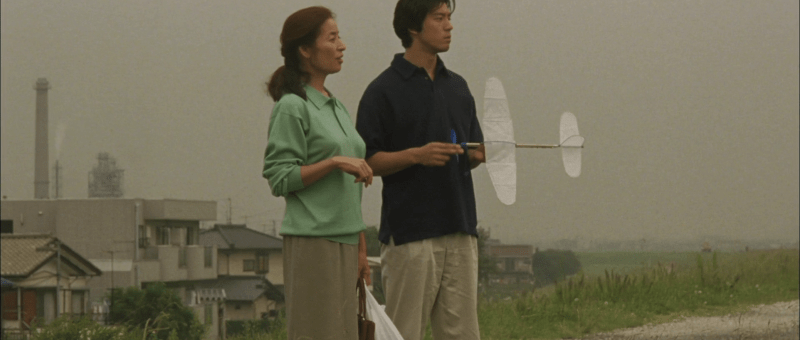
Ichikawa signals his intentions early on, transitioning from a nighttime shot of the city to a small cafe where a woman is sitting in the foreground looking forlorn while customers behind her discuss the reappearance of Koichi (Kyozo Nagatsuka), the son of the man who owns the electronics store opposite, who had walked out on his family several years previously but has abruptly returned. From this short scene, we can perhaps infer that there is some connection between Koichi and the woman, Tami (Kaori Momoi), though we aren’t quite sure what it is. In any case, the cafe, which bears the name of her late husband Osawa, becomes a kind of nexus uniting the lives of the various community members who each come there to play go and discuss the past. 

Like Tami, Koichi is reticent and melancholy. He says nothing of where he’s been and his wife, Hisako (Mitsuko Baisho), asks him no questions. She later tells the writer, Tei, whose affections she does not return, that she doesn’t really care about how Koichi is living his life because she is busy living her own and likes to do as she pleases. His sister asks him if he plans to stay this time, but Koichi can’t answer her seemingly uncomfortable in himself and unable either to stay or to go. Walking on crutches his injured foot seems to symbolise his emotional unsteadiness literally unable to find sure footing or move forward with his life. 

Piecing the tale together, Tei figures out that Koichi and Tami were once together but she suddenly married someone else who had a terminal illness and passed away shortly afterwards around the time that Koichi first went walkabout. Hisako, meanwhile, had been in love with Osawa though he loved Tami who did not love him. Somehow it’s all very complicated and incredibly simple, the way they’ve sabotaged their own lives and happiness though it couldn’t have been any other way. Tei watches something similar play out in the neighbourhood. One of the young men who works at the electronics shop had been dating a girl who worked at the record store, but he abruptly begins pursuing Ng, a Chinese woman who works at the cafe, and eventually marries her leaving the record store girl heartbroken. 

Things change and they stay the same. Ng takes over the cafe, Koichi’s foot heals while he also manages to resurrect the family business by turning it into a shop that video games as if taking a symbolic step into modernity that suggests this time he’ll stay just as Tami decides it’s time for her to leave. Paths cross endlessly, Ichikawa frequently cutting away to tiny vignettes of other cafe goers as their stories weave through each other, each one note in the great symphony of the city without which life would be impossible. Yet what’s more important is what is not said, the silences that exist between people and perhaps within them too. Things that are understood, and those which are not. 

Tami explains that she looked for answers but all she found was junk until the relief of boredom became her only frame of happiness. Only by escaping the city does it seem that she’ll be happy while Koichi seems as if he’s getting itchy feet and Tei, joining the cycle, decides to move on rather than remain in painful proximity to Hisako who as she said has her own life and does not seem to want to share it with anyone much less him. The pain of the past cannot fully be healed, only borne amid the cheerful scenes of city life, children playing, people doing business, the sun shining and elderly couples meeting in cafes. Pain and loneliness seem to be the natural conditions of urbanity, but Ichikawa paints them with a kind of rosiness, merely the sadness that unpins the lullaby of a city which is always changing yet remains the same in its unwalled alleyways and those that exist only in the deepest recesses of memory. 


Original trailer (no subtitles)
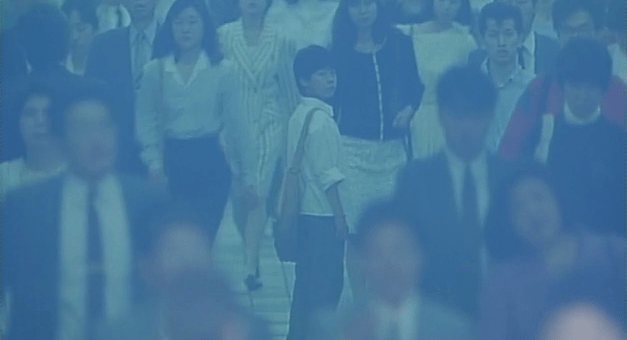
No Life King (ノーライフキング, Jun Ichikawa, 1989)

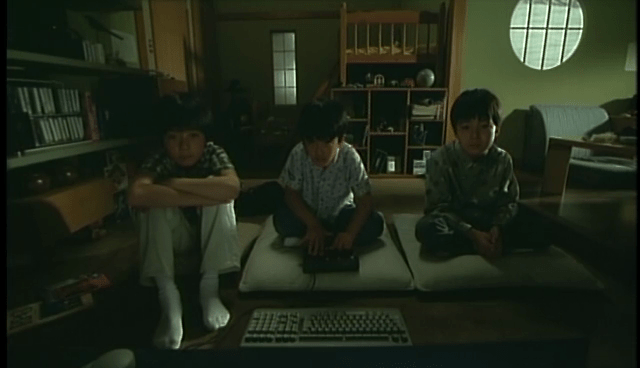
Taking place at the tail end of the Bubble era and on the eve of a technological revolution, Jun Ichikawa’s No Life King (ノーライフキング) in many ways anticipates the world we have today in which much of our communication has already become digitised. The cult-like speech of the next-gen guru who pops up towards the film’s conclusion may have eerie ring to it, but he has a kind of point in his talk of “new children” who will become “new adults” in a new digital world that was then only just becoming a reality. 

As someone later says, “the problem is not video games” though many seem to assume it is. The hero, Makoto (Ryo Takayama), whose name means “truth”, is one of a group of five boys obsessed with Nintendo console gaming. A game series known as Life King has become so popular that hundreds of youngsters camped out all night waiting for the release of the fourth instalment. The only problem is that the game seems to be unbeatable, and Makoto’s young friends begin to hear rumours that some of the cartridges are “cursed” with an alternate “No Life King” version that means death for players who cannot finish the game. 

The “curse” reflects a confusion that is beginning to emerge over what is “real” and what is “virtual” in an era of rapid technological development. The kids begin to worry that if you die in the game you die for real, while otherwise becoming obsessed with all kinds of urban legends relating to mysterious deaths and conspiracy theories such as that of the actor who plays tokusatsu hero Pris secretly being dead and that all the collectible Pris pencil erasers you can get from gachapon machines are cursed with the resentment he felt as he died. Some would be keen to dismiss this kind of thing as silly things kids say, but then Makoto’s mother also suggests that cakes from the bakery the family of his classmate Noriko owns are “cursed” as customers have been coming down with food poisoning after eating them. According to the guru’s assistant Mizuta (Neko Saito), the rumours are having a serious economic impact and have led to delays in product launches and construction projects in addition to provoking a politician’s resignation. 

Then again, the film seems to wonder if it’s the Bubble-era economy which is the enemy. While Makoto plays video games on his own but chats to his friends doing the same thing via telephone headset, his mother often works late into the night staring at a computer screen in their home. Makoto attends a summer cram school where all of the work is done via computers linked via a primitive version of the internet. The teacher is present but cannot actually see any of the children and they can’t see him. Questions are asked and answered via the interface rather than directly, though the computer network of cram school students does eventually allow Makoto to get in touch with other “new children” who are just as worried about the cursed game as he and his friends are while the adults respond by taking their consoles away which of course denies them the ability to lift the curse by beating the game. 

The “curse” itself may symbolise mortality, though obviously the children will still someday die regardless of whether they beat Life King IV because life itself is an unwinnable game. “The problem is…” the opening text crawl explains, “the battle has begun. It is unlikely to end until you die.” The same words are uttered by Makoto’s principle only he substitutes “video games” for the second part of the sentence before dramatically falling backwards just like the stricken king of the game while Makoto and the other kids are lined up almost identically to the ranks of soldiers amassed in front of him. This moment of symmetry links back to a line from the guru Akiyuki Mori who hints at a new world in which life and death exist simultaneously. It is this new world that “new children” must learn to adapt to as they grow with technology.

“It’s scary, but we’ll die if we can’t lift the curse” Makoto tells one of his online buddies and eventually becomes an accidental folk hero with the other kids looking to him to free them by beating the game. Graffiti tags go up all over the city reading, “hang in there, Makoto”, while he becomes preoccupied by the nature of the “real” as related to him by Mori and his assistant Mizuta who begin to view him as something like a prophet or at least the first of the “new children” to enter the “new real” in which the distinction between the “real” and “virtual” has disappeared. Fearing for his mortality, Makoto saves himself in the digital space by writing a bio and saving it to floppy disc much as a hero who died in the game was immortalised in stone so that no one would ever forget that he existed. 

By the film’s conclusion, “real life” has become a kind of game as evidenced by the advice of Makoto’s cram school tutor that he try and raise his score by 20 points to increase his chances of getting into a higher level institution. The mysterious boy somewhere on another computer tells him to go and look around outside at which point he wanders through the contemporary city and sees it with new eyes. “It is all real” he concedes, catching sight of Mori and his assistants in the crowd just as we start to wonder if this really is “reality’ after all. Then again, perhaps the best lesson the boys learn is from one of their grandfathers who simply “kept living until he died”. Ichikawa captures a sense of technological anxiety in the uncanny eeriness of the “real” world around the boys but is perhaps less pessimistic about the new age that awaits them in the solidarity that exists between the “new children” despite the seeming indifference of the adults incapable of understanding the anxiety that engulfs them.


Bu Su (BU・SU, Jun Ichikawa, 1987)

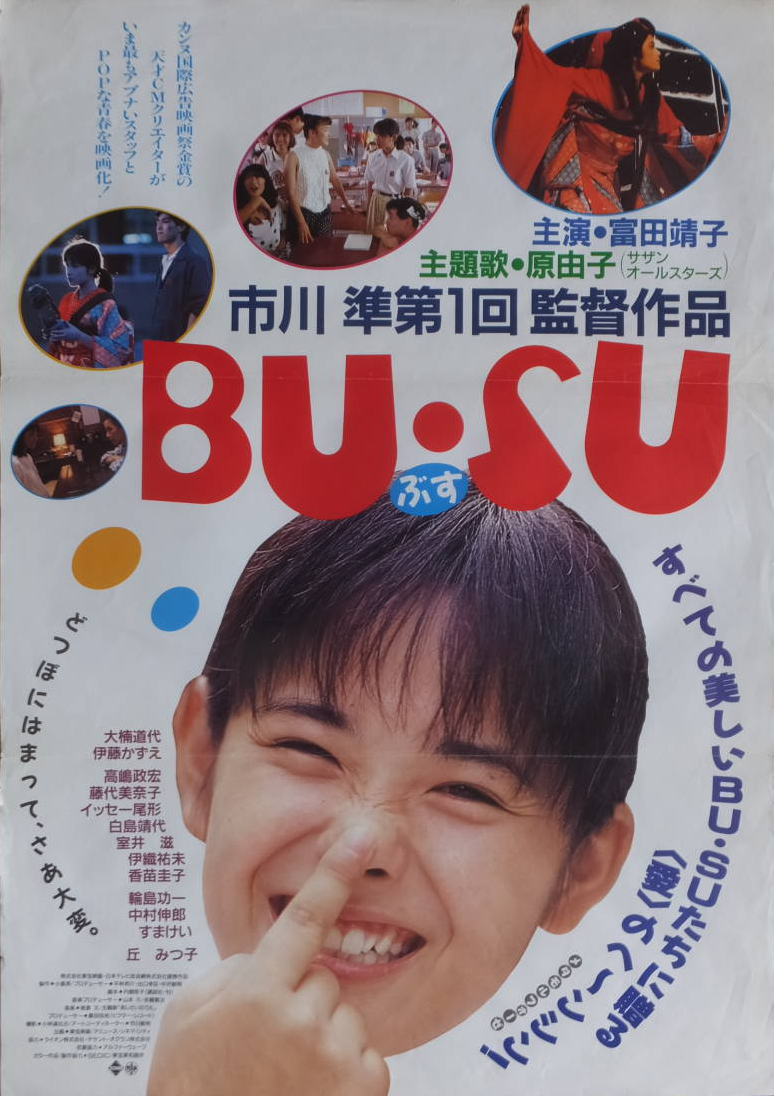
Busu poster 2Already a well respected and much in demand director of television commercials Jun Ichikawa released his debut feature, Bu Su (BU・SU), in 1987. “Bu Su” is, loosely translated, pejorative slang for a woman who is not considered to be attractive. The closest equivalent, in British English at least, would be something like “a dog”. It’s especially ironic then that the movie was conceived as a vehicle for a popular idol whose success was perhaps dependent on a perception of attractiveness, or at least of “kawaii” innocence. Yasuko Tomita was at that time at the height of her fame having shot to stardom through open audition leading to an award winning role in Aiko 16 Sai. Two years later she starred for Nobuhiko Obayashi, who was originally slated to direct Bu Su, in Miss Lonely, but even in comparison to Obayashi’s melancholy heroines, Bu Su’s Mugiko (Yasuko Tomita) is a particularly moody teen, the “ugliness” here apparently relating to her emotional isolation.

For reasons we never quite understand, Mugiko leaves her island home after a traumatic incident and moves in with her aunt in Tokyo with the intention of becoming a geisha. It seem’s Mugiko’s mother was once a famous geisha herself until she met Mugiko’s late father and left for a more conventional life in the peaceful countryside. Mugiko’s flight then has a peculiarly perverse quality in being both to and from her mother with whom she seems to be on bad terms despite her mother’s obvious affection for her. Unfortunately Mugiko is not a fantastic fit for the world of the geisha, being somewhat innocent and childishly clumsy, not to mention her ongoing grumpiness. Nevertheless, everyone at the geisha house is keen to help her if only out of loyalty to her mother.

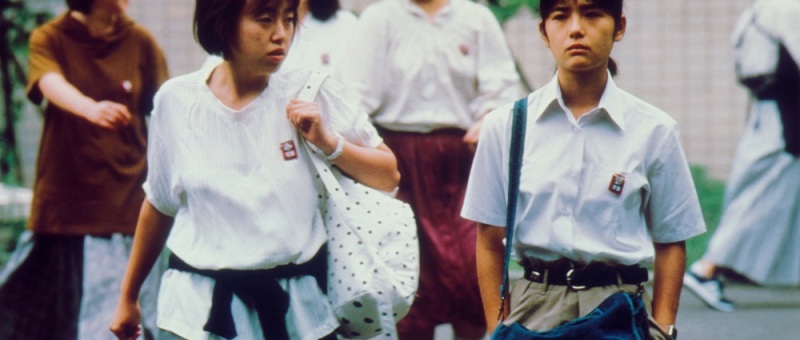
At school, meanwhile, Mugiko is nervous and withdrawn, barely audible during her introduction to her new classmates and with her eyes permanently on the floor. Her teacher, taking her aside, adds to the mystery in remarking that she’s certainly been through a lot back in Izu and that she should leave all that behind and try to make a new start. Nevertheless, she remains sullen and isolated, barely speaking to anyone yet perhaps examining the dynamics of the people around her. Maybe that’s why she alone finds the strength to stand up to a popular kid bullying another girl (Yuriko Hirooka) considered to be “plain” with a mean trick teasing a nasty surprise lurking in a box which turns out to be nothing more than a hand mirror.

Mugiko might not be quite sure what it is that’s worrying her, or at least we can’t be sure because we don’t know exactly what happened in Izu, but the rest of her classmates have their own insecurities to deal with from Sakurako’s preoccupation with her perceived lack of looks to boxing enthusiast Tsuda (Masahiro Takashima) who knows he’s not much for studying but is less than convinced of the possibility of living off his fists. What they’re going through is the normal teenage process of figuring themselves out, which they begin to do through the time-honoured fashion of the school cultural festival which is an extra special event this year because it’s the school’s centenary. Goaded into it by the mean popular girl who meant to embarrass her by outing her as a geisha, Mugiko agrees to dance the dance of Yaoya Oshichi who was prepared to burn the world in the hope of meeting her love.

Yaoya Oshichi was burned at the stake for arson, and though Mugiko’s path eventually ends in flames they’re of a much less threatening variety. When she first arrives in Tokyo we see her taking in some of the iconic sights of the city, crossing at Shibuya Scramble and taking a stroll through upscale Ginza before taking a bite out of a fast food hamburger as if she were about to taste some famous local delicacy. When not training with the other geisha we see her wander through the city alone, sullen but also taking pleasure in exploring her new environment. It’s here that we hear the film’s title uttered, crudely, by a sleazy middle-aged man who picks Mugiko up and takes her to a coffeeshop where he embarks on weird chat up lines about the beauty of the local railway before trying to drag her into a love hotel. Luckily, Mugiko manages to get away from him only for the man to shout “busu” after her, implying that he didn’t want her anyway but also that her refusal is in someway arrogant.

By Ichikawa’s logic, Mugiko’s “busu”ness is not because she’s “ugly” but that she’s so sour faced, permanently sulky and angrily keeping a deliberate distance from everyone around her. We see her spikily refuse her mother’s tearful attempt to see her off to the train, and then speak rudely to her on the phone, while remaining aloof from most of the other geishas save her aunt’s daughter, primed to take over the business but unbeknownst to most longing for a more conventional life with a boring salaryman husband. Yet through all of these encounters, some friendlier than others, her heart finally begins to open and she’s no longer so closed off or aloof, eventually able to laugh along with her mother and pithily dismiss her questions with the generic answers that Tokyo is “fun” and yes she’s going to school. Mugiko’s path is certainly a meandering one, taking the scenic route through the charms of bubble era Tokyo, but it has its charms and even if she takes her time she gets there in the end, smiling at last having rediscovered the joys of being alive.


Short clip (Japanese subtitles only)

https://www.youtube.com/watch?v=1PDPc0W-kr8