Hakkenden (八犬伝, Fumihiko Sori, 2024)

Kyokutei Bakin thinks he’s a hack who writes inconsequential pulp that will be forgotten faster than yesterday’s headlines. He’d never believe that people hundreds of years later would still be talking about his work. Yet he may have a point in his conviction that people crave simple stories where good triumphs over evil specifically because the real world is not really like that and a lot of the time the bad guys end up winning. But does that mean then that all his stories are “lies” and he’s irresponsible for depicting the world not the way that it is but the way he wants it to be? 

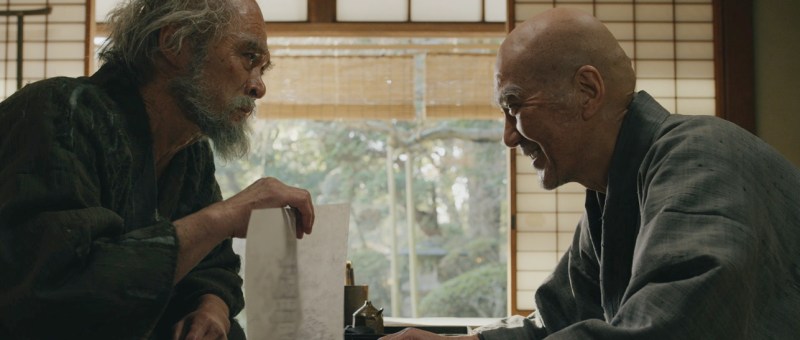
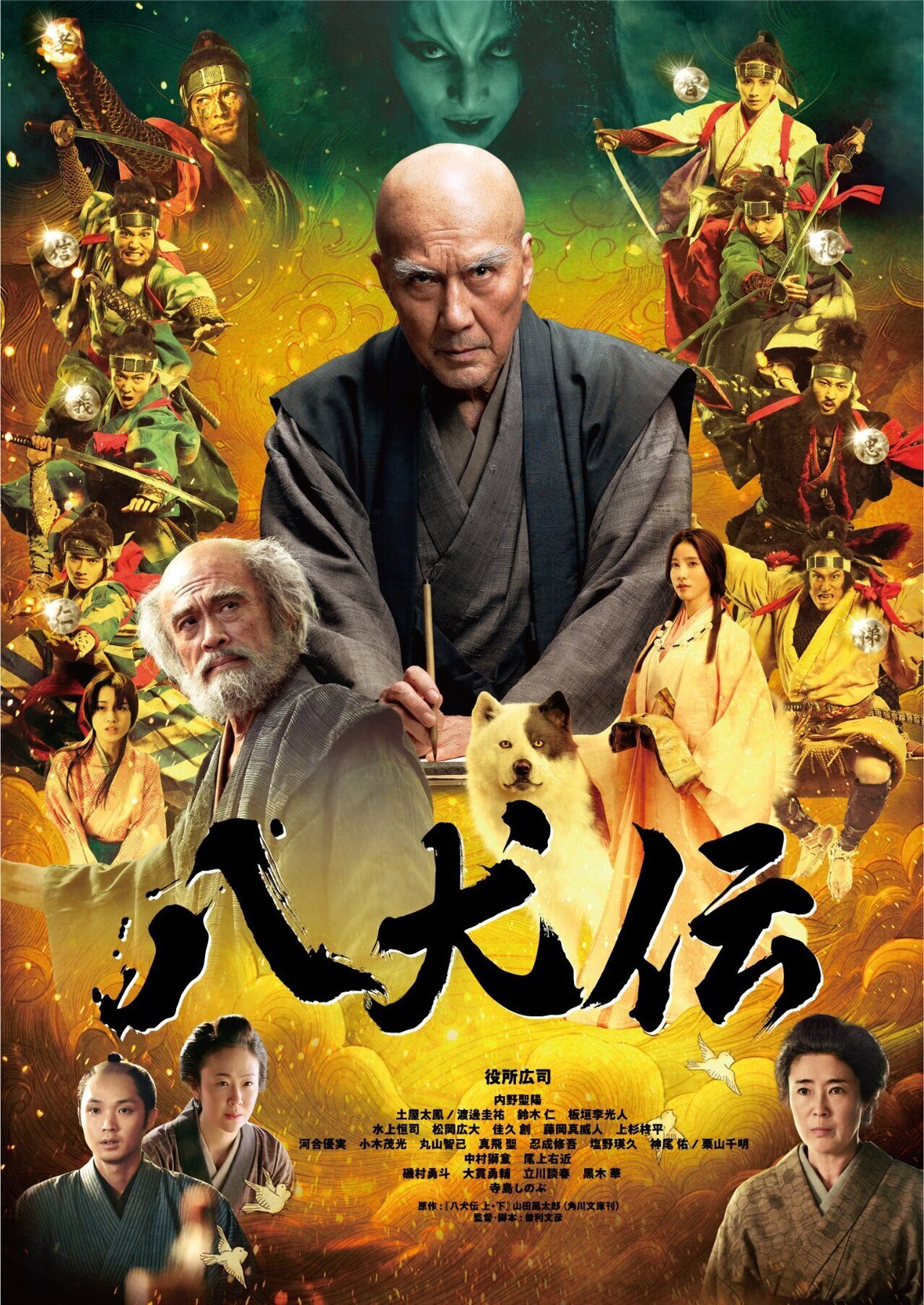
Fumihiko Sori’s Hakkenden (八犬伝) is on one level an adaptation of the famous tale probably most familiar to international audiences as The Legend of the Eight Samurai, and also a story of its writing and the private doubts and fears of its author. In dramatising the tale, Sori plays fantasy to the max and revels in Bakin’s outlandishness. An unusually picky Hokusai (Seiyo Uchino), Bakin’s best and he claims only friend and unwilling collaborator, points out that his use of guns is anachronistic because they didn’t come to Japan until 60 or 70 years after the story takes place but Bakin doesn’t care. He says people don’t notice things like that and all they really care about is that good triumphs in the end, so he’ll throw in whatever he feels like to make a better story. In any case, the tale revolves around magical orbs, evil witches, dog gods and good fairies, so if you’re worrying about there being guns before there should be, this isn’t the story for you. 

Hokusai is also shocked that Bakin has never been to the place where the story is set, but as he tells him it all happened long ago and far away so going there now would be pointless. Even so, Hokusai needs to see what he draws which is why he spends half his life on the road costing him relationships with his family. Whatever else anyone might say about him, and he admits himself to being a “difficult” person, Bakin is very close to his family even if his wife yells at him all the time for being rude to influential people and not making any money when he could have just taken over her family’s clog-making business rather than carry on with this writing malarkey. His biggest ambition is that his son become a doctor to a feudal lord and thereby restore their samurai status which on one level points to a kind of conservatism that doesn’t matter to Hokusai and singles Bakin out as a tragic figure because the age of the samurai is nearing its end anyway. 

In his fantasy, however, he hints at and undoes, up to a point, injustices inflicted on women in the romance between Shino (Keisuke Watanabe) and Hamaji (Yuumi Kawai) who is almost forced into a marriage with a wealthy man because of her adoptive parents’ greed but is finally revealed to be a displaced princess and returned to her father who is thereby redeemed for having accidentally killing his other daughter in a mistaken attempt to control her after accidentally promising her in marriage to a dog god without really thinking about what he was saying. A neat parallel is drawn in a brief mention of Hokusai’s artist daughter Oi and Bakin’s daughter-in-law Omichi (Haru Kuroki) who did not receive an education and is almost illiterate but finally helps him to complete the story by transcribing it in Chinese characters he teaches her as they go after he loses his sight.

As his literary success increases, Bakin’s own fortunes both improve and decline. He becomes wealthier and moves to nicer houses in samurai neighbourhoods, but his son Shizugoro’s (Hayato Isomura) health declines and he never opens his own clinic like he planned while remaining committed to the idea that his father is actually a great, unappreciated artist. In a way, completing the story gives Bakin a way to say the world could be kind and just even if it has not always been so to him. He needs to maintain the belief in a better world in order to go living even if he feels it to be inauthentic while his life itself is a kind of fiction. On a trip to the theatre, he ends up seeing Yotsuya Kaidan and is at once hugely impressed and incredibly angry. The world that Nanboku sees is the opposite of his own. People are selfish and greedy. The bad are rewarded and the innocent are punished. Yet perhaps this is the “reality” of the way the world really is, where as his work is a wishful fantasy. All he’s doing is running away from the truth. But then, as his son’s friend tells him, if a man devotes himself to the ideal of justice and believes in it all his life, then it becomes a reality and ceases to be fiction. There is something quite poignant about the dog soldiers coming to take Bakin to the better world he dreamed of where bad things happen but good always triumphs in the end, which has now indeed become a reality if only for him.


Hakkenden screens 13th June as part of this year’s Toronto Japanese Film Festival.

Original trailer (no subtitles)
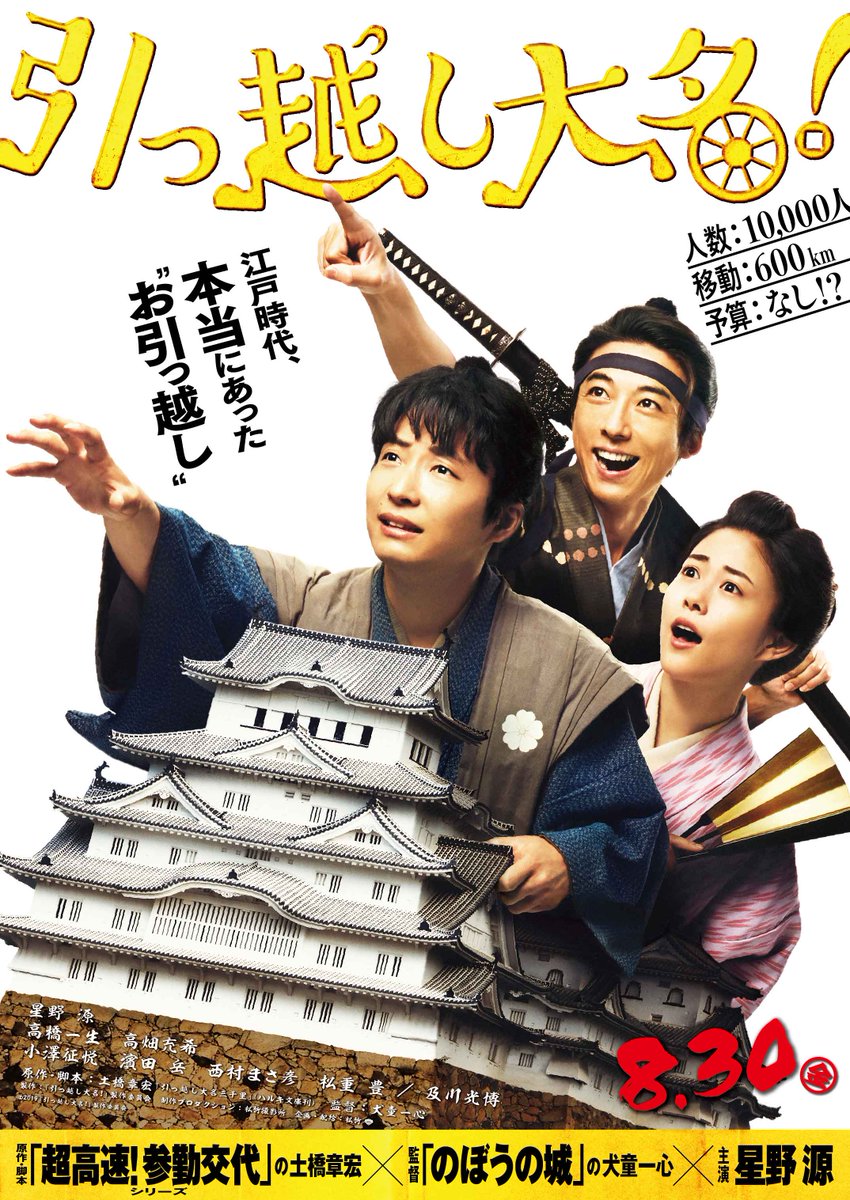
Samurai Shifters (引っ越し大名!, Isshin Inudo, 2019)

Samurai Shifters poster 1Forced transfers have been in the news of late. Japanese companies, keen to attract and keep younger workers in the midst of a growing labour shortage, have been offering more modern working rights such as paid parental leave but also using them as increased leverage to force employees to take jobs in far flung places after returning to work – after all, you aren’t going to up and quit with a new baby to support.

As Isshin Inudo’s Samurai Shifters (引っ越し大名!, Hikkoshi Daimyo!) proves, contemporary corporate culture is not so different from the samurai ways of old. Back in the 17th century, the Shogun kept a tight grip on his power by shifting his lords round every so often in order to keep them on their toes. Seeing as they had to pay all the expenses and handle logistics themselves, relocating left a clan weakened and dangerously exposed which of course means they were unlikely to challenge the Shogun’s power and would be keen to keep his favour in order to avoid being asked to make regular moves to unprofitable places.

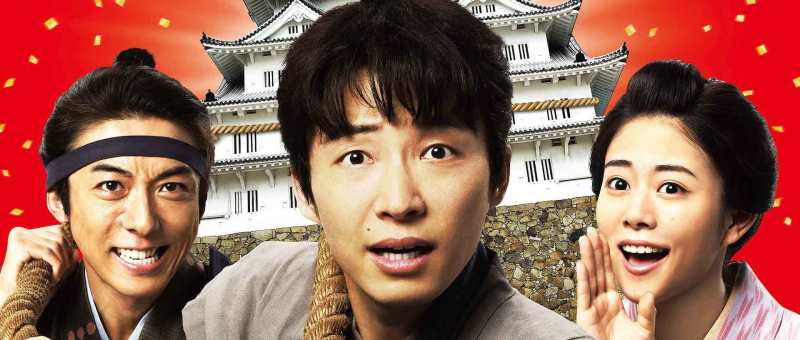
When the Echizen Matsudaira clan is ordered to move a considerable distance, crossing the sea to a new residence in Kyushu which isn’t even really a “castle”, they have a big problem because their previous relocation officer has passed away since their last move. Predictably, no one wants this totally thankless job which warrants seppuku if you mess it up so it falls to introverted librarian Harunosuke (Gen Hoshino) who is too shy refuse (even if he had much of a choice, which he doesn’t). Unfortunately for some, however, Harunosuke is both smart and kind which means he’s good at figuring out solutions to complicated problems and reluctant to exercise his samurai privilege to do so.

In fact Harunosuke is something of an odd samurai. As others later put it, he doesn’t care about status or seniority and has a natural tendency to treat everybody equally. When the head of accounts advises him to take loans from merchants with no intention to pay them back, he objects not only to the dishonesty but to the unfairness of stealing hard-earned money from ordinary people solely under the rationale that they are entitled to do so because they are samurai and therefore superior. Likewise, when he finds out that his predecessor was of a lower rank and that all his achievements were credited to his superiors he makes a point of going to his grave to apologise which earns him some brownie points with the man’s pretty daughter, Oran (Mitsuki Takahata), who was not previously minded to help him because of the way her father had been treated.

Harunosuke’s natural goodness begins to endear him to the jaded samurai now in his care. Though they might be suspicious of some of his methods including his “decluttering” program, they quickly come on board when they realise he is not intending to exclude himself from his ordinances and even consents to burn his own books in order to make it plain that everyone is in the same boat. He hesitates in his growing attraction to Oran (who in turn is also taken with him because of his atypical tendency to compassion) not only because of his natural diffidence but because he feels it might be selfish to pursue a romance while urging everyone else towards austerity.

Meanwhile, “romance” is why all this started in the first place. The lord, Naonori Matsudaira (Mitsuhiro Oikawa), is in a relationship with his steward (something which seems to be known to most and not particularly an issue). While he was in Edo, he rudely rebuffed the attentions of another lord, Yoshiyasu Yanagisawa (Osamu Mukai), who seems to have taken rejection badly and has it in for the clan as a whole. In an interesting role reversal, his advisor laments that perhaps it would have been better for everyone if he’d just submitted himself, but nevertheless a few thousand people are now affected by the petty romantic squabbles of elite samurai in far off Edo.

Bookish and reticent as he is, Harunosuke sees his chance to “go to war against the unjust Shogunate” by engineering a plan which allows them to reduce the burden of moving, reluctantly having to demote some samurai and leave them behind as ordinary farmers with the promise that they will be reinstated as soon as the clan resumes its former status. Asking the samurai to drop their superiority and carry their own bags for a change has profound implications for their society, but Harunosuke’s practical goodness eventually wins out as the clan comes together as one rather than obsessing over their petty internal divisions. A cheerful tale of homecoming, friendship, and warmhearted egalitarianism, Samurai Shifters is an oddly topical period comedy which satirises the vagaries of modern corporate culture through the prism of samurai-era mores but does so with a wry smile as Harunosuke finds a way to live within the system without compromising his principles and eventually wins all with little more than a compassionate heart and a finely tuned mind.


Samurai Shifters screens in New York on July 21 as part of Japan Cuts 2019.

Teaser trailer (English subtitles)