Brand New Landscape (見はらし世代, Yuiga Danzuka, 2025)

Do we inhabit spaces, or do the spaces inhabit us? Yuiga Danzuka’s autobiographically inspired Brand New Landscape (見はらし世代, Miwarashi Sedai) situates itself in a haunted Tokyo which is forever remaking itself around its inhabitants like a constantly retreating cliff edge that leaves them all rootless and in search of a home that no longer exists. Some long for a return to the past and wander endlessly, while others defiantly refuse to look back and are content to let history eclipse itself in a journey towards an ineffable “new”.

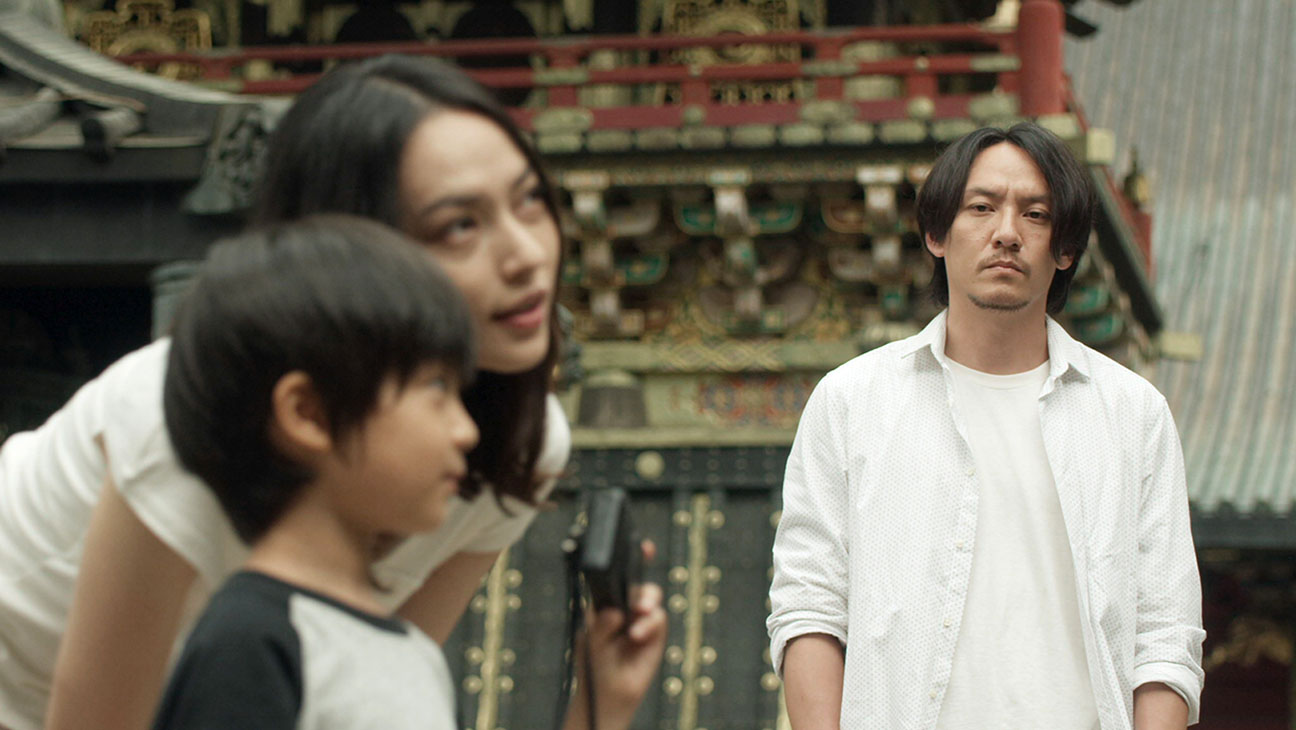
These imprinted spaces come to represent the disintegration of a family torn apart by their shifting foundations. Ten years previously, Ren (Kodai Kurosaki) and Emi’s (Mai Kiryu) mother, Yumi (Haruka Igawa), took her own life during a family holiday after their father Hajime (Kenichi Endo) told her that, despite his promises, he would be returning to Tokyo to pursue a work opportunity. “It’s pointless to go back and forth like this,” he remarks with exasperation, making it clear that he’ll be going no matter what she says. Rather than simply being a workaholic, Hajime is a deeply selfish person who doesn’t much care how other people are affected by the decisions that he makes. He wants this opportunity to prove himself and acts out of a mixture of vanity and a desire for external validation through professional acclaim rather than the love of his family. He claims he’s doing this for them, that the opportunity will provide additional financial security and a better quality of life for his children, but Yumi replies that they don’t need any more money. All she wanted was family time, albeit within this artificial domestic space of a rented holiday villa by the sea.

Three years after their mother’s death, Hajime left the children to chase opportunities abroad and they haven’t seen him in years. Younger son Ren is now working as a floral delivery driver for a company selling expensive moth orchids. It’s on a job that he first learns that Hajime has returned and is holding an exbitiion of his work that includes the controversial Miyashita Park redevelopment project designed to fuse the natural space of the park with a commercial centre the exhibition’s copy describes as a symbol of the “new” Tokyo. It also, however, required the displacement of a number of unhoused people who were living in the park in order to provide space for upscale outlets such as Louis Vuitton and Gucci. When Hajime accepts the opportunity to work on another such project, a young woman on his team voices her concern. She asks him where these unhoused people are supposed to go, but Hajime says it’s not his problem. It’s for the authorities to decide. She asks him if he’s considered the effect taking on such a large project will have on their team when the company is already working beyond its limit, but he gives her all the same excuses he gave Yumi that make it clear he’s not interested in the needs and well-being of his employees just as he wasn’t interested in those of his family. “It’s pointless going back and forth,” he tells her while trying to sound sympathetic but really emphasising that his decision is made and nothing she could say would sway him from his course.

Maybe, to that extent, oldest daughter Emi is much the same in that she’s decided she doesn’t want to see her father and resents Ren’s attempts to force her into doing so. She’s about to move in with her boyfriend and looking ahead towards marriage, but also prone to “low energy” days like her mother and anxious in her relationships, fearful that like that of her parents’ they can only end in failure. Ren, meanwhile, struggles with authority figures like his ridiculous boss who tries to assert dominance by giving him a public telling off about the non-standard colour of his hip pack, and then yells at him that he’s fired only to chase him out of the building throwing punches when Ren calmly replies that shouting only makes him look silly. In the midst of the drama, another young woman states her own intention to quit, politely bowing to everyone except one particular man before walking out the other door towards freedom as if to remind us that there are countlessly other stories going on in this city at the same time.

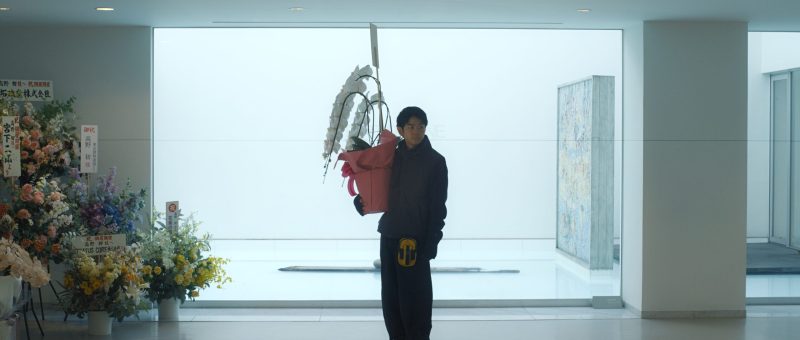
There’s a moment when Ren is delivery the orchids that he just stands there holding them, like he doesn’t know where to go or what to do. He’s lost within this space and is unable to find his way back within a Tokyo that’s always changing. In an attempt to find some sort of resolution, he drives Emi back to the service station where they had their final meal as a family, only their mother’s chair remains painfully empty. A perpetually falling ceiling light hints at the unreliability of these spaces. It isn’t and can’t ever be the same place it was before and has taken on new meanings for all concerned. Ren stares up at the Miyashita Park development as if caught between admiring his father’s achievement, wondering if it was worth it, and mourning the loss of everything it eclipsed in building over the past with a “new” that will quickly become the “old” and then be rebuilt and replaced. Nevertheless, he has perhaps begun a process of moving on even if for him moving forward lies in looking back.


Brand New Landscape screens as part of this year’s San Diego Asian Film Festival.

Original trailer (no subtitles)

Ring Wandering (リング・ワンダリング, Masakazu Kaneko, 2021)

“Don’t forget me” pleads a mysterious young woman guiding the hero of Masakazu Kaneko’s Ring Wandering (リング・ワンダリング) towards the buried legacy he is unwittingly seeking. In this metaphorical drama, the aspiring manga artist hero is on a quest to discover the true appearance of the long extinct Japanese wolf, but is confronted by a more immediate source of unresolved history while working on a construction site for the upcoming Tokyo Olympic Games. 

The manga Sosuke (Show Kasamatsu) is working on is about a wolf and a hunter, Ginzo (Hatsunori Hasegawa), whose daughter Kozue was killed by one of his own traps. Though praising the general concept, his workplace friend points out that his manga lacks human feeling but Sosuke claims it’s unnecessary in a story that’s about a duel to the death between man and nature while matter of factly admitting that Kozue is merely a plot device designed to demonstrate Ginzo’s manly solitude. Yet Soskue complains that he can’t make progress because the Japanese wolf is extinct and he can’t figure out how to draw it. 

His quest is in one sense for the soul of Japan taking the wolf as a symbol of a prehistoric age of innocence though as it turns out he knows precious little about more recent history. The workers at the construction site have heard rumours about a stoppage at another build and joke amongst themselves that if they should find any kind of cultural artefact they’ll just ignore it rather than risk the project being shut down or any one losing their job. The site itself symbolises a tendency to simply build over the buried past erasing traces of anything unpleasant or inconvenient. When Sosuke comes across an animal’s skull buried in a pit he has recently dug, he is convinced it’s that of a Japanese wolf only later realising it is more likely to be that of a dog killed in the fire bombing of Tokyo during the war along with thousands of others on whose bodies the modern city is said to lie. 

Then again, impassive in expression Sosuke is particularly clueless when it comes to recent history. While searching for more wolf cues he comes across a young woman (Junko Abe) looking for her missing dog but completely fails to spot her unusual dress aside from assuming the old-fashioned sandals she is wearing are for the fireworks show set to take place that day incongruously in the winter. Similarly in accompanying her to her home he is confused by all her references to things like the metal contribution and her brother having been sent to the country. He wonders if she might be a ghost, and she wonders the same of him, but still doesn’t seem to grasp that he’s slipped into another era fraught with danger and anxiety only realising the truth on exiting the dream and doing some present day research. 

The fallacy of violence works its way into his manga in the fact that Ginzo’s traps eventually lead to the death of his daughter while he becomes on fixated on besting the wild wolf as a point of male pride though others in the village are mindful to let it live. A pedlar meanwhile explains that the wolf has been forced down towards the village because of the declining economic situation as more people hunt in the mountains for food and fur depriving him of his dinner. He tells Ginzo that the country has been “brainwashed in militarism” and the gunpowder that killed Kozue and will one day be repurposed to create joy and awe is now his most wanted commodity. In the end Ginzo too is saved by a kind of visitation, a ghost from the past offering a hand of both salvation and forgiveness along with an admonishment forcing him to take responsibility for his role in his daughter’s death.

In forging a familial relationship with a lost generation Sosuke comes to a new understanding of more recent history and in a sense discovers the connection he was seeking with his culture, weaving the anxieties of 1940s into an otherwise pre-modern fable about the battle between man and nature in which wolf becomes not aggressor but casualty in a great national folly. Like Kaneko’s previous film Albino’s Trees deeply spiritual in its forest imagery and oneiric atmosphere, Ring Wandering finds its hero transported into the past while unwittingly discovering what it is he’s looking for without ever realising that it has always been right beneath his feet. 


Ring Wandering streamed as part of this year’s Nippon Connection.

Original trailer (English subtitles)

Images: ©RWProductionCommittee

Mr. Long (ミスター・ロン, SABU, 2017)

Mr. LongTaiwan and Japan have a complicated history, but in SABU’s latest slice of cross-cultural interplay each place becomes a kind of refuge from the other. Working largely in Mandarin and with Taiwanese star Chang Chen, SABU returns to a familiar story – the lonely hitman tempted by a normal family life filled with peace and simplicity only to have his dreams taken from him by the spectre of his past. Only this time it isn’t just his past but that of others too. Despite the melancholy air, Mr. Long (ミスター・ロン) is a testament to the power of simple human kindness but also a condemnation of underworld cruelty and its vicelike grip on all who enter its grasp.

Mr. Long (Chen Chang) is the best hitman in the Taiwanese underground. A part-time cook, he’s known for his knife skills and fearless action, entering a room full of gangsters and instantly eviscerating them before they can even reach for their weapons. Sent to Japan to take out a prominent yakuza, Mr. Long finds his usual methods ineffective owing to the fact his target is wearing a stab vest. Captured, beaten and driven out into the middle of nowhere, Mr. Long is beginning to think this is the end of his story when the gangsters are attacked by another knife wielding assailant repeatedly asking them to free his girl. Mr. Long escapes in the ensuing chaos but has no money or way back home.

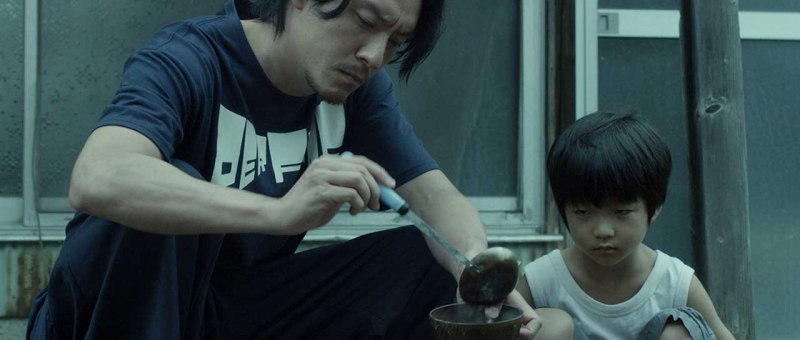
Marooned and bleeding in a rundown area, Mr. Long is saved by quiet little boy who brings him first medical supplies and then some probably stolen vegetables. Mr. Long manages to find an abandoned house which still has running water and cooking facilities and shares his improbably tasty soup with the little boy whose name is Jun. Surprisingly, Jun can speak fluent Mandarin because his mother, Lily, is also from Taiwan. Soon enough, other people in the area start to hear about the mysterious stranger and his wondrous cooking. Before he knows what’s happening, the tiny town has adopted him and built a stall on a cart where he can sell Taiwanese beef noodles.

SABU embraces his absurd sense of humour as Mr. Long’s capture becomes a cartoonish slapstick affair which ultimately sees him running off into the night with a sack on his head before regaining his quintessential cool. Mr. Long is the archetypal movie hitman – the major reason why he doesn’t say much is firstly that he doesn’t know any Japanese but  his conversations with the boy are pretty one sided and he doesn’t seem to be the chattiest even in Taiwan. Confused as to why all of this is happening Mr. Long asks Jun for guidance only for him to point out that it’s his own fault for acting so cool and never saying anything.

Yet for all the comedy there’s an underlying sadness as Mr. Long comes to care for this strangely friendly village which has more or less adopted him, providing him with food, clothing, and even an occupation in his brand new beef noodle stand. Even though he’s been in contact with his bosses and is supposed to get a boat to Taiwan in just a few days, Mr. Long doesn’t quite want to go home and let all of these nice people down. Especially as he’s begun to bond with the boy and grow closer to his mother.

Both Mr. Long and Lily are people who’ve had their lives ruined by proximity to the underworld – his by being trapped into a profession of killing with no possibility of escape, and hers by losing the love of her life to men who claimed to own her. Lily’s story is a sad one which eventually sees her fall into prostitution as a means of caring for her son only to be exploited by a duplicitous customer who gets her hooked on heroine as a means of control. Mr. Long frees her from this particular demon and the three begin to look as if they could make a go of things together only for the past to suddenly reappear and ruin everything.

Unexpectedly dark, Mr. Long veers between whimsical comedy and heartbreaking tragedy as its hero begins to long for another life which he knows he will be denied. Filled with SABU’s typically absurd world view mixed with balletic yet horrifying violence as the lonely hitman becomes the dragon spelt out in his name, Mr. Long is a familiar gangland tale in which a man cannot escape his past or his nature and risks rejection from those who’ve come to love him when they discover who he really is, but even if there can be no escape for some there is hope of redemption in human kindness and genuine connection.


Mr. Long was screened at the 17th Nippon Connection Japanese Film Festival.

Original trailer (no subtitles)