LUPIN THE IIIRD: The Movie – The Immortal Bloodline (LUPIN THE IIIRD THE MOVIE 不死身の血族, Takeshi Koike, 2025)

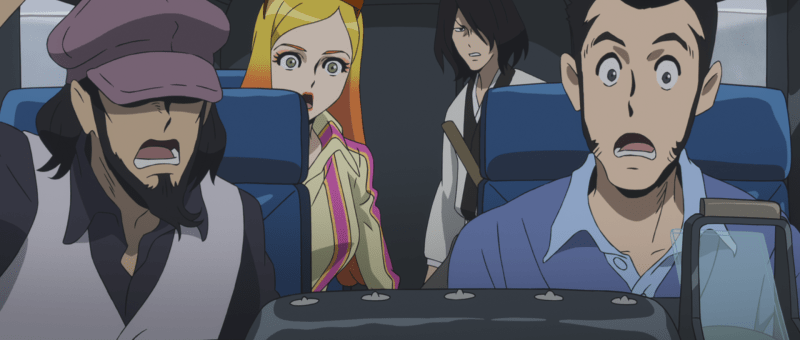
Lupin and the gang find themselves in a race against time after being lured to a mysterious private island in Takeshi Koike’s latest instalment in the classic franchise, LUPIN THE IIIRD: The Movie – The Immortal Bloodline (LUPIN THE IIIRD THE MOVIE 不死身の血族, Fujimi no Ketsuzoku). A sequel to a series of specials, the film opens with a lengthy recap explaining that each member of Lupin’s team has been targeted for assassination and seen off their adversaries using their own particular skills. Now Lupin’s home has been destroyed taking most of his loot with it, so he too is in hot pursuit looking for answers about who might be trying to kill them and why, along with some treasure, of course.

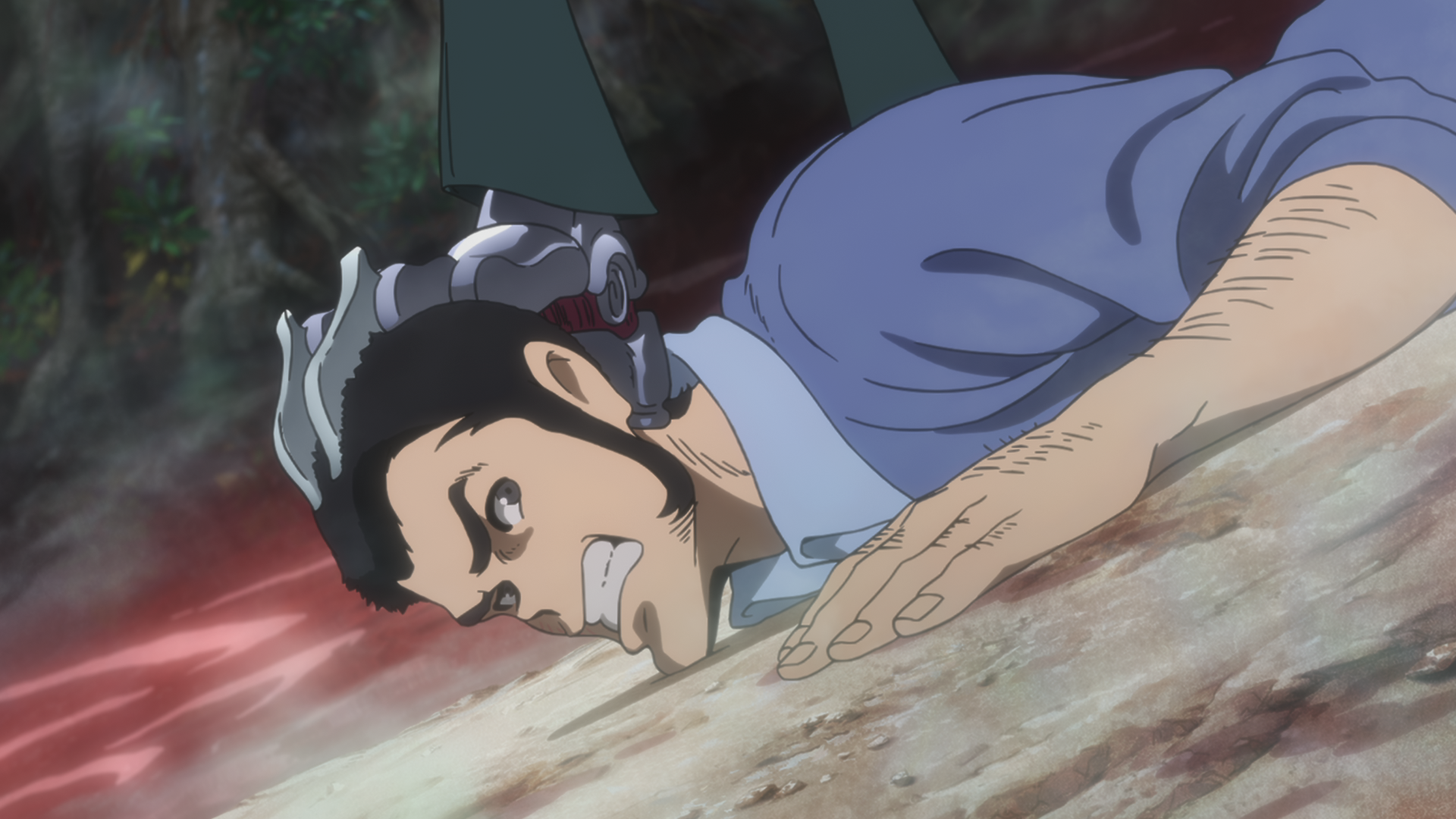
What he discovers, however, is that the island is a kind of graveyard for the unwanted. The place is full of mindless men in masks, the hitmen who didn’t make it reduced to animalistic predation. Disused military equipment scatters the landscape as if in reminder of mankind’s folly. But Lupin (voiced by Kanichi Kurita) is here because according to apparent mastermind Muom (Kataoka Ainosuke VI), he’s trash too and doesn’t belong in the new world Muom is trying to create by making the earth immortal. The air on the island is toxic to people like Lupin and unless he and his friends find a way off it within the next 24 hours, they’re destined to become zombie-like masked men too or else fade away into oblivion leaving not even a legacy behind them. 

The war is then against a notion of obsolescence or the idea that a person can become somehow unnecessary. The gang were followed to the island by Zenigata (Koichi Yamadera) who is still trying to catch Lupin but ends up becoming trapped too. Lupin is obviously very necessary to Zenigata as without him he doesn’t really have a reason to exist. That’s one reason he ends up ironically teaming up with him, protecting Fujiko Mine (Miyuki Sawashiro) and breaking his own code to shoot some bad guys in an attempt to keep Lupin alive to face justice. 

But as it turns out, Interpol might not be the best place to turn for back up as there’s some sort of blackout code on all things related to the island which is marked on no maps. Zenigata’s contact describes it as “sacred” and rather than sending the helicopter he asked for, explains everyone who sets foot on it will have to die because they know too much. As weird as Muom’s plans to make the earth immortal sound, it appears it’s locked into something bigger. All of which is quite good for Lupin who starts to realise there might not be much treasure here after all, but he’s found something more precious in a lead on even greater riches just waiting to be plundered.

This might be his way out of the purgatorial space of the island, the “hell for those burdened by karma” as Goemon (Daisuke Namikawa) describes it, in kicking back against Muom’s plans by identifying his nature and, quite literally, heading straight to the heart of the matter while reclaiming his identity as the gentleman thief from those who think he’s an unwelcome presence. Returning to the lair, he burns the history of himself and declares that life is a fiction to be enjoyed while immortality is a worthless gift that robs existence of its meaning. Separated on the island, the team must face their personal traumas alone before reuniting to try and figure out how to defeat their seemingly immortal captor and fight their way off the island before being consumed by its toxic gases.

The last in Koike’s Lupin cycle, the film is, in some ways, intended as a prequel to Mystery of Mamo, the very first Lupin anime released in 1978. As such it continues the style Koike has established in the series so far complete with kinetic action sequences and retro jazz score. Though this may seem like the end of the line for the gentleman thief, it is really just another beginning in returning the franchise to its point of origin. Lupin is, in a sense, reborn to steal back everything that was taken from him, with Zenigata hot on his heels and the world set to rights again, saved by his very particular brand of chaos.


LUPIN THE IIIRD: The Movie – The Immortal Bloodline opens in UK cinemas 21st February courtesy of Anime Limited.

International trailer (English subtitles)

Images: © MP / T

Shin Ultraman (シン・ウルトラマン, Shinji Higuchi, 2022)

The classic tokusatsu hero rises again to rescue kaiju-plagued Japan from geopolitical tensions and internal bureaucracy in Shinji Higuchi’s Shin Ultraman (シン・ウルトラマン). Scripted by Hideaki Anno, Shin Ultraman shares much in common with Shin Godzilla which the pair co-directed but is also a much more obvious homage to the world of classic tokusatsu or “special effects” franchises which became cult TV hits from the 1960s onwards and have remained popular with children and adults alike throughout Asia. 

This new iteration takes place in a world in which kaiju attacks have become commonplace, so much so that there is a specialised government department, the SSSP, dedicated to dealing with them. Led by determined veteran Tamura (Hidetoshi Nishijima), the team do not engage with the giant monsters directly but are responsible for research and strategy quickly trying to work out what kind of kaiju they’re dealing with, what the dangers associated with it may be, and where it’s weaknesses lie so they can figure out a way to stop it. Just when it looks like an electricity-guzzling lizard monster is about to do some serious damage, a robot-like giant humanoid arrives and saves the day. The team are very grateful to the heroic defender they name Ultraman, but are puzzled that he seems to be aware of all their research while otherwise missing the connection that their near silent colleague Kaminaga (Takumi Saitoh) always seems to be mysteriously absent every time Ultraman arrives.  

At heart, Shin Godzilla had been a satire on government bureaucracy and a mediation on the response to the 2011 earthquake and tsunami. Shin Ultraman might not be so pointed but still has a few bones to pick with the political machine as the team’s boss at HQ moans about the need to keep buying fancy weapons from the Americans (and making sure it’s the Defence Ministry that foots the bill) while cynically suggesting that the government is keen to use the kaiju crisis as leverage to further its policy goal of nuclear re-armament. Meanwhile, it’s also clear that for some reason kaiju attacks only happen in Japan and the International community largely sees them as a Japanese issue which they have to deal with alone, but as soon as Ultraman turns up and is thought to be extraterrestrial everyone is suddenly interested. 

As it transpires these geopolitical divisions are incredibly useful to another extraterrestrial visitor, Zarab (Kenjiro Tsuda), who plans to sow discord among nations so that humanity will destroy itself thereby, ironically, preventing an intergalactic war between planets who may be tempted to fight amongst themselves over the potential enslavement of humanity as valuable bioweapons. Aware of Zarab’s power, the government is manipulated into signing an uneven treaty with him in order to be first out of the gate and gain an advantage over other nations who, for reasons of self preservation, are also keen to ensure no one has sole access to new alien technologies and emissaries. Asked why he picked Japan, all Zarab can come up with it that he happened to land there which is quite a coincidence though he also has a vested interest in taking out Ultraman, the only force capable of resisting him. 

Even so, according to Zarab, the kaiju plague is humanity’s doing in having awakened sleeping monsters through environmental destruction. Hailing from the Planet of Light which has strict rules about what he’s supposed to be doing, Ultraman longs to understand humanity having merged with a human he accidentally killed who had dedicated his life to saving others. What he gains is a sense of communal responsibility along with a desire to care for what he sees as, essentially, babies someway behind his own planet in terms of evolution and in need of guidance. What he doesn’t want to do is endanger their “autonomous progression” by solving all their problems for them, so in grand tokusatsu fashion its up to the team to engineer their own solution in addition to deciding what they will do with this new technology using it for good or ill. Being buddies is all about trust, after all. Higuchi’s composition borders on the avant-garde recalling both that of the legendary Akio Jissoji and those more often associated with anime and manga rather than live action while the effects, even those utilising CGI, are pleasantly nostalgic with retro mono explosions and the iconic ringing of laser beams. Heading in a melancholy philosophical direction in its final moments, Shin Ultraman does at least suggest that the best weapons against a kaiju attack are teamwork and mutual trust especially if one of your friends is an all powerful being from another galaxy. 


Shin Ultraman screened as part of this year’s New York Asian Film Festival.

Original trailer (English subtitles)

Images: © 2022 TSUBURAYA PRODUCTIONS CO., LTD. / TOHO CO., LTD. / khara, Inc. © TSUBURAYA PRODUCTIONS