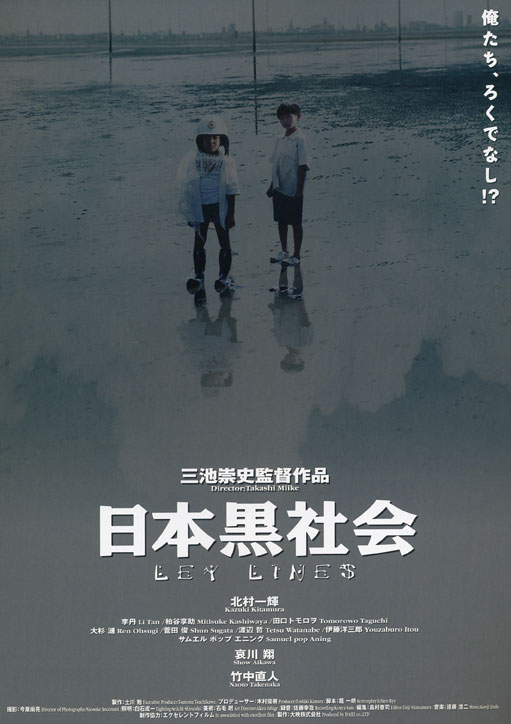
 The three films loosely banded together under the retrospectively applied title of the Black Society Trilogy are not connected in terms of narrative, characters, tone, or location but they do all reflect on attitudes to foreignness, both of a national and of a spiritual kind. Like Tatsuhito in the first film, Shinjuku Triad Society, the three young men at the centre of the final instalment, Ley Lines (日本黒社会 LEY LINES, Nihon Kuroshakai LEY LINES), have each faced prejudice and discrimination due to their Chinese heritage. Fleeing their small town blues and heading for the big city, they want out of the homeland which can find no place for them to try their luck in pastures new, but desperation breeds poor choices and if they find their freedom it may not be in the way they might have hoped.
Angry young man Ryuichi (Kazuki Kitamura) seems to have been in some trouble with the law recently, at least that’s the reason the pedantic government official gives for rudely rejecting Ryuichi’s attempts to get a passport whilst subtly underlining the fact that a “real” Japanese person would know you can’t have one whilst on probation. Offended, Ryuichi picks up a small potted tree and hits the uncooperative desk jockey on the head with it. With Brazil off the cards and no work or prospects on the horizon, Ryuichi decides to blow town with some friends. All but three of them change their minds at the train station but Ryuichi, his sensitive younger brother Shunrei (Michisuke Kashiwaya), and their friend the impulsive Chan (Tomorowo Taguchi) head for the sleazy streets of Shinjuku hoping to find someone to forge their papers for passage overseas.
Once there, hotheaded Ryuichi immediately begins to cause trouble and the trio get mixed up in an ongoing series of gang problems with the traditionally minded Chinese gangsters and a petty thug (Show Aikawa) selling what he claims is a new wonder drug, Toluelene. Teaming up with a brutalised local prostitute, Anita (who previously ripped them off leading to their ill advised Tolulene adventures), also desperate to get the hell out of Shinjuku, the four form an unconventional mini family but a last ditch solution to their dilemma will turn out to be a gamble too far.
Neatly uniting the themes of the previous two movies in the Black Society Trilogy, Ley Lines casts its heroes as multilayered outsiders. Miike begins the film with deliberately retro, aged footage of the brothers as young boys playing happily on a beach until some Japanese kids turn up and remind them that they’re different. Never allowed to just fit in, Ryuichi has become angry and frustrated whereas Shunrei studies harder than anyone trying to earn his place in a competitive society. If their Chinese heritage had set them at odds with their small town peers, the boys are just as much adrift in the big city, a trio of bumpkins wandering into all the wrong places naively thinking they can scrap their way out of Japan. Anita, also Chinese, shares in their desperation as her situation has become unsustainable. Shackled to a useless pimp and forced to endure frightening and barbaric treatment, Anita needs out of the flesh trade and the guys might just be her ticket to ride.
As he would later do so splendidly in Audition, Miike deliberately wrong foots us in the beginning as if he’s about to embark on a standard tale of a young man making his first big set of mistakes which will set him on a path to becoming a better person, but of course this isn’t where we’re going. The original Japanese title, “Japan Black Society” hints at the all pervading darkness which exists below the everyday world into which our trio of hapless dreamers have fallen. The guys are ordinary young men making ordinary mistakes which have a familiar, often comedic quality which only serves to deepen the agony they’re about to face.This underworld belongs to people like the mad gangster Wang (Naoto Takenaka) dreaming of his Chinese homeland and forcing young women to tell him folktales to remind him of it, the pimp the who mishandles the desperate Anita, and the deluded drug dealer Ikeda convinced he’s onto the next big thing. The boys don’t stand a chance. Ending with a typically poetic, bittersweet set of images as some of our heroes find a kind of freedom in an endless sea, Miike does not stint on the irony but his sympathy is very much with these disenfranchised youngsters, denied their futures at every turn and finally backed into a corner by the cruel and unforgiving nature of the Black Society which they inhabit.
Original trailer (English subtitles)
 Windows on Worlds