A New Love in Tokyo (愛の新世界, Banmei Takahashi, 1994)

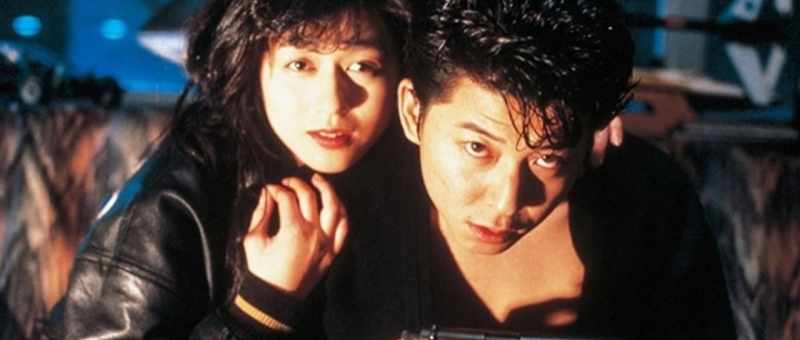
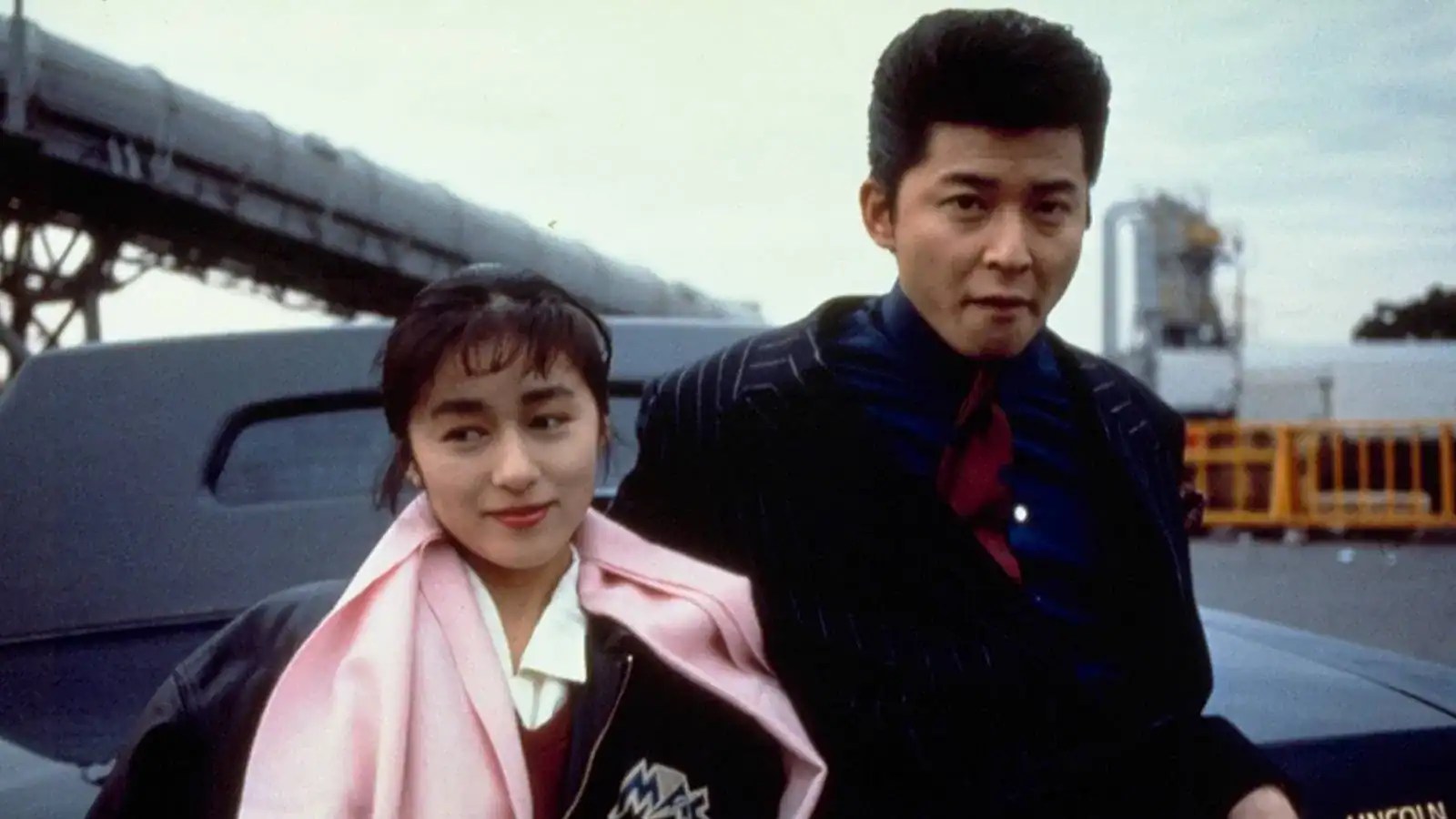
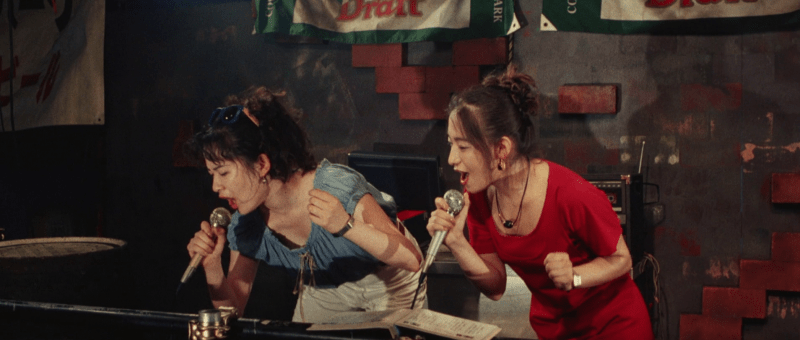
Life is theatre in Banmei Takahashi’s A New Love in Tokyo (愛の新世界, Ai no Shinsekai). Strangely marketed in some quarters as a kind of sequel to Ryu Murakami’s Tokyo Decadence though it is entirely unconnected to it, Banmei Takahashi’s after hours drama is a breezy riot that runs in direct contrast to other post-Bubble era movies which saw only despair and disillusionment in economic stagnation. For Rei (Sawa Suzuki) and Ayumi (Reiko Kataoka), however, life is one long party that they live on their own terms hoping to ride the wave all the way to the sea.

That said, it’s true that Rei, at least, is doing her dominatrix job because it’s impossible to support oneself as an artist in this economy. She is, in fact, basically subsidising her whole theatre troupe through sex work as a means of keeping it going. Her relationship to the men in the group is almost like Snow White and the Seven Dwarves while, for unexplained reasons, she sleeps with each of her dopey castmates on a rota system. It’s not until crunch time that they realise they should probably get jobs too, while the only other woman in the group (Yoko Nakajima) takes a job as a receptionist answering the phone at the call girl agency where Ayumi works.

Rei often runs into Ayumi leaving hotels and the pair soon become fast friends, though unlike Rei, Ayumi is a regular sex worker who sleeps with her clients. Nevertheless, Rei seems to like her precisely because, as she puts it, she’s a good liar, which is perhaps what you need to be to be successful at this business. She manipulates her clients by pretending to be a shy virgin so they pay her more for basic services, while lying to her boyfriend that she’s an office lady. The fact he takes it at face value suggests he might not be all that bright, which is why he’s struggling to finish his exams to become a doctor. Later, she’s thrown him over for a lad training to be a lawyer but just with as much success. Both the men she ends up with seem to be feckless and dim, though she fluffs their egos by pretending to be stupid. She says that her end goal is to become the wife of a professional lawyer or doctor, which is to say she’s looking for class status and respectability, though she’s probably earning more than they are by herself already. Ayumi has a host of savings pots and sometimes transfers large sums of money into one telling her boyfriend it’s from her father to help pay for a wedding.

Which is to say, everyone here is playing a kind of role. Both Rei and Ayumi seem to be using their real names for their work, but as Rei says the dominatrix gig is good for her acting career in allowing her to take on multiple personas. She too writes frequent letters home to her mother which bear little relation to reality in which she claims to be a therapist’s receptionist. But the clients are acting too, because this is, after all, all about role play. One of Rei’s most devoted customers is a yakuza who bosses his men around all day then comes to her to be punished. He is scrupulously polite and really rather sweet, buying up all the tickets to Rei’s play to make sure she’s not embarrassed on the opening night. Generally speaking, the streams shouldn’t cross between Rei the actress and Rei the dominatrix, so the yakuza is crossing a line by intruding on her personal life at the play, though he does so in an otherwise respectful way, apologising for his presence and making it clear that he doesn’t mean to expose her to those who might not know nor does he intend to encroach any further on her personal life.

Another of the women’s clients seems to be a fed up salaryman ranting about his boss and company lay-offs, hinting at the stressfulness of the economic situation for those working outside of the sex industry as well as the emasculating nature of corporate life in which the salaryman can only vent his frustrations through BDSM role-play rather than by actually taking it up with his boss. Rei and Ayumi are, by contrast, free from any such concerns. That is not to say, however, that their lives are easy or without danger. When a sex worker is found dead in a love hotel bathroom, a gloom falls over the industry. Rei asks Ayumi if she’s feeling alright, but as it turns out her agency has spotted a business opportunity seeing as most of the others will have decided to close for the sake for safety and as a gesture of respect. Ayumi too is threatened by a customer with a knife and is only saved by the arrival of a yakuza, in an unexpected cameo from ice cool V-Cinema star Show Aikawa, who intimidates the customer into backing off by eating his own sunglasses. Nevertheless, Ayumi goes straight back to work to meet the next customer, unwilling to let herself be cowed by male violence.

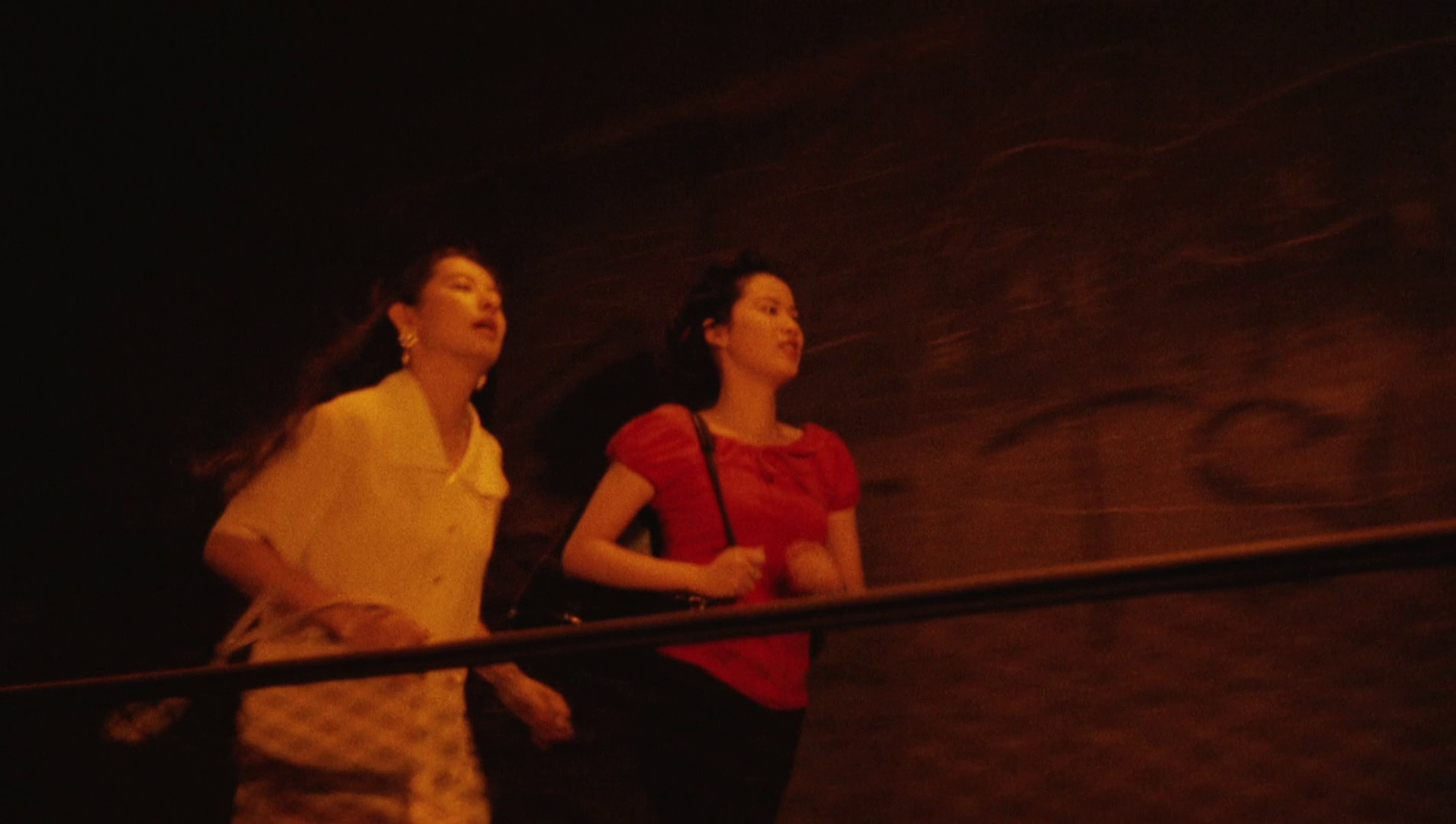
That’s something she has in common with Rei who similarly treats the attempts of men to ruin her night with similar disdain. When one customer proves rebellious, she keeps him waiting for hours while tied up and bound in the dark. She and Ayumi try turning the tables by visiting a host club, but are instantly put off by their poor quality patter. They go on a kind of date with two guys who tried to pick them up, but dump them when they’ve had enough. Rei, in particular, has several boyfriends who think they have some sort of claim on her body and her time, but she only ever does as she pleases. There’s something unexpectedly joyful about the two women running hand in hand through the midnight city, as if this were only ever their playground. The juxtaposition of the erotic photographs taken of actress Sawa Suzuki by Nobuyoshi Araki and those of her childhood hint at this quality of playfulness, as if her life were one of fun games in which she’s never quite grown up. They also remind us, however, of her ordinariness. She had a childhood too, and is, in fact, just like everyone else. Her job is just a job, no different from those of the guys at her theatre troupe who work in restaurants and video stores. She and Ayumi even exchange business cards. This festival might be over now, but that only means it’s time to start preparing for the next in the company of her friends as she and Ayumi enjoy their lives in the permanent dawn of a city that seems to exist only for them.


Trailer (English subtitles)
Danger Point: The Road to Hell (Danger Point: 地獄への道, Yasuharu Hasebe, 1991)

A pair of hitmen find themselves conflicted when their latest target dies gripping the photo of an innocent-looking nurse. Who was this man, what’s his relationship to the woman in the photo, and why did he have to die? Asking questions is taboo when you’re a hired killer, and you’re probably better off not knowing anyway, but there’s something that’s bugging veteran executioner Joji (Jo Shishido) and it’s not just the missing 20 million dollars.

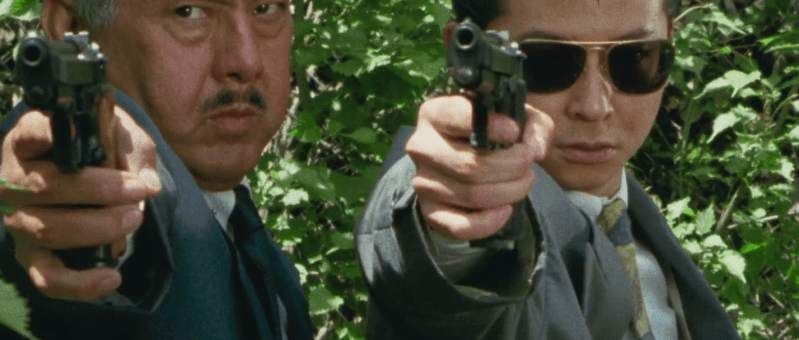
Nikkatsu veteran Yasuharu Hasebe’s V-Cinema noir Danger Point (Danger Point: 地獄への道, Jigoku e no Michi) is a classic tale of nihilistic fatalism in which the bond between the two assassins is tested by the intervention of greed and mystery. Shishido’s Joji is the more old-fashioned of the pair yet fascinated by the mystery behind Sakai’s death, not necessarily wondering if he bears any culpability but confused about why he had to die despite not actually having the missing money. This puts Joji partially at odds with the younger Ken, a more dynamic and less morally ambivalent figure played by the contemporary star Show Aikawa who’d come to represent for V-Cinema what Shishido once had for Nikkatsu action. Together, the chase the various clues they’ve been given looking for the person behind the job and, of course, the missing money.

But the money presents a problem too. Ken begins to wonder if Joji will abandon him and take the prize for himself, though that doesn’t seem to be something that Joji is actively considering. The relationship between the two men is more brotherly than paternal, though Joji does scold Ken for his treatment of Yumi (Nana Okada), the nurse from the hospital and their key witness. He beats and sexually assaults her, though it’s less his lack of chivalry that Joji criticises than the wisdom of bringing a woman into their business. He’s suspicious of Yumi in a way Ken does not seem to be, though they both agree that eventually she’ll have to go before she does them any harm because now she knows too much.

Ultimately, the money turns out to be from a bank job in the Philippines that the American criminals were hoping to convert to US dollars in Japan, though predictably everyone wants the whole amount for themselves, not least Joji and Ken along with the kingpin’s horse-loving girlfriend Saeko (Miyuki Ono) who is playing her own side of the game. Neither Saeko nor Yumi do very well out of this particular affair and are each constrained by the men around them. While Yumi was apparently seduced and abandoned by corrupt cop Sakai, Saeko is hemmed in by her gangster boyfriend Takamura (Hideo Murota) and seeks escape through stealing the money with the help of Sakai, one way or another, at least. Though this world doesn’t seem to want to let either of them have it while the  men fight over the spoils in a desperate struggle to assert dominance over the situation.

As the ironic “Dead End” sign at the film’s conclusion implies, however, that chasing money is a fool’s errand and leads only to hell. A chase past the no entry signs into an industrial complex suggests that this world is not quite fully formed or in the process of falling apart. The ironic and strangely obvious product placement for Perrier sparkling mineral water might hint at a more sophisticated world the hitmen are on one level trying to inhabit, but in other ways their presence is incongruous. They belong to an earlier time as does this hidden world of bank robberies, smuggled cash, criminal gangs and fixers that seem out of place amid the tail end of the Bubble era. Or in that sense at least, perhaps it’s Japan heading for a crash desperately chasing the riches that seem only slightly out of reach. Nevertheless, there’s a genuine sense of mystery that leads Ken and Joji to their final destination in which they discover that it might not be greed that does for them after all, but in an odd way, love. Their desire for togetherness and fear of separation in the end can have only one conclusion and as much as it is the money that leads them to their doom, it’s loneliness and brotherhood that eventually seal their fate.


Neo Chinpira: Zoom Goes the Bullet (ネオ チンピラ 鉄砲玉ぴゅ~, Banmei Takahashi, 1990)

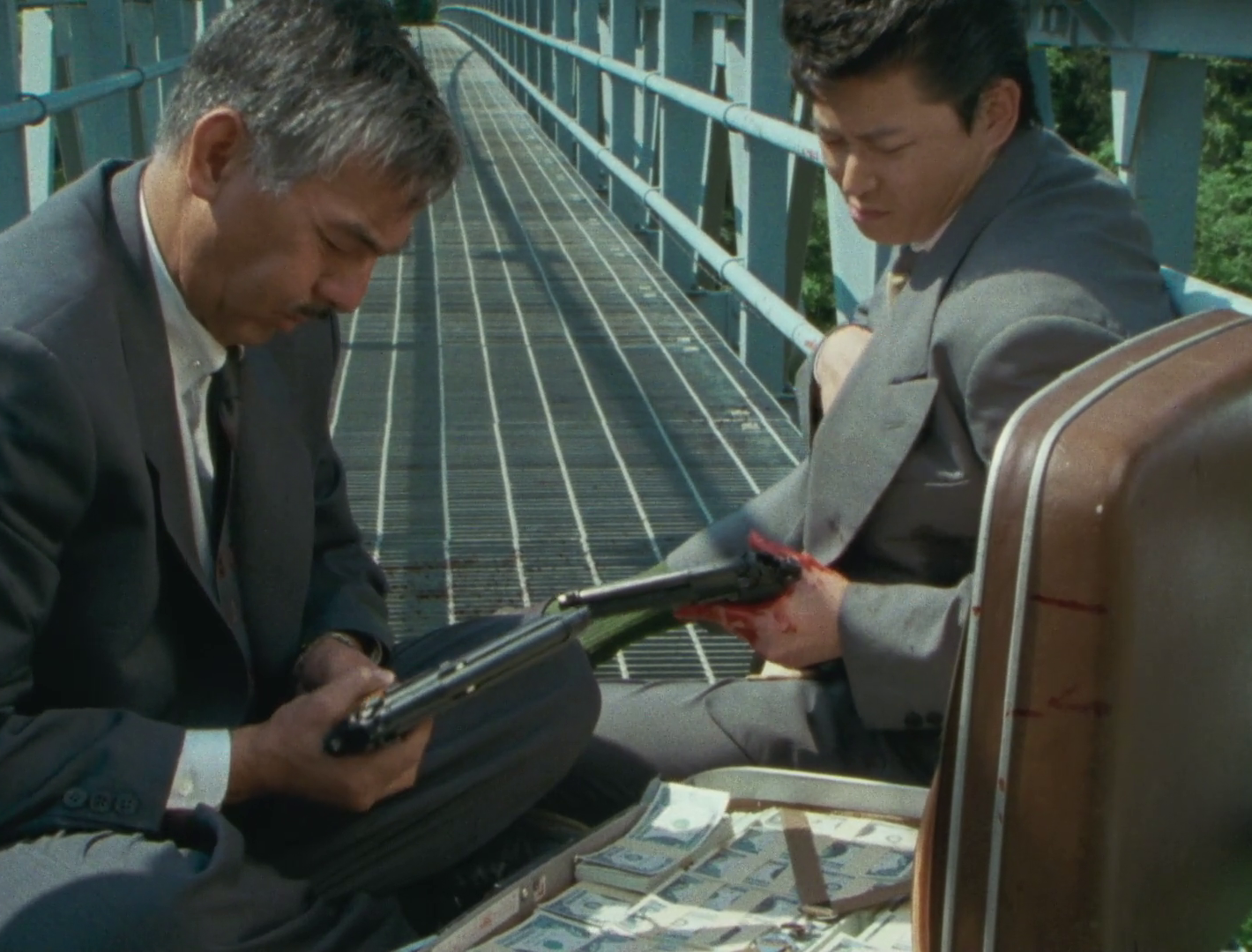
In the classic yazkua films of old, going to prison for the gang could be a badge of honour and one of the ways you could catapult yourself into the higher ranks. By the 1990s, however, the yakuza is a much depleted force and it seems few are willing to give up years of their lives on a point of honour for an uncertain reward. At least, that’s how it is for most of the gangsters at the centre of Banmei Takahashi’s Neo Chinpira: Zoom Goes the Bullet (ネオ チンピラ 鉄砲玉ぴゅ~, Neo Chinpira: Teppodama Pyu) , a slacker comedy in which a young hanger on faces a dilemma when he’s made the lookout on a squad sent to bump off a rival only for his squamates go to great lengths to injure themselves first so they won’t have to go through with it.

Junko (Sho Aikawa) is an unlikely hero. With a rockabilly quiff and a red jacket, he’s nominally the driver for gangster Yoshikawa (Toru Minegishi) which means he gets to drive his limo and act like a big man for a while making calls on his carphone. But as much as Junko shows off to his girlfriend Noriko, a hostess at a Korean bar, by instructing the landlady not to clear up his empty bottles because they’ll make a good weapon in an emergency, he’s otherwise something of a joke. The limo ends up getting “stolen” by a young woman who just likes American cars and sexually aroused by gunfire.

Even Yumeko (Chikako Aoyama) chuckles that Junko sounds like a girl when he says he wants to see the ocean while they’re driving around. “Junko” is ordinarily a girl’s name. He picked it up as a kind of hazing based on an alternate reading of his name kanji. She says the same thing again when he reveals he’s never brought a girl back to his place before, probably because it’s in a disused building he was given to manage where he’s surrounded by junk like an old barber’s chair and pinball machine while the figure of Humphrey Bogart in the Maltese Falcon looks down at him from a poster as if embodying his unattainable gangster dreams. As masculine icons go, Junko is also plagued by his uncle, Mizuta (Joe Shishido), a legendary gangster and representative of old school yakuza who take the code seriously and wouldn’t put up with people like Junko’s colleagues who engage in “zooming”, deliberately shooting themselves to get out of being ordered to carry out a hit. He’s not overly impressed by Junko either, unable to understand why he’d become an errand boy for a petty gangster rather than be his own boss as a small-time crook.

Junko’s dilemma is whether he’s really up to this task and will be to go through with it or will end up chickening out and injuring himself too. Crows are more cowardly than they seem, Yumeko explains in an obvious allegory for the yakuza. They pick a place and defend it as a group, while their numbers are way up lately so their individual turfs are shrinking. But now Junko’s all on his own and filled with uncertainty not knowing if he can pass this rite of passage and be accorded a man or will forever be trapped in a liminal space of adolescence never to be taken seriously or make any progress in his life. In an effort to toughen up, he swaps his red jacket for a suit and finally puts on a shiny leather overcoat, ripping off the buttons to bind it more tightly around him with the belt as if it were a kind of armour. 

Somehow the lighthearted ridiculousness of this world of bumbling yakuza and creepy corrupt cops lends an additional poignancy to Junko’s final gesture as he sets off on his path, not really believing he will return. He doesn’t even wait for the pictures he had taken at a photo booth. They won’t be much use to him where he’s going, but at the same time it’s like he’s treading water never quite getting closer to his destination but continuing along his long sad walk. Banmei Takahashi sticks firmly to his pink film roots, sticking in a weird sex scene at regular intervals as Yumeko becomes enraptured by pistols, but also has quite a lot of fun with his “uncool” gangsters and the lost young man who looks up to them while perhaps knowing that this image of stone cold masculinity only really exists in the movies.


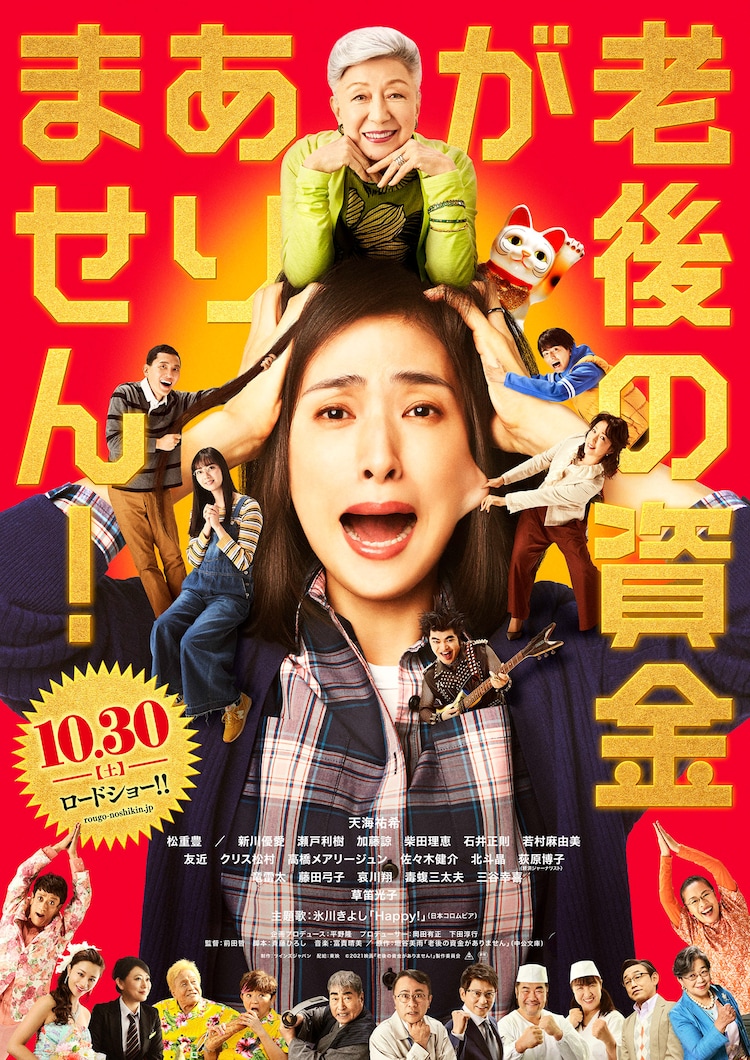
What Happened to Our Nest Egg!? (老後の資金がありません!, Tetsu Maeda, 2021)

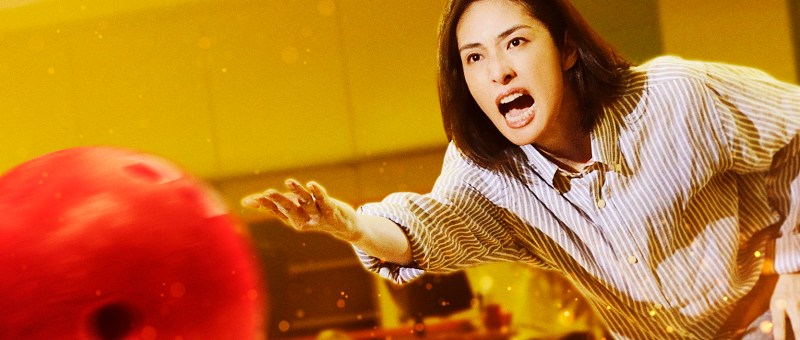
A minor controversy erupted in Japan in 2019 when then finance minister Taso Aso issued a statement recommending that couples should have 20 million yen (£104,620 total at the time of writing) saved for their retirement on top of the state pension in order to live a comfortable life in old age. All things considered, 20 million yen actually sounds like quite a low sum for two people who might live another 30 years post-employment. Nevertheless, Atsuko (Yuki Amami) and her husband Akira (Yutaka Matsushige) are now in their mid-50s and don’t have anywhere near that amount in savings. They’re still paying off their mortgage and though their children are grown-up, neither of them seem to be completely independent financially and both still live at home. 

Tetsu Maeda’s familial comedy What Happened to Our Nest Egg!? (老後の資金がありません!, Rogo no shikin ga arimasen!) explores the plight of the sandwich generation which finds itself having to support elderly relatives while themselves approaching retirement and still needing to support their children who otherwise can’t move forward with their lives. Seeing an accusatory ad which seems to remind her personally that even 20 million yen isn’t really enough when you take into consideration the potential costs of medical treatment or a place in a retirement home, Atsuko has a sudden moment of panic over their precarious financial situation. The apparently sudden death of Akira’s 90-year-old father acts as a sharp wake up call especially as Akira’s apparently very wealthy but also selfish and materialistic sister Shizuko (Mayumi Wakamura) bamboozles him into paying for the entirety of the funeral while pointing out that they’ve been footing most of the bill for the parents’ upkeep over the last few years.

There was probably a better time to discuss the financial arrangements than with their father on his deathbed in the next room, but in any case Shizuko doesn’t pay attention to Atsuko’s attempt to point out they’ve been chipping in too. Akira’s mother Yoshino (Mitsuko Kusabue) also reminds them that their family was once of some standing and a lot of people will be attending the funeral so they need to make sure everything is done properly. The funeral arranger is very good at her job and quickly guilts Atsuko into spending large sums of money on pointless funeral pomp to avoid causing offence only to go to waste when hardly anyone comes because, as she later realises, all of the couple’s friends have already passed away, are bedridden, or too ill to travel. 

Yoshino is however in good health. When Shizuko suddenly demands even more money for her upkeep, Atsuko suggests Yoshino come live with them but it appears that she has very expensive tastes that don’t quite gel with their ordinary, lower-middle class lifestyle. Having lived a fairly privileged life and never needing to manage her finances, Yoshino has no idea of the relative value of money and is given to pointless extravagance that threatens to reduce Atsuko’s dwindling savings even more while in a moment of cosmic irony both she and Akira are let go from their jobs. Now they’re in middle age, finding new ones is almost impossible while their daughter suddenly drops the bombshell that she’s pregnant and is marrying her incredibly polite punk rocker boyfriend whose parents run a successful potsticker restaurant and are set on an elaborate wedding.

The film seems to suggest that Atsuko and Akira can’t really win. They aren’t extravagant people and it just wasn’t possible for them to have saved more than they did nor is it possible for them to save more in the future. Instead it seems to imply that what they should do is change their focus and the image they had of themselves in their old age. One of the new colleagues that Akira meets in a construction job has moved into a commune that’s part of the radical new housing solution invented by his old friend Tenma (Sho Aiwaka). Rather than building up a savings pot, the couple decide to reduce their expenses by moving into a share house and living as part of a community in which people can support each other by providing child care and growing their own veg. Yoshino too comes to an appreciation of the value of community and the new exciting life that she’s experienced since moving in with Atsuko. It may all seem a little too utopian, but there is something refreshing in the suggestion that what’s needed isn’t more money but simply a greater willingness to share, not only one’s physical resources but the emotional ones too in a society in which everyone is ready to help each other rather than competing to fill their own pots as quickly as possible. 


What Happened to Our Nest Egg!? screens as part of this year’s Japan Foundation Touring Film Programme.

Trailer (English subtitles)

The Cold-Blooded Trap (冷血の罠, Takahisa Zeze, 1998)

“This place is full of people like me” a violent criminal jeers, admitting that he’s killed “plenty” of women but not necessarily the one he’s being questioned about. There is indeed something eerie that seems to have taken over this small corner of Shibuya in Takahisa Zeze’s dark millennial thriller The Cold-Blooded Trap (冷血の罠, Reiketsu no Wana). “Strange things are happening here” another investigator notes, “someone’s malice has infected this whole place.” Yet the sense of haunting may be closer to home than it first seems as two men attempt to come to terms with a traumatic past by solving present mystery. 

Even the police seem to concede that the strange goings on are a “continuation” of something else. As we first meet him private detective Fujiwara (Sho Aikawa) appears to be following a young woman home from the station only as we later discover she hired him herself to watch over her because she had the feeling she was being watched. Fujiwara watches her enter her apartment building and then calls her to say everything looks clear on the ground, but a short time later a body wrapped in sheets is dropped from the roof onto the street below. The weird thing is that it’s the same building Fujiwara’s sister Noriko used to live in, only she took her own life and that of her child by jumping off the roof five years previously. 

Not only does Fujiwara feel as if he failed in his duty to protect his client, but he’s forced into a similar contemplation in his latent guilt surrounding his sister’s death. The most obvious reason for Noriko to have considered suicide was that her salaryman husband Hanazono (Hidetoshi Nishijima) had been having an affair with a work colleague, Yoko (Asuka Kurosawa), yet Hanazono refuses to accept responsibility and is convinced that Noriko was murdered by a mysterious serial killer stalking the streets of Shibuya. 

The irony is that we first think Hanazono is the faceless killer after watching him enter the woman’s apartment building, only to learn that he may have been investigating Noriko’s death. Later these assumptions are overturned again, but even he concedes that he seems suspicious. Wandering around the city at night, he runs into women alone who immediately see him as a threat and assume he may be a dangerous criminal who means them harm. The realisation first shocks him, but then gives way to a physical high in the adrenaline rush of fleeing the scene. He comes to the conclusion that he must get into the killer’s mindset in order to catch him and begins actively stalking people around the city, following them home and checking mailboxes to find out names. 

Fujiwara doesn’t trust Hanazono for obvious and understandable reasons, but even so he begins following him as Hanazono continues to follow the killer. Zeze opens the film with fuzzy 90s camcorder footage trained on the forecourt of a station from a balcony opposite. The camera follows a woman as she leaves, and Fujiwara behind her with eerie intent evoking the mild paranoia of millennial surveillance. Later Hanazono films his own POV walking through the midnight city, once again lending the streets a sense of lurking malevolence and dread-fuelled fatalism even before he arrives at his shocking destination. 

Yet we wonder if Hanazono is just a paranoid obsessive with his giant map of crime insisting that seemingly isolated incidents of violence are somehow linked. Before Fujiwara hears about the woman’s death on the news they were reporting on insolvent banks hinting at a financial anxiety in the contemporary society, and as the suspect Fujiwara later tracks down suggests there are lot of distressed or perhaps disturbed people around. The crimes may really be random, but they are also connected by virtue of being provoked by an anxious society even if as Hanazono admits there are several criminals behind them. Whether or not he gets the answer he seeks, Fujiwara will have to accept that he too bears some responsibility as Hanazono has perhaps already done even if desperate to deny it. “I’ve always been responsible” he admits while taking control over his life, only the elliptical structure of the film may imply otherwise. Dark and eerie, Zeze captures a sense of millennial dread in the streets of the capital filled as they are with “random” crimes and lurking killers in the haunting anxiety of constant threat.


Clip (English subtitles)

Pulse (回路, Kiyoshi Kurosawa, 2001)

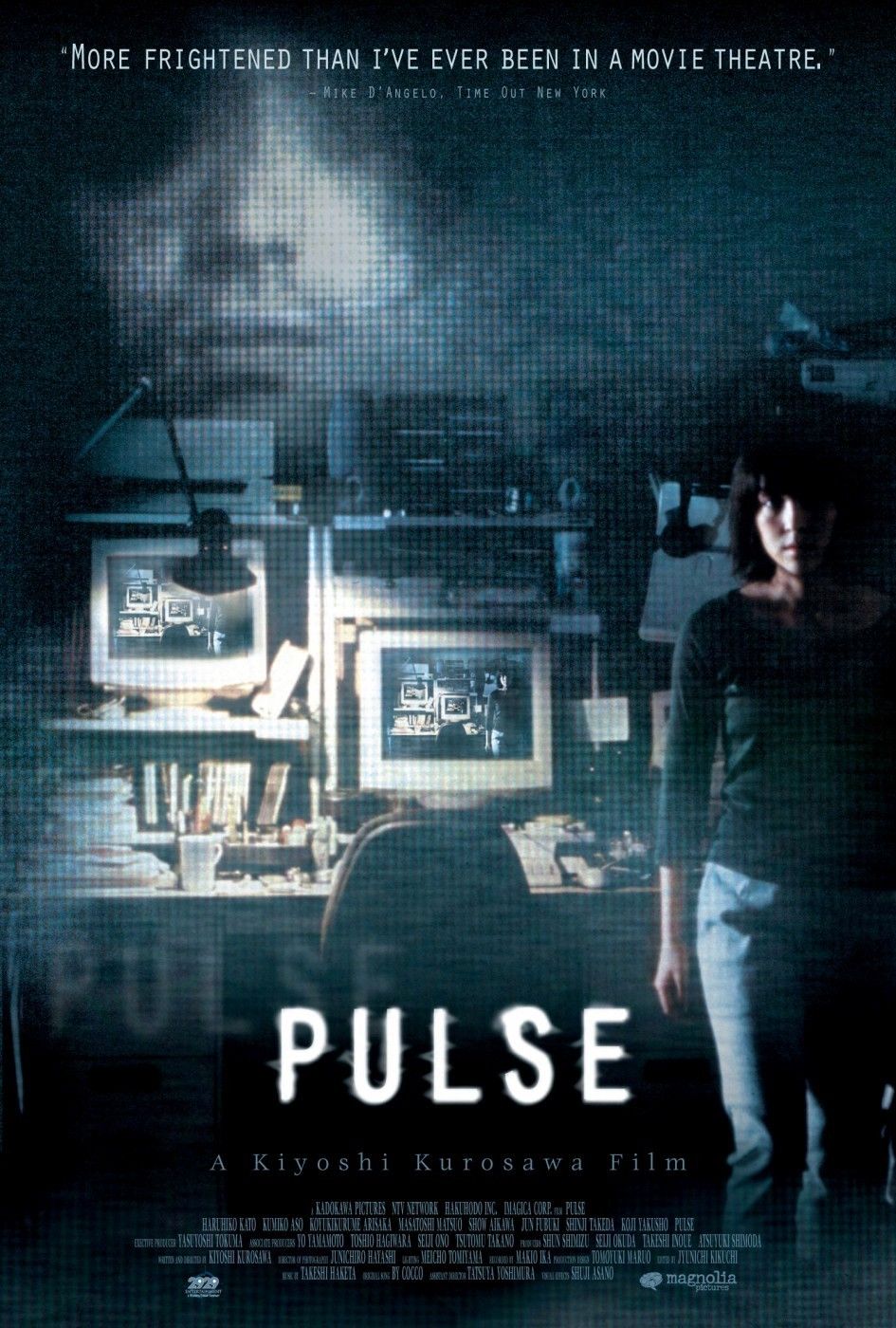
pulse US posterTimes change and then they don’t. 2001 was a strange year, once a byword for the future it soon became the past but rather than ushering us into a new era of space exploration and a utopia born of technological advance, it brought us only new anxieties forged by ongoing political instabilities, changes in the world order, and a discomfort in those same advances we were assured would make us free. Japanese cinema, by this time, had become synonymous with horror defined by dripping wet, longhaired ghosts wreaking vengeance against an uncaring world. The genre was almost played out by the time Kiyoshi Kurosawa’s Pulse (回路, Kairo) rolled around, but rather than submitting himself to the inevitability of its demise, Kurosawa took the moribund form and pushed it as far as it could possibility go. Much like the film’s protagonists, Kurosawa determines to go as far as he can in the knowledge that standing still or turning back is consenting to your own obsolescence.

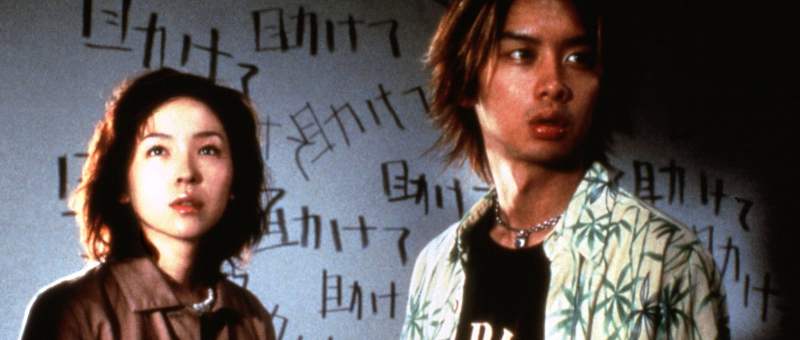
The end of the world starts with a young man staring at his computer screen and the strange images it conjures of the only half alive. Michi (Kumiko Aso), a young woman working at a rooftop plant centre, is dispatched to find out what’s happened to a colleague, Taguchi (Kenji Mizuhashi), who has some essential information stored on a floppy disk. Arriving at his flat she finds him distracted, informing her that the disk is somewhere in a pile scattered on the desk before disappearing off somewhere else. Having found what she came for, Michi looks for Taguchi to say goodbye but finds him hanged in an adjacent room. Barely reacting, Michi deals with the police before meeting up with her colleagues to relate the news, leaving each of them stunned. Another colleague, Yabe (Masatoshi Matsuo), then receives a strange phone call as a distorted voice repeatedly utters the words “help me”.

Meanwhile, economics student Kawashima (Haruhiko Kato) is attempting to set up this new fangled internet thing in his dorm but failing miserably. When he finally gets online and is greeted with the message “would you like to meet a real ghost?” he thinks he’s done something very wrong and hurriedly shuts his computer down. Seeking advice in the uni computer club he gets to know IT professor Harue (Koyuki) who tries to help him but may be beyond help herself.

The Japanese title, “Kairo”, literally means “circuit”, a fixed path of connectedness along which something flows continuously. A “pulse” is itself a circuit, or more accurately an observation of a fixed point in motion along it which maybe continuous or finite. Pulse, in its most immediate meaning is the life force by which we live, the thing which defines the states of life and death, but the “circuit” here is bigger than that which exists in one body alone, extending across the great confluence of humanity, or at least of that still regarded as “living”.

When Harue attempts to fix Kawashima’s internet she prompts him about why he wanted it in the first place (it was hardly necessary back in the still largely analogue world of 2001). He seems confused and replies he doesn’t quite know, it’s just that everyone seemed to be into it. Harue thinks she has his number – he thought he could use it to connect with people, but, she says, that is hopeless, people don’t truly connect, we all live in our separate bubbles. Harue is the most classically “disconnected” of our protagonists. Never having felt at home in the world, she talks of a lifelong fascination with the idea of death as a portal to another one in which it might be possible to live happily with others, only to realise as a teenager that it might also be a gateway to a land of perpetual nothingness and isolation. Terrified of being alone yet unwilling to submit herself to the inherent risks of connection, Harue exists in a permanent state of embittered longing and anxiety in which the cold embrace of death may prove the the only companion she will ever allow.

Harue may be an extreme case but she’s not the only example of disconnected youth. Michi, is also aloof and isolated – a child of divorced parents who has a close if imperfect relationship with her mother (Jun Fubuki) and an absent father she has already rejected. She says she’s OK in the city because she has her friends prompting her mother to warn her that she’s too trusting, too blind to the dangers of city life. Michi’s connections may turn out to be shallow, but unlike Harue she remains broadly open, seeking physical connections rather than digital ones. She visits her friend’s apartment, and makes a point of chasing after Yabe even after her boss warns her that friendly words can wound and that wounding a friend is also an act of self harm. Compelled to travel onwards, she resolves to keep on living, continue seeking connections until there are no more left to seek.

Kurosawa’s world is one of essential interconnectedness which finds itself frustrated by a mysterious forces leaking in. Yet the ghosts are not all on the other side, these are people who are spiritually dead while physically alive – isolated, defined by routine and expectation, and endlessly unfilled. “Trapped inside their own loneliness” as one character puts it, the disappeared gain a kind of immortality but it’s one filled with eternal longing and isolation. These “broken connections” are continually in search of vulnerable ports, flooding a system which has already begun to fail, and threatening to destroy that which they seek. The “ghosts” have destroyed the machine, but Kurosawa’s apocalyptic conclusion, melancholy as it seems to be, offers as much a hope for rebirth as it does a condemnation to existential loneliness.


Now available on blu-ray from Arrow Films!

Arrow release EPK

The Shonen Merikensack (少年メリケンサック, Kankuro Kudo, 2009)

The Shonen Merikensack posterWhen you spent your youth screaming phrases like “no future” and “fumigate the human race”, how are you supposed to go about being 50-something? A&R girl Kanna is about to find out in Kankuro Kudo’s generation gap comedy The Shonen Merikensack (少年メリケンサック) as she accidentally finds herself needing to sign a gang of ageing never were rockers. A nostalgia trip in more ways than one, Kudo is on a journey to find the true spirit of punk in a still conservative world.
25 year old Kanna (Aoi Miyazaki) is an unsuccessful scout at a major Japanese label which mainly deals with commercial bands and folk guitar outfits. As she’s about to quit any way, Kanna makes a last minute pitch for a punk band she’s found on YouTube, fully expecting to be shown the door for the last time. However, what she didn’t know is that her boss, Tokita (Yusuke Santamaria), is a former punk rocker still dreaming of his glory days of youthful rebellion. With her leaving do mere hours away, Kanna’s contract is extended so that she can bring in these new internet stars whose retro punk style looks set to capture the charts.

Unfortunately, the reason Tokita was so impressed with the band’s authentically ‘80s style is because the video was shot in 1983. The Brass Knuckle Boys hit their heyday 25 years ago and are now middle aged men who’ve done different kinds of inconsequential things with their lives since their musical careers ended. Kanna needs to get the band back together, but she may end up wishing she’d never bothered.

Mixing documentary-style talking heads footage with the contemporary narrative, Kudo points towards an examination of tempestuous youth and rueful middle age as he slips back and fore between the early days of the Brass Knuckle Boys and their attempts to patch up old differences and make an improbable comeback. Kanna, only 25, can’t quite understand all of this shared history but becomes responsible for trying to help them all put it behind them. Her job is complicated by the fact that estranged brothers Akio (Koichi Sato) and Haruo (Yuichi Kimura) made their on stage fighting a part of the act until a stupid accident left the band’s vocalist, Jimmy (Tomorowo Taguchi), in wheelchair.

The spirit of punk burns within them, even if their contemporaries are apt to point and laugh. The Brass Knuckle Boys, when it comes down to it, were successful bandwagon jumpers on the punk gravy train. Craving fame, the guys started out marketing themselves as a very early kind of boy band complete with silly outfits and cute personal branding full of jumpsuits, rainbows, and coordinated dance routines. Yet if the punk movement attracted them merely as the next cool thing, it also caught on to some of their youthful anger and teenage resentment. In the end unrestrained passion destroyed what they had as the ongoing war between the brothers escalated from petty sibling bickering to something less kind.

Twenty-five years later the wounds have not yet healed. Akio is a lousy drunk with a bad attitude, Haruo is an angry cow farmer, drummer Young has a range of health problems, and Jimmy’s barely present. Tokita has become a corporate suit, a symbol of everything he once fought against and his former bandmate is his biggest selling artist – eccentric, glam, and very high concept.

The men are looking back (even those of them who aren’t even really that old), whereas Kanna can only look forwards. Before the Brass Knuckle Boys, she was about to be kicked out of her A&R job and planned to go home with her tail between her legs to help her confused father with his very unsuccessful conveyor belt sushi restaurant. Apparently in a solid relationship with a coffee shop guitarist who keeps urging her to put in a good word for him at the record label with his sappy demo tapes, Kanna’s life is the definition of middle of the road. Neither she not her boyfriend could be any less “punk” if they tried but if they truly want to follow their dreams they will have to find it somewhere within themselves.

At over two hours The Shonen Merikensack is pushing the limit for a comedy and does not quite manage to maintain momentum even as its ending is, appropriately enough, an unexpected anticlimax. Kudo’s generally absurd sense of humour occasionally takes a backseat to a more juvenile kind which is much less satisfying than the madcap action of his previous films but still provides enough off beat laughs to compensate for an otherwise inconsequential narrative.


Original trailer (English subtitles)

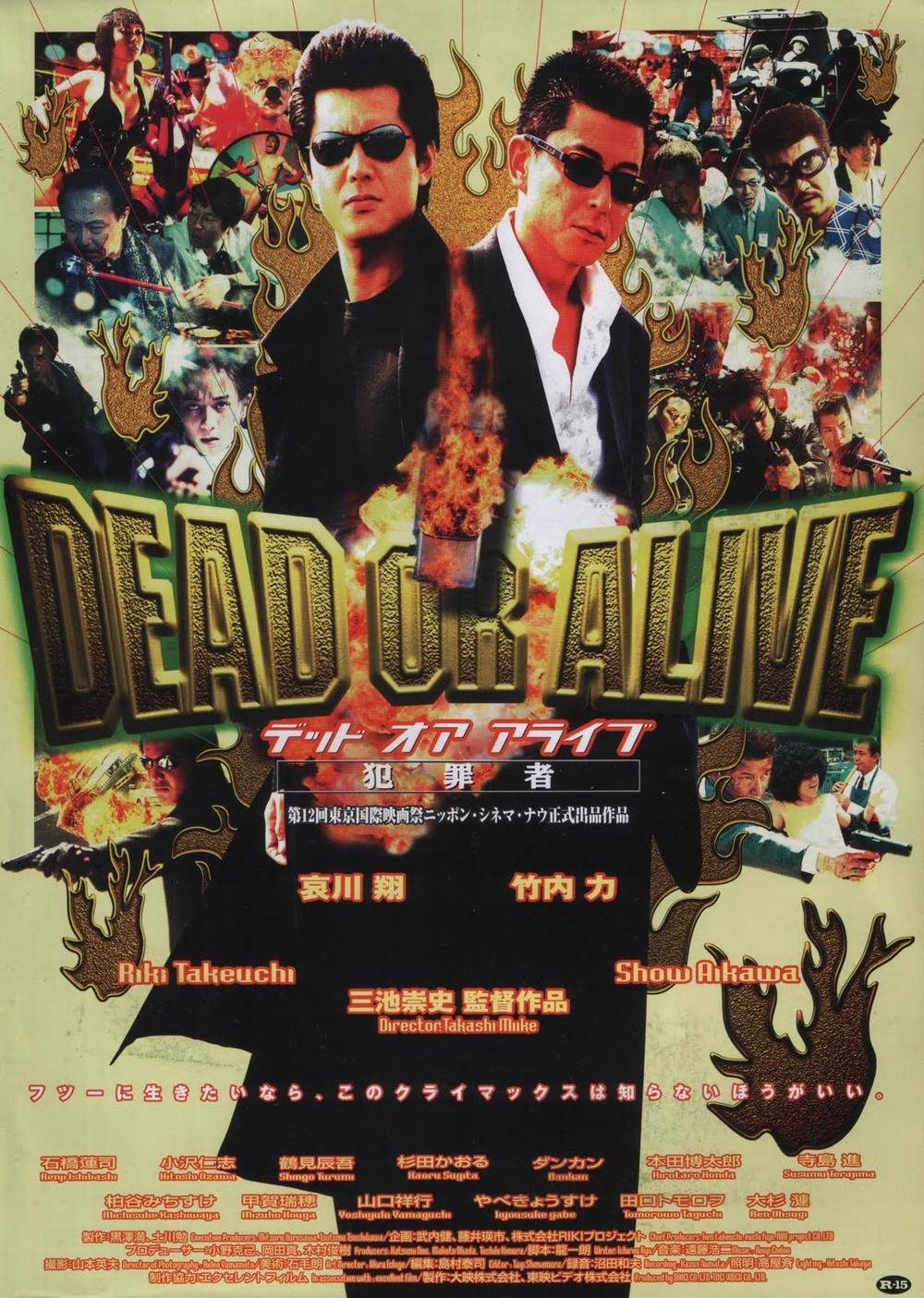
Dead or Alive: Final (Takashi Miike, 2002)

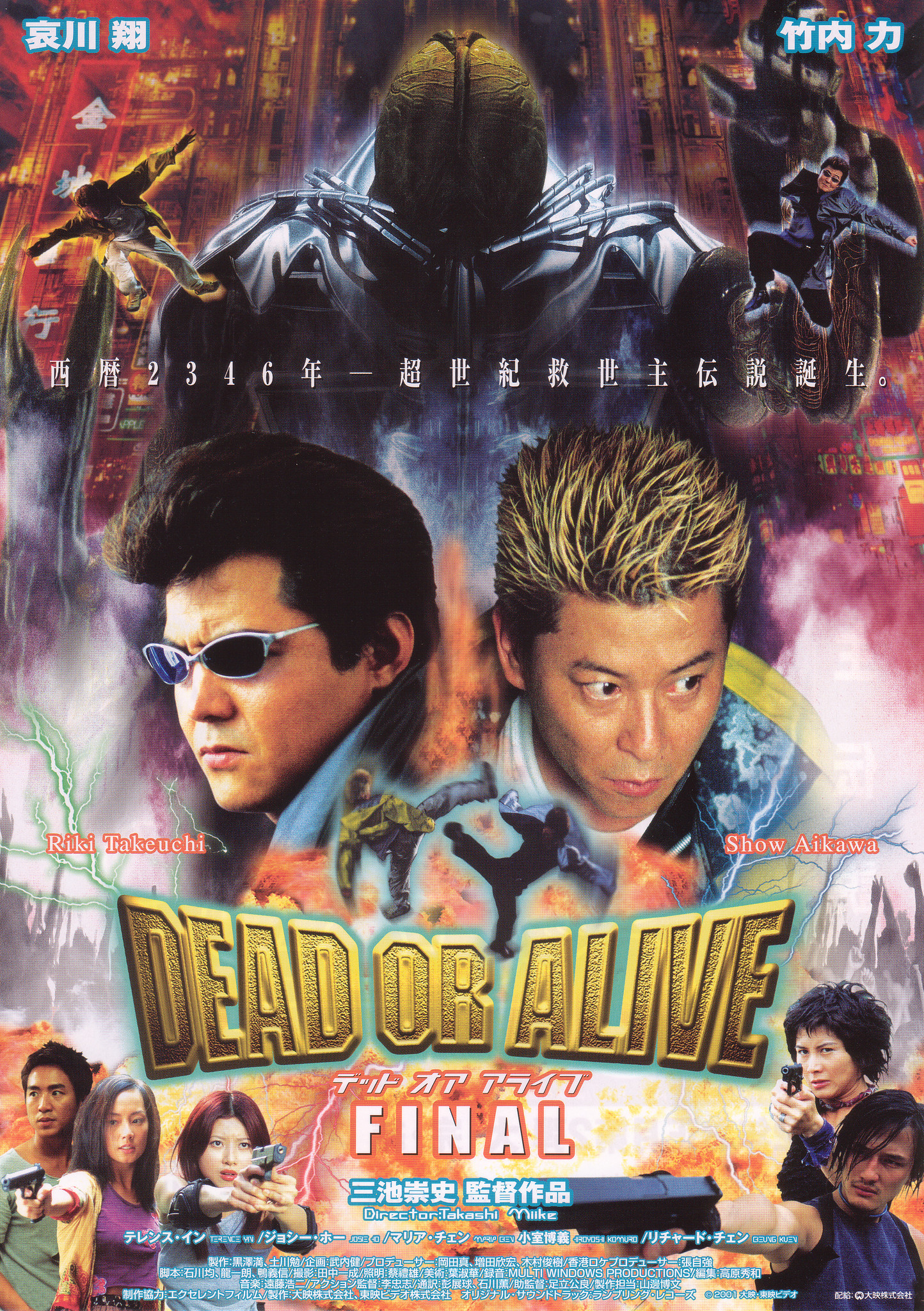
dead_or_alive_final_jap_chirashiThe Dead or Alive Trilogy began in a furious, drug fuelled hymn to violence in which a petty vendetta between the opposing forces of good and evil (mingled and bloody) eventually destroyed the entire world. Dead or Alive 2: Birds was an altogether more contemplative affair in which two orphaned boys rediscover each other as jaded hitmen and decide to put their talents to “good” use by donating the hit money to pay for medicinal drugs for impoverished children around the world. Strange and surreal, Birds moved beyond the first film’s absurd ending for an altogether more abstract approach to universe building but Final pushes the idea to its limit in a cyberpunk infused far future tale of rogue robots and sexual dictatorship.

Yokohama, 2346. A new society is being forged, a new social order has been created. All powerful Mayor Wu (Richard Chen) has decreed that the only true love is gay love and made heterosexuality taboo. Births are strictly controlled to maintain population numbers with contraception ruled mandatory. The heterosexual resistance has gone into hiding in a ruined part of the city, living in a free love commune in which the birth of children is a primary goal. Lead by Fong and his first lady Jun, the resistance aims to liberate the people from the yoke of the crazed dictator and create a better, freer world for the as yet unborn children of the future. Teaming up with a rogue “Replicant”, Ryo, (Sho Aikawa) the gang attempt to further their cause by kidnapping the young son of Wu’s chief of police, Honda (Riki Takeuchi), who later discovers some uncomfortable truths about his own existence.

The use of the world “Replicant” is a pointed one and an overt reference to Final’s key text – Blade Runner, though its intentions amount much more to a pastiche than an examination of the existential questions so central to the seminal cyberpunk classic. Online captions state the action is taking place in Yokohama – an industrial harbour town close to Tokyo, but is in reality a thinly disguised Hong Kong with a green tint. Nevertheless, Miike makes the most of rundown industrial complexes now overrun by nature and the symbols of historical hubris. Aside from the flying cars and other CGI touches, the dystopianism is all too real in its sense of economic and social failures which have allowed a man like Wu to run a strange fascist police state even in the absence of the necessary infrastructure.

In keeping with the Hong Kong setting the Yokohama of 2346 is largely Chinese with broad mix of intermingled languages. Once again the nature of family is called into question but this time more through a large scale change in the social order which sees birth strictly controlled through medical and cultural enforcement. The largely Cantonese speaking resistance movement want to create a world where children can be born and then grow up freely, neatly echoing the previous films’ preoccupation with the fates of children as considered by orphans. Aside from their idealism, the Resistance turns out not to be so far removed from the petty gangsters of the previous instalments as they ultimately turn on each other with deadly consequences.

Sho Aikawa and Riki Takeuchi face off once again with Aikawa playing a Rutger Hauer-esque android who proves his “humanity” through his affiliation with children. A “Replicant” from a long forgotten war, Ryo has superpowers which allow him to stop bullets in mid-air or send out sparks of energy but is also at home playing the clown as he brushes his teeth nonchalantly in the middle a fist fight or plays dead to entertain a little boy. Takeuchi’s Honda, by contrast, is the stereotypical gestapo inspired secret police chief whose family life is a hollow one devoid of genuine feeling and maintained solely for professional expectation.

If Miike has been playing Blade Runner all along, his finale jumps ship for Tetsuo: The Iron Man as the trilogy’s leading men relive the totality of their experiences across three different plains of existence before merging into one as a kind of angel of destruction. The cycle of violence has reached its apotheosis as the twin angels are sent to wreak revenge on those who have misused their authority. Shot on high grade video, Final makes the most of its more modest production values but can’t help suffering in comparison to its predecessors. The B-movie opening is a helpful clue to Miike’s intentions as he creates his own kind of sci-fi dystopia inspired by pop culture memories, but even if the overarching themes lack integrity, Final provides the perfect ending for this often frustratingly absurd series, defying rational explanations until the end of time.


Available now in UK from Arrow Video!

Original trailer (English subtitles)

Dead or Alive 2: Birds (DEAD OR ALIVE 2 逃亡者, Takashi Miike, 2000)

dead-or-alive-2-birds

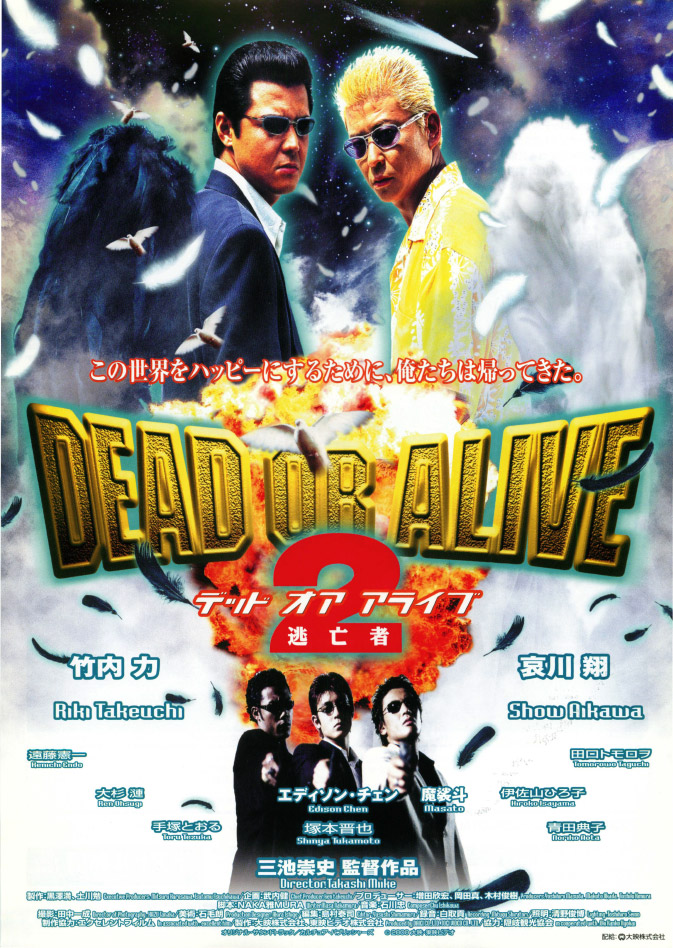
How do you make a sequel to a film which ended with the apocalypse? Takashi Miike is no stranger to strange logic, but he gets around this obvious problem by neatly sidestepping it. Dead or Alive 2: Birds (DEAD OR ALIVE 2 逃亡者, Dead or Alive 2: Tobosha) is, in many ways, entirely unconnected with its predecessor, sharing only its title and lead actors yet there’s something in its sensibility which ties it in very strongly with the overarching universe of the trilogy. If Dead or Alive was the story of humanity gradually eroded by internecine vendetta, Dead or Alive 2 is one of humanity restored through a return to childhood innocence though its prognosis for its pair of altruistic hitmen is just as bleak as it was for the policeman who’d crossed the line and the petty Triad who came to meet him.

Signalling the continuous notions of unreality, we’re introduced to this strange world by a magician (Shinya Tsukamoto) who uses packets of cigarettes to explain the true purpose of a hit ordered on a local gangster which just happens to be not so different from the plot of the first film. Because the gangster world has its own kind of proportional representation, neither the yakuza nor the Triads can rule the roost alone – they need to enter a “coalition” with a smaller outfit no doubt desperate to carve out a little more power for themselves. The free agents, however, have decided on a way to even the power share – hire a hitman to knock off a high ranking Chinese gangster and engineer a turf war in which a proportion of either side will die, leaving the third gang a much more credible player.

Mizuki (Sho Aikawa), bleach blond and fond of Hawaiian shirts, is an odd choice for a secret mission but his sniper rifle is rendered redundant when a man in a dark suit does the job for him – loudly and publicly. So much the better, thinks Mizuki, but the memory of the strangely familiar figure haunts him. Finding himself needing to get out of town, Mizuki has a sudden urge to go home where he encounters the suited man again and confirms that he is indeed who he thinks he is – childhood friend, Shuichi (Riki Takeuchi).

Revisiting an old theme, Mizuki and Shuichi are orphans but rather than being taken directly into the yakuza world they each spent a part of their childhood in a village orphanage on an idyllic island. Miike frequently cuts back between the violent, nihilistic lives of the grown men and the innocent boyhood of long hot summers spent at the beach. The island almost represents childhood in its perpetual safety, bathed in a warm and golden light at once unchanging and eternal. Reconnecting with fellow orphan Kohei (Kenichi Endo) who has married another childhood friend, Chi (Noriko Aota), the three men regress to their pre-adolescent states playing on the climbing bars and kicking a football around just like old times.

Returning to this more innocent age, Mizuki hatches on an ingenious idea – reclaim their dark trade by knocking off those the world would be better off without and use their ill gotten gains to buy vaccines for the impoverished children of the world. In their innocent naivety, neither Mizuki nor Shuichi has considered the effect of their decision on local gangland politics (not to mention Big Pharma) and their desire to kill two “birds” with one stone will ultimately boomerang right back at them.

Innocence is the film’s biggest casualty as Miike juxtaposes a children’s play in which Mizuki and Shuichi have ended up playing a prominent role, with violent rape and murder going on in the city. Whether suggesting that the posturing of a gang war is another kind of playacting, though one with far more destructive consequences, or merely contrasting the island’s pure hearted fantasy with the cold, hard, gangland reality, Miike indulges in a nostalgic longing for the simplicity of childhood with its straightforward goodness filled with friendship and brotherhood rather than the constant betrayals and changing alliances of the criminal fraternity.

The question “Where are you going?” appears several times throughout the film and perhaps occurred to Mizuki and Shuichi at several points during their journeys from abandoned children to outcast men. Neither had much choice in their eventual destination and if they asked themselves that same question the answer was probably that they did not know or chose not to think about it. All of these hopes and ruined dreams linger somewhere around the island’s shore. Kohei is about to become a father but the birth of a child now takes on a melancholy air, the shadow of despair already hanging over him. There is no way out, no path back to a time before the compromises of adulthood but for two angelic hitmen, the road ends with meeting themselves again and, in a sense, regaining lost innocence in shedding their city-based skins.


Out now in the UK from Arrow Video!

Original trailer (English subtitles)

Dead or Alive (DEAD OR ALIVE 犯罪者, Takashi Miike, 1999)

dead or alive
Prolific as always, Takashi Miike released four feature length films in 1999, in addition to working in TV and video. Dead or Alive (DEAD OR ALIVE 犯罪者, Dead or Alive: Hanzaisha) came out within the same year as Miike’s seminal Audition and though it is the latter which has gone on to define his reputation, the Dead or Alive Trilogy is equally responsible for the director’s ongoing popularity. Following the Black Society Trilogy the finale of which, Ley Lines, was also released in 1999, Dead or Alive returns to the world of orphaned exiles and Chinese gangsters, men looking for family in all the wrong places and finding only loneliness, rage, and disappointment. Criminal or cop, everyone is looking for the same old thing but for one reason or another it continually evades their grasp.

Late ‘90s, Shinjuku night life. Miike captures all of its sordid glory in a wordlessly frenetic opening sequence which begins with a naked woman falling off a building and ends with the exploding belly of a noodle loving Triad. The Shinjuku gang scene is a large and complex one but this tiny corner is about to be torn apart by the opposing forces of petty Chinese gangster Ryuichi (Riki Takeuchi) and veteran policeman Jojima (Sho Aikawa).

A little later, the major antagonist – yakuza boss Aoki (Renji Ishibashi), asks a drugged up woman he’s immersed in a pool of her own excrement he himself extricated by means of a series of enemas if she’s high or if she’s come down. Drugs are always on the periphery from the bag in the hands of the falling woman to the deluded hopes and dreams of everyone who’s had the misfortune to find themselves here but Miike takes things one step further and structures his film like the inverted bell curve of a strange trip. The relentless pace of the opening sequence with its constant noodle refills, cocaine excess, and eventual bathroom sex and murder combo gradually winds down giving way to the comfortably numb central section in which Jojima and Ryuichi mirror and circle each other in the murky Shinjuku streets but, as he often does, Miike refuels for an angry, increasingly bizarre final sequence as two men whose quests have cost them everything they were fighting to protect prepare to burn the world rather than see the other live another day.

Ryuichi, like many a gangster hero, is an orphan. His major motivation is a desire to protect his delicate younger brother whom he has sent abroad to study in the hope that he will be catapulted into a successful middle class life while Ryuichi takes over the criminal underworld. Toji (Michisuke Kashiwaya) has returned, but such close proximity to his brother’s darkness may have destabilising consequences for both of them. Ryuichi’s “family” is a constructed one made of other similarly lost or discarded kids of Chinese descent, all looking for a home when neither of the two which present themselves is willing to offer them full acceptance but there is no unconditional love here, betrayal is an easily applied judgement met with a harsh and irreversible punishment.

Even if Ryuichi’s world is cold, Jojima’s may be colder. Despite his wife’s pleas he sleeps on the sofa and seems to have a difficult, strained relationship with the family his life is founded on protecting. Jojima’s reasons for continuing to avoid his marital bed are unclear whether from simple consideration of his strange policeman’s hours or the hushed phone call his wife receives which suggests she may be seeking comfort outside the home, but the one thing which is clear is that this is a family already deeply fractured. Adding to the strain, Jojima’s daughter is seriously ill and his wife has worked out that they will need an enormous amount of money for her treatment. Jojima continues to proclaim that he is “working on it” and will find the money somewhere, reacting angrily to his wife’s desperate suggestion of asking her family for a loan. Wanting to save his daughter himself, he ventures ever deeper into the criminal underworld, crossing the line from law enforcer to law breaker.

Miike operates a tightly controlled approach to pacing after the frenetic opening, slowing right down before exploding in a flurry of gun fire for the climactic shootout (flying chicken feathers and all) and then taking a break until the bonkers finale with its self amputations, mysterious bazookas and strange power orbs. Dead or alive, these are men living in a furious purgatory each denied the very thing they’ve been searching for, but in the end they mirror each other, locked in a vicious cycle of rage and violence which threatens to engulf us all.


Out now in the UK from Arrow Video!

Original trailer (English subtitles)