

As we follow the road that leads down to the beach in the presence of a black cat, there’s a sign at the beginning of Satoko Yokohama’s Seaside Serendipity (海辺へ行く道, Umibe e Iku Michi) that lets us know that this town welcomes artists. Adapted from the manga by Gin Miyoshi, the film is another in the idyllic summer adventure genre with its tranquil, almost magical setting that even one of its temporary residents describes as somehow different from other places, but also contemplates the nature of art and its ability to influence the environment.
This is certainly a very creative place where strange things happen and people mostly seem to do their own thing. Then again, Risako (Ayame Goriki) rents out apartments to artists looking for quiet retreats to practise their art in a peaceful environment but mainly ends up with those arriving for other reasons whose “art” is more like subterfuge. A young couple arrive running a bizarre scam selling fake knives that won’t even cut tofu after a couple of days. A stone sculptor she ends up dating is on the run from a loan shark, who just happens to be an old friend who said her job was in “sales” rather than admit she works as a debt collector chasing failed artists who always have an excuse as to why they can’t pay or haven’t yet produced anything.
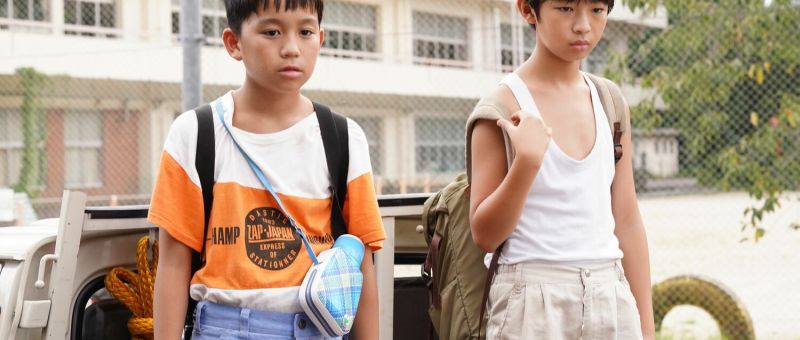
A mysterious man gives Megu (Koharu Sugawara) a canary-shaped whistle that’s supposed to chirp in the presence of a true artist and make an unpleasant noise in the case of a false one. But as the kids eventually put it, all artists are self-proclaimed. The only requirement for calling oneself and artist is that you make something you consider to be “art” even if others disagree. Art can take many forms, as in the weird structure Ryoichi (Toma Nakasu) constructs made out of all the spoons he’s bent in his life. Sosuke (Kōnosuke Harada), meanwhile, attracts the attention of another mysterious man calling himself “A” who commissions him to make a model of a mermaid from a painted scroll. Sosuke dutifully makes it with a few additions such as the ability to remove the mermaid’s left breast and extract her heart. A interprets this as an expression that one cannot hide anything in art, whether things about themselves the artist wanted to conceal or things that they simply did not know.
But Sosuke’s friend Teruo (Shun Aoi) also lets him in on the idea of mimesis, that they aren’t trying to reproduce something exactly as it appears but understand its true essence and recreate that. Teruo uses the art of mimesis to create a realistic mask modelled after the late husband of an elderly woman who says that it was foretold to her in a dream that he would come to her on her birthday. Though it might be a questionable gesture, he did it out of a desire for her dream to be true and to bring comfort to a lonely person whose family were unable to communicate with her, perhaps because they did not have the ability to lipread as Teruo apparently does. Nevertheless, they accuse him of stealing her money, insulting the purpose of his art.
The art club’s art is also misused in a way when Ritsuko bizarrely asks them to create a hole she can say her boyfriend used to escape, like in a cartoon. This appears to be the sort of place where one can get away with such a ridiculous conceit. Trying to tell the truth, meanwhile, backfires for an aspiring journalist who uncovers suspect goings-on at the local nursing home where a nurse forces elderly people to sing songs out in the summer heat and prevents them from eating lunch as a means of staving off dementia. When her teacher leaks the video she recorded to social media, she’s annoyed to have missed the scoop and also that the teacher didn’t investigate properly opting for mob justice instead. The young woman worries the nurse may kill herself because of what she uncovered which is perhaps only a version of the truth. Meanwhile, everyone else is hot on the trail of mysterious animals appearing in the town that are somehow repelled by Teruo’s mystery art project. Even so, everything continues as normal in this strange little town as Sosuke pursues his artistic dreams painting tranquil visions of peaceful destruction from the deserted jetty, seemingly paying it no mind.
Seaside Serendipity screens in Chicago March 22nd as part of the 20th edition of Asian Pop-Up Cinema.
Trailer (English subtitles)

 Windows on Worlds