The Nineteen-Year-Old’s Map (十九歳の地図, Mitsuo Yanagimachi, 1979)

“What should I do with my life?”, the question becomes a frequent refrain in Mitsuo Yanagimachi’s dark tale of urban alienation, The Nineteen-year-old’s Map (十九歳の地図, Jukyusai no Chizu). Adapted from a novel by Kenji Nakagami which painted a bleak picture life on the margins of the economic miracle, the film’s quiet sense of unease hints at a coming explosion but also that there will never be one because in the end the hero is too filled with despair and ennui to ever follow through on the various threats he makes during a series of prank calls to people in the neighbourhood who’ve incurred his wrath.

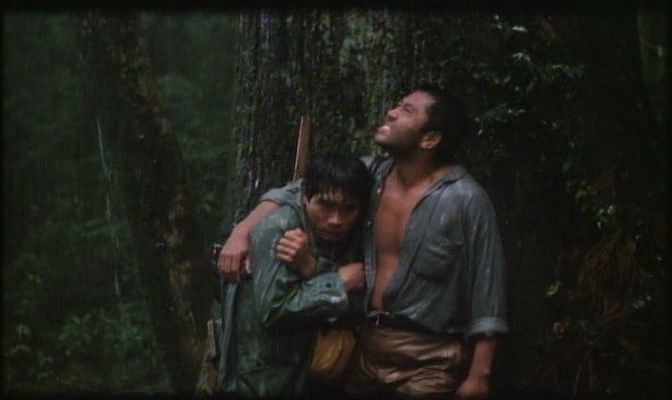
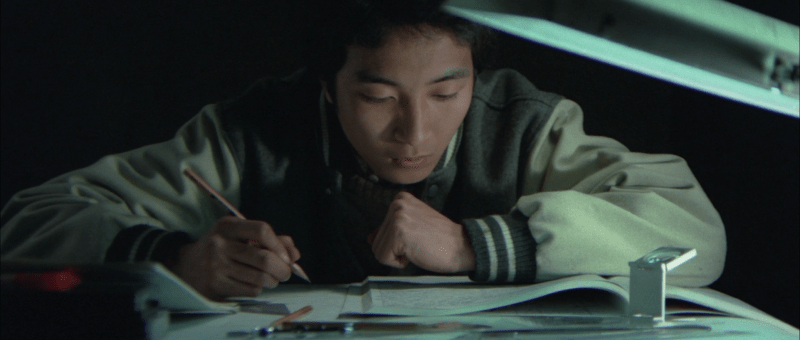
The nineteen-year-old of the title, Yoshioka (Yuji Honma) is in theory a student taking a year out to study for university exams while earning his keep delivering papers for a newsagent where he lives in a dorm with several other paperboys all just as defeated and aimless as he is. They all, however, look down on and make fun of him for being a bit odd not least because he hangs around with a 30-year-old man who is still stuck living a like a teenager that the other guys think is creepy. Konno (Kanie Keizo) is creepy in a way, in that he’s an obvious image of what these boys might be in 10 years’ time if they do not manage to find something that will allow them to move forward, out of the slums and into a more fulfilling life. 

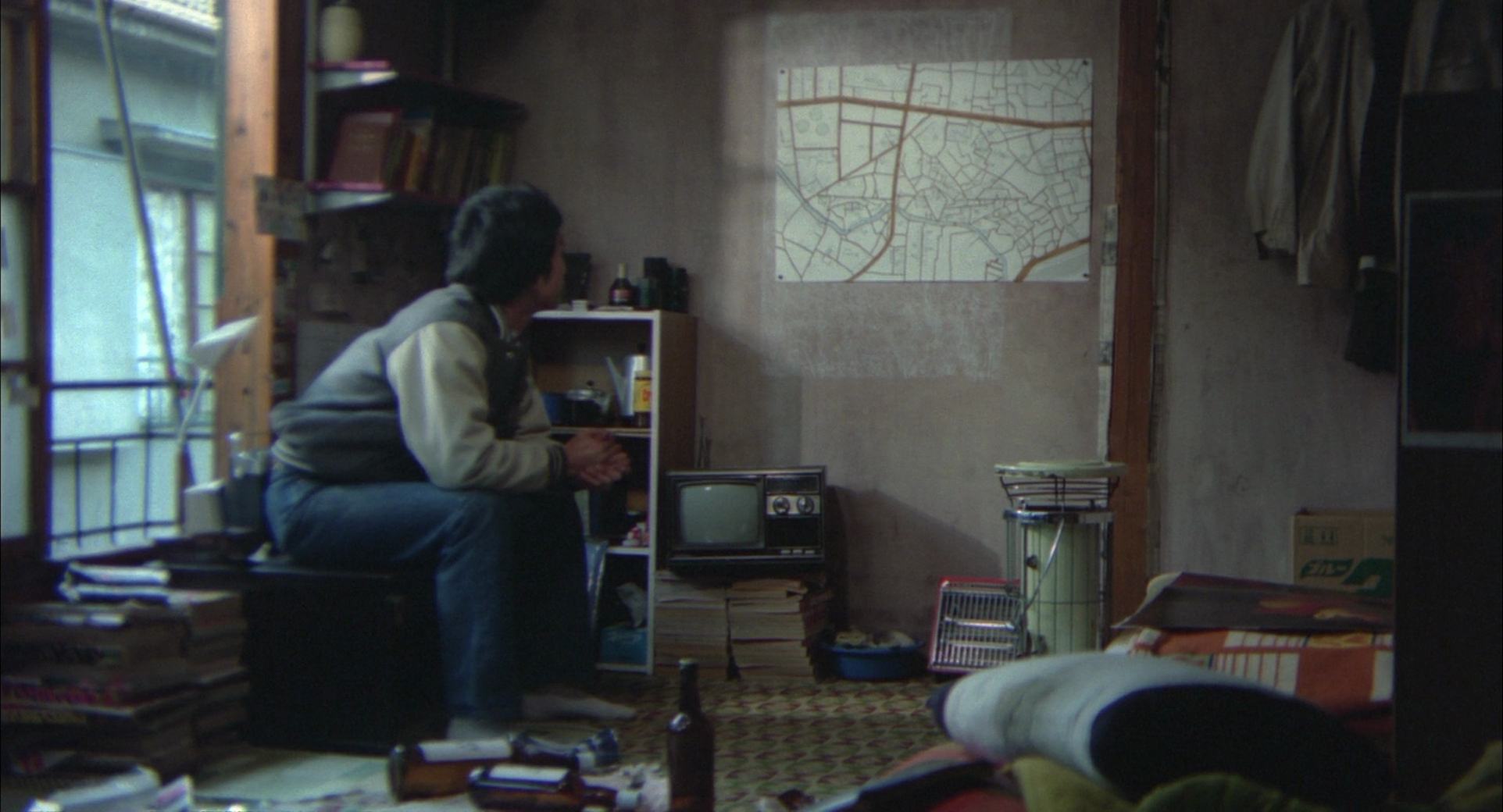
Yoshioka’s main outlet is making a map of the local area which he annotates with notes about the various people who live there, many of them on his paper round. If they do something to displease him or otherwise display something he regards as a moral failing he puts a large cross against their name, and when someone has three crosses he makes a harassing phone call threatening to burn down their house. It’s never quite clear whether his threats have any serious intent or if the threat itself is enough in allowing him to feel powerful and superior to world around him which he feels is rotten beyond repair. People often ask him where he’s from and he tells them but with slight hesitation, as if he’s not telling the entirety of the truth as perhaps confirmed by one woman’s attempt to probe his origins surprised that he doesn’t have any kind of rural accent while she’d never heard of the town he claimed to be from. 

One of the other boys at the newspaper office is an aspiring boxer, but he gets badly beaten in a fight and eventually leaves to join the Self Defence Forces. The meanest of them, Sato, has a sharp tongue but seemingly no more direction than Yoshioka finding his release through more direct forms of violence and hateful behaviour. Everyone around him is disappointed and filled with despair. Even the lady who runs the newsagent’s reflects on her unsatisfying life and the ruined hopes of her youth in which she dressed in fine kimonos and kept herself nice. Her only comfort is that she “saved a man deserted by his wife” even if she mainly treats him with contempt for his failure to repair the loose nail in the hallway she keeps catching her foot on, or fix the toilet which continually backs up and floods the bathroom. 

Yoshioka does seem to be followed around by leaky appliances while everywhere around him is dank and muddy. Konno has one ray of hope in his life in the form of a woman he calls Maria (Hideko Okiyama) who is covered in scars but still she survives. Maria is indeed a Madonna figure, a symbol of scarred purity and human suffering that Konno regards as a kind of salvation. Yet Konno’s attempt to reach her only leads to further ruin as he commits small but increasingly daring acts of crime from bag snatching to burglary to get the money to run away with her only to end up in prison still wondering what it is he should do with his life. 

Maria had told them of a dream she had in which hundreds of people emerged from her and went happily to heaven while she was left on the ground below. Some angels on a cliff tried to lift her up, but she found herself unable to reach out to them only standing immobile and looking up in jealousy. In his way, Yoshioka is much the same perhaps as Konno had said afraid to be happy and unable to envisage for himself a life outside of the slum. Konno sometimes introduces him as a student at a top university which seems to further press on his insecurity. Yoshioka rarely attends classes, spending all his time delivering papers or making his map of iniquity. He describes himself several times as a “right-winger” and at one point fantasises about taking part in a nationalist parade, but aside from his conservative takes on morality seems to have no real ideology save the fact that everyone, even the people who are actually nice to him, pisses him off. 

“Even if you’re angry at something, why should you explode the gas tanks?” a telephone operator reasonably asks after Yoshioka makes a prank call reporting a bomb threat on a train leaving Tokyo station while explaining that he also plans to blow up a set of gas cylinders to obliterate the town. The voice on the phone does not appear to take him seriously and sympathetically tries to talk him out of his strange delusion, but all Yoshioka can do is go home and cry in the utter impotence of his life. In the end, Maria is the only one who is able to feel any kind of joy. Finding a pretty dress while dumpster diving, she twirls cheerfully dancing around even with the leg which was left lame after a failed suicide attempt. This time she’s the one who tries to reach out, but Yoshioka ignores her and looks away as they head in different directions. It seems he will never really act on any of his threats, or be able to escape the futility of his life trapped on the margins of a prosperous society which he feels continues to reject him. Yanagimachi films his uneasy existence with naturalist detachment, capturing the mud and filth that cling to Yoshioka along with the strangely violent, goldfish-killing kids, the angry dads, and women who urinate in the street that occupy his round in this particular corner of the “hell” of modern Tokyo.


DVD release trailer (no subtitles)
Fire Festival (火まつり, Mitsuo Yanagimachi, 1985)

By 1985 the Japanese economy was approaching its zenith yet along with increasing economic prosperity had come social change of which small-town Japan was either casualty or sacrificial victim. “Nigishima will stay as it is” declares the last holdout of an increasingly obsolete way of life in Mitsuo Yanagimachi’s intense modernity drama, Fire Festival (火まつり, Himatsuri), a manly mountain man and animalistic force of nature by several metrics unsuited to life in the contemporary society into which he is ultimately unable to progress. 

There are many things which it seems have not changed in Nigishima for generations, one being the animosity between the cohorts of its bifurcated community, those who live by land and those who live by sea. Rural depopulation may have forced them to come closer but it has also increased their sense of mistrust while both industries continue to suffer in an economy which no longer prizes their humble rural output. Despite being catapulted into a promised modernity by the advent of the railway to great fanfare in 1959, it now seems that Nigishima cannot survive without a new road which could be paid for by the development of a marine park only mountain man Tatsuo (Kinya Kitaoji) owns the property right in the middle of the earmarked area and has hitherto refused to sell further increasing the tension between the two communities. 

Tatsuo is thought of, and thinks of himself, as a big man in the area quite literally it seems as part of the reason he enjoys this status is down to his being unusually well-endowed. He believes himself to have a special relationship with the mountain goddess, often joking to the other men about having a sexual relationship with her while sometimes describing her as his girlfriend. Several times he is mistaken for an animal, firstly by the boatman bringing his childhood sweetheart and sometime mistress Kimiko (Kiwako Taichi) back to the island who assumed he was a monkey crawling along the cliff edge thoughtlessly throwing rocks at them, while he often gambols through the forest whooping like some kind of Tarzan. Entirely unreconstructed, his worldview is patriarchal and misogynistic. All of his banter with the other men is sexual, constantly referring to his penis while greeting his friends with lewd hand gestures thrusting his fist into his pocket as if waving with an erection. The cure for offending the goddess he tells his young protege Ryota (Ryota Nakamoto) is to drop his trousers and display his manhood, Tatsuo strangely believing this would appease her for taking wood from a sacred tree or killing without permission. 

Smearing the blood of a sacrificial animal over his chest and forearms he dedicates the death to the goddess, a gesture he will repeat in the film’s violent and tragic conclusion yet there is also arrogance in his conduct as if he believes himself above natural law, protected as the goddess’ favourite even as he describes himself as “suffocated” by the women in his life from his mother and five older sisters all of whom indulge him to his wife, kids, and mistresses. He has trained his dogs to hunt wild boar without the use of guns in a method he admits even other hunters describe as “cruel” while breaking a local taboo shooting monkeys in the forest well aware of nature red in tooth and claw. As such, there is little nobility to be seen in his determination to preserve this already obsolete way of life. His virility maybe contrasted with that of the ageing land broker Yamakawa (Norihei Miki) and his failed attempts to bed sex worker Kimiko who tricks him into paying off her debts, but he at least knows the way the wind is blowing explaining to her that towns such as Nigishima survive only through things like marine parks or hotels or even nuclear power plants. Without the road, the town will die. 

Yet in 1959 they were told the railway would save them and it seems it did not. Tatsuo’s love making with Kimiko in a boat borrowed from a treacherous fisherman who later agrees to sail it transgressively into sacred waters is intercut with memories of the rail line’s opening ceremony, two teenagers who might have been them or at least of around the same age ride an elephant on the jetty while the townspeople arrange themselves into the formation of the character for “celebration” captured by the aerial photographer above. For Tatsuo as a boy, was this a rebirth of Nigishima or the beginning of its demise as the coming modernity began to eat away at its foundations? 

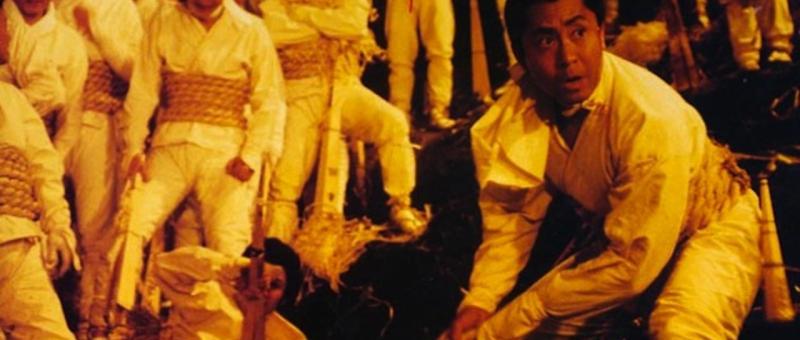
The fire festival is “for men”, according to Tatsuo, “to drive out evil spirits”, his manliness getting the better of him as he disrupts the proceedings to attack a man he accuses of having brought “false fire”. These are the lessons he teaches to surrogate son Ryota whose devotion to him borders on the homoerotic, Tatsuo cradling him during the climactic rain storm and he seeming to develop a fascination for Kimiko as a kind of indirect fixation. Ryota has learned Tatsuo’s chauvinism mimicking his lewd hand gestures and swaggering walk, his cruelty in sacrificing 1000 yen to trick Yamakawa into injuring his hand in a bear trap, and his arrogance ensuring that his problematic masculinity will survive into another generation presumably no more capable of halting the march of modernity than he has been. Tatsuo poisons the waters with fuel oil which as one of the greek chorus of fish wives points out does not catch fire, Tatsuo himself smouldering until an inevitable explosion. Receiving some kind of epiphany during a mystical congress with the goddess in the middle of a storm, he knows what he must do and accepts that he cannot progress into the modern society. Smoulderingly intense in its small-town animosity and primeval sensibilities, Yanagimachi’s poetic tragedy of futility and the broken promises of a badly distributed modernity may accept the the sacrifice but mourns it all the same. 


Fire Festival screens at the BFI on 20/27 December as part of BFI Japan.

Clip (English subtitles)