Fly Me To The Saitama -FROM BIWA LAKE WITH LOVE- (翔んで埼玉 ~琵琶湖より愛をこめて~, Hideki Takeuchi, 2023)

The Saitamafication of Japan continues in the long-awaited sequel to the hit 2019 comedy Fly Me to the Saitama. Though the visa system has been abolished and the citizens of Saitama are new free to enter the capital, that does not mean to say everyone is on the same page and the prefecture still faces internal divisions and increasing factionalism. Revolutionary Rei (Gackt) proposes a solution which involves connecting the series of train lines to make it easier to get around and building a beach resort to lesson their sense of inferiority over having no access to the sea.

Once again it has to be said that humour is very local and largely built around regional stereotypes, though it is perhaps curious that the ordinary citizens are often seen in clothing reminiscent of the 1930s something which is also echoed in scenes of trains arriving at stations greeted by crowds of well-wishers seeing soldiers off to war. This may in a sense echo the film’s central theme in the encroachment of Osaka imperialism in which Japan’s second city has launched a not so secret campaign to Osakify the rest of the nation, if not the world, using white powder manifesting as sand from Koshien Baseball Stadium which is a holy place to many as it is where the high school baseball championship takes place. 

They have a visa system in Osaka too, or more strictly the Kansai area, with Kyoto and Kobe apparently in on the plot and intent on looking down on suburban areas such as Wakayama and Shiga which is where Rei was planning on getting his sand. Shiga is set up as a the Saitama of the south west, a pleasant if dull sort of place with a lake its only claim to fame. Like Saitama it has a liberation front, led by Kikyo (Anne Watanabe) who known as the Oscar of Shiga because she went to France to study revolutions and is is dressed like Oscar from the Rose of Versailles. 

The citizens of Kyoto come in for a bit of a kicking for their stereotypically snobbish attitude, the natural politeness of the local dialect undone by a social gadget that reveals what they’re “really” thinking which is that their definition of Kyoite is very narrow. The stereotypical view of Osaka, as voiced towards the end of the film, is that the people are cheerful and warmhearted. The city is associated with comedy and particularly manzai double acts like the one which appears during the opening credits, which perhaps adds to the sense of despair and confusion that the normally nice Osakans could suddenly be hellbent on world domination aided by the already strong love for takoyaki throughout the nation.

As before, we also have a “real world” subplot in which members of a family listen to the radio broadcast outing the urban legend of Rei and his BL love story with Momomi, the Tokyo-raised governor of Saitama. These regional rivalries are tearing up the real world too with a tug of war match that threats to go incredibly wrong if the two areas with an existing beef are allowed to face each other in the final. In contrast, the fantasy world is a riot of zany 18th-century influenced design that sees Rei set off on a pirate ship to get his sand for the fake beach though the mayor of Kobe turns up dressed like Audrey Hepburn in Breakfast at Tiffany’s, and the Kyoto-ite has Taisho-esque straw hat. When the gang are caught by the fascisitic Osakans they’re relegated to a dungeon under Koshien Stadium and enslaved because of Saitama’s low ranking amid the other prefectures of Japan.

It’s all very silly, and somewhat impenetrable to non-Japanese speakers who can’t pick up on the dialect switching or zany wordplay while a certain degree of familiarity with regional stereotypes is certainly helpful. In any case, while the Osakafication of Japan undoubtedly sounded quite bad, the same cannot be said for its Saitamaification and Rei’s desire to create a land without discrimination free of the oppression and inequality born of pointless regional snobbery where everyone is free to go wherever they please without let or hinderance. 


Fly Me To The Saitama -FROM BIWA LAKE WITH LOVE- screened as part of this year’s Nippon Connection

Original trailer (English subtitles)

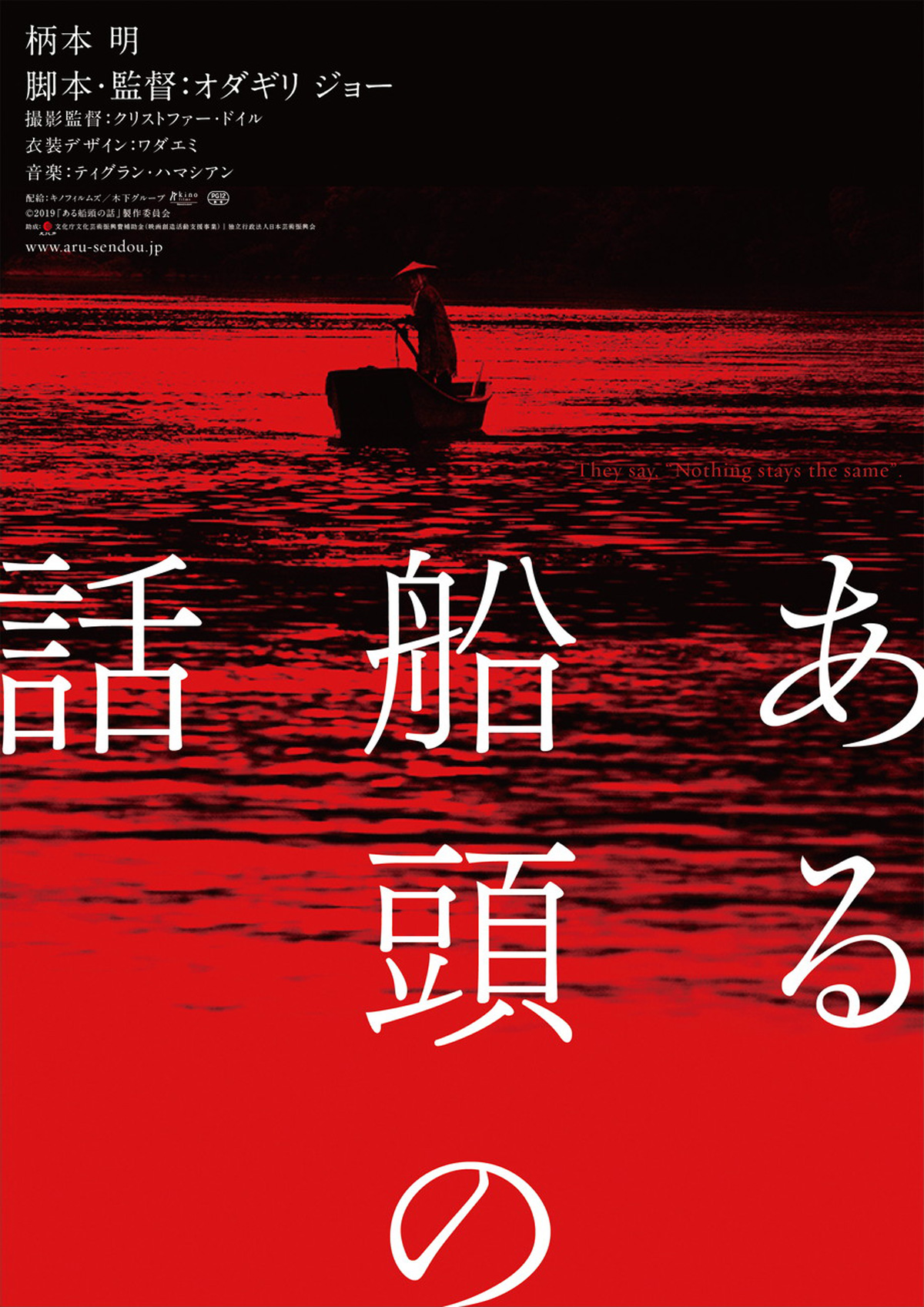
They Say Nothing Stays the Same (ある船頭の話, Joe Odagiri, 2019)

“Something new comes along, old things have to go” according to the philosophical boatman at the centre of Joe Odagiri’s They Say Nothing Stays the Same (ある船頭の話, Aru Sendo No Hanashi). A Meiji-set lament for changing times, Odagiri’s first feature following his 2009 mid-length comedy Looking For Cherry Blossoms is a visual tour de force shot by Christopher Doyle with whom he worked on the 2017 Hong Kong film The White Girl whose ethereal images of the majestic Japanese landscape with its misty vistas and rolling river perfectly compliment Odagiri’s poetic contemplation of transience and goodness. 

Toichi (Akira Emoto), the boatman, has ferried weary souls across the river for as long as anyone can remember but his days are numbered. Modernity is coming to the village in the very literal form of a bridge currently under construction not far from the crossing point, the workmen’s hammers ringing in Toichi’s ears like a ticking clock reminding him that his era is coming to a close, industrial noise at war with the tranquility of nature. For all that he tries to be philosophical. The bridge will certainly be convenient, as he admits to a man (Takashi Sasano) who needs to transport his cow across the river, the only current solution being to cross where the water’s shallowest and have the cow (and its minder) swim alongside while the man rides the boat. Toichi’s young friend Genzo (Nijiro Murakami) who sells herbal medicines, however, isn’t quite so philosophical. He doesn’t think the bridge is a good thing at all and only half-jokingly suggests blowing it up before it’s finished. 

But change comes earlier than expected. Hitting a strange object in the water, Toichi discovers it to be the body of a young girl (Ririka Kawashima) apparently still alive if only just. He takes her in and nurses her back to health, dressing her in a red outfit incongruously in the Chinese style, though she claims to have lost her memory and only later gives her name as “Fu”. Toichi muses on the possibilities, her name perhaps taken from the character for wind which, he points out, is a great motivator for a boatman capable of speeding up the rate of change, but also hears tell of a heinous crime the next village over in which an entire family were brutally murdered with only the daughter apparently spared, feared to have been kidnapped by the killer. Suspecting Fu may be the missing girl, he decides to help her, explaining her presence away in implying she’s a relative from “upriver” he’s been asked to look after for unspecified reasons. 

Toichi too claims to be from “upriver” though we never find out where it was he got those clothes from, assuming someone left them on his boat or like the portrait of the Virgin Mary he admires for its beauty and a memory of sorrow in the eyes of the woman who gave it to him as she explained that she would not come this way again, they simply drifted into his life. The poetic import of his existence as a boatman is not lost on him as he crosses the wide river of life and death, haunted by the strange spectre of another young woman who tells him that he’s damned himself with kindness in intervening in matters of fate. The modern world ebbs ever closer, a city doctor dressed in a white suit bringing Western medicine that challenges Genzo’s concoctions while the arrogant engineer and coarse construction workers resentfully climb into Toichi’s boat. 

“Bridges aren’t important, I prefer fireflies” Fu affirms, hearing the various ways in which the river is already changing. We find the bridge completed in the depths of winter, Toichi attempting to earn a living with animal pelts but now throroughly out of place in the frozen landscape. Nihei (Masatoshi Nagase), a local, laments the way the bridge seems to have hurried their lives, everyone busily crossing back and forth, the modern world now thoroughly penetrating the village. No longer so young or so kind, Genzo is fully corrupted, dressed in a three-piece suit and cape with a brogues on his feet unsuited to the rocky terrain and now looking down on his old friend who will not be able to cross the bridge into the modern world but will be forever cast away, a boatman to the end never resting too long on the shore. 

Yet Toichi maintains his imperfect humanity, admiring Nihei’s father (Haruomi Hosono) as man who truly put others before himself even in death in bequeathing his body to the animals in recompense for the many lives he took as a hunter. Toichi admits that he is not so good, a “selfish nobody” who resents the bridge despite himself but resolves to do better to become a man like Nihei’s father. Odagiri shows us leaves on the water which resemble Toichi’s boat as if to remind us how small he is and how great the river, but leaving us with the knowledge that it and he flows on if in flight, continually displaced by the onrush of an unwelcome modernity with its all of its selfishness and lust for the dubious lure of convenience. Boasting a host of famous faces in tiny roles from an imposing Yu Aoi taking village women to perform in a festival to Masatoshi Nagase in an extended cameo and Harumi Hosono as a beatific corpse, Odagiri’s melancholy tone poem is an elegy for an idealised pre-modern age in which the fireflies still shone on the banks of the river and there was time enough for human goodness. 


They Say Nothing Stays the Same streamed as part of this year’s New York Asian Film Festival.

International trailer (English subtitles)