Let’s Have A Dream (九ちゃんのでっかい夢, Yoji Yamada, 1967)

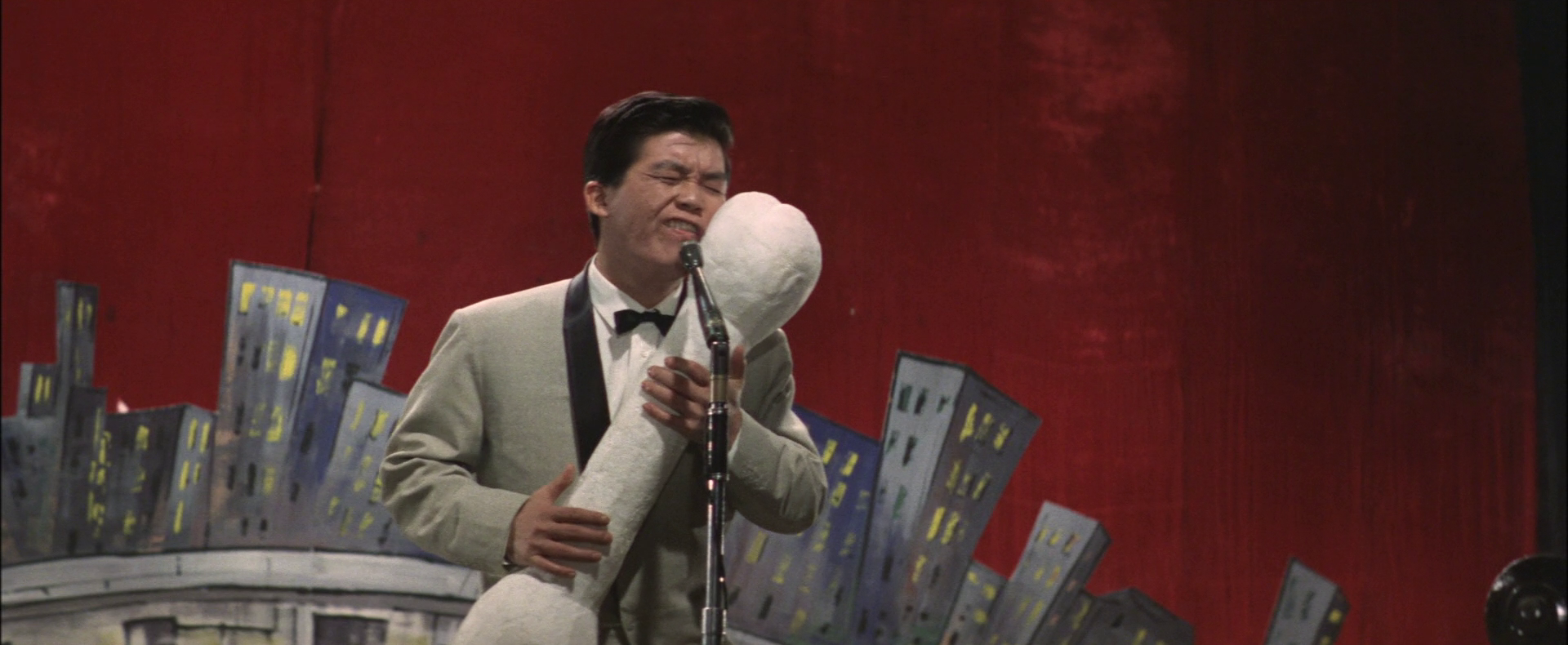
Convinced he’s dying of a terminal illness, a young nightclub singer yearns for death in Yoji Yamada’s romantic farce, Let’s Have a Dream (九ちゃんのでっかい夢, Kyu-chan no Dekkai Yume). In fact, the Japanese title is “Kyu’s Big Dream,” directly putting the name of the star into the name of the picture though he does in fact play a character called “Kyutaro” whose music career is starting to take off just as he convinces himself that his life is hopeless. Best known for “Ue o Muite Aruko”, Kyu Sakamoto was a huge singing star throughout the 1960s until his death in a plane crash at the very young age of 43.

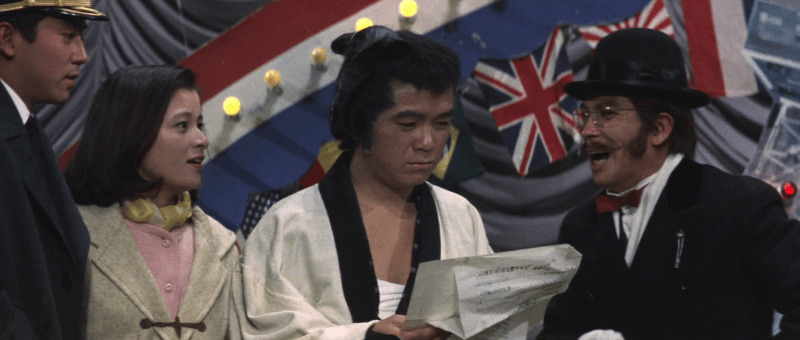
Based on a novel by Nobuhiko Kobayashi who was working with Sakamoto on a television show at the time (and asked for a pseudonym because he wasn’t sure how the movie would turn out), the film is however partly an exploration of the nation’s growing internationalism. Indeed, the film opens with the Pan Am logo and then immediately travels to Switzerland where an elderly lady is dying having apparently never married or had children but still attached to the memory of her first love, a man from Japan. Accordingly, she decides to leave her entire fortune to that man’s grandson, Kyutaro (Kyu Sakamoto), which comes as a total shock to her closest living relative, “The wicked Mr Edward Allan Poe.” Her butler then vows to travel to Japan to tell Kyutaro the good news, but ends up sitting next to the hit man Edward Allan Poe hires on the plane.

But Kyu has already hired a hitman to take himself out because he thinks he’s suffering from a terminal disease and feels nothing other than fear and hopelessness. Though all he wants to do is die, he is unable to take his own life and so has decided this is the best way. He’s also in love with a childhood friend who works in a diner at the docks, but unbeknownst to him Ai (Chieko Baisho) has just got engaged to their other friend Kiyohiko (Muga Takewaki), a sailor. To add to the sense of European romanticism, Kyu writes long notes to himself about his sadness and melancholy all while the countess’ right-hand man continues to refer to him as the luckiest man in the world. 

In a running gag, the hitman speaks mainly in French and the Countess’ butler in cod German hinting at a new kind of internationalism. The hitman Kyu hires through shady local guy Pon (Kanichi Tani) is, however, much less sophisticated. He can’t afford a gun and fails to kill Kyu several times in other ways usually injuring himself in the attempt which again makes Japan look somewhat inferior to the rest of the world just as the opulent vistas of the Countess’ castle contrast so strongely with the down and dirty nature of the docks where Kyu lives and works. 

Despite being so desperate to die, Kyu pulls away when the hitman he hired tries to kill him which along with his inability to take his own life may suggest that he really does want to live after all. Though she evidently does not return his romantic feelings, Ai clearly cares for him deeply describing Kyu as like oxygen for her while trying to get to the bottom of what’s with wrong with him but it takes Kyu a little longer to figure out that people care about him even if not quite in the way he was hoping they would. Even so, there’s no denying the farcical quality of all that’s befallen him as he finds himself “the luckiest man in the world,” caught between two hitmen, and staving off eventual romantic heartbreak.

Still, even this plays into the melancholy sense of romanticism and elliptical ending as Kyu eventually gets to fulfil one of his big dreams by going to Europe and getting to live the life of a heartbroken count from a 19th century romantic novel. As a vehicle for Sakamoto, the film also features several of his songs along with dance routines and some otherwise goofy clowning while Chieko Baisho also performs a short but sweet rendition of My Bonnie Lies Over the Ocean. It’s all undoubtedly very silly but somehow heartfelt and wholesome for all its buried melancholy and deeply felt romanticism. 


Original trailer (no subtitles)

Everything Goes Wrong (すべてが狂ってる, Seijun Suzuki, 1960)

Everything goes wrong posterThe Tokyo of 1960 was one defined by unrest as the biggest protests in history filled the streets urging the government to rethink the renewal of the security treaty Japan had signed with America after the war in order to provide military support in the absence of a standing army. Yet the protests themselves are perhaps an indication of the extent to which the nation was already recovering. With the Olympics just four years away, post-war privation had been replaced by a rapidly expanding economy, dynamic global outlook, and increased possibilities for the young who enjoyed both greater personal freedom than their parents’ generation and a kind of optimism unthinkable merely ten years previously. Nevertheless, this sense of the new, of unchecked potential was itself disorientating and had, as some saw it, led to a moral decline in which youth aimlessly idled its time away on self indulgent pleasures – namely drink, drugs, promiscuous sex and American jazz.

This dark side of youth had become a talking point thanks to a series of notorious “Sun Tribe” movies produced by the youth-orientated Nikkatsu studios. The films were so controversial the studio was eventually forced to stop making them, but all they really did was tone down the shock factor to one of mild outrage. Seijun Suzuki, picking up the Sun Tribe mantle, goes further than most in Everything Goes Wrong (すべてが狂ってる, Subete ga Kurutteru), painting post-war malaise as a tragedy of generational disconnection as the chastened wartime generation, accepting their role in history, watch their children hurtle headlong down another alleyway of self destruction but are ultimately unable to save them.

Our “hero”, Jiro (Tamio Kawaji), is as someone later poignantly puts it, “a nice boy”. A student, he spends his spare time on the fringes of gang of petty delinquents who get their kicks freaking squares, engaging in acts of casual prostitution, and enacting non-violent muggings. Jiro’s main problem in life is his fierce attachment to his single-mother, Masayo (Tomoko Naraoka). After Jiro’s father was killed in the war (apparently run over by a Japanese tank), Masayo became involved with a married man who has been supporting herself and Jiro for the last ten years. Young enough to have an almost completely black and white approach to moral justice, Jiro cannot stomach this fact and accuses his mother of being a virtual prostitute, accepting money for sex without love.

Jiro repeatedly accuses the older generation of hypocrisy, that they lie about their true feelings and motivations whilst denying their responsibility for the war which took his father’s life. Yet, Nambara (Shinsuke Ashida), his mother’s lover, is a kind and honest man who answers every question put to him honestly and with fierce moral integrity. He admits his responsibility for the folly of war – something he feels keenly seeing as he is a weapons engineer by trade, but rejects Jiro’s characterisation of his relationship with Masayo as something essentially immoral. His justifications are perhaps, as Jiro puts it, “philanderer’s clichés”, but that doesn’t mean they aren’t true. Nambara, as a young man, entered into an arranged marriage with the daughter of a now deceased general. The marriage is loveless and emotionally dead, but Nambara is an earnest person and will honour the commitment he made to his first wife even if it brings him personal pain. Masayo has always known this and even if he cannot legally marry her, Nambara has given her his heart and will also honour that commitment in continuing to try and make her son see that he is not the enemy, just another man who loves his mother.

There is something quite ironic in Jiro’s strangely conservative moral universe which rejects the “impure” nature of his mother’s romance, while the older generation are better positioned to understand that things are never as simple as they seem. Jiro is rigid and unforgiving where his parents are flexible and empathetic. He rejects his mother for being a “whore” but throws money at a girl who is in love with him because he thinks that’s what women “want”. Unable to accept her emotional needs, he thinks of her as a prostitute and thereby abnegates his responsibility – the exact opposite of the “goodness” Nambara displays in offering financial support for a woman he loves which (in his eyes) has no particular strings and is given only with the intention of making her life easier.

Jiro, infected both by mother and madonna/whore complexes, is profoundly disturbed when another young woman tries to point out that aside from being his mother Masayo is also a woman with normal human needs both emotional and physical. Following his botched attempt to blacken Nambara in her eyes, he drags his mother to a breezy youth fuelled beach party where he throws her into a tent full of lithe young male bodies and tells her to have her fill. Nambara, still determined to talk Jiro around, laments to Masayo that they never had the opportunity to experience the kind of freedom that these youngsters feel themselves entitled to. If only they were not so trapped by the social codes of their era, they might have been happy. Yet these youngsters, with everything in front of them, are anything but – determined to destroy themselves in nihilistic confusion, caught in a moment of flux when nothing is certain and everything is possible.

At the film’s conclusion, a cynical journalist remarks to a sympathetic mama-san that “today, goodwill between people can’t exist anywhere, everything has gone wrong”. Jiro’s tragic fate is that he, like many “nice” kids like him, cannot reconcile himself to the moral greyness of the post-war world in which the “heroic sacrifice” of their parents’ is hypocritically held up as wholesome entertainment. Unable to accept the love and kindness of Nambara who only wants to act as a father to him and continues to believe that “one day he will understand” even after Jiro has hurt him deeply both emotionally and physically, Jiro has only one direction in which to turn.

Suzuki weaves Jiro’s tale around that of his friends – the unhappy delinquents and the struggling workers, women used by men who promise them love but reject their responsibilities, women who think they have to trade something to win love which ought to be freely given, and the older generation who can do nothing more than look on with sadness as youth destroys itself. Suzuki’s sympathies lie with everyone, but more than most with the Nambaras of the world who are desperately trying to fix what was broken but find that in a world that’s already gone crazy kindness is met with suspicion while money, corrupting true emotional connection, has become the only arbiter of bitter truths.