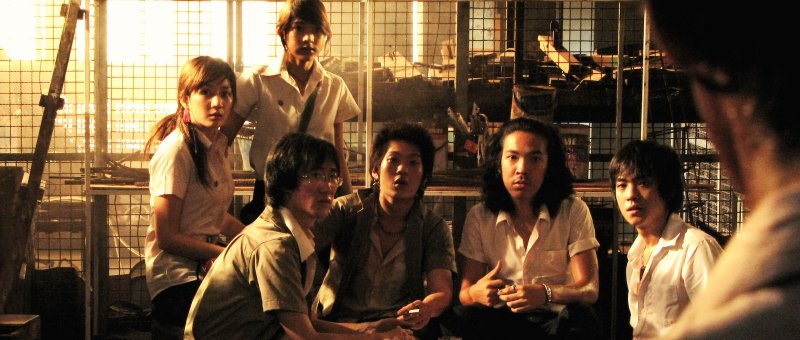

4bia (สี่แพร่ง, Youngyooth Thongkonthun, Banjong Pisanthanakun, Parkpoom Wongpoom, Paween Purijitpanya, 2008)

A quartet of Thai directors come together for four tales of horror in the appropriately titled 4bia (สี่แพร่ง). Though the stories are largely unconnected save for a few common details that locate them in the same universe, they each deal with a particular kind of anxiety and different sorts of ghosts who for various reasons are haunting the protagonists. What’s certain is that if you’re targeted by an otherworldly spirit, finding escape will not be easy.

That’s something quite obvious even in the first episode in which a young woman trapped alone in her apartment after breaking her leg in a horrific car crash begins chatting with a total stranger who sends her a random text message. Of course, replying to a message like that is not very sensible and even perhaps dangerous, as Pin (Maneerat Kham-uan) herself may release when she asks the (presumably) male messenger to send a photo only to be sent back the one she just sent of herself with the reply that he’s in it next to her. In any case, the real malevolent force here seems to be loneliness itself which is what motivates Pim to message back having already spent 100 days without interacting with another human being. The messenger has also spent the same amount of time alone in what he calls a “cramped space,” which is why he wants company. It’s gradually revealed that the pair share a kind of destiny which is an inversion of the kinds of meet-cutes you might find in a romantic comedy that makes Pim’s 100 days a purgatorial space of borrowed time in which she might as well have been a ghost herself.

But in the second chapter, Tit for Tat, it’s almost the opposite of loneliness that’s the problem as bunch of delinquent high school students and recreational drug users bully a bookish boy, Ngid (Nattapol Pohphay) and end up killing him. The boy then becomes a vengeful spirit and uses black magic to take them all out. Though one of them quips that they need to start smoking less weed, there’s no real question that the ghost is real or that the gang pretty much deserve what’s coming to them for having been so obnoxious in real life. The later part of the drama focuses on Pink (Apinya Sakuljaroensuk), a peripheral member of the gang who did try to tell the others to stop but otherwise did nothing to help Ngid and is punished for her sin of omission, though she does eventually think of a way to break the curse if only ironically in poetic justice for simply standing by and watching in the face of injustice. 

The third sequence, Banjong Pisanthanakun’s Man in the Middle is, however, a meta textual-delight that asks why ghosts in films always have long hair and pale faces. Four boys go on a rafting trip and swap campfire stories about how you should never sleep on the end when you’re close to the jungle in case a succubus comes to get you. When they get into an accident on the water and are separated, it leads to a sense of suspicion as some wonder if their friend actually died and is a ghost come to haunt them who, like in the Sixth Sense, may not know he’s dead. Though the twist maybe somewhat predictable, the tale is told with good humour and a sense of narrative cohesiveness that is lacking in some of the other chapters. 

Similarly, the final instalment Last Fright, is a chamber piece focusing on a stewardess who is unexpectedly charged with escorting a princess (Nada Lesongan) who’s fallen out of favour on her trip to Thailand where she spent her honeymoon. Pim’s (Laila Boonyasak) secret is that she’s been having an affair with the princess’ husband whom she met on their honeymoon flight which is why the incredibly imperious woman tortures her all the way through the flight before dying in a hotel room on arrival. Pim must, for reasons that don’t really make sense, escort the body back only to begin going out of her mind while haunted by the princess’ spirit. This is the only sequence which flirts with the idea of the ghost not actually being real but a manifestation of Pim’s guilt, or else a vengeful spirit come to punish her not for her secondary crime but for the transgression of adultery. Despite its potentially moralising overtones it’s a pretty chilling moment on which to end the film suggesting that in the end there is no real escape either from a vengeful ghost or your own questionable decisions.


4bia is available as part of Umbrella Entertainment’s Thai Horror Boxset.

International trailer (English subtitles)

Love of Siam (รักแห่งสยาม, Chookiat Sakveerakul, 2007)

Two young men contending with grief and familial dislocation begin to wonder if it’s possible to love someone knowing that you’ll lose them, or conversely if it’s possible to live without love in Chookiat Sakveerakul’s melancholy drama Love of Siam (รักแห่งสยาม, Rak haeng Siam). The title may sound overly patriotic but in actuality refers to the Siam Square shopping area when the boys meet again as teenagers after many years apart and rekindle their friendship only to be confused by their growing feelings for each other while each struggling with contradictory demands from fracturing family and romantic drama to the responsibilities of friendship and career. 

When they first meet as small boys, Mew (Arthit Niyomkul), who has come to live with his elderly grandmother, and Tong (Jirayu La-ongmanee) live opposite each other in a small Bangkok back street. When Mew is hassled in the school toilets, Tong comes to his rescue and gains a black eye in the process, cementing the boys’ friendship. Everything begins to change, however, when Tong goes on holiday with his family to Chiang Mai. His older sister Tang (Laila Boonyasak) stays on to hang out with friends and later disappears during a hiking trip leaving the family devastated. To escape their grief they decide to move away, breaking the friendship between the two boys. A decade or so later, they re-encounter each other by chance in Siam Square where Tong (Mario Maurer) is trying to buy a CD of rising boyband August of which Mew (Witwisit Hiranyawongkul) just happens to be the lead singer. 

In the intervening years, Tong has become somewhat distant and is now in an unsatisfying relationship with one of the school’s most popular girls, Donut (Aticha Pongsilpipat). As we discover, his father has developed an alcohol problem unable to overcome his guilt and grief over what happened to Tang, while his mother attempts to power through by exerting control over every aspect of her life. In a shocking coincidence, Mew’s band manager June (Laila Boonyasak) happens to look exactly like Tang, Tong and his mother eventually asking her to play the part of the absent sibling in the hope of curing his father’s depression. 

As much as the film revolves around the love story between the boys as they begin to figure out their sexuality, at the end it’s a story of love in its many forms and key among them the familial. Both the boys are in a sense displaced, Mew for reasons not explicitly stated living not with his father but his grandmother and then as a teenager alone following her death while Tong is caught between his grieving parents looking for new signs of stability. Understandably anxious, Tong’s mother still makes a point of picking him up by car though he is already a teenager when such solicitation might seem embarrassing. When she catches Tong kissing Mew, her world is destabilised attempting to reassert her control by asking Mew to stay away from her son fearful of losing him and the life she’d envisioned for his future with a wife and children. Yet through her interactions with June, who is also displaced having lost her parents in some kind of accident, she begins to realise that her need for control is not the way to save her family as they each begin to face their grief and repair their familial bonds accepting both the continuing presence and absence of Tang as symbolised by the family photo taken on their last holiday in which she is not pictured but only because she was standing behind the camera. 

In this way, Mew perhaps gets his answer to whether it’s possible to go on loving someone knowing that you’ll lose them unwilling to live a life without love even if the price is grief and loneliness. Where there’s love, there’s hope according to a Chinese song translated by Mew’s lovelorn neighbour, Ying (Kanya Rattapetch), who becomes an accidental friend of Tong learning to put her hurt and jealousy aside to embrace her friendship with both boys. As someone else puts it, mistakes are just opportunities for change and perhaps doing the wrong thing out of love is better than doing nothing at all. Nevertheless, as the family begins to repair itself, healing in mutual acceptance along with acceptance of their loss, the youngsters discover the strength to accept themselves discovering their place amid the admittedly chaotic streets of Siam Square. 


Love of Siam screens at Rich Mix on 29th May as part of this year’s Queer East.

Original trailer (English subtitles)