The Sadness (哭悲, Robert Jabbaz, 2021) [Fantasia 2021]

“You’re just like me, violent and depraved” a crazed aggressor sneers, almost victorious in his defeat in having goaded his target into bashing his head in with a fire extinguisher. A defiantly depraved tale, Robert Jabbaz’ zombie-adjacent horror The Sadness (哭悲, Kū Bēi) as the title implies suggests that the propensity for violence and cruelty lurks within us all merely waiting for some kind of trigger, in this case a deadly virus, to set it free. 

The film opens, however, with tranquility as young couple Jim (Berant Zhu Ting-Dian) and Kat (Regina) cuddle in bed before Kat’s alarm goes off. The mood begins to sour when Jim reveals they’ll have to cancel their upcoming holiday because he’s been offered work on a film and that is apparently something that’s been thin on the ground. As he turns on the TV, a pundit and a scientist argue about the “Alvin virus” which many people apparently believe is only a cold, though those people are obviously quite wrong (sound familiar?). The virologist continues to explain that the danger is the virus contains similar genetic material to rabies and he fears it may soon mutate into something seriously worrying. In any case, he finds it suspicious the virus has fetched up on the eve of an election and hints at the dubious immorality of politicising a public health crisis. Jim first encounters the afflicted on spotting an elderly person in a bloodstained nightgown who later turns up at his local cafe to bite several members of the clientele who then turn on him seemingly consumed by a violent and irrational rage.

Kat meanwhile experiences something similar as a madman with a knife rips through the carriage of the MTR in which she is currently sitting. Yet, as we discover, the violence and sadism is not entirely indiscriminate but informed by the underlying “sadness”, resentment, and anxieties of the infected person. Kat’s day had got off to a bad start when the middle-aged creep (Wang Tzu-Chiang) sitting next to her kept trying to chat her up only to go off a rant about the entitlement of pretty women when he’s only trying to be friendly after she threatens to call the police because he’s ignored all of her polite hints and requests to be left alone. Crazed, the train creep continues to stalk her determined to get his revenge. His rage and violence is fuelled by the pre-existing condition of his misogyny. 

The fact that Kat appears to be otherwise immune to the virus may suggest that she is a fairly well-adjusted person with no underlying sadnesses or personal resentments, yet she is apparently still capable of great violence when presented with the right trigger(s), in this case being existential terror. The infected meanwhile profess themselves in a state of ecstasy as they indulge their darkest desires. Jabbaz’ gore-fuelled odyssey is in truth a little too depraved, the sickening scenes of sadistic violence accompanied by copious amounts of blood not to mention scattered innards and severed limbs. “This is my kiss, I’m kissing you to death” a woman preens while holding a circular bone saw seconds after revealing that she always had trouble making friends but is beginning to feel as if she’s finally found her crowd. 

A minor irony is that this pandemic anxiety is expressing itself in Taiwan which up until recently at least had done a stellar job of suppressing COVID-19 largely thanks to the opposite of the impulses on display here. Yet there is also something of obvious satire in certain people’s refusal to listen to the science even as the president’s head literally explodes live on TV, while Jim picks up a brochure for reasonably priced apartments only to be told that the pandemic has also “depressed” the property market. His next-door neighbour, Mr. Lin thinks Alvin is a conspiracy theory designed to create economic instability those in the know can profit from later. He seems to have a nasty cold, but refuses to go to the doctor because it seems like a lot of bother when they’re just going to tell you to stay at home and rest. Mr. Lin’s theories are in part vindicated by another scientist who also thinks the government has been ruled by political concerns, too afraid of the economic consequences of a lockdown to contemplate ordering one even while knowing not to do so endangers public health. “Everything must be politics. There’s no room for truth” he laments, though as it turns out he isn’t free of his own darkness either. 

Not for the faint of heart, Jabbaz’s absurdist satire is a depraved journey through every kind of human degradation imaginable darkly suggesting that sadistic violence is never as far from the surface in the ordinary person, or indeed in ourselves, as we’d like to believe. “It feels like I’ve finally found a purpose in life” a member of the infected dreamily explains, embracing his life of ultra violence apparently freed of the burdens of contemporary civility. 


The Sadness screened as part of this year’s Fantasia International Film Festival.

Original trailer (English subtitles)
High Flash (引爆點, Chuang Ching-shen, 2018)

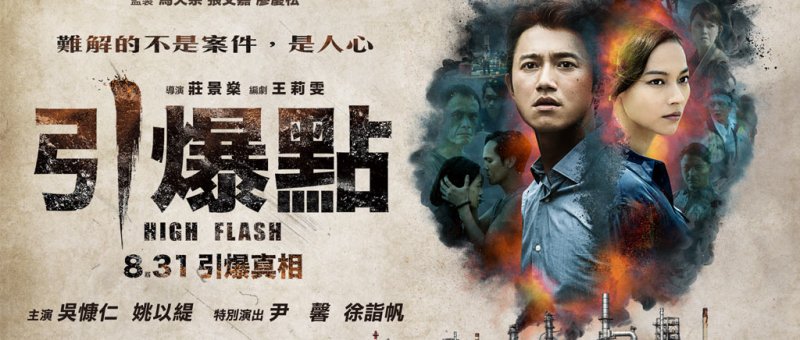
High Flash posterThe little guy is often at the mercy of big business, but the conspiracy runs still deeper in Chuang Ching-shen’s high stakes thriller High Flash (引爆點, Yǐnbàodiǎn). Set in the relatively unglamorous world of a small fishing village, High Flash begins with a mysterious death but quickly spirals outwards to ask questions about the connections between industrial conglomerates and the political establishment both local and national. Those who seem keenest to root out corruption may in fact be no less self serving than those who take advantage of it but perhaps there’s nowhere free of greed and selfishness when there are such gains to be made.

The action opens with a fierce protest by the local fishing community towards the large scale Tonglian petrochemical plant which they believe has been polluting their waters, ruining their health and livelihoods. While the newly elected mayor, Chen (Lan Wei-hua), is giving his best at the megaphone, a commotion breaks out when a burning boat collides with protestors and is later found to be harbouring the body of one Ah-hai (Bokeh Kosang / Hsu Yi-Fan) who is assumed to have committed self immolation in protest of the plant’s continued intransigence.

Earnest medical examiner Chou (Chris Wu Kang-Ren) isn’t sure that’s the case. His evidence suggests Ah-hai, who was already terminally ill with liver cancer, did not die of burns or smoke inhalation while his kidneys also exhibited strange florescent spots later identified as copper sulphate. Chou’s findings are music to the ears of jaded prosecutor Jin (Yao Ti-Yi), who also happens to be Chou’s former fiancée. She too is convinced there’s more to this than the elaborate suicide of a man whose life had been ruined by the heartlessness of big business.

Chuang quickly sets up the expected contrast between the scientifically minded Chou who claims to assess only hard evidence without emotional baggage, and the passionate Jin who is desperate to expose the truth at any cost though the romantic drama between the pair never quite ignites even as the past continues to inform their present relationship and the case at hand. Despite his insistence on hyper-rationality, Chou is not is a cold or unfeeling man as he proves by tenderly introducing himself to Ah-hai’s body and asking for his cooperation in investigating why he died, but his rigidity is perhaps to have unexpected consequences despite his best intentions which see him taking a special interest in Ah-hai’s unfortunate wife and son.

Ah-hai’s illness and that of his little boy who is suffering from a brain tumour are not explicitly linked to the illicit activities of Tonglian but the implication is clear. Industrial pollutants have destroyed not only the local fishing industry but with it a community which is now suffering with a large number of serious and unexplained illnesses. Tonglian, as might be assumed, is not particularly bothered, assuming it can rely on friends in high places and a complex web of thuggery and corruption to deal with any more serious opposition. Meanwhile, Ah-hai’s death is already being repurposed for political gain. The village regards him as a hero and a martyr who sacrificed himself in the most painful of ways in order to bring attention to their plight and the evils of Tonglian. None of which, however, is much use to his wife and son who are now unable to claim on his life insurance and are left without an income.

Vested interests exist on both sides – those keen to uphold Ah-hai as a hero and a martyr at the cost of his wife and son, and those keen to minimise the effects of his death in ensuring Tonglian is able to go on doing its (extremely dodgy) business with the same bottom line. While top execs boast about making a killing on the fluctuating company stocks and spending it on yachts, horses, and vintage wine, Ah-hai’s wife and son are left at the mercy of prevailing forces and fearful for their futures. The village might well feel that seeing as Ah-hai is dead anyway making a martyr of him whether he was one or not might be worth it if it helps expose Tonglian’s various transgressions but then again they may have overestimated the extent to which anyone really cares about big business corruption and the complicity of the state.

Nevertheless, in true conspiracy thriller fashion getting too close to the truth can prove dangerous and Chuang perhaps missteps in the case of whom he allows to pay the price, but his anti-corruption messages and warning about the cynical hypocrisy of big business eager to claim it cares about the little guy and his environment are sadly universal, as are his world weary implications regarding the eventual corruption and diminishing efficacy of longterm protests.


High Flash screens as part of the eighth season of Chicago’s Asian Pop-Up Cinema on March 28, 7pm at AMC River East 21 where director Chuang Ching-shen & actor Chen Chia-kuei will be present for a Q&A.

Original trailer (English subtitles)