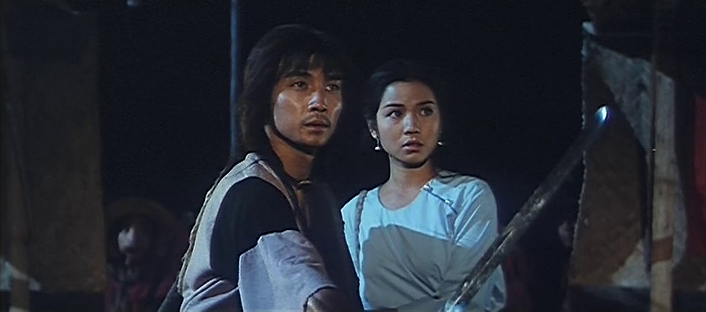
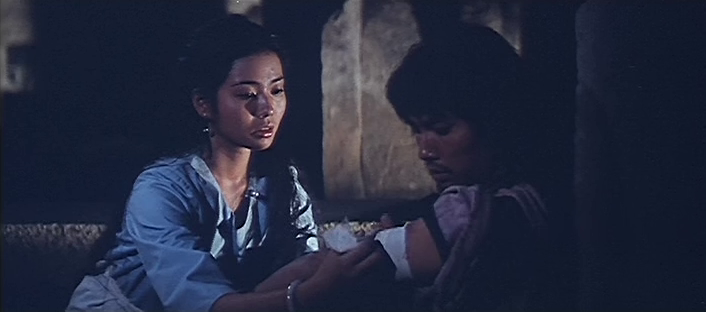
Nothing is quite as it seems in Johnnie To’s 1980 debut feature co-directed with Andrew Kam, The Enigmatic Case (碧水寒山奪命金) which it has to be more than said lives up to its otherwise nebulous English-language title. What exactly is the case at hand and why is the hero constantly being tortured for a crime he did not commit and gold he does not and never has had? Scripted by Zhu Yan, To’s debut nevertheless reflects the persistent concerns of his later career in its depiction of a cruel and arbitrary world ruled by chance even if it lacks the sense of lyricism for which he has become known.
Somewhere in feudal China, prisoner Lu (Damian Lau Chung-Yan) is being tortured by the evil magistrate Hsiung Chien who believes he knows the location of a vast amount of stolen gold. Together with another prisoner, he finally manages to escape and heads straight back towards the scene of the crime which he did not commit followed by a large number of former prisoners also hoping he will lead them to the missing treasure but all Lu is interested in is proving his innocence. Pursued by Hsiung, he also picks up another follower in the form of a beautiful young woman, Pei Pei (Cherie Chung Cho-Hung), who has come to the conclusion he must be an OK guy and hopes he will help her get to Stone City where she is supposed to collect the ashes of her recently deceased father only to discover from a wanted poster in a tavern that Lu is the guy convicted of killing him.
In a repeated motif, the situation is further complicated by people not being quite as dead as they were reputed to be. Lu finds himself at the centre of a paradoxical conspiracy in which a collection of Robin Hoods has attempted to stage a rebellion against corrupt government by reappropriating official gold to return to the people. The only problem with that is that the government is already so corrupt that they don’t think much of torturing prisoners in order to confiscate their ill-gotten gains, while even those staging the rebellion have done so in a fairly cavalier way which involves the murder of the ordinary people they claimed to want to protect.
No part of any plot but simply a wandering vagabond, Lu stumbles into a conspiracy and becomes a victim of it. He is consistently depicted as a noble hero, firstly in voluntarily leaving a rain shelter when Pei Pei arrives knowing that his presence may make her uneasy, and then by giving his money away to a widow forced into sex work by lack of other options after her husband died in the plague following lengthy period of “floods and droughts”. Floods and droughts might be a good way of describing a confusing era of generalised chaos provoked by a corrupt and self-serving government yet there is no real indication that the sickness can be cured even through Lu’s personal quest to clear his name. Even once the truth his revealed all he can do is try to ensure the money gets back to the peasants rather falling into the wrong hands.
On a similar note, his relationship with Pei Pei cycles between suspicion and attraction as she tries to decide whether to believe his side of the story or take revenge against him for her father’s death. The film’s abrupt and unexpectedly tragic conclusion might in a sense hint that doesn’t matter because there is no real justice in the world only arbitrary cruelty, Lu’s certainty that his enemy does not lack basic humanity immediately disproved. Thematically apt if slightly ironic, To & Kam shoot most of the action leading to the final confrontation in near darkness lit only by Pei Pei’s torch as Lu continues his noirish quest for truth while otherwise employing freeze frames and slow motion as if in search of experimentation or a personal take on a contemporary style even while the world that they’ve created seems deliberately disjointed, filled with random (re)appearances and the comic machinations of a pair of Hidden Fortress-style petty crooks. Even the score sometimes echoes Star Wars while the James Bond theme plays over the discovery of the stolen gold as if adding an additional note of uncanniness. Still in this elliptical tale To & Kam have to take us back to where we started with Lu a melancholy wanderer adrift in a confusing world scarred both literally and mentally by its myriad cruelties.
Theme song video (Traditional Chinese subtitles only)

 Windows on Worlds