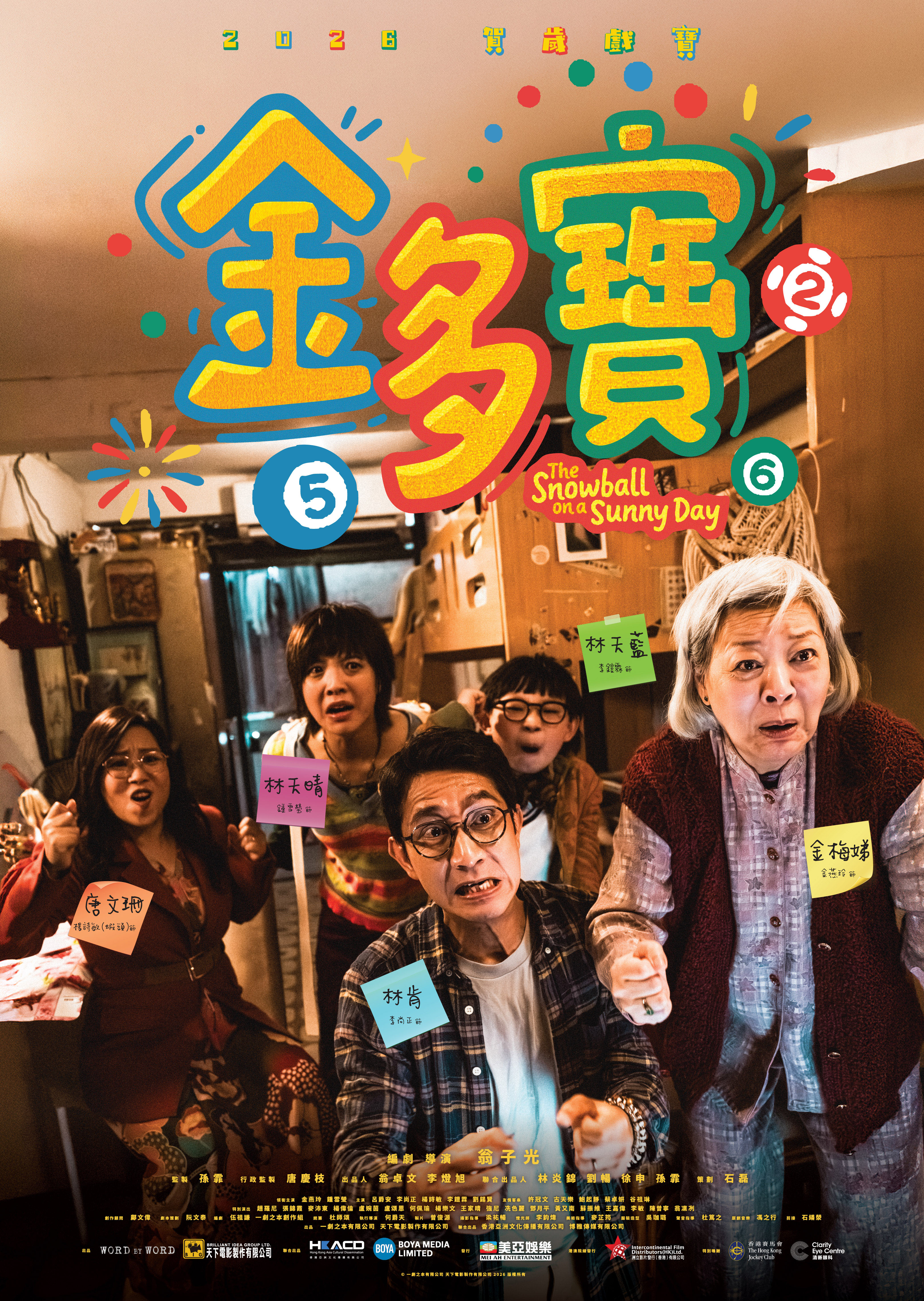
Philip Yung isn’t the first person you think of when it comes to Lunar New Year Comedies. His previous films have largely been hard-hitting crime dramas such as Port of Call and Papa. The Snowball on a Sunny Day (金多寶) is then a world away with its largely warmhearted story of an ordinary family pulled apart by the demands of modern living but brought back together through subterfuge when it becomes necessary to keep up the pretence that they’ve won the lottery.
As one of their neighbours says, every family needs its little white lies every now and then. Widowed grandmother Mui (Elaine Jin) has been playing the same lottery numbers for 30 years. Buying the ticket has become the responsibility of granddaughter Sunnie (Chung Suet Ying), but she is currently living a frantic life as a script supervisor/runner on film sets. Her plan to use her father’s Jockey Club account to buy one online is frustrated when he reveals he’s cancelled it after a run of bad luck at the tracks, meaning she’ll have to go to the shop in person. When she gets there, the security guard turns out to be someone she had an altercation with on a shoot, so they won’t let her in. A relative, Great Uncle Wah, says he’ll buy a ticket for her, but is escorted out by loan sharks before he can do so.
Inevitably, Mui’s numbers come up and Sunnie doesn’t have the heart to tell her that she never bought the ticket, so she embarks on an elaborate ruse to pretend they’re all millionaires by “borrowing” an expensive villa where her friend Jay (Edan Lui ) is currently “housesitting” for a film producer who’s apparently disappeared following rumours of some kind of financial impropriety. In some ways, Mui’s desire for a house where the whole family could live together is reflective of the current realities of the Hong Kong housing market. Even with a lottery win, the villa wouldn’t really be within their reach, which is why they have to make up excuses to convince her mother Charlotte (Harriet Yeung), an estate agent, that there are reasons it’s so “reasonably priced” that aren’t necessarily dealbreakers for the family such as being a stigmatised property where a violent death took place.
Meanwhile, this tranquil, spacious environment and relief from financial pressures provide a place in which Sunnie’s parents, who are currently separated but keeping the breakdown of their marriage secret from Mui, a chance to work out their differences. Her father Ken (Jiro Lee) is a washed up former idol star who evidently didn’t make any financial plans for his or his family’s future and now makes a living as a taxi driver who refuses to move with the times by following GPS or working via apps. Sunnie, meanwhile, was sent to live with Mui so that her mother Charlotte could devote her attention to her younger brother Harry (Marek Li Hoi-Lam) who is neurodivergent and has health issues.
While some tension exists between Mui, Sunnie, and Charlotte, Sunnie is reaching the age at which she begins to realise the sacrifices that were made on her behalf and is mindful of repaying them. Her career as a filmmaker is, however, off to a slow start with her life mostly spent at the beck and call of autocratic directors, managing extras and on occasion having to step in herself such as playing the part of a ghost when an actor doesn’t show up and wearing the costume that Mui has hand stitched for the production, presumably without any pay. There are various meta comments about the declining state of the Hong Kong film industry coupled with a sense of nostalgia for an earlier time when her grandfather hand painted posters and marquees for the latest releases after he and Mui migrated from Indonesia.
Mui’s life on the public housing estate similarly evokes a sense of warmth in a community that’s otherwise disappearing. Aside from the jobsworth of an estate manager to goes around telling people off for drying their washing outside or breaking some sort of other rule, Mui is well liked by her neighbours and only wants to move to have more space so the family could all live together. Through all the zany, farcical action as they try to keep up the act for Mui, from whom you can’t can’t really hide anything, the family begins to repair itself in true New Year comedy style while apparently making friends with some of their other “enemies” such as an extra/ice cream van diver and a Liverpool fan with whom Manchester United devotee Ken has some kind of vendetta. Despite the silliness, the film has a degree of genuine poignancy in its closing moments as various truths are revealed and the family is forced to remember what it is that’s really most important.
The Snowball on a Sunny Day screened as part of Hong Kong Film Fest UK
Trailer (Traditional Chinese / English subtitles)