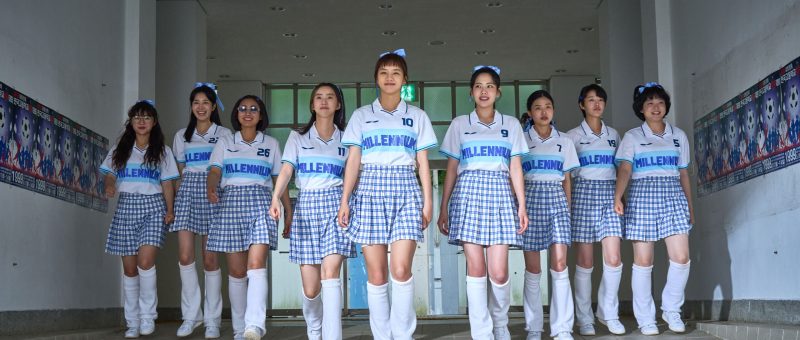
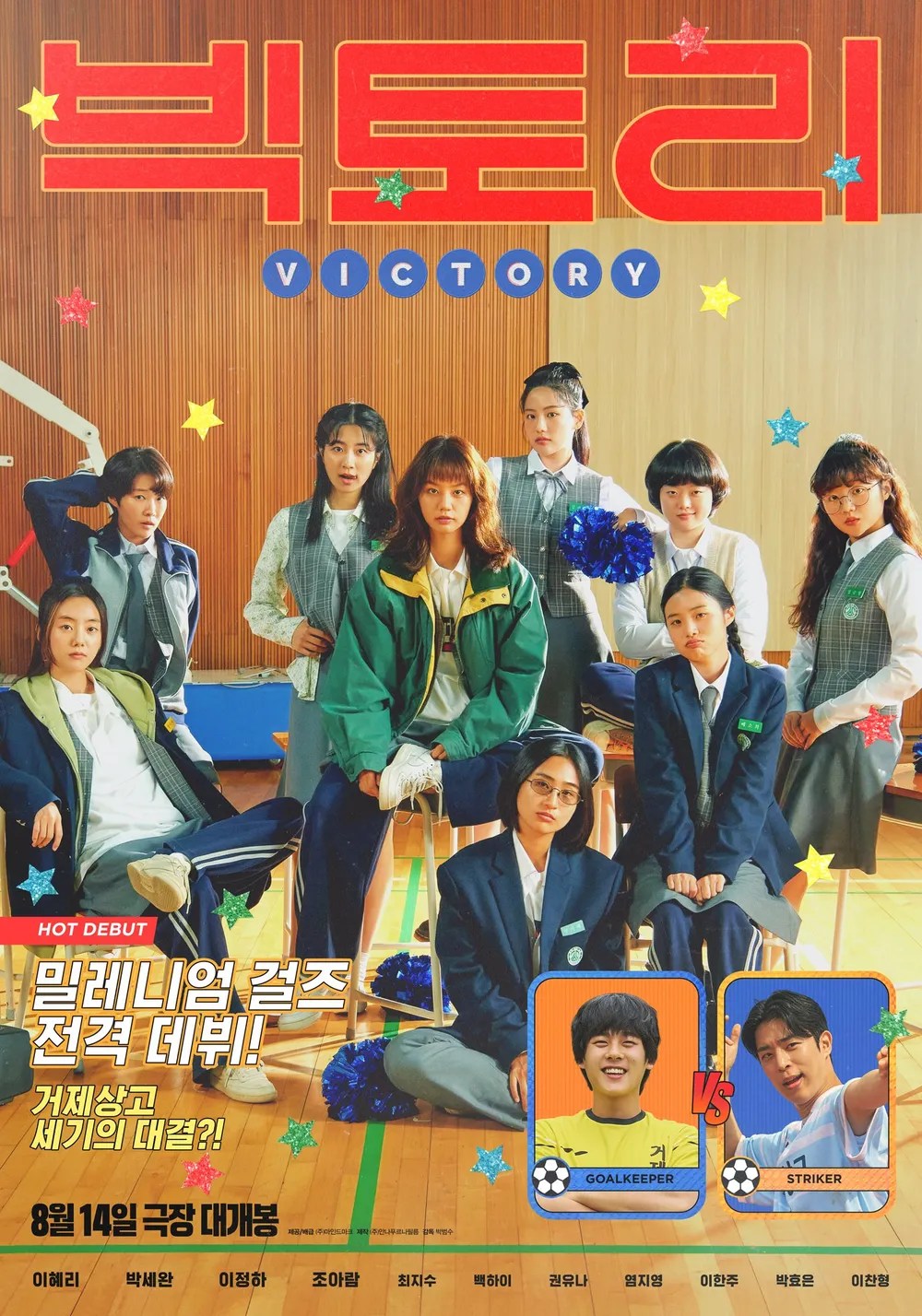
At the end of Park Beom-su’s millennial coming-of-age drama Victory (빅토리) there’s a title card quoting scientific data that people perform better with encouragement. In order to get the headmaster to agree to their starting a cheerleading squad so they can use the clubroom for dance practice, the heroine comes up with a ruse that the moribund football team will play 50% better with the cheerleaders encouraging the crowd to shout their support. But of course it’s really the girls who prosper through a process of mutual encouragement and solidarity.
Set in a small town in 1999, the film’s heroines dream of becoming K-pop dancers in glamorous Seoul. Feisty Pin-sun (Lee Hye-ri) doesn’t see much of a future for herself in Geoje much to her father’s consternation and is forever asking to transfer to a high school in the capital though in truth all she wants to do is dance. The deputy-head seems to have it in for her, taking the clubroom away from them and belittling their dancing while Pil-sun and her best friend Mi-na (Park Se-wan) are older than the other kids having been forced to repeat a year after getting into a fight with a rival school at a disco. Cheerleading’s not something they had much interest in until meeting snooty new student Se-hyun (Jo Ah-ram) who’s moved to their rural backwater with her brother who has been lured their as a top scorer for the school’s football team by the football-crazy headmaster.
The fortunes of the makeshift team are directly contrasted with the protestors at the shipyard where Pil-sun’s father works. Pil-sun’s father seems to be a man beaten down by life. He’s taken a managerial position but finds himself conflicted in the midst of a labour dispute with his bosses pressuring him to name the ringleaders of the strike so they can shut the protests down. Faced with unfair and exploitative conditions, the men are protesting for basic rights such as not being forced to work overtime and weekends and having a right to time off. Pil-sun’s father may agree with them, but doesn’t want to risk his job and tries to placate both sides with a spinelessness that later appears cowardly to his daughter Pil-sun. Perhaps as a single-father, he’s mindful of the necessity of keeping his job but otherwise appears obsequious and willing to debase himself in the service of a quiet life. When Pil-sun is once again in trouble in school, her father drops to his knees and apologises much to Pil-sun’s embarrassment.
Yet like the shipyard workers, the girls fight in unity if in this case for cheerleading success. This is after all a synchronised sport that requires the team to act as one. Though they may not universally get on initially, interactions with the team help each to realise their special talents and give them additional confidence to dance their way into a future of their choosing. Meanwhile, they’re each faced with a millennial dread that now seems nostalgic in its references to Y2K and the end of the world. There may not be very much for them in this small town, but there is at least each other along with their burning desire to succeed.
It’s this infectious sense of determination that really does seem to improve the atmosphere in this gloomy environment, the protestors also joining in their routine while Pil-sun’s father eventually gains the courage to reassess his loyalties. They are each sustained by the community around them, supported and encouraged by their friends and comrades. The point is rammed home by the fact that Se-hyun’s striker brother Dong-hyun (Lee Chan-hyeong) turns out to be something of a disappointment, while goofy goalie Chi-hyung (Lee Jung-ha) proves unexpectedly reliable telling Pil-sun that he prefers to be the last line of defence rather than the pre-emptive strike as he proves by defending her when the gang is hassled by older kids from another school. With a series of knowing meta jokes (“Girls’ Generation.” “That sounds so dumb.”), Park piles on the sense of nostalgia for a perhaps more innocent turn-of-the century world but equally for the gentle days of youth as the teens dance their way through hardship and heartbreak bolstered by their unbreakable bonds and sense of hopeful determination for brighter futures that are theirs for the taking.
Victory screens Nov. 12 as part of this year’s San Diego Asian Film Festival.
Original trailer (English subtitles)
 Windows on Worlds