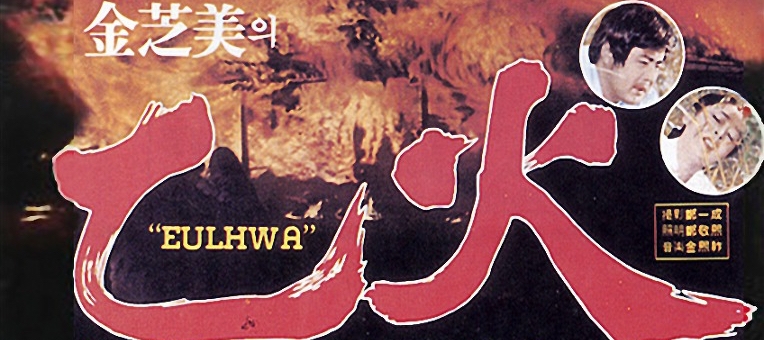
Eul-hwa (乙火 / 을화, Byun Jang-ho, 1979)

Changing times and karmic retribution conspire against a venal shamaness in Byun Jang-ho’s expressionist take on the often adapted story by conservative writer Kim Dong-ni, Eul-hwa (乙火 / 을화). Finding Korea at a moment of transition, Byun’s adaptation is a tale of tradition vs modernity, indigenous religion vs Western Christianity, nature vs civilisation, and the young vs the old, but it’s also an old-fashioned morality tale in which the sins of greed and arrogance can never be forgiven because there can be no peace or happiness for those who seek to prosper through betrayal. 

During an intense storm, Ok-sun (Kim Ji-mee) is woken by an order from a dream instructing her to dig up the cairn outside her home to free a trapped spirit. Fearful as her young son Young-sul is ill, Ok-sun dutifully does what she’s told and discovers a chest containing what appear to be the instruments of a shaman. Leaving Young-sul alone for the moment, she seeks advice from the local shamaness, Mother Pak-ji (Jeong Ae-ran), who reveals that a well known shaman once lived in her home and that she has been selected by the Holy Mother of Sun-do Mountain to serve her as a shamaness. Though some might find this an imposition at best, Ok-sun is not unwilling but is unable to afford the money involved to mount an initiation ceremony. Luckily, Mother Pak-ji agrees to help, taking her on as a pupil and renaming her “Eul-hwa” after the house in which she lives. Young-sul recovers, and Eul-hwa is fully converted to the life of a “mudang”. 

Eul-hwa is less reluctant than some might be to become a shamaness because she is in a sense already an outcast as the unmarried mother to an illegitimate son, forced out of her home village and living in a small, rundown home on the outskirts of a neighbouring settlement where she struggles to support herself and her child. As someone with supernatural powers she earns herself a degree of freedom otherwise rare as a lone woman from an ordinary family, able to earn good money and in fact be fairly wealthy while maintaining her independence even if that independence might come at a price as it may have done for Mother Pak-ji who remains single and is now in a vulnerable position as she enters old age alone with only her fellow shamans for support.  

As Eul-hwa explains to Bang-dol (Baek Il-seob), a male shaman musician who will later become her husband, she once chose to become the second wife of a wealthy man, perhaps the only means available to her feed her young son and though not unhappy with the arrangement chose independence rather than to stay with his family once he died. In one sense she retains the upper hand in her marriage as the star draw and higher earner, but is also manipulated by her husband towards the taboo transgression of betraying her mentor Mother Pak-ji through the very modern crime of stealing all her business and destroying her ability to support herself. Having become a talented shamaness drunk on her own sense of power and success she becomes cold to those who have been good to her when she was otherwise rejected, cruelly refusing Mother Pak-ji’s pleas to consider her position and thereafter earning her enmity. 

The female solidarity which had enabled the two women to prosper together has been corrupted by male greed, Bang-dol’s ambition mediated through his wife as he convinces her to betray her own “mother” without ever considering that she too may one day be betrayed. In this way it is Mother Pak-ji’s “curse” that overshadows her life and success, but Eul-hwa also finds herself a victim of changing times as modernity begins to encroach on the village. A passing Buddhist monk issues a prophecy to the effect that Young-sul will become a great man, but only if he is not raised by his mother in whose care he will otherwise die. Eul-hwa makes a maternal sacrifice and sends her son away to be educated at the temple, intending to train her daughter Wol-hee to become a “great shaman” though she is mute, only to see him return a decade later having converted to Christianity in the city. “The Jesus demon” is an existential threat to the mudang, one she’s so far managed to mediate by performing exorcisms outside the newly erected church that have convinced most of the villagers to stay away. 

The tragedy is that mother and son are intent on “saving” each other from their respective “demons”, Young-sul now convinced his mother is at the mercy of false idols while she believes him possessed by an evil spirit of the West. As representatives of past and future they cannot co-exist and are incapable of accepting that they each hold differing beliefs. Yet even aside from the church we can see modernity already encroaching on the village, uniformed police officers arriving to make an arrest, representatives of an urban authority dressed much like Young-sul in his Westernised student uniform complete with cap and cape. The mudang’s days are numbered, even if she were not about to face the same fate as Mother Pak-ji in being betrayed by her child. 

Cutting to the rhythms of ritual, Byun conjures an atmosphere of fatalistic dread from the expressionist opening with its crashing waves and flashes of lightning to the repeated fire motifs which foreshadow the famous ending and the ominous sound of gloomy church bells clashing with the angry cries of birds. In the clash of cultures, however, modernity will always triumph in the end leaving the present alone to wander in the wreckage of a world consumed by violent conflagration. 


Eul-hwa streams in the UK until 11th November as part of this year’s London Korean Film Festival.

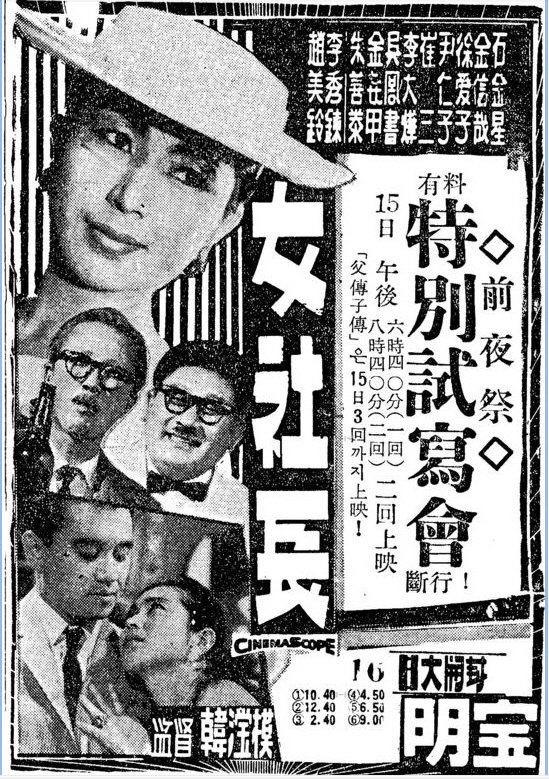
A Female Boss (女社長 / 여사장, Han Hyung-mo, 1959)

Female Boss poster

Romantic comedies, most essentially, are made to reflect the anxieties of their times. They are not, and never have been, at the forefront of progressive thought and are, generally speaking, intended to reinforce typical notions of social conservatism. Even so, the messages of Han Hyung-mo’s A Female Boss (女社長 / 여사장, Yeosajang) are extremely jarring for the modern viewer though they proved popular enough at the time and most audiences were apparently able to find something funny in the crushing victory of the patriarchy.

Joanna (Jo Mi-ryeong) is the editor of a magazine entitled “The Modern Woman” and apparently successful enough to live a life of selfish entitlement. She has a message board above her desk which reads “women are superior to men” and most of her senior employees are also female. However, she is also extremely jaded when it comes to love and has instituted an office-wide ban on romance. Despite her previous successes, Joanna’s magazine has hit a rough patch and has been on hiatus for the last three editions. Urged on by a relative, she’s currently engaged in a form of long form flirting with the easily flattered “Golf Pants”, or Mr. Oh (Joo Sun-tae) to call him by his more dignified name, whom she intends to manipulate into propping up The Modern Woman.

Meanwhile, selfishly hogging a public telephone brings her into contact with Yong-ho (Lee Su-ryeon) who angrily kicks her little dog Mario in an effort to get her to hang up. What Yong-ho doesn’t know is that the job interview he wanted to chase a recommendation for is with Joanna’s company. Joanna, infuriated by Yong-ho’s manly insolence, decides to give him the job but only so that she can make his life a misery as a form of revenge. However, despite her “feminist” leanings, Joanna falls for Yong-ho’s brash masculinity and begins a campaign of sexual harassment that threatens to implode both her personal and professional lives.

“Joanna” has obviously taken a Western name and the title of her magazine, “The Modern Woman” is also a clue as to her “progressive” attitude towards women’s liberation. Within the context of the film, these are not “good” things to pursue or “right” opinions to hold. Joanna’s women first policy is largely held up for ridicule – not only is her magazine in trouble, but her employees are portrayed as harridans who only exist to belittle and undermine their male colleagues whose jobs they have, by implication, usurped. Joanna is not married and has no interest in men until she meets Yong-ho and is overcome by his masculine confidence and conservative attitude towards the separation of the sexes, effectively inhabiting the role of the sleazy CEO salivating over the new girl only this time it’s a new boy whose “gentlemanly” resistance to Joanna’s atypically assertive romantic pursuit only makes her want him more while also upholding his moral rectitude.

Yong-ho’s original problem with Joanna also stems from her sense of entitlement – something he is personally offended by, not just by her lack of feminine deference but in her callous flaunting of her economic superiority. Making use of the public phone to conduct her business, Joanna feeds luxury cakes to her little dog, Mario. Given than many of the other people in the queue can barely afford rice to feed their families let alone luxury foreign pastries, idly feeding one to a pet dog right in front of them is an extremely insensitive act though it’s hardly poor Mario’s fault and Yong-ho’s kick is firmly aimed at Joanna. Confronting him later, Yong-ho sees nothing wrong in his violence towards an innocent dog but even more worryingly Joanna starts to complain about damage to her “property” rather than a genuine worry that Yong-ho had caused physical pain to a creature she “loved”.

What Female Boss sets out to do is to paint the very idea of a female business leader as a ridiculous nonsense, an unwelcome subversion of the proper order which must be rectified before the whole thing comes crashing down. This does perhaps reflect a male anxiety of the growing agency of women in the post-war world where they are no longer resigned to being shuffled into arranged marriages and thence into motherhood with no other possibilities or paths to fulfilment. Worried that women won’t go back in their boxes again, men reassert their masculinity to put them back in their place. Thus, at the end of Female Boss, Joanna is made to realise the “error” of her ways by ceding her business interests to Yong-ho (by her own volition) who becomes the magazine’s editor while she, now his wife, stays home to cook fish and knit baby clothes. The other senior women are demoted and the older man they’d constantly found fault with put in their place, intent on revenge. Yong-ho does, however, promote another woman he’d become friends with to a more senior position, a woman with a young child no less, proving that perhaps it’s not all about gender, but also makes sure to take down Joanna’s sign and replace it with one which reads “men are superior to women” which is quite something to see above the editor’s desk at a magazine still calling itself The Modern Woman.

That is not to say Han doesn’t also stick the boot in to hollow masculinity as seen in the dismal collection of men who turn up to interview for Yong-ho’s position. Running from the independently wealthy who apparently just want to meet women, to scary looking silent types, and in a notably subversive touch an ultra-nationalist just demobbed from the army who breaks into an impassioned patriotic rant about how everyone should be bravely dying for the nation, these are a sorry collection of modern Korean men whom, Han seems to imply, have been emasculated by female empowerment. Poor Mr. Kim, a middle-aged man with 12 children, is apparently so incompetent at his job as to be constantly threatened with termination, only to regain his “rightful” place under the new Yong-ho regime, suddenly standing a little taller now all those “nasty women” have been robbed of their power to “oppress” him.

Unlike many other romantic comedies of the time, Female Boss’ humour is subtler and meaner, had entirely at the expense of its “ridiculous” heroine. Han does however make sure to add in a fair few club scenes and musical numbers to lighten the mood while Joanna makes her way through predatory, unwomanly, unKorean, modern girl to hanbok-wearing housewife all in a few easy steps. Female Boss is distinctly unfunny to anyone born into a society where the idea of sexual equality, if not the reality, is at least regarded as an ideal but it does perhaps betray the anxieties of a society still in flux, afraid of both the future and the past.


A Female Boss is the third of three films included in the Korean Film Archive’s Romantic Comedy Collection of the 1950s box set. It is also available to stream online from the Korean Film Archive‘s YouTube Channel.