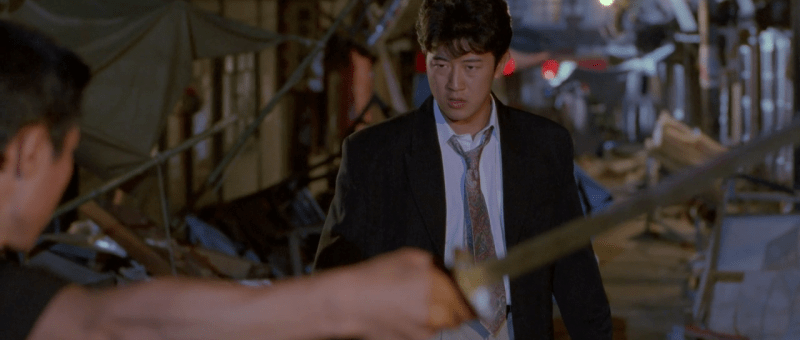
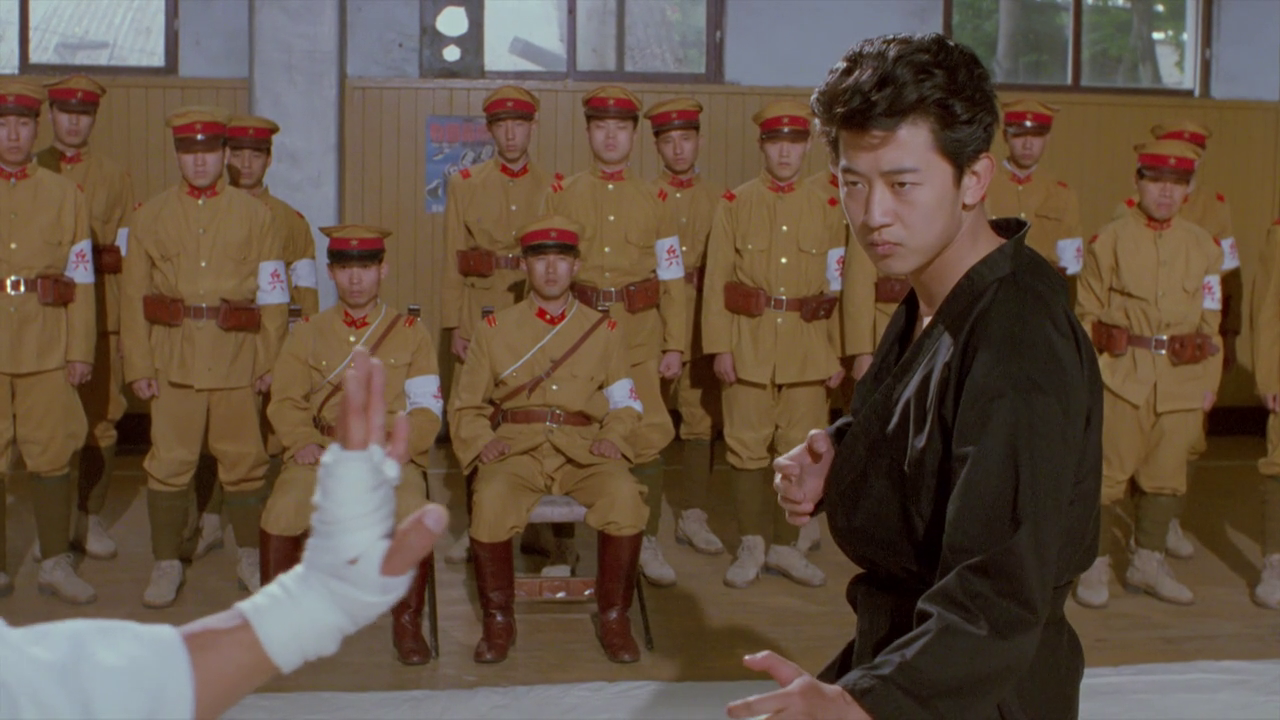
General’s Son 3 (將軍의 아들 3 / 장군의 아들 3, Im Kwon-taek, 1992)

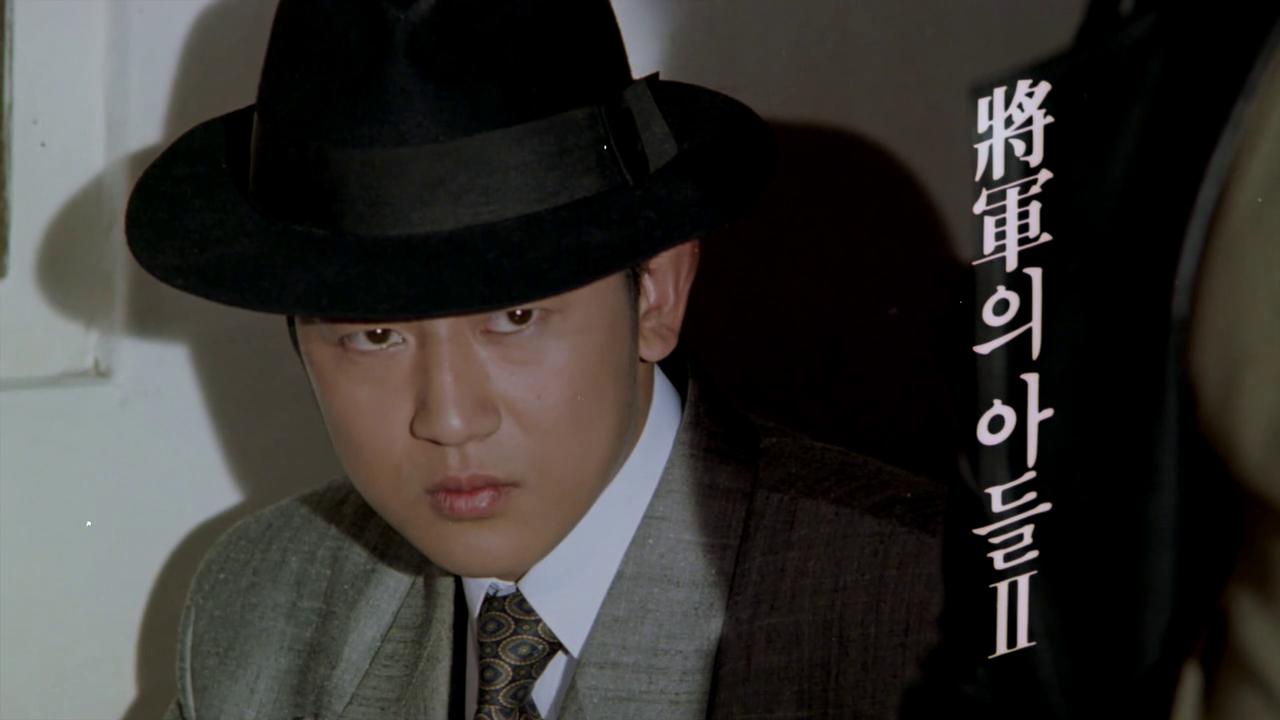
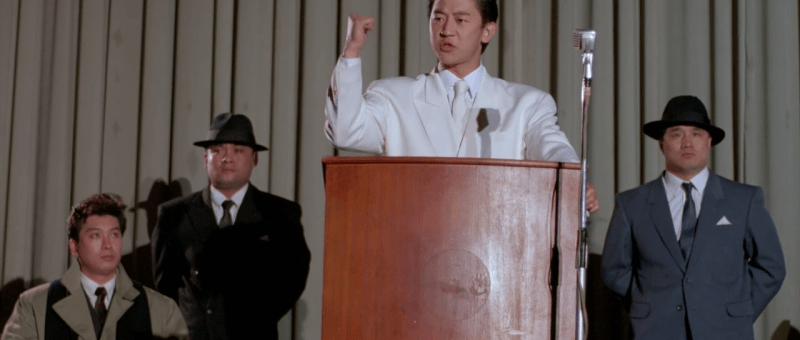
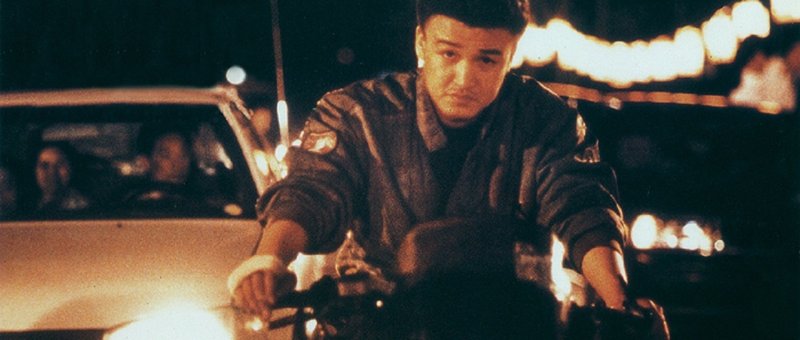
The third and final instalment in the General’s Son trilogy picks up some time after the events of the previous film, not with Doo-han (Park Sang-min) being released from prison but emerging from hiding. After his showdown with Kunimoto, he’d been lying low in a temple but is now on the run, heroically jumping off a train to avoid the police and thereafter making his way to Wonsan and seeking asylum with an affiliated gang. By this time, Doo-han’s role as the son of a legendary general who was murdered by communist traitors while fighting bravely for independence seems to have been forgotten as he wanders around trying to evade the colonial net. 

In Wonsan, he immediately starts causing trouble by objecting to gang leader Shirai’s treatment of an aspiring singer, Eun-sil (Oh Yeon-soo), whom he has more or less imprisoned until she agrees to sleep with him. Doo-han helps her to escape and encourages her to continue pursuing her dreams of stardom, but motions toward romance create an ongoing instability which indirectly echoes throughout the rest of the film as he tries to balance his desire for Eun-sil with the ongoing battle for Jongno and resistance against the Japanese. 

For her part, Eun-sil falls for Doo-han as the man who saved her from Shirai and restored her freedom but still finds herself at the mercy of the Japanese as otherwise sympathetic lieutenant Gondo (Dokgo Young-jae) takes a liking to her after being struck by her singing talent which he apparently did not expect seeing as she is a mere Korean. Later Gondo and Doo-han become accidental rivals when Eun-sil is arrested because of her associations with Doo-han and they have to work together to get her out. Gondo is fiercely critical of their relationship, not only out of romantic jealously but because he finds the Korean approach to romance vulgar. Despite her later agency which sees her primed to reject both men in order to pursue her career, Eun-sil is also a mere device to emphasise Doo-han’s virility as the entire neighbourhood is kept awake by her moans of ecstasy even after Doo-han has been badly injured in a fight, is covered in bandages, and has been told he will need to stay in bed for the next month to recover. 

Gondo meanwhile, in a slightly symbolic gesture, tries to force Eun-sil to marry him by laying his sword on the table and making it plain that if she refuses he will kill her and then himself. Perhaps in a more romantic tale, he might have threatened Doo-han and asked her to make a sacrifice, but in any case Doo-han tries something much the same on hearing the news, having a kitchen knife brought to him and thrusting it into the table. Eun-sil merely seems amused, or perhaps worryingly pleased at open show of romantic jealousy as proof of love, knowing that it is quite unlikely Doo-han is actually going to hurt her (the same cannot be said for Gondo). He still however tries to command her to stay and marry him, refusing to let her leave because she is “his”, but in the end of course it’s bluster and if she chooses to leave he cannot stop her because he is not a man like Shirai or Gondo who would willingly restrict another’s freedom. He is still “fighting for our liberty” after all. 

Meanwhile, he undergoes a parallel “romance” with Dong-hae (Lee Il-jae) who left alone for Manchuria after renouncing the gangster life but has apparently left the Independence Movement because it was too socialist when what he seems to want is individual capitalist prosperity which is why he’s got mixed up in the opium trade. Still on the run, Doo-han seeks out Double Blade, the street thug mentor who brought him into the gang all those years ago. Unfortunately he makes a lot of trouble for Double Blade in annoying one of his underlings who runs a local Chinese gang and then starting a turf war after getting himself into trouble with the bandits who run the drugs trade. He and Dong-hae are eventually separated in the escape from the bandits but reunite when Hayashi (Shin Hyun-joon), who is still nominally running the yakuza but has delegated Jongno to his sadistic brother-in-law Uda, tries to use him in a plot to take out Doo-han once and for all. 

Throughout the series, Doo-han has been a mythic, comic book-style hero who is respected for the integrity of his fists, refusing to use weapons and leaving his opponents beaten but breathing so that they can verbally concede the victory. The previous film had seen him enact a more serious kind of violence, but even so his rival apparently survived only permanently changed. His final confrontation with Hayashi, by contrast, sees him kill for the first time by picking up a blade and then a gun. Nevertheless, he is perhaps the General’s Son after all. According to his gang members, scattered after he left, he is the only force with can keep Jongno free, without him they fell apart and let the Japanese take their streets from them. The final instalment in Doo-han’s story ends on a moment of tempered victory which avenges his gangster honour but places him firmly in the arms of his brother Dong-hae as they temporarily retreat from the battlefield towards an increasingly unstable future. 


General’s Son 2 (將軍의 아들 2 / 장군의 아들 2, Im Kwon-taek, 1991)

A year after General’s Son struck box office gold, Im Kwon-taek returns to colonial Korea picking up pretty much where he left off with Doo-han (Park Sang-min) once again getting released from prison only this time to a hero’s welcome. Pushing deeper into the colonial era, The General’s Son 2 (將軍의 아들 2 / 장군의 아들 2, Janggunui adeul 2) takes place in increasingly straitened times in which the Japanese are both in control and on the offensive, using the colonial base to strike further into Manchuria while Doo-han discovers a little more about his legendary father and the fate of the Independence Movement in exile. 

Like the first film, the sequel largely consists of a series of episodes in which Doo-han fights and defeats his various rivals. The major change this time is that he begins in defeat as the early celebrations of his return give way to a dawn raid by Hayashi’s yakuza after which Doo-han is dragged into the town square and forced into submission. When Doo-han’s mentor Ki-hwan (Min Eung-shik) is also released from prison, the gang opts for a truce, but Ki-hwan then absents himself after realising Hayashi has tricked him leaving Doo-han in charge. 

During the first film Doo-han’s Korean gangsters had been presented as unambiguously good, standing between the ordinary people and Japanese oppression. While Doo-han was away, however, things have changed. The Japanese have infiltrated Jongno and the Jongno gang has lost the support of the merchants through pressing them too hard for collection money. Doo-han’s first task is then to get the smaller Korean gangs back on side, fighting the local Mokpo kingpin to ensure he resumes sending taxation payments back to Jongno. His main source conflict, however, is still with Dong-hae (Lee Il-jae), the Korean fighter working for the yakuza whom he defeated at the end of the previous film but who got his own back by getting the jump on him at the beginning of this one. 

As a defender of Korean liberty, Doo-han’s side mission is to win back Dong-hae to the side of right, reminded of their childhood meeting by a repeat of the flashback in which he helps a starving Dong-hae cadge a meal by teaching him how to dine and dash. The Dong-hae dilemma is compounded by Doo-han’s increasingly complicated love life which begins with a brief flirtation with Setsuko, a half-Korean Japanese woman working at a gangster-friendly bar who seems to have taken a liking to him, but then later transfers to Chae-hwan (Song Chae-Hwan), a new gisaeng at his regular hangout who is sweet on Dong-hae and is also carrying baggage because her late husband was stoned to death as a traitor when the Japanese discarded him. 

Through Chae-hwan, Doo-han gets to know a dissident author, Park Gye-ju, whose novel Pure Love he pays two high school students to read aloud to him because he is still illiterate. According to Gye-ju, Doo-han’s general father is dead, assassinated by communist traitors among his men including such esteemed names as Kim Il-sung, placing Doo-han at a peculiar intersection of anti-communist and anti-Japanese ideology. Despite that however, Doo-han is warned off associating with Gye-ju because of his “suspicious ideology” by his arch nemesis, Kunimoto, formerly “Lee” the Korean detective working for the Japanese who arrested him all the way back at the beginning of his journey in the first movie.

Traitorous Koreans rather than the Japanese are the main antagonists with Kunimoto first among them, but then as Chae-hwan puts it it’s not the fault of the world only the Japanese whose continuing oppression has placed them all into these perilous positions. Dong-hae weighs up his options, persuaded to end his problematic associations with Hayashi despite his previous assertion that he didn’t care where the money came from he only wanted to survive. The world abandoned us first, he explains, what else was there to do? Chae-hwan criticises Doo-han, suggesting that he’s using his fists not for the people of Korea but for himself, convincing Dong-hae that he can be “saved” if he leaves the gangster world behind. Like his nation, he decides he wants “independence”, eating his own food bought with his own money, rather than remaining at the mercy of a higher authority be that Hayashi or Doo-han. 

The Japanese army, however, believe themselves above the law and answer only to the emperor. Dong-hae’s decision brings him further into conflict with Doo-han, rejecting not just the law of the street but provoking romantic jealousy. As Chae-hwan points out love isn’t a fight you win or lose, but it’s still at the mercy of the various political forces in play and in not in any way helped by Doo-han’s childish provocation of Japanese soldiers at Setsuko’s bar. In any case, Doo-han remains a folk hero, concluding his final showdown with his first show of real violence with active consequences, but in the end protected by the people of Jongno as they offer themselves as human shields holding back the forces of oppression while Doo-han remains trapped in a world of pointless gangster violence. 


General’s Son (將軍의 아들 / 장군의 아들, Im Kwon-taek, 1990)

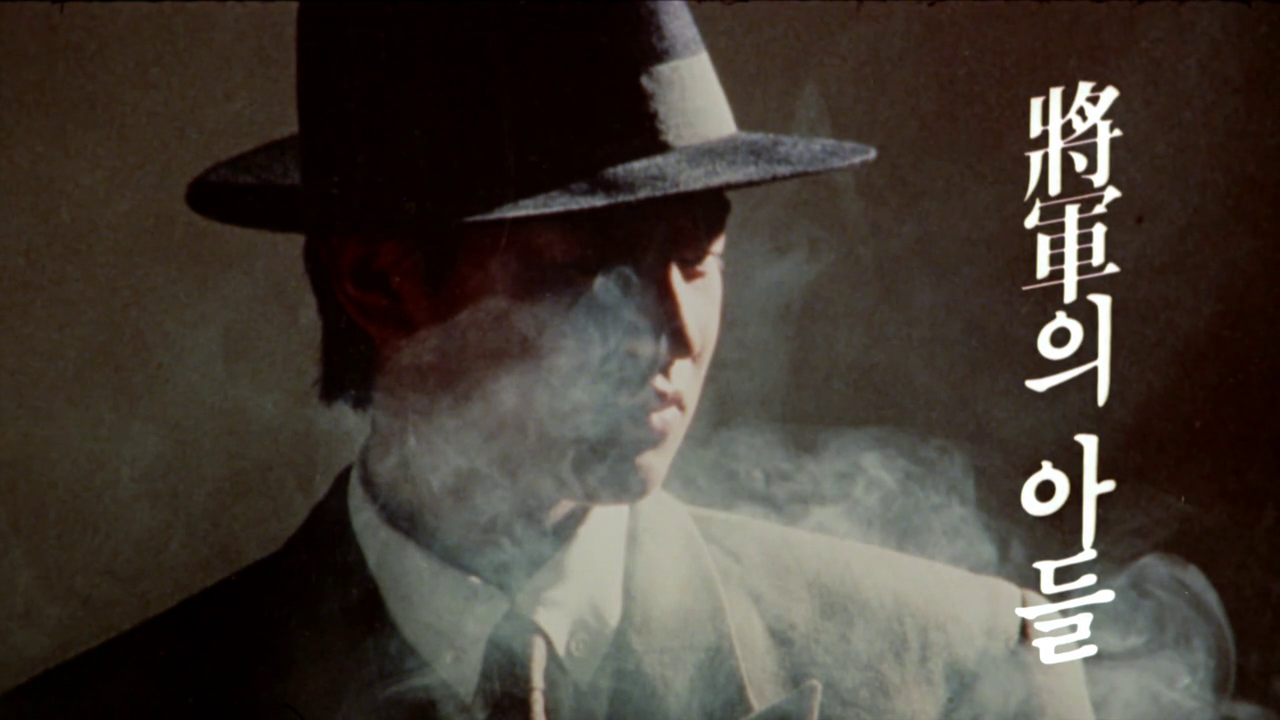
Im Kwon-taek may have been among the first Korean film directors to secure a spot on the international festival circuit, but his long and meandering career began with action cinema which is where his early ‘90s blockbuster trilogy General’s Son (將軍의 아들 / 장군의 아들, Jangguneui Adeul) returns him. Quite clearly influenced by recent Hong Kong martial arts movies, ninkyo eiga yakuza dramas from Japan, and episodic fighting comics, General’s Son creates legend from recent history in further mythologising a real life street king who eventually shifted into politics in the 1950s which might be one shift too far in terms of the film’s complicated politics. 

This first instalment in the trilogy opens with Doo-han (Park Sang-min) being released from prison after apparently having been picked up for sneaking into a Japanese cinema and getting into some kind of fight. An orphan, Doo-han has spent his life on the streets as a beggar but also has a deep love of the movies and is determined to get a job at the cinema, eventually landing one as a sandwich board/announcements guy parading through the streets shouting about what’s currently on for which he gets two tickets on top of his pay. The tickets become a bone of contention when some lowlife punks try to cheat him out of them, but Doo-han is a handy boy and so he manages to beat the guys up and get the tickets back despite being stabbed in the thigh. The altercation brings him to the attention of a local gang boss who decides to recruit him because he’s in need of street muscle and even helps him get a job at the cinema which turns out to be a hub for the local organised crime community. 

The complication is that this small area of Jongno which is ruled by the gangs is also the last remaining outpost of a “free” Korea where Japanese interference is apparently minimal. There is, however, a Japanese gang presence in the form of traditional yakuza led by the youthful and handsome Hayashi (Shin Hyun-joon), who becomes the central if not direct villain. In typical gangster origin fashion, Doo-han climbs the ranks by using his fists, taking down one big boss after another but, crucially, only while his own guys collectively decide to make way for him. As one after the other is killed or arrested, they each affirm that their era has passed, they’ve been beaten, and it’s all up to Doo-han now. In fact, in this highly ritualised setting, most fights ends with the defeated party solemnly admitting that they have lost and will politely leave Jongno at their earliest opportunity. 

As for Doo-han himself, he belongs to the noble brand of gangster and becomes something of a folk hero for his spirited defence of the ordinary man in the face of “Japanese tyranny”. Of course, that ignores all the ways in which the gangsters themselves could be quite oppressive and the film does indeed resist any mention of how they make their money other than a veiled allusion to collecting protection from the market traders in order to keep them safe from harassment by the Japanese.

At the end of the film, Doo-han receives an explanation for all the crytic hints to the film’s title to the effect that he is the son of a legendary general in the Independence Movement. His role is, in effect, to be the general in Jongno holding back the Japanese incursion and saving the soul of Korea from being despoiled by colonisers intent on erasing its essential culture. Just as his father is fighting in Manchuria, Doo-han is “fighting for our liberty” on the streets of Jongno while standing up for the oppressed wherever he finds them, including the gisaeng one of whom he saves from being sold into a Chinese brothel by her father by robbing wealthy Japanese officials to pay her debt. What he’s mostly doing, however, is fighting with fellow gangsters, proving himself in tests of strength which leave his opponents breathing but humiliated and thereafter removing themselves from the game in graceful defeat. It’s unlikely the Japanese will do the same, but Doo-han will be monitoring the streets until they do.


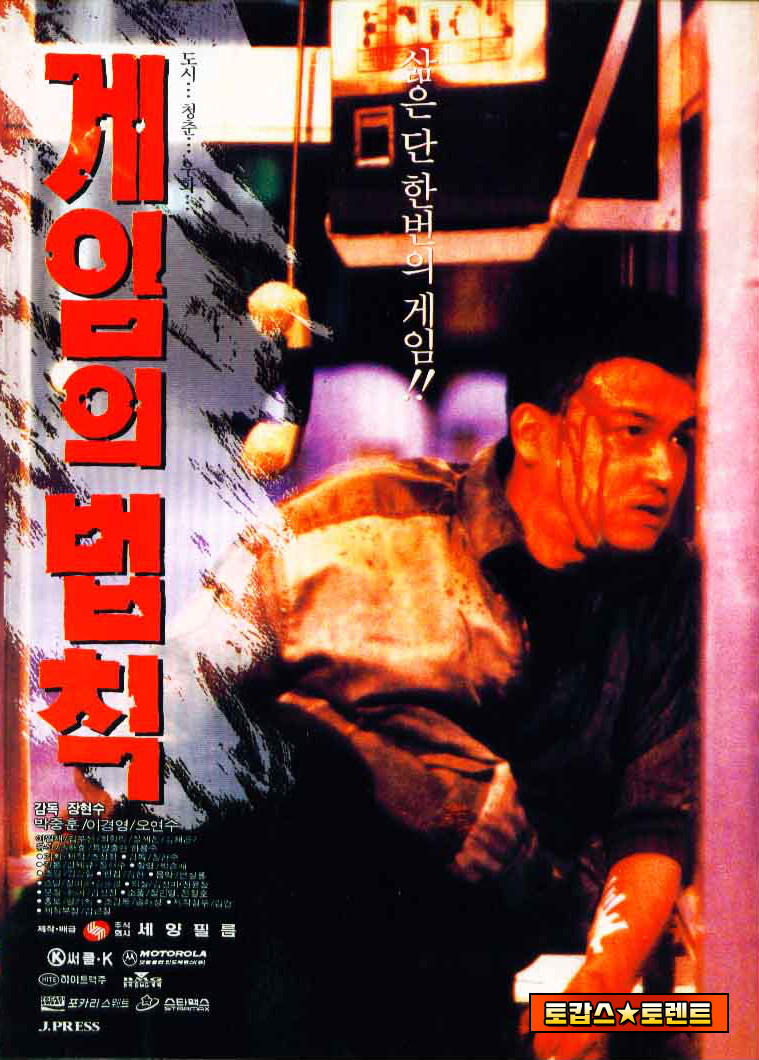
The Rules of the Game (게임의 법칙, Jang Hyun-soo, 1994)

Rules of the GameEvery game has its rules, but then again perhaps the game lies in learning how to bend them to one’s advantage. Owing a debt to a Pacino/De Palma diptych – Scarface and the later but then just released Carlito’s Way, Jang Hyun-soo’s Rules of the Game (게임의 법칙, Gameui beobjig) was the first in a resurgence of contemporary action dramas which had gone out of fashion since their 1970s heyday. The story is a timeless one of a young man looking for gangland fame, his loyal girlfriend, and the duo’s loveable third wheel of a degenerate gambler whose sob story may actually turn out to be truer than it seemed.

Young-dae (Park Joong-hoon) is a young upstart in a tiny town. Bored with his life of daily drudgery washing cars, he decides to upsticks to the city, taking his adoring girlfriend Tae-suk (Oh Yeon-su) with him. Young-dae plans on engineering a meeting with famed ganger Gwang-cheon and pledging his allegiance to him, hoping to set himself on the road to gangland success. Things get off to a bad start when the pair of naive country bumpkins run into to smooth talking conman Man-su (Lee Kyoung-young) on a train. Man-su claims to know Gwang-cheon and writes a letter of recommendation before suddenly announcing they’re at his stop and jumping off the train leaving Young-dae and and Tae-suk with a healthy dinner bill.

The city proves particularly hostile to the out of towers as Young-dae realises joining a gang is not as simple as marching in, dropping to your knees and exclaiming “I will die for you, please accept me”. Repeatedly striking out, Young-dae distances himself from Tae-suk who ends up working as a hostess for the gangster Young-dae still hasn’t been able to meet. Finally spotting an opportunity to prove himself by interrupting a gang raid, Young-dae gets a foot on the ladder but as an outsider in an established gang he’s always going to be a liability.

Meanwhile, Man-su has continued to get himself into trouble with cards and is a constant thorn in the side to Gwang-cheon’s guys. After a beating leaves him crippled, Man-su turns to Young-dae for retribution. Young-dae, Man-su, and Tae-suk form an odd, sometimes volatile trio as they try to survive and make Young-dae’s gangster dreams come true while Man-su dreams to going to Saipan where the sun shines everyday and everything is palm trees and summer fruits.

It doesn’t take a genius to realise Saipan is a place Young-dae will never go, no matter how much he might want to. After getting into the gang and reuniting with Tae-suk, Young-dae does seem to be getting himself together but success soon goes to his head. He begins dressing in snappy suits moving from brown, to blue, to white, and drives a BMW around town as if he really owned it. As Tae-suk points out, he’s just a driver – a driver for a top gangster, but a driver all the same. In his desperation to reach the top, Young-dae makes himself a figure of suspicion in the mind of the boss he is so desperate to impress, inadvertently placing a target on his own back.

Jang may have pegged De Palma as an influence, one which is very much felt in the Tony Montana-esque story arc and Carlito’s Way denouement, but his shooting style is pure Hong Kong by way of John Woo – frantic action shot in slow motion. Young-dae is a slap-happy lover of violence, never one to let to the opportunity of getting into a fight pass him by. This is quite a good quality in an aspiring foot soldier, even if not in a potential boyfriend though Tae-suk does her best to tame him, but his impetuosity and naive faith in others’ ability to abide by the “rules” of gangsterdom are at the heart of his eventual downfall. His later decision to mistreat a fellow would-be minion who echoes his own phrase back to him “I will die for you, please accept me” is a clear indicator of how far he has moved away from the scrappy boy who left his village full of angry dreams even if something of his youthful innocence is later returned in his desire to leave the gangster world far behind for a life of ease and friendship with Man-su and Tae-suk in tranquil Saipan. The rules of the game, however, rarely reward missteps and Young-dae will pay heavily for his misplaced faith.


Screened at London Korean Film Festival 2017.