Exit (迴光奏鳴曲, Chienn Hsiang, 2014)

exit 1Review of this existential character drama from Taiwan up at UK Anime Network. This one was screened at BFI London Film Festival but now it’s at Glasgow too and will be getting a further UK release courtesy of relatively new distributor Facet Films in April!


Sometimes it’s the little things that wear you out; stretching over years, becoming almost invisible until a surge of troubles washes over you and leaves you gasping for air in stormy seas. So it is for Ling, an ordinary, middle aged Taiwanese woman who finds herself alone with her husband working in Shanghai (constantly incommunicado even via telephone) and a teenage daughter, Mei Mei, who’s not very interested in spending quality time with her mother when she’s suddenly made redundant from her job as a seamstress at a factory and also discovers she’s heading into the menopause. Ling has also become the de facto carer for her mother-in-law who’s in hospital (not that her mother-in-law seems to appreciate it very much) where she becomes increasingly fascinated by a badly injured man in the bed opposite who has no family to visit him or take care of his daily needs. In a gesture of kindness, Ling begins by trying to ease some of his discomfort by mopping his brow and dripping water on his parched lips but soon transitions to bed baths. This purely physical relationship with a blinded stranger begins to reawaken something in Ling but will it be enough to save her from life’s disappointments?

Exit is the feature debut from director Chienn Hsiang, an award winning Taiwanese cinematographer (Blue Gate Crossing) and stars frequent Tsai Ming-liang collaborator Chen Shiang-Chyi in the leading role. Unfolding slowly with minimal, naturalistic dialogue the shadow of Tsai looms large (not that that’s ever a bad thing) but Chienn handles this extended moment of existential crisis with a steady hand and interesting compositional choices. Occasionally, his metaphors feel a little overplayed – the sticking lock on Ling’s front door for example and her general trouble with blocked exits are nice ideas but call attention to themselves a little too readily. That said, Chen’s central performance keeps the film well anchored in its everyday mundanity and ordinary despair whilst also ensuring Ling maintains the audience’s sympathies.

At heart, Exit is an intense character study of one woman’s struggles in modern Taiwan as she finds herself caught between several different transitionary moments. Everybody in Taiwan, it seems, is on their way to China. Ling has already lost her husband who never takes her calls any more, she’s just lost her job because the factory owner’s sons are all obsessed with the idea of the mainland – all everyone ever seems to talk about is leaving, there’s no more work here. She lives alone in a pretty run down apartment where the wallpaper is peeling off the walls (she reseals it with sellotape) and she’s plagued by amorous noisy neighbours next door. Her only ray of sunshine is the dance club run by a former work colleague which, aside from also providing a bit of income in the form of costuming and repairs, is the only thing that seems to catch Ling’s attention.

That and the mysterious stranger in the hospital with his strange and terrible injuries. Ling’s encounters with the blind man take on an oddly intimate, sensual quality but as soon as his eye bandages come off she becomes shy or possibly ashamed. Likewise, having made herself a nice new dress and wearing the new shoes suggested by her dance club owning friend Ling goes for a rare night out only to catch sight of her daughter. Once again conflicted, Ling removes her make-up in haste ready to confront Mei Mei (who also rejects her telephone calls) only to discover the girl and her boyfriend have already left leaving only a vague air of shame and discontent behind them.

Exit is a nuanced and engaging snapshot of a moment of crisis in an ordinary woman’s life. It may be true that we all lead lives of quiet desperation but Ling’s troubles are, sadly, of the relatable kind. Trapped in a rapidly changing city and isolated by its social circumstances and cultural constraints it isn’t surprising that Ling’s frustrations finally come to a head but like everyone else Ling has to find a way to go on living and watching her getting back to herself becomes an intensely moving experience.

The World of Kanako (渇き, Tetsuya Nakashima, 2014)

WorldOfKanako-PAnother LFF review up at UK Anime Network – The World of Kanako. I was also lucky enough to interview the director, Tatsuya Nakashima, who was actually very nice and quite chatty in contrast to some of the other interviews I’d read with him! (The consequence being I had way too many questions so it’s sort of a front loaded interview, oh well.) Interview’s already transcribed and in the system so hopefully live soon.


Tetsuya Nakashima is probably best known for his 2010 film, Confessions, which saw a school teacher’s extremely convoluted bid to avenge the death of her daughter at the hands of her students spill out to reveal a whole host of other ‘confessions’ of varying natures from its out of control teenage cast. Though Confessions had its fair share of violence and blood, this is nothing compared to the hellish darkness which fills The World of Kanako. Corrupt cops, teenage femme fatales, wife beaters, child traffickers, pimps and drug dealers make up the cast of this grim exposé of just how wrong you can be about the people most close to you. Those of you with a weak disposition had better step off here – this journey is not for the faint of heart.

Disgraced former policeman Fujishima has a whole host of problems in his life, alcoholism and possible schizophrenia being but two of them. Suddenly he gets a call from his estranged wife who’s out of her mind with worry because their teenage daughter, Kanako, has not been home in a few days. On searching her room in true detective style, he finds a stash of illegal drugs hidden in her school pencil case. This alarming discovery sends Fujishima down an increasingly dark alley way that leads only to the heartbreaking realisation that the kind and beautiful straight A student he believed his daughter to be was no more than a figment of his own imagination.

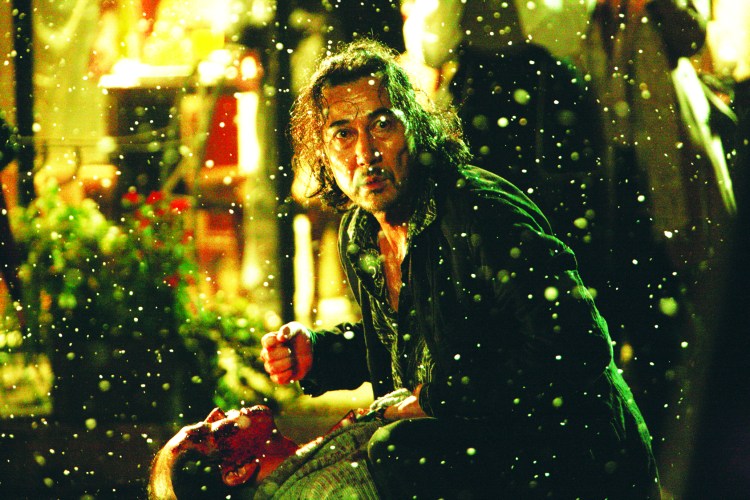
Fujishima is not a nice guy. There’s not really any other way to put it – he’s an arsehole. A self aggrandising drunk who lives inside a dream where he’s a hero fighting for justice with a loving wife and adorable little daughter waiting for him in their beautiful home. Except that his wife wants nothing to do with him, he hasn’t seen his daughter in a very long time and he’s been kicked off the force and currently works in security. Often drunk and on medication he’s never quite in the moment and therefore neither are we – thrown between flashbacks and unreliable mental images, we begin to float just as freely as Fujishima. It’s testimony to the abilities of the great Koji Yakusho that somehow we still feel a degree of sympathy and a desire to understand Fujishima’s complex psychology despite his deep seated rage which is directed both at himself and others. Deluded beyond belief, his quest to find his daughter is really a thinly veiled attempt to save himself by resurrecting the idealised image he had of her as the one decent thing he’d been able to  build in his life.

His daughter turns out to be daddy’s little girl after all, just not in the way Fujishima originally thought. She may be beautiful and clever, but never kind and her attentions are always part of some grander plan. Like the femme fatales of old and despite her young age, Kanako knows how to get what she wants but what she wants is to cause other people pain. She too lives in a dream, or perhaps a nightmare, as she says at one point falling like Alice in Wonderland through a seemingly endless black hole. There aren’t any ‘decent’ people in this world, everyone is fighting to maintain some kind of delusional self image that will allow them to believe in their own goodness – often through projected images of an idealised family.

Coupled with this intensely dark world, the film wears its influences on its sleeve including ‘60s quirky cool action films, as evidenced by its psychedelic title sequence, and 50s Noir B-movies with their down at heel antiheroes who are often lost in worlds far darker than their imaginings. It’s also true the film is extraordinarily violent in way you don’t generally see in modern times but that doesn’t mean that Nakashima’s gift for intensely beautiful set pieces is entirely absent. The teenager’s world is full of extreme bubblegum pop and purikura garishness coupled with introspective retro tunes and animated sequences which contrast heavily with the adults’ universe of bespoke kitchens and ordered realities.

Ironically, Fujishima turns out to be quite a good detective, though the clues don’t lead him to the answers he really wanted to find. Where they do lead him is ever onward down a dark and dingy rabbit hole with no end in sight. It’s a gloriously bleak tale, but told with an ironic, detached eye that seems to be finding all of this cosmic lack of clarity ever so slightly amusing. The World of Kanako almost redefines the word ‘extreme’ but it does it with so much style that even the most jaded of viewers couldn’t help raising a wry, if slightly depressed, smile.


A Girl at My Door (도희야, July Jung, 2014)

fullsizephoto427951Review of A Girl at My Door from the London Film Festival up at UK-anime.net. This is also playing at the London Korean Film Festival which opens today with a gala screening of Kundo: Age of the Rampant. Director July Jung will be at the LKFF screening on 7th November for a Q&A tootickets still available!


You’d never know it, but A Girl at My Door is actually the first feature film from promising new Korean director July Jung. Produced by well regarded Korean auteur Lee Chang-dong (Poetry, Oasis, Peppermint Candy), the film evidently benefits from some of his expertise but it would be a mistake to over emphasise his involvement. Like Lee’s films A Girl at My Door is a tightly plotted character drama that opens up to explore a whole host of social issues but Jung has certainly been able to put her own stamp on the project and if A Girl at My Door is anything to go by, she is very much a talent on the rise.

Lee Young-nam (Bae Doona) has just arrived in the little hick town she’s been exiled to thanks to some kind of undisclosed infraction committed in Seoul. As the town’s new police chief, she’s thrust into the largely male world of local law enforcement and forced to acclimatise to small town politics with hardly enough time to breathe. Lee is also a high functioning alcoholic who guzzles soju from refilled litre bottles of water though her colleagues don’t seem to have noticed and her work is barely affected. After catching sight of the same young girl who seems to be constantly running away from someone or other, Lee eventually intervenes when a group of teenagers are picking on her. Do-hee is a troubled teenager from a violent home where, abandoned by her mother, she’s ‘cared for’ by a step father and resentful drunken grandmother. Do-hee quickly fixates on Lee and her superficially fearless attitude and eventually Lee has taken the girl in and offered her a place of solace way from the chaos of her home life. However, no matter how good one’s intentions may be, others will twist the facts to their own advantage and doing the right thing can often prove dangerous.

Possibly one of the benefits of having a high profile producer like Lee Chang-dong is that you’re able to get yourself a high profile cast of talented actors for your first film despite not having a proven track record or industry clout of your own. Bae Doona’s performance of the largely silent Lee is nothing short of extraordinary. There’s a sort of defiance in Lee’s silence, an unwillingness to speak because she knows there’s very little point. All we can glean about what happened in Seoul is that her dismissal has something to do with the fact that Lee is gay – something that is accidentally discovered by exactly the wrong person when Lee’s ex-partner comes to town. It’s not so much that she’s keeping that secret from the townspeople, but more that she knows it’s going to be a problem and she’s unwilling to deny it either. After all, she’s been here before and she knows how this scenario plays out. Taking in someone else’s child can be a dangerous thing for anyone, but as one policeman later puts it “it’s different when a homosexual does it” and even the most innocent, well meaning of gestures suddenly becomes something sordid and dirty. Lee’s world weary attitude seems to imply she half expected this would happen, still – there was a girl at her door, what else could she do?

Bae Doona is equally matched by the already fairly experienced teenage actress Kim Sae-ron as the troubled young girl, Do-hee. A mess of contradictions, Do-hee is both vulnerable and dangerous. One of the villagers refers to her as a monster and she certainly has a dark side which can be selfish and manipulative as well as a tendency towards fantasy. However, at the root of things she’s just a lonely, abandoned, unloved and unwanted child. Of course, as soon as someone shows her the slightest hint of kindness she will latch on and become fearful of losing even that extremely slight glimpse of affection. Perhaps therefore, she says things that aren’t quite true without fully understanding their implications and ironically risks ruining the fragile happiness she’s so desperate to cling to. It is quite an extraordinary performance from such a young actress – Kim Sae-ron manages to unify all of Do-hee’s contradictory sides into a convincing, and ultimately quite moving, whole.

A Girl at My Door does have its social issue dimension – the exploitation of illegal immigrants, small town politics, homophobia, sexism and of course unwanted children are all themes at some point touched on through the film, but what is at heart is a character drama about two lonely women who both find new strengths thanks to their unexpected friendship. Jung has crafted a charming and moving film that is only improved by its tremendous feeling of stillness. Beautifully shot and full of intriguing ambiguities, A Girl at My Door is a fantastically assured debut feature which hints at a very interesting career ahead for director July Jung.


LFF 2014 Round-up

lff-2014-identity-1000x750

Total Films
  1. Hill of Freedom
  2. Come Back to the 5 and Dime, Jimmy Dean, Jimmy Dean
  3. Black Coal Thin Ice
  4. Bjork Biophilia Live
  5. Tokyo Tribe
  6. Shrew’s Nest
  7. Still the Water
  8. Giovanni’s Island
  9. The Drop
  10. The New Girlfriend
  11. Dearest
  12. Rosewater
  13. John Stewart Debate Event
  14. War Book
  15. The Wonders
  16. A Girl Walks Home Alone, at Night
  17. Black Souls
  18. The Goddess
  19. A Girl at My Door
  20. No Man’s Land
  21. Betibú
  22. Dragon Inn
  23. Jauja
  24. Leviathan
  25. Furthest End Awaits
  26. Shadow Days
  27. White Haired Witch of Lunar Kingdom
  28. Winter Sleep
  29. Satellite Girl and Milk Cow
  30. Three Hearts
  31. Mommy
Booked but Missed
  1. Pasolini
  2. Exit
  3. White Bird in a Blizzard
Wanted to see but couldn’t (off the top of my head, probably I’ve forgotten most of them)
  1. Duke of Burgundy
  2. The Dinner
  3. pretty much everything else
Top Picks (the ones I liked most, not necessarily the ‘best’ films, also a bit arbitrary )
  1. A Girl Walks Home Alone, At Night
  2. The New Girl Friend
  3. Mommy
  4. Black Coal Thin Ice
  5. The Furthest End Awaits

So, the London film festival is over for another year. Blow for blow I think I feel less ‘wowed’ by this year than others even though most of the films I saw were more than good and I only saw two that I didn’t like so much, hmm – well maybe three.  My selections were a bit random though – started with the ones I most wanted to see and worked around those meaning I missed some of the most popular titles like Hard to be a God, Goodbye to Language, The Tribe etc. I really wanted to see Duke of Burgundy but that’ll get a release soon enough, bit disappointed I had to miss Exit but it was for a good reason. Would have liked to have seen more of the archive stuff – had an idea I didn’t really like Altman but I was kind of blown away by Jimmy Dean. Oddly I saw most of the competition films and agree with the winner, Leviathan – a true masterpiece. I guess that’s it ’til next year – I wonder what that will bring?