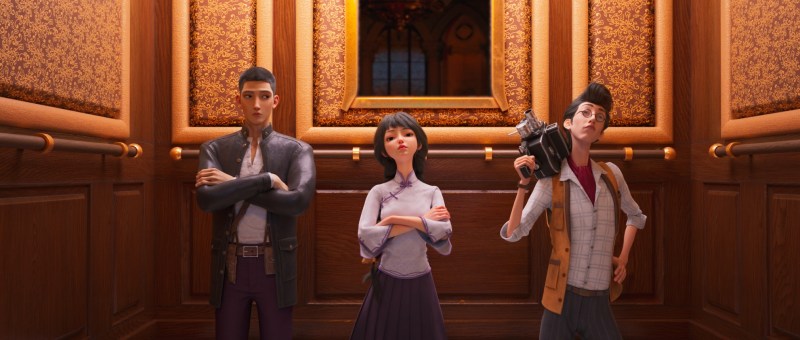
The Girl Who Stole Time (时间之子, Yu Ao & Zhou Tienan, 2025)

All Qian Xiao (voiced by Liu Xiaoyu) wants to escape her boring island life where time runs slowing to experience the fast-paced life of the city, though her guardian, an older man she describes as an artist who can develop film, is not keen for her to go. Washing up on the island three years previously having lost her memory, Qian Xiao is fascinated by the films they watch in the town square which seem to her modern and exciting while also a means of capturing time and assuring that nothing is ever really forgotten.

But when she’s shipwrecked after accidentally stowing away on a steamship that collides with an ocean liner, she unexpectedly gains the ability to pause time with a small device known to assassin Seventeen (Wang Junkai) as the “time dial”, though she calls it the “shiny gold spinny thing”. Seventeen has been charged with recovering it on behalf of his mysterious boss Mr Zou who has set his minions a challenge declaring the person who brings it to him will be the only one to survive. The ability to pause time is indeed useful in a practical sense in that it allows Qian Xiao to escape her enemies temporarily, flicking a bullet out of the way that otherwise have entered the back of Seventeen’s head.

In other ways, however, it may not always be a good thing and time can never really be turned back but is ever marching forward. It’s not meant to be paused forever. Qian Xiao tries to extend her time in the city by putting it on pause, but then quickly becomes bored. There’s not a lot to do here if everyone’s stood still like a statue and she’s stuck on her own again. The irony is that she’d complained about island life being too slow, but as she grows closer to Seventeen all she wants is string time out for as long as possible. This is also, in someways, a reflection of ageing that young people are often in a hurry to grow up and experience the world, but as you get older time passes more quickly and you begin to feel it running out. Despite having said that you only have one life and there are things you can’t fix no matter how hard you try, she begins trying to find ways to get a second chance and stop time from moving forward.

Mr Zou wanted the dial for the same reason, unable to deal with his own deep-seated grief and hoping to use it to bring back those who he’s lost even if it means a lot of other innocent people might die. Seventeen might not have cared about that before, but has become more human through this adventures with Qian Xiao and can no longer allow him to misuse time in that way. As he says, all things must eventually come to an end and it’s enough to be remembered by those you leave behind. Qian Xiao may have become an immortal being and the master of time, but that also means existing in a perpetual state of loss. Eventually, she will need to learn to let go and treasure what she once had rather than being mired in her grief. 

Films are also, though, a means of stopping time and allowing Qian Xiao to revisit her past. While the film looks back to golden days of Chinese cinema in the glamorous Shanghai of the 1930s though its use of silent film techniques, it also seems to draw inspiration from Western animation such as Disney with its unexpected musical number and Qian Xiao eventually donning a very Cinderella-like ballgown for a romantic waltz for the ages. In its final stretches, however, it is more philosophical in contemplating the nature of time and how it’s spent, the ways in which it is sort of rewound and relived, along with the conviction that there’s no need to be sad when the movie’s over because it was it always about who you watched it with. Less anarchic than some recent Chinese animation, if energetic, the film revels in the elegance of its 1930s setting and derives genuine poignancy from its central love story as the fated lovers find their way back to each other only to part once again.


The Girl Who Stole Time screens in Chicago March 28th as part of the 20th edition of Asian Pop-Up Cinema.

Trailer (English subtitles)

Last Letter (你好,之华, Shunji Iwai, 2018)

“Anything we need to change?” asks a young woman looking for feedback on a speech, “Nothing. It’s fine” her mentor replies in an exchange which takes on a peculiar poignancy, hinting at a gentle accommodation with the ordinary tragedies of life which is perhaps itself the hallmark of director Shunji Iwai’s career. Adapting his own novel and calling back to his 1995 masterpiece Love Letter, Iwai makes his first foray into Sinophone cinema with the Peter Chan-produced Last Letter (你好,之华, Nǐhǎo Zhīhuā) taking his key concerns with him as a collection of lovelorn souls ponder the what ifs of romantic misconnections and the “limitless possibilities” of youth. 

In the present day, the now middle-aged Zhihua (Zhou Xun) attends the funeral of her elder sister, mother of two Zhinan, who sadly took her own life though the family have been telling people she died of an illness which is in a sense not exactly untrue. Zhinan left behind her only two things, a letter to her children daughter Mumu (Deng Enxi) and son Chen Chen (Hu Changling), and an invitation to the 30-year reunion for her middle school class. Attending the reunion with the intention of letting everyone know that her sister has passed away, Zhihua is mistaken for Zhinan and ends up going along with it, even reconnecting with a teenage crush, Yin Chuan (Qin Hao) now an unsuccessful novelist, for whom she became an unfaithful go-between charged with delivering his love letters to the sister she feared was always prettier and cleverer than she was. After her husband, Zhou (Du Jiang), destroys her phone in a jealous rage, Zhihua finds herself ironically mirroring her teenage years in continuing a one-sided correspondence with her first love in the guise of her sister.  

As in Love Letter the older protagonists find themselves trapped in a nostalgic past, Yin Chuan complaining that he’s stuck with memories of Zhinan, the subject of his first novel, leaving him with perpetual writer’s block. Like misdirected letters the past is filled with missed opportunities and painful misunderstandings, but then again there are no guarantees that it would have been different if only the message had made it home. Little Zhihua (Zhang Zifeng in a double role), chastened to have been discovered frustrating Yin Chuan’s teenage attempts at romancing her sister (doubled by Deng Enxi) by not delivering the letters, plucks up the courage to write one of her own but finds it rejected while as her adult self is perhaps engaging in a little self delusion little realising that Yin Chuan may have already seen through her ruse but is as intent on attempting to communicate with the past in the form of her departed sister as she is. 

Perhaps slightly unfulfilled if not exactly unhappy (husband’s unexpected act of violence aside), Zhihua ponders lost love while attempting to come to terms with her sister’s death, denied an explanation for her apparently abrupt decision to run off with a rough man with no family who turned out to be a violent drunk exorcising his class resentment by beating up an educated, middle-class woman. Mumu, meanwhile, afraid to read her mother’s last letter, engages in a little epistolatory deception of her own, accidentally causing confusion in also replying to Yin Chuan’s letters posing as her mother when he tries writing to her old address with fond memories of their youth. “Life is not something you can write on a whim” he’s reminded, and it’s true enough that, as echoed in the poignant graduation speech, some will achieve their dreams and others won’t. Those limitless possibilities of youth don’t last forever, life doesn’t obey the rules of narrative destiny and you don’t always get a happy ending or in fact an ending at all. 

Yet unlike Love Letter, the man and the letter eventually arrive at the correct destination if much later than intended. The message reaches those it is intended to and a kind of closure comes with it. Mirroring her teenage self, Zhihua finds herself a go-between once again, passing letters between her lonely mother-in-law and her former professor whom she’s been secretly meeting in a local park, while reflecting on her own role as perpetual bystander not quite destined for the position of protagonist. As she had her daughter Saran (Zhang Zifeng) struggles with a nascent crush preferring to stay with grandma and keen to avoid going back to school in order not to have to face him, while Mumu attempts to deal both with the loss of her mother and with her legacy as a figure of romantic tragedy. Little Chen Chen is sadly forgotten, putting a brave face on grief and largely left to get on with it on his own until forced to face his sense of rootlessness as an orphaned child wondering if the world still has a place for him to call home. Shot with Iwai’s customarily lush, wandering camera filled with a sense of painful melancholy, the lasting message is nevertheless one of accommodation with life’s disappointments that even in moments of despair and hopelessness lack of resolution can also spark possibility and the memory of those “wonderful choices” of youth need not foreground their absence so much as sustain.


Last Letter streams in the US Feb. 12 to 18 as part of Asian Pop-Up Cinema’s “Happy Lunar New Year!”

Original trailer (English subtitles)