Operation Hadal (蛟龙行动, Dante Lam Chiu-Yin, 2025)

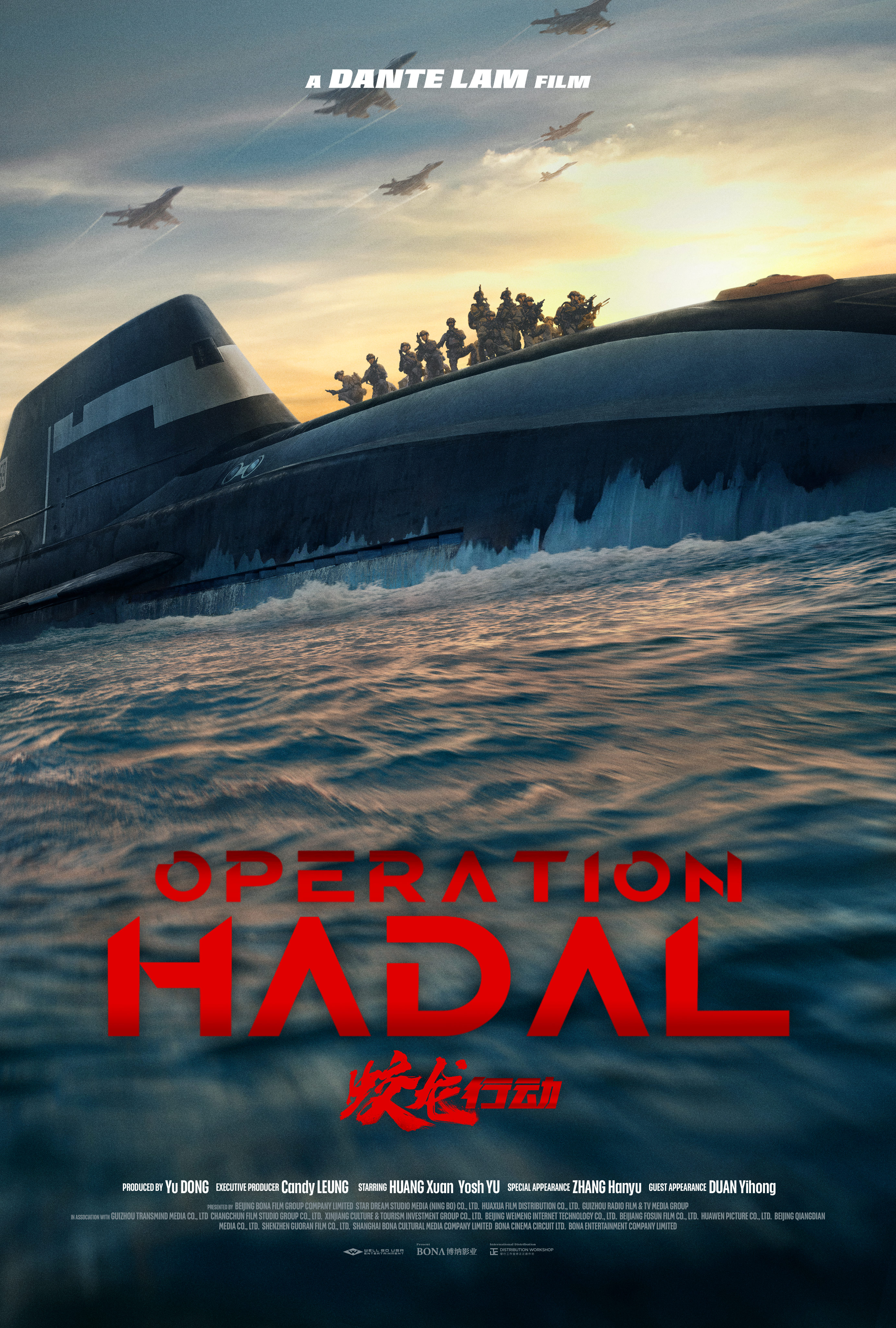
In recent years, Dante Lam has busied himself with a particular brand of Mainland propaganda actioner. Operation Hadal (蛟龙行动, Jiāolóng Xíngdòng) is intended as a kind of thematic sequel to earlier hits Operation Red Sea and Operation Mekong each of which featured the Chinese military springing into action to defend Chinese citizens from a plausible geopolitical threat while reminding the world at large that China will rise to defend itself and its citizens wherever they may be. 

All of which makes Operation Hadal a rather curious addition to the franchise. Unlike previous instalments, it’s set in the near future and revolves around round a completely ridiculous plot to blow up a volcano and destabilise East Asia with a series of what look to be natural disasters. Or so it would seem, the narrative is often incoherent and difficult to follow. If it were any other Chinese military propaganda film, it would doubtless want to show off the capabilities of the nuclear submarine at the film’s centre. The film even includes a quote from Chairman Mao in 1970 that the nation should hurry up and build nuclear submarines as soon as possible, but it’s not all that clear if this sort of submarine actually exists yet and the qualities the crew are most excited about on boarding the brand-new ship are that it’s much more spacious and comfortable to live in, while the fact that it’s much quieter and, therefore, can evade detection more easily is added as an after thought. 

Meanwhile, Captain Zhao Qing (Zhang Hanyu) is seen to make some questionable command decisions such as playing the harmonica on deck in a moment of crisis which is one thing that seems to have particularly upset the target audience. Zhang clarified that the tune he’s playing is a navy song and is intended as a call to arms for the submarine officers, though it doesn’t really play out that way and feels more like a misplaced homage to the western. Chinese technology is even eclipsed at times with the team finding themselves bogged down fighting robot dogs controlled by the other side, the so-called State of Siekerman, which at any rate seems to populated largely by people with American accents.

There is no clear reason why the State of Siekerman wants to destroy Asia with a series of “mid-sized nuclear bombs”, though there is division within the armed forces with some objecting to the plan because it will necessarily destroy the ecoculture of the area which is beneficial for the rest of the planet, leading to a mutiny by those who are in favour of blowing everything up. This sense of division is perhaps supposed to contrast with the intense unity of Chinese forces, in the same way as the friendship between Zhao Qing and the Admiral back on land is contrasted with that of the two State of Siekerman commanders who disagree about strategy.

The film’s biggest weakness is, however, a lack of characterisation among the Jiaolong team who are often indistinguishable due to the heavy equipment they are wearing. Interpersonal drama comes in the form of a man hung up on the death of a friend in a previous mission and his relationship with his fallen comrade’s son that is probably intended as a touching advocation of filial piety but largely gets lost among the chaotic action. The fact that everything comes down to one officer’s listening ability doesn’t seem like a very good advert for Chinese technology, if perhaps praising the abilities of rank and file soldiers to rise to the occasion. Subpar CGI often gets in the way of the action sequences which are the central draw, leaving the film quite literally all sea with no clear idea of what it’s trying to do. Where the violence of Operation Red Sea was realistic and horrifying, there’s a slightly camp quality with villains being dispatched by hatchets to the head or else popped by sliding doors. It’s not much of an advertisement for Chinese military prowess and never really discovers the sense of patriotic heroism that films like these generally rely on.


Operation Hadal is released on Digital in the US on 16th June courtesy of Well Go USA.

Trailer (English subtitles)蛟龙行动,

The Girl Who Stole Time (时间之子, Yu Ao & Zhou Tienan, 2025)

All Qian Xiao (voiced by Liu Xiaoyu) wants to escape her boring island life where time runs slowing to experience the fast-paced life of the city, though her guardian, an older man she describes as an artist who can develop film, is not keen for her to go. Washing up on the island three years previously having lost her memory, Qian Xiao is fascinated by the films they watch in the town square which seem to her modern and exciting while also a means of capturing time and assuring that nothing is ever really forgotten.

But when she’s shipwrecked after accidentally stowing away on a steamship that collides with an ocean liner, she unexpectedly gains the ability to pause time with a small device known to assassin Seventeen (Wang Junkai) as the “time dial”, though she calls it the “shiny gold spinny thing”. Seventeen has been charged with recovering it on behalf of his mysterious boss Mr Zou who has set his minions a challenge declaring the person who brings it to him will be the only one to survive. The ability to pause time is indeed useful in a practical sense in that it allows Qian Xiao to escape her enemies temporarily, flicking a bullet out of the way that otherwise have entered the back of Seventeen’s head.

In other ways, however, it may not always be a good thing and time can never really be turned back but is ever marching forward. It’s not meant to be paused forever. Qian Xiao tries to extend her time in the city by putting it on pause, but then quickly becomes bored. There’s not a lot to do here if everyone’s stood still like a statue and she’s stuck on her own again. The irony is that she’d complained about island life being too slow, but as she grows closer to Seventeen all she wants is string time out for as long as possible. This is also, in someways, a reflection of ageing that young people are often in a hurry to grow up and experience the world, but as you get older time passes more quickly and you begin to feel it running out. Despite having said that you only have one life and there are things you can’t fix no matter how hard you try, she begins trying to find ways to get a second chance and stop time from moving forward.

Mr Zou wanted the dial for the same reason, unable to deal with his own deep-seated grief and hoping to use it to bring back those who he’s lost even if it means a lot of other innocent people might die. Seventeen might not have cared about that before, but has become more human through this adventures with Qian Xiao and can no longer allow him to misuse time in that way. As he says, all things must eventually come to an end and it’s enough to be remembered by those you leave behind. Qian Xiao may have become an immortal being and the master of time, but that also means existing in a perpetual state of loss. Eventually, she will need to learn to let go and treasure what she once had rather than being mired in her grief. 

Films are also, though, a means of stopping time and allowing Qian Xiao to revisit her past. While the film looks back to golden days of Chinese cinema in the glamorous Shanghai of the 1930s though its use of silent film techniques, it also seems to draw inspiration from Western animation such as Disney with its unexpected musical number and Qian Xiao eventually donning a very Cinderella-like ballgown for a romantic waltz for the ages. In its final stretches, however, it is more philosophical in contemplating the nature of time and how it’s spent, the ways in which it is sort of rewound and relived, along with the conviction that there’s no need to be sad when the movie’s over because it was it always about who you watched it with. Less anarchic than some recent Chinese animation, if energetic, the film revels in the elegance of its 1930s setting and derives genuine poignancy from its central love story as the fated lovers find their way back to each other only to part once again.


The Girl Who Stole Time screens in Chicago March 28th as part of the 20th edition of Asian Pop-Up Cinema.

Trailer (English subtitles)

Home Coming (万里归途, Rao Xiaozhi, 2022)

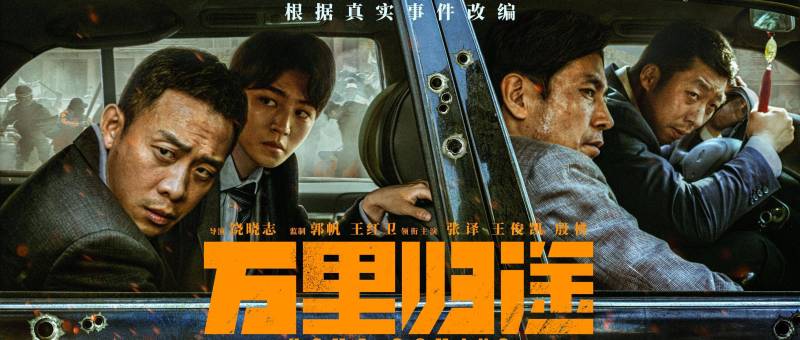
A pair of Chinese diplomats find themselves the last hope of stranded construction workers when civil war erupts in a middle-eastern nation in Rao Xiaozhi’s visually impressive action drama, Home Coming (万里归途, Wànlǐ Guītú). A “Main Melody” National Day release, the film is less heavy on jingoistic patriotism than might be expected if slotting neatly into the recent trend of celebrating various branches of officialdom, this time foreign service consular staff, but nevertheless leans into the recurrent “just stay in China” message of government-backed big budget cinema in insisting that nowhere is the Chinese citizen safe other than at “home”. 

According the closing titles inspired by a series of real life events, the film opens in the fictional nation of Numia which is currently experiencing a period of instability with widespread protests against the government. As tensions quickly rise amid a full-scale uprising led by rebel warlords, consular staff are tasked with evacuating Chinese citizens. Jaded consular attaché Zong (Zhang Yi) has a heavily pregnant wife at home, but gives up his seat on the last plane out to a “Taiwanese compatriot” in what can only be read as a less than subtle advocation for a One China philosophy. Booked on the next boat out, Zong nevertheless ends up staying behind to help rescue a contingent of construction workers who are unable to cross the border as they have lost their documentation and require consular assistance to secure exist visas to a neighbouring nation. 

The message of the film might in some ways seem confusing. The by now familiar inclusion of stock footage featuring Chinese citizens overjoyed to arrive home thanks to the assistance of the consular officials emphasises that the Chinese government will always be committed to protecting the interests and safety of Chinese citizens abroad, but it’s also clear that the safest thing of all is not to leave or else to return home as quickly as possible. “Let’s go home” becomes a recurring motif as the construction workers and diplomats will themselves forward fuelled by hometown memories and a desire to see their families as much as simply to survive. Then again, there is also a subtle defence of the role of Chinese corporations overseas. An elderly driver from the local area makes a point of defending his friends and employers to a warlord as he points a gun at his head, reminding him that the Chinese do them a service by building railways and hospitals though it seems this corporate intrusion is one of the things the warlord is rising up against.

No information is really given as to why there is animosity towards the ruling regime, but the film nevertheless goes out of its way critique dissent by suggesting that it is the rebels who are in the wrong. Bodies are frequently seen hanging from billboards and bridges, and rebel leader Mufta tortures and pillages while playing sadistic games with captives. A secondary plot strand seems to suggest that a good leader must sometimes mislead those around them for their own good. Zong finds himself in conflict with his young and naive partner Lang who thinks they should be honest and admit that even if they make it to the next town there may be no one waiting for them while Zong knows that if they tell the construction workers that they’ll never reach it anyway in which case there’s nothing else to do but stay still and die. Zong is proved right, implying that Lang’s problem was that he had insufficient faith in China to protect them (which they can largely because of their massive satellite surveillance network) and endangered the lives of others because of it. But then Mufta also makes a strategic error in a bit of showmanship that effectively unmasks him in front of his men as a duplicitous coward rather than the grizzled revolutionary they thought they were following. 

In any case the closing news reports emphasise the rescue’s value in demonstrating that China is a strong and reliable country capable of protecting its people abroad, though the flip side of that is also seen in Zong’s insistence to the warlord that China will retaliate if any of his people are harmed. Meanwhile, Zong also seems keen to prove that China is a more inclusive place than many others, offering to take their driver back with them if he wanted to come. When the rebels finally concede the Chinese can leave, they refuse permission for an orphaned local girl who had been adopted by a Chinese couple but Zong refuses to leave without her insisting that as she has been adopted she is now incontrovertibly Chinese and he will protect her too. Rao shoots with a gritty roving camera drawing inspiration from the paranoid thrillers of the 1970s along with similarly themed contemporary pictures such as Korea’s Escape From Mogadishu and Hollywood’s Argo, while making the most of incredibly high production values with a series of explosive action sequences but does his best to mitigate the jingoistic undertones through his uncertain, battle weary hero even if ending on a slightly ironic note with an unexpected, post-credits appearance from a National Day movie icon.


international trailer (English / Simplified Chinese subtitles)