Following (그녀가 죽었다, Kim Se-hwi, 2024)

“None of this would have happened if you didn’t follow me,” the hero of Following (그녀가 죽었다, Geunyeoga jug-eossda) is told by his opposite number though he himself doesn’t see anything untoward about his voyeuristic hobby and justifies his habit of “peeping” into the lives of others on the grounds that it does no harm. Of course, he’s not very well placed to make that decision and too narcissistic to consider that while he watches someone may be watching him. 

In any case, what Jung-tae (Byun Yo-han) claims to want to see is “the real you” rather than the persona created for public consumption which is why he’s drawn to duplicitous influencer Sora (Shin Hye-sun) whom he spots simultaneously munching on a sausage and posting about eating a vegan salad. Of course, as an influencer “followers” are what most she most craves though not of the kind Jung-tae becomes nor does she want this particular kind of attention not least because it threatens the facade she’s created for herself as a “good person” posting about her altruistic deeds such as rescuing dogs and cats for which her followers send her monetary gifts and donations for various funds and charities. 

As for himself, Jung-tae thinks he remains a fairly anonymous person. As an estate agent, he projects an image of himself as being kind and trustworthy, while he runs a popular online blog under a pseudonym. He gives little of himself away and later acknowledges that part of the thrill of his voyeurism is a sense of superiority, that he is privy to privileged information about strangers that others do not have. Misusing his position, he sneaks into people’s houses and takes something insignificant as a trophy while also performing small household tasks in recompense. Perhaps it should have seemed like a red flag to him that Sora suddenly wanted to sell her apartment (on her landlord’s behalf), let alone that she didn’t make any attempt to tidy up before giving him a key, but he is so assured of himself that the possibility he has been discovered doesn’t really occur to him until he sneaks into Sora’s place and finds her dead, covered in blood on her living room sofa. Predictably, he does not call the police because he’d have to admit he let himself into her apartment when he shouldn’t have. 

Receiving a threatening letter, Jung-tae then becomes a classic wrong man in the firing line for Sora’s murder and in his mind unfairly persecuted for his “harmless” hobby. The irony is that the person who’s targeting him is doing so because they had something they did not wish others to see and fear Jung-tae may have done so which would give him power over them, while what Jung-tae wants to keep hidden is his own voyeurism. “It’s all about reputation,” he explains and his would be ruined if his clients knew he’d been misusing the keys they entrusted to him for professional purposes let alone the embarrassment of being exposed as a peeping tom even if in this case his peeping isn’t sexual but intimate on another level. 

The power dynamics between the seer and the seen are always shifting, not least because Jung-tae believed himself invisible and in fact continues to think that he is the victim as does the person targeting him. He later comes to realise that what he did was wrong and that he invaded these people’s privacy, but continues to centre himself and despite the glasses he now wears at the film’s conclusion he may not see anything any more clearly than before. What unites him with his own stalker is a sense of frustrated loneliness and longing for connection if also a kind of acceptance even if mediated through a “fake” persona to paper over the cracks in their identity. Yet ironically, even the killer’s words that none of this would have happened if he hadn’t been following them further bolsters his narcissistic sense of importance as much as it reflects the words of an abuser deflecting responsibility for their own actions. Jung-tae has met his mirror image and may not like what he sees (or perhaps does not see at all) while they equally struggle to understand why others cannot see that they are the victim. Told with a touch of humour and a degree of B-movie silliness, Kim Se-hwi’s taut psychological thriller nevertheless suggests that even as we obsess over the image we project to others and that they project to us, we remain largely blind to ourselves and all too keen to justify our actions to maintain a carefully constructed self-hood that is otherwise unlikely to stand up to scrutiny.


Following screened as part of this year’s London Korean Film Festival.

Original trailer (no subtitles)

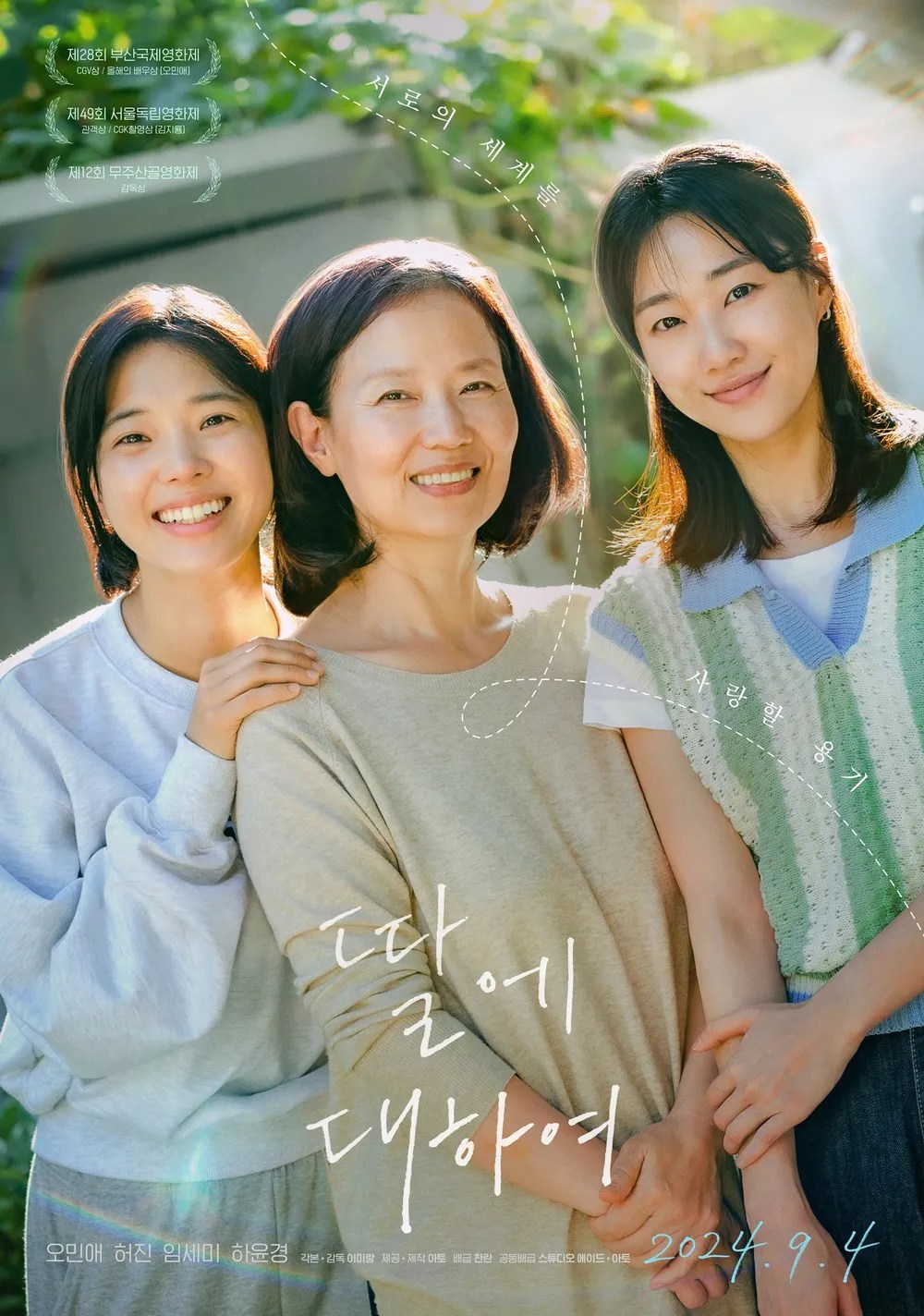
Concerning My Daughter (딸에 대하여, Lee Mi-rang, 2023)

The unnamed mother (Oh Min-ae) at the centre of Lee Mi-rang’s Concerning My Daughter (딸에 대하여) has only one wish, that her daughter will find a nice man to marry and have a few grandchildren. But Green (Im Se-mi) is gay and has been in a relationship with her partner Rain (Ha Yoon-kyung) for the last seven years though her mother doesn’t seem to accept that what they have together is “real” believing it to be some kind of delusion that’s holding Green back from her happy maternal future. 

When she suggests Green move back in with her after her attempt to secure a loan to help her out with the rising cost of housing is denied, it doesn’t seem to have occurred to her that Rain would be coming too while it perhaps seemed so natural to Green that it didn’t occur to spell it out. Green can at times be obtuse and insensitive, unfair both to her mother and to Rain who bears the unpleasant atmosphere with grace and tries her best to get along with her new mother-in-law who is openly hostile towards her and makes no secret of the fact she would prefer her to leave. Of course, some of these issues may be the same were it a heterosexual relationship as the mother-in-law struggles to accept the presence of the new spouse in the family home and the changing dynamics that involves, but Green’s mother’s resentment is so acute precisely because her daughter’s partner is a woman. She cannot understand the nature of their relationship because it will produce no children and to her therefore seems pointless. 

While her attitude is in part determined by prejudice and a sense of embarrassment that her daughter is different, it’s the question of children which seems to be foremost in her mind. Another woman of a similar age at her job at a care home remarks on her maternal success having raised her daughter to become a professor, but she also says that only by leaving children and grandchildren behind you can die with honour. Green’s mother is the primary carer for an elderly lady, Mrs Lee (Heo Jin), who had no children of her own though sponsored several orphans none of whom appear to have remained in touch with her. Now ironically orphaned herself in her old age, Green’s mother is the only one who cares for her while the manager berates her for using too many resources and eventually degrades Mrs Lee’s access to care Green’s mother suspects precisely because she has no family and therefore no one to advocate for her. 

It’s this fate that she fears for her daughter, that without biological children she will become a kind of non-person whose existence is rendered meaningless. Of course, it’s also a fear that she has for herself and her tenderness towards Mrs Lee is also a salve for her own loneliness and increasing awareness of mortality. Green is her only child, and she may also fear that she will not want to look after her as she might traditionally be expected to because her life is so much more modern as exemplified by the bread and pasta the girls bring into her otherwise fairly traditional Korean-style home. On some level she is probably aware that if she continues to pressure Green to accept a traditional marriage they may end up becoming estranged and she will be in the same position as Mrs Lee, wilfully misused by a cost-cutting care industry because they know there’s no one to kick up a fuss about her standard of care.

Even so, it doesn’t seem to occur to her that Rain could care for her daughter into their old age. Resentfully asking her why they “have to” to live together, Rain patiently explains that in a society which rejects their existence, in which they are unable to marry or adopt children, togetherness is all that they have. Green is currently engaged in a battle with her institution which has fired her colleague on spurious grounds but really because of her sexuality with claims that some students are “uncomfortable” with her classes. The violence with which the women are attacked is emblematic of that they endure from their society while even colleagues interviewing her invalidate Green’s concerns because she too is “one of them,” in their prejudicial way of speaking. 

Green’s mother had also, rather oddly, said that her daughter wasn’t like that when Rain reluctantly explained her difficulties at work and again resents that she’s making waves rather than keeping her head down and getting on with her career. Her decision to jump in a car with boxes of biscuits intending to smooth things over with Green’s boss by apologising on her behalf bares out her old-fashioned attitudes, though she too is shocked by the violence directed at Green and her colleague. When her lodgers ask about Rain, she tells them she’s her daughter’s friend, while she avoids the question when her colleagues ask, still embarrassed that her daughter has not followed the conventional path as if it reflected badly on her parenting. 

Yet through her experiences with Mrs Lee and Rain’s constant, caring patience she perhaps comes to understand that her daughter won’t be alone when she’s old and that she too does not need to be so lonely now. There’s something a little a sad in the various ways Green’s mother is told that her attachment to Mrs Lee is somehow inappropriate as if taking an interest in the lives of those not related to us by blood were taboo even if it’s also sadly true that it’s also in Mrs Lee’s best interests to ask those questions to protect her from those who might not have her best interests at heart. What the film seems to say in the end is that we should all take better care of each other, something which Green’s mother too may come to realise in coming to a gradual, belated acceptance of her daughter-in-law if in part through recognising that they aren’t alone and that it’s a blessing that her daughter is loved and will be cared for until the end of her days.


Concerning My Daughter screened as part of this year’s London Korean Film Festival.

Trailer (English subtitles)

Handsome Guys (핸섬가이즈, Nam Dong-hyub, 2024)

The malicious inequalities of the contemporary society are manifested in an angry goat demon who wants to burn the world in Nam Dong-Hyub’s zany horror comedy, Handsome Guys (핸섬가이즈). Adapted from the American film Tucker & Dale vs. Evil, the film plays with prejudice and superficiality along with the pernicious snobbishness of a society founded on status in which, as a would-be-exorcist later says, some have lost the ability to distinguish good from evil.

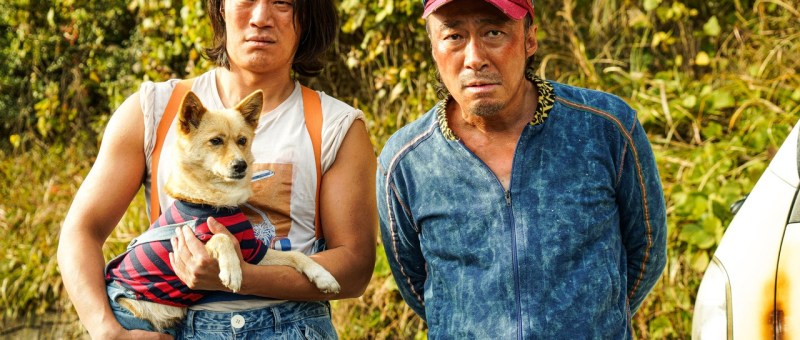
Step-brothers Sanggu (Lee Hee-joon) and Jaepil (Lee Sung-min) often suffer precisely because of this inability. They are actually nice, sweet guys who are always trying to do the right thing but somehow their behaviour always comes off as creepy giving rise to a series of misunderstandings. That might be why they’ve decided to buy a cottage in the woods in order to live a rustic life, only the house they’ve purchased is a little more rundown than the estate agent implied and was previously home to a Catholic priest which doesn’t altogether explain the goat-themed pentagram in the basement. 

Like the brothers, Mina (Gong Seung-yeon) is also a nice person as we can tell because she’s the only one of her friends who wanted to give the goat they hit with their car a proper burial while the others decide to just leave it in the road and drive off. She too thought the brothers were creepy, but is also awakening to the fact that Sungbin (Jang Dong-joo), a rising star of the golf world, is a bit of a twit who wields his privilege like a weapon and has essentially invited her on this country weekend as entertainment. He also bullies his friend/minion Byung-jo (Kang Ki-doong) whom they regard as a loser and is evidently willing to bear humiliation merely to be in the same orbit as a man like Sungbin who with his good looks, refined manners and modern manliness projects an idealised image of contemporary masculinity that is the exact opposite of the brothers. 

In many ways, he is the demonic presence of privileged youth damaging the hopes and prospects of ordinary youngsters like Mina. Believing that she has been kidnapped by the brothers, the three guys set out to “rescue” her but Sungbin doesn’t care about Mina at all and in fact only wants to retrieve his phone which contains evidence of his sordid lifestyle which would destroy his prospects of becoming a celebrity through achieving success in his golfing career. Nevertheless, they decide to attack the brothers with mostly disastrous results believing them to be nothing other than idiotic hillbillies if also depraved backwoods serial killers living an animalistic, uncivilised existence that is far too close to the land for city slickers like Sungbin. 

Once again, the brothers are plagued by a series of bizarre misunderstandings based on the perception of their “ugliness” which aligns them with “evil” and demands they be exiled from a society that equates physical “beauty” with moral goodness. To that extent, having been rescued from falling in a pond, Mina becomes a kind of Snow White ensconced in the home of the brothers and coming to understand that they are actually nice, if a bit strange, and merely have difficulty expressing themselves while their down-to-earth homeliness only seems suspicious to those who are a little less honest with emotions.

Their niceness, however, seems to be perfectly primed to face off against the Goat Demon as they become determined to protect their homestead from the likes of Sungbin who has only contempt for them and thinks they’re merely fodder for his heroic fantasy of retrieving his phone and proving his manliness at the same time. In essence, it’s Sungbin who embodies the ugliness of the contemporary society with its hypocrisy and superficiality, its casual misogyny and petty prejudice, while the brothers later vindicated as angelic presences of altruistic goodness. Slapstick humour mingles with a sense of malevolence and an inescapable cosmic irony that plagues the brother’s with misunderstandings and has kept them isolated, “handsome guys” too beautiful for a profane world and attempting to find refuge in their remote homestead and homoerotic relationship but eventually discovering unexpected solidarity with the equally exiled Mina as she delivers a silver bullet to privilege and patriarchy, sending ancient evil back to whence it came.


Handsome Guys screened as part of this year’s London Korean Film Festival.

International trailer (English subtitles)