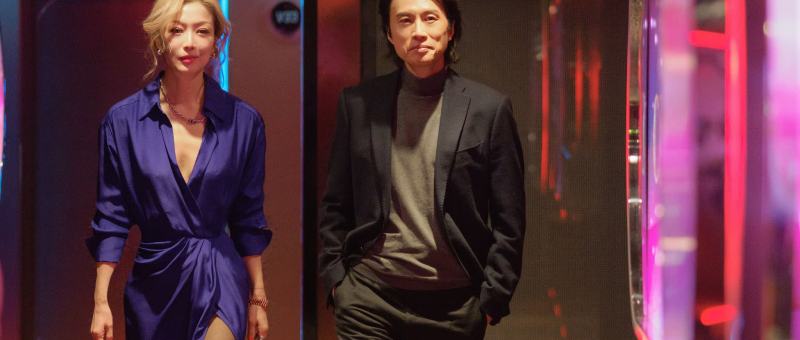
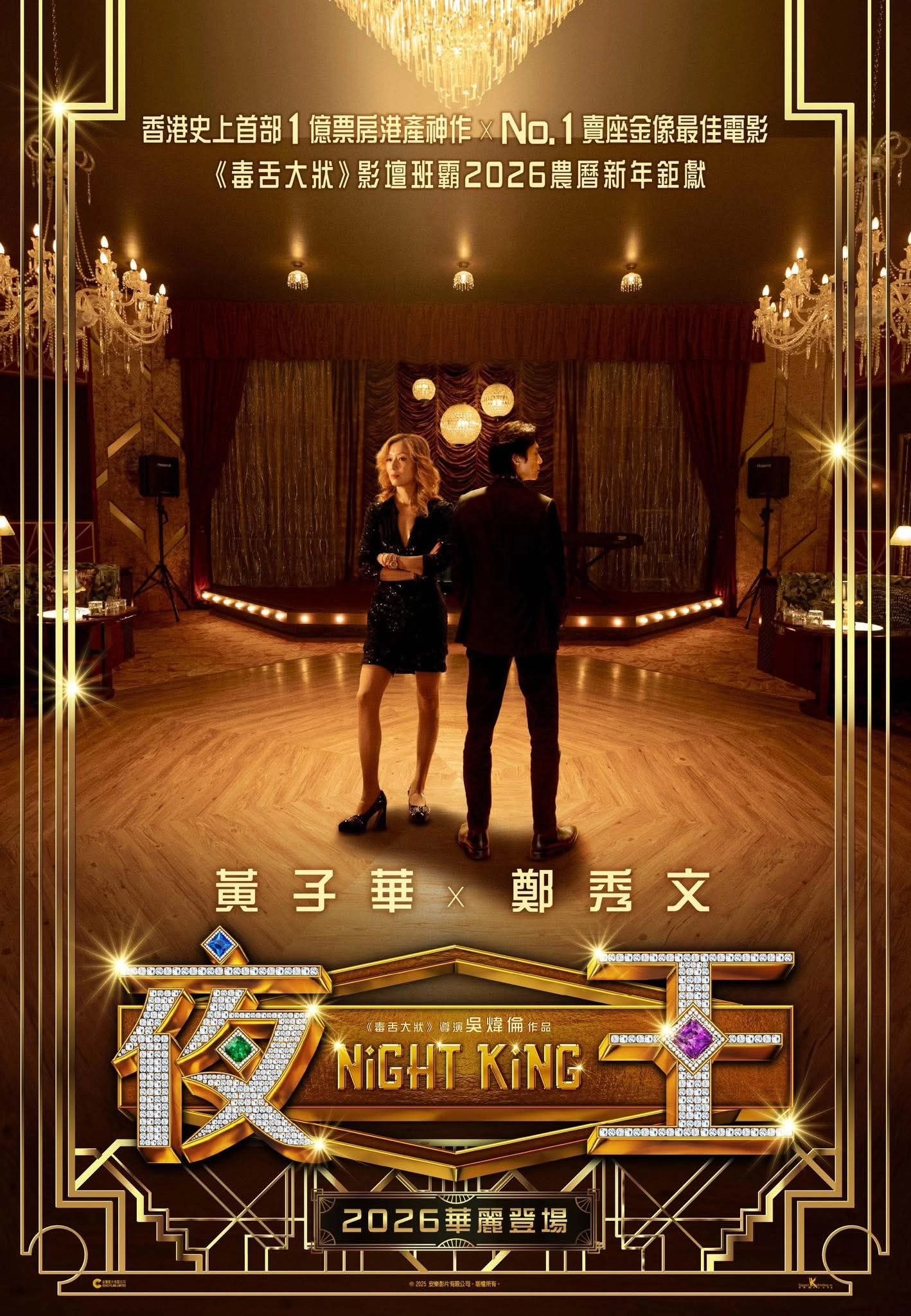
Times are changing in the Hong Kong of Jack Ng Wai-Lun’s Lunar New Year comedy, Night King (夜王). Reuniting the team behind the megahit A Guilty Conscience, Ng paints the tiny enclave of old-fashioned hostess bars at its centre as the last bastion of a disappearing culture where a good-hearted manager holds out against the encroaching forces of capitalism in the form of his ex-wife, Madam V (Sammi Cheng), who is determined to buy the club and rule all of East Tsim Sha Tsui.
Back in the economic boom of the 80s and 90s, Foon (Dayo Wong) ruled the roost as the famed “Night King” of the entertainment district, but these days clubs are closing reft, left, and centre, while his EJ is one of the only holdouts left alongside Madam V’s Muses. Madam V has poached several of Foon’s best girls which is why his bar is understaffed, but there’s no real denying that the place is on its way out because customer behaviour has changed. Madam V bristles when her boss’ nerdy son Prince Fung (Siuyea Lo) suggests young people don’t go to places like these any more and they’re better off turning it into a modern nightclub instead, but he does have a point. Most of the clientele are elderly men who might be rich but won’t be very coming for very much longer while there’s no one really there to take their place. The younger men who do come, like Fung, on occasion, are there because, as Foon says, hostess bars are naturally places where information circulates freely.
To that extent, Madam V represents an incursion of modern capitalism as she ruthlessly takes her red pen to the books and insists on getting rid of unpopular girls. Rather than the current system, she suggests switching to a pageant style in which the girls are brought in en masse with the customer taking his pick, which somehow seems even more sexist and sleazy than before. Madam V’s ambition seems to have been one reason for the marriage’s failure and it’s clear that she resents Foon for being a soft touch. As she says, he lends money to every girl that asks him and is actually quite supportive of them in a way that makes this business seem less exploitative than it might otherwise be. In any case, he’s determined to hang on to his long timers even if some of them have aged out of active hostessing while Madam V wants to bring in her army of soulless and identical ringers.
So the question is really, is it better to go down with the ship clinging to the past or join the capitalist revolution alongside men like Fung who no longer value Hong Kong and do most of their business abroad. Of course, there might be another way if Madam V and Foon can find their way back to working together, but the first problem is the petty princeling with a sexist chip on his shoulder because he can’t accept it that his sister is a better businesswoman and the likely heir to his father’s empire. His family seem to have written him off already, and sadly they may have been right. Giving himself a glam up, Fung shows up at the club like a playboy throwing his money around, but has secretly teamed up the widow of Foon’s late Triad godfather to screw over Madam V for the purposes revenge, while Mrs Wong simply wants rid of the club because she couldn’t stand her husband’s involvement in the seedier side of his business as a violent gangster.
As in so many recent Hong Kong films, the idea seems to be that it’s better to let go of the past and take with you only what you can carry. Foon and Madam V eventually open a new club that’s fully their own rather than inherited or run on behalf of a backer. In essence, it’s still a hostess bar, but in a different part of town and more modern in sensibility, skewing young professional rather than elderly billionaire. Foon too is dressing in a more contemporary fashion, abandoning his colourful open-neck shirts with visible medallion and jeans for a smart suit jacket and turtle neck. Nevertheless, Ng seems to be looking back rather than forwards in his directorial style including typical elements of 80s and 90s cinema such as slow motion, freeze frames, and fade to black transitions perhaps to echo the ways in which Foon is stuck in the past. The eventual message though is one of solidarity and creating your own space outside of whatever external forces may be constraining it.
Trailer (Traditional Chinese / English subtitles)
 Windows on Worlds