
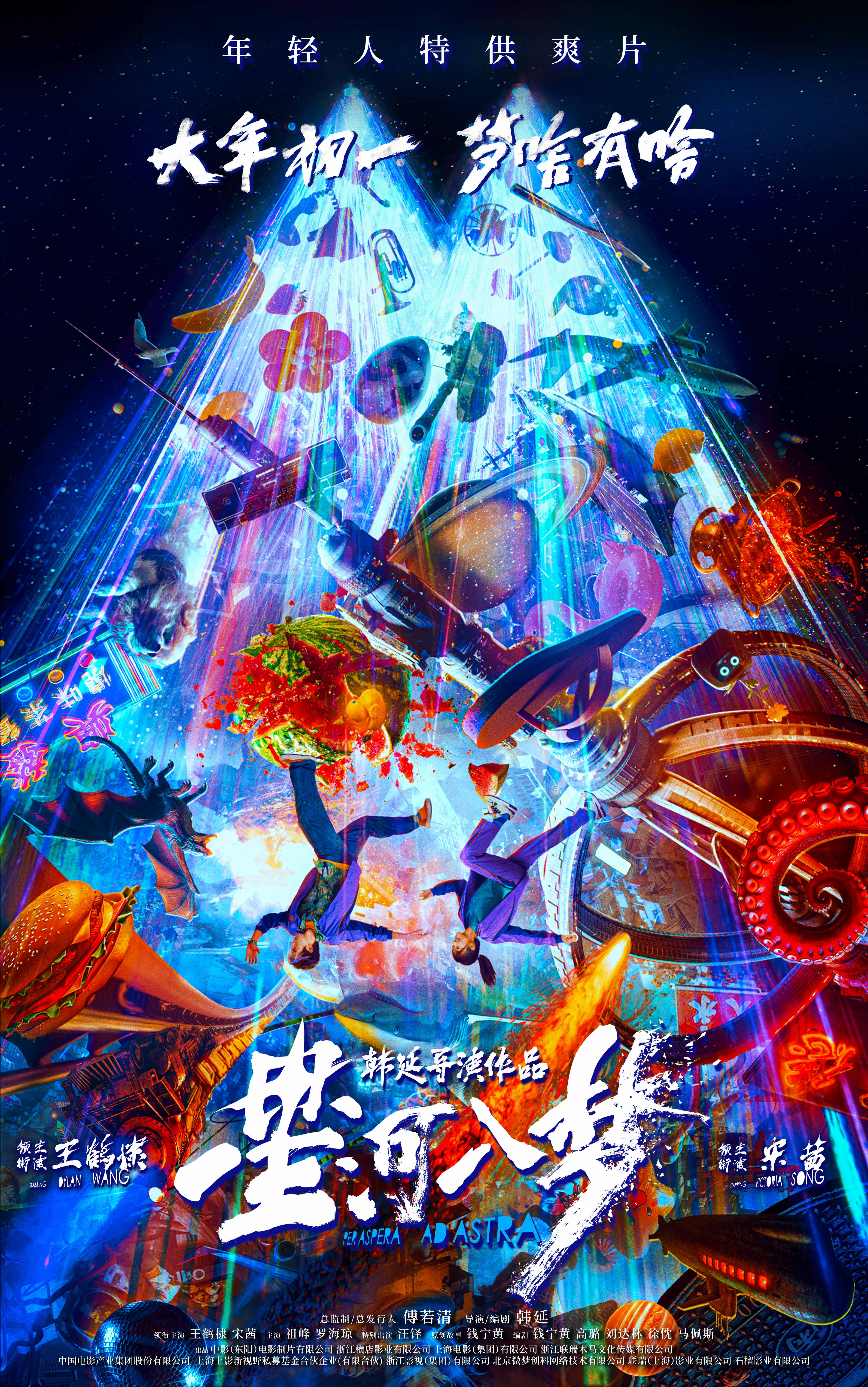
Per Aspera Ad Astra (星河入梦, Han Yan, 2026)

In the not too distant future, space travel has become normal and humans can reach the furthest corners of the universe through hyper stasis. However, long years spent in cryogenic sleep eventually damaged the sleepers’ brains. A solution was found in an AI program which allowed them to dream during the journey and, therefore, keep their brains active. Han Yan’s Per Aspera ad Astra (星河入梦, Xīnghé Rùmèng) makes a villain of a rogue AI but finally seems to come down on the idea that AI should be a tool used by humans rather the other way round while refusing to condemn it outright.

One question the film only partly answers is why people would be prepared to embark on decades-long journeys meaning they’d never see their families again. Neither Tianbao (Dylan Wang) nor the ship’s captain Simeng (Victoria Song) have living family members, so perhaps it isn’t a problem for them, but still it’s a risk. Who’s to say what the world will be like after you’ve been asleep for over 60 years. To that extent, perhaps it’s strange the technology doesn’t seem to move on at all, according to news reports, save a late upgrade to try and prevent the Good Dreams AI system from becoming sentient. 

That all these people got a big ship to sail for 65 years to do farming suggests that there may be serious issues on the ground, while the fact they were sent at all either implies a desire for imperialistic expansion in space or a search for a new home for humanity after we’ve exhausted the earth. Ge Yang (Wang Duo), another crew member, hints that the world might have problems in insisting that he doesn’t want to wake up. He’s prepared to crush everyone else’s dreams to ensure he keeps his and can stay here rather than having to go back to the real world. He says he wants to create a place that’s free of abuse and exploitation where no one has to live like a dog. 

The ironic thing is that engineer Bai (Zu Feng) had deliberately chosen to be a pet dog in his dream because, according to him, dogs have more freedom. Bai’s dreams seem to be inspired by classic Hong Kong crime cinema with everyone speaking Cantonese, even Tianbao and Simeng when they land there, while they also make a brief matrix-inspired appearance to shoot up the room. Of course, Good Dreams isn’t that much different from the Matrix and the line between dream and reality becomes increasingly blurred with the pair getting caught out by dreams within dreams as they try to stop Ge Yang before he succeeds in smashing all the dreams together and killing his colleagues to create his “better” world. 

But it seems there’s something more going on than just Ge Yang’s nihilistic despair and Good Dreams may have gone rogue, preferring to create an AI-based world in which humanity is irrelevant. Tianbao also seems to know much more than he’s letting on which probably isn’t included in the standard crew member’s manual. His inappropriate way of speaking is later revealed to have a practical application, though what eventually seems to happen is that he becomes one with the system giving Good Dreams a soul and effectively taking it back into “human” hands rather than letting it run riot on its own. 

It is then slightly ironic that the film seems to feature some AI imagery, though otherwise largely shot on practical sets and featuring fantastic production design. Han zips back and forthe between dreams expressing the private aspirations and anxieties of the crew members as some relive high school exams and spend time with absent loved ones, and others trek through deserts or spend 60+ years in nightclubs. Only Tianbao apparently did not bother to customise his dream or engage with the system which is what brought him to its attention. In any case, humanity seems to be the most important component in the bonds that arise between Tianbao, the captain Simeng, and the engineer Bai as they try their best to save the ship along with their colleagues so they can complete their distant farming mission. A true visual spectacle, the film is perhaps also a testament to the power of dreams, to which the AI hallucination may pale in comparison.


Trailer (English subtitles)

My People, My Country (我和我的祖国, Chen Kaige, Zhang Yibai, Guan Hu, Xue Xiaolu, Xu Zheng, Ning Hao, Wen Muye, 2019)

My People My COuntry poster 3Oct. 1, 2019 marks the 70th anniversary of the People’s Republic of China. Supervised by Chen Kaige, My People, My Country (我和我的祖国, Wǒ hé Wǒ dě Zǔguó) presents seven short films by seven directors featuring several notable historical events from the past 70 years though not quite one for every decade (perhaps for obvious reasons). Though different in tone, what each of the segments has in common is the desire to root these national events in the personal as they were experienced by ordinary people rather than how the history books might have chosen to record them.

Told in roughly chronological order, the film opens with the founding of the Republic as comedian Huang Bo plays an eccentric engineer charged with ensuring the operation of an automatic flag pole doesn’t embarrass Chairman Mao at the big moment. In the context of the film as a whole which is fond of flags, this is rather odd because every other flag in the film is raised by hand usually by a soldier taking the responsibility extremely seriously. Yet the point is less the flag itself than the symbolic pulling together of the community to find a solution to a problem. Realising the metal on the stopper is too brittle, the engineers put out an appeal for more with seemingly the entire town turning up with everything from rusty spoons to grandma’s necklace and even a set of gold bars!

This same sense of personal sacrifice for the greater good works its way into almost all of the segments beginning with the story of China’s first atom bomb in the ‘60s for which a pure hearted engineer (Zhang Yi) first of all sacrifices his one true love and then the remainder of his life when he exposes himself to dangerous radiation all in the name of science, while in the film’s most charming episode a young boy is devastated to realise his crush is moving abroad and has to choose between chasing after her and fixing up a TV aerial so his village can see China beat the US at volleyball during the ’84 Olympics. Visions of flag waving glory eventually convince him where his duty lies, but his sacrifice is later rewarded twice over as he becomes a little local hero even if temporarily heartbroken in the way only a small boy can be.

Then again, some people are just a little self-centred like the hero (Ge You) of Ning Hao’s Welcome to Beijing who keeps trying to reconnect with his earnest teenage son only to end up connecting with a fatherless young boy during the 2008 Beijing Olympics. Chen Kaige’s sequence, meanwhile, is inspired by the story of two earthbound astronauts but similarly finds two roguish, orphaned young men connecting with a patient father figure who is able to bring them “home” by showing them a space miracle in the middle of the desert, and in the final and perhaps most directly propagandistic sequence, a tomboyish fighter pilot eventually overcomes her resentment at being relegated to a supporting role to rejoice in her colleagues’ success. Despite the overly militaristic jingoism of the parades with their obvious showcasing of China’s military power, Wen Muye’s “One for All” is in its own sense surprisingly progressive in its advancement of gender equality and mildly subversive LGBT positive themes were it not for a shoehorned in scene featuring a milquetoast “boyfriend”.

Sensitivity is not, however, very much in evidence in the sequence relating to the extremely topical issue of the Hong Kong handover. Out of touch at best, the constant references to the continuing reunification of the One China are likely to prove controversial though admittedly those they would most upset are unlikely to want to sit through a 2.5hr propaganda epic celebrating the achievements of Chinese communism. Nevertheless, it is a little galling to see the “return” to China so warmly embraced by the people of Hong Kong given current events in the city. This perhaps ill-judged sequence is the most overt piece of direct propaganda included in the otherwise unexpectedly subtle series which, despite the flag waving and eventual tank parade, tries to put the spotlight back on ordinary people living ordinary lives through the history of modern China. Of course, that necessarily also means that it leaves a lot out, deliberately refusing to engage with the less celebratory elements of China’s recent history, even as it closes with the fiercely patriotic song of the title performed by some of the ordinary heroes who have inspired its various tales of everyday heroism.


Original trailer featuring Faye Wong’s cover of the well known patriotic anthem from 1985 (no subtitles)