
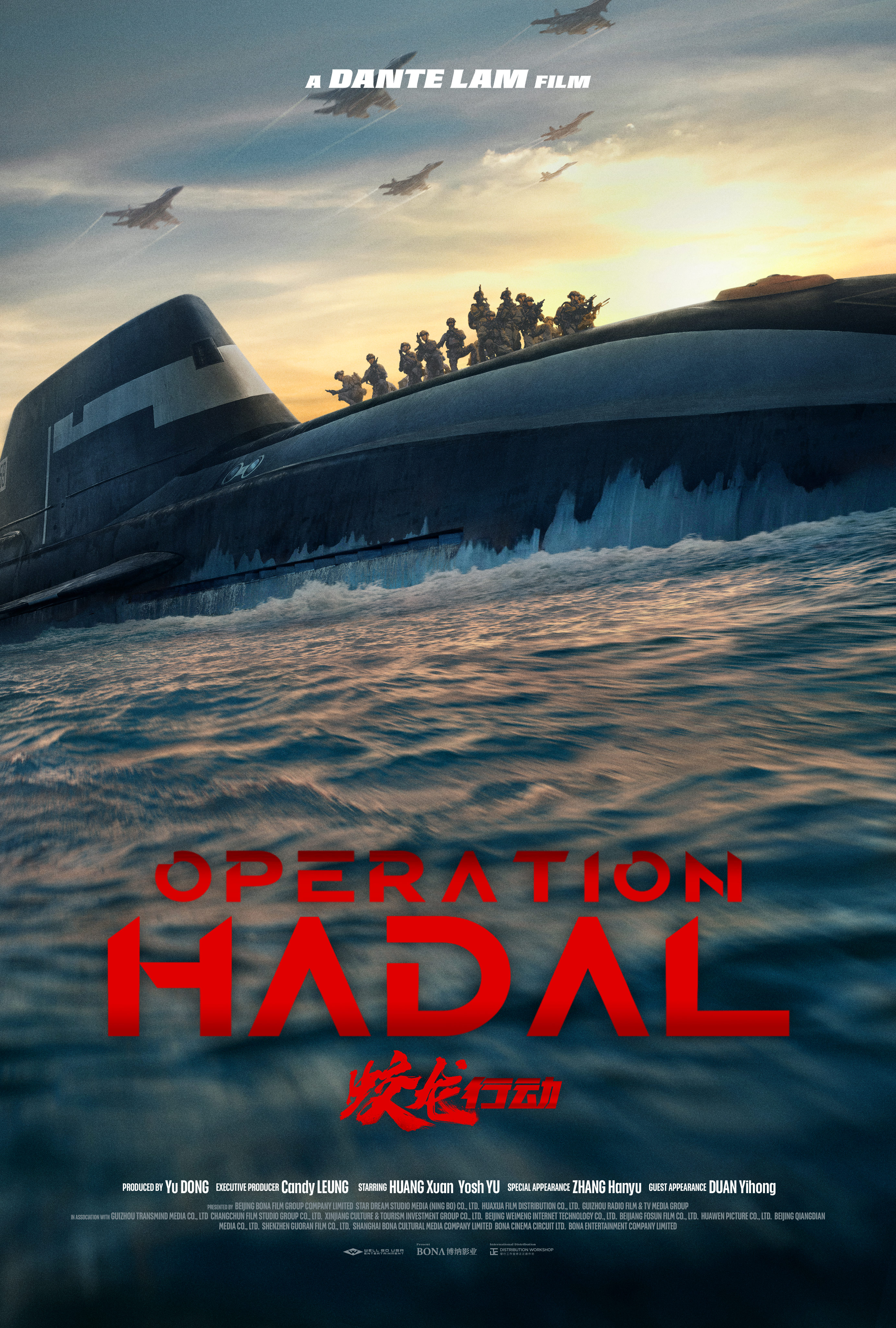
Operation Hadal (蛟龙行动, Dante Lam Chiu-Yin, 2025)

In recent years, Dante Lam has busied himself with a particular brand of Mainland propaganda actioner. Operation Hadal (蛟龙行动, Jiāolóng Xíngdòng) is intended as a kind of thematic sequel to earlier hits Operation Red Sea and Operation Mekong each of which featured the Chinese military springing into action to defend Chinese citizens from a plausible geopolitical threat while reminding the world at large that China will rise to defend itself and its citizens wherever they may be. 

All of which makes Operation Hadal a rather curious addition to the franchise. Unlike previous instalments, it’s set in the near future and revolves around round a completely ridiculous plot to blow up a volcano and destabilise East Asia with a series of what look to be natural disasters. Or so it would seem, the narrative is often incoherent and difficult to follow. If it were any other Chinese military propaganda film, it would doubtless want to show off the capabilities of the nuclear submarine at the film’s centre. The film even includes a quote from Chairman Mao in 1970 that the nation should hurry up and build nuclear submarines as soon as possible, but it’s not all that clear if this sort of submarine actually exists yet and the qualities the crew are most excited about on boarding the brand-new ship are that it’s much more spacious and comfortable to live in, while the fact that it’s much quieter and, therefore, can evade detection more easily is added as an after thought. 

Meanwhile, Captain Zhao Qing (Zhang Hanyu) is seen to make some questionable command decisions such as playing the harmonica on deck in a moment of crisis which is one thing that seems to have particularly upset the target audience. Zhang clarified that the tune he’s playing is a navy song and is intended as a call to arms for the submarine officers, though it doesn’t really play out that way and feels more like a misplaced homage to the western. Chinese technology is even eclipsed at times with the team finding themselves bogged down fighting robot dogs controlled by the other side, the so-called State of Siekerman, which at any rate seems to populated largely by people with American accents.

There is no clear reason why the State of Siekerman wants to destroy Asia with a series of “mid-sized nuclear bombs”, though there is division within the armed forces with some objecting to the plan because it will necessarily destroy the ecoculture of the area which is beneficial for the rest of the planet, leading to a mutiny by those who are in favour of blowing everything up. This sense of division is perhaps supposed to contrast with the intense unity of Chinese forces, in the same way as the friendship between Zhao Qing and the Admiral back on land is contrasted with that of the two State of Siekerman commanders who disagree about strategy.

The film’s biggest weakness is, however, a lack of characterisation among the Jiaolong team who are often indistinguishable due to the heavy equipment they are wearing. Interpersonal drama comes in the form of a man hung up on the death of a friend in a previous mission and his relationship with his fallen comrade’s son that is probably intended as a touching advocation of filial piety but largely gets lost among the chaotic action. The fact that everything comes down to one officer’s listening ability doesn’t seem like a very good advert for Chinese technology, if perhaps praising the abilities of rank and file soldiers to rise to the occasion. Subpar CGI often gets in the way of the action sequences which are the central draw, leaving the film quite literally all sea with no clear idea of what it’s trying to do. Where the violence of Operation Red Sea was realistic and horrifying, there’s a slightly camp quality with villains being dispatched by hatchets to the head or else popped by sliding doors. It’s not much of an advertisement for Chinese military prowess and never really discovers the sense of patriotic heroism that films like these generally rely on.


Operation Hadal is released on Digital in the US on 16th June courtesy of Well Go USA.

Trailer (English subtitles)蛟龙行动,

My People, My Country (我和我的祖国, Chen Kaige, Zhang Yibai, Guan Hu, Xue Xiaolu, Xu Zheng, Ning Hao, Wen Muye, 2019)

My People My COuntry poster 3Oct. 1, 2019 marks the 70th anniversary of the People’s Republic of China. Supervised by Chen Kaige, My People, My Country (我和我的祖国, Wǒ hé Wǒ dě Zǔguó) presents seven short films by seven directors featuring several notable historical events from the past 70 years though not quite one for every decade (perhaps for obvious reasons). Though different in tone, what each of the segments has in common is the desire to root these national events in the personal as they were experienced by ordinary people rather than how the history books might have chosen to record them.

Told in roughly chronological order, the film opens with the founding of the Republic as comedian Huang Bo plays an eccentric engineer charged with ensuring the operation of an automatic flag pole doesn’t embarrass Chairman Mao at the big moment. In the context of the film as a whole which is fond of flags, this is rather odd because every other flag in the film is raised by hand usually by a soldier taking the responsibility extremely seriously. Yet the point is less the flag itself than the symbolic pulling together of the community to find a solution to a problem. Realising the metal on the stopper is too brittle, the engineers put out an appeal for more with seemingly the entire town turning up with everything from rusty spoons to grandma’s necklace and even a set of gold bars!

This same sense of personal sacrifice for the greater good works its way into almost all of the segments beginning with the story of China’s first atom bomb in the ‘60s for which a pure hearted engineer (Zhang Yi) first of all sacrifices his one true love and then the remainder of his life when he exposes himself to dangerous radiation all in the name of science, while in the film’s most charming episode a young boy is devastated to realise his crush is moving abroad and has to choose between chasing after her and fixing up a TV aerial so his village can see China beat the US at volleyball during the ’84 Olympics. Visions of flag waving glory eventually convince him where his duty lies, but his sacrifice is later rewarded twice over as he becomes a little local hero even if temporarily heartbroken in the way only a small boy can be.

Then again, some people are just a little self-centred like the hero (Ge You) of Ning Hao’s Welcome to Beijing who keeps trying to reconnect with his earnest teenage son only to end up connecting with a fatherless young boy during the 2008 Beijing Olympics. Chen Kaige’s sequence, meanwhile, is inspired by the story of two earthbound astronauts but similarly finds two roguish, orphaned young men connecting with a patient father figure who is able to bring them “home” by showing them a space miracle in the middle of the desert, and in the final and perhaps most directly propagandistic sequence, a tomboyish fighter pilot eventually overcomes her resentment at being relegated to a supporting role to rejoice in her colleagues’ success. Despite the overly militaristic jingoism of the parades with their obvious showcasing of China’s military power, Wen Muye’s “One for All” is in its own sense surprisingly progressive in its advancement of gender equality and mildly subversive LGBT positive themes were it not for a shoehorned in scene featuring a milquetoast “boyfriend”.

Sensitivity is not, however, very much in evidence in the sequence relating to the extremely topical issue of the Hong Kong handover. Out of touch at best, the constant references to the continuing reunification of the One China are likely to prove controversial though admittedly those they would most upset are unlikely to want to sit through a 2.5hr propaganda epic celebrating the achievements of Chinese communism. Nevertheless, it is a little galling to see the “return” to China so warmly embraced by the people of Hong Kong given current events in the city. This perhaps ill-judged sequence is the most overt piece of direct propaganda included in the otherwise unexpectedly subtle series which, despite the flag waving and eventual tank parade, tries to put the spotlight back on ordinary people living ordinary lives through the history of modern China. Of course, that necessarily also means that it leaves a lot out, deliberately refusing to engage with the less celebratory elements of China’s recent history, even as it closes with the fiercely patriotic song of the title performed by some of the ordinary heroes who have inspired its various tales of everyday heroism.


Original trailer featuring Faye Wong’s cover of the well known patriotic anthem from 1985 (no subtitles)