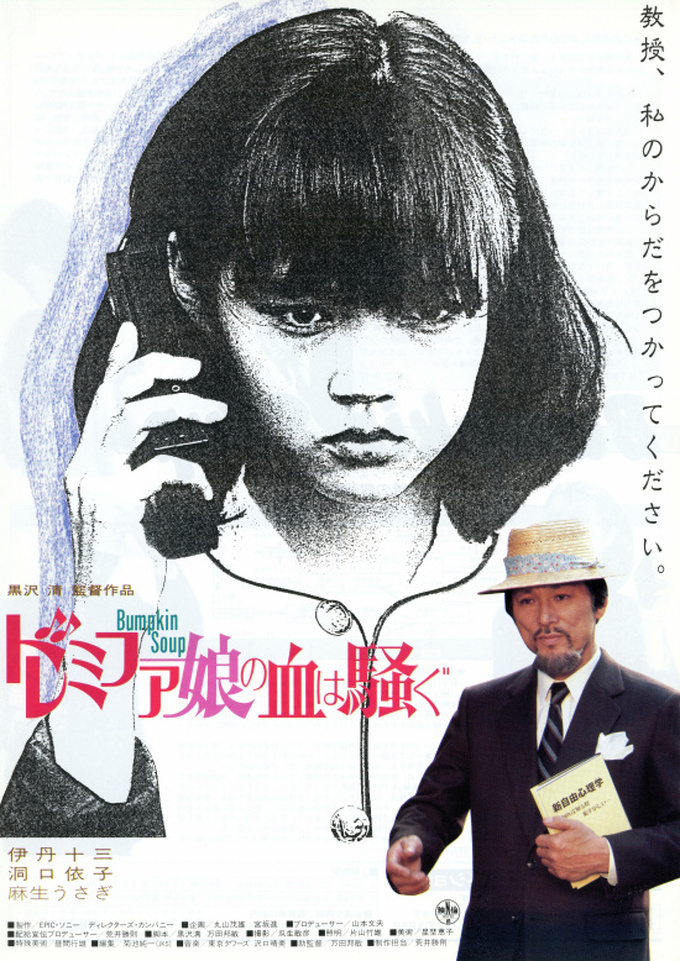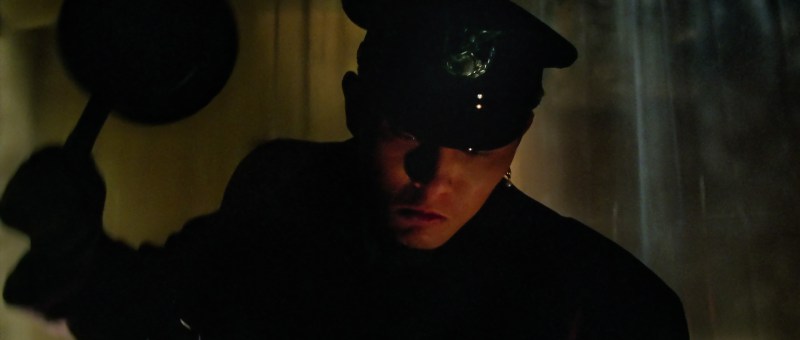
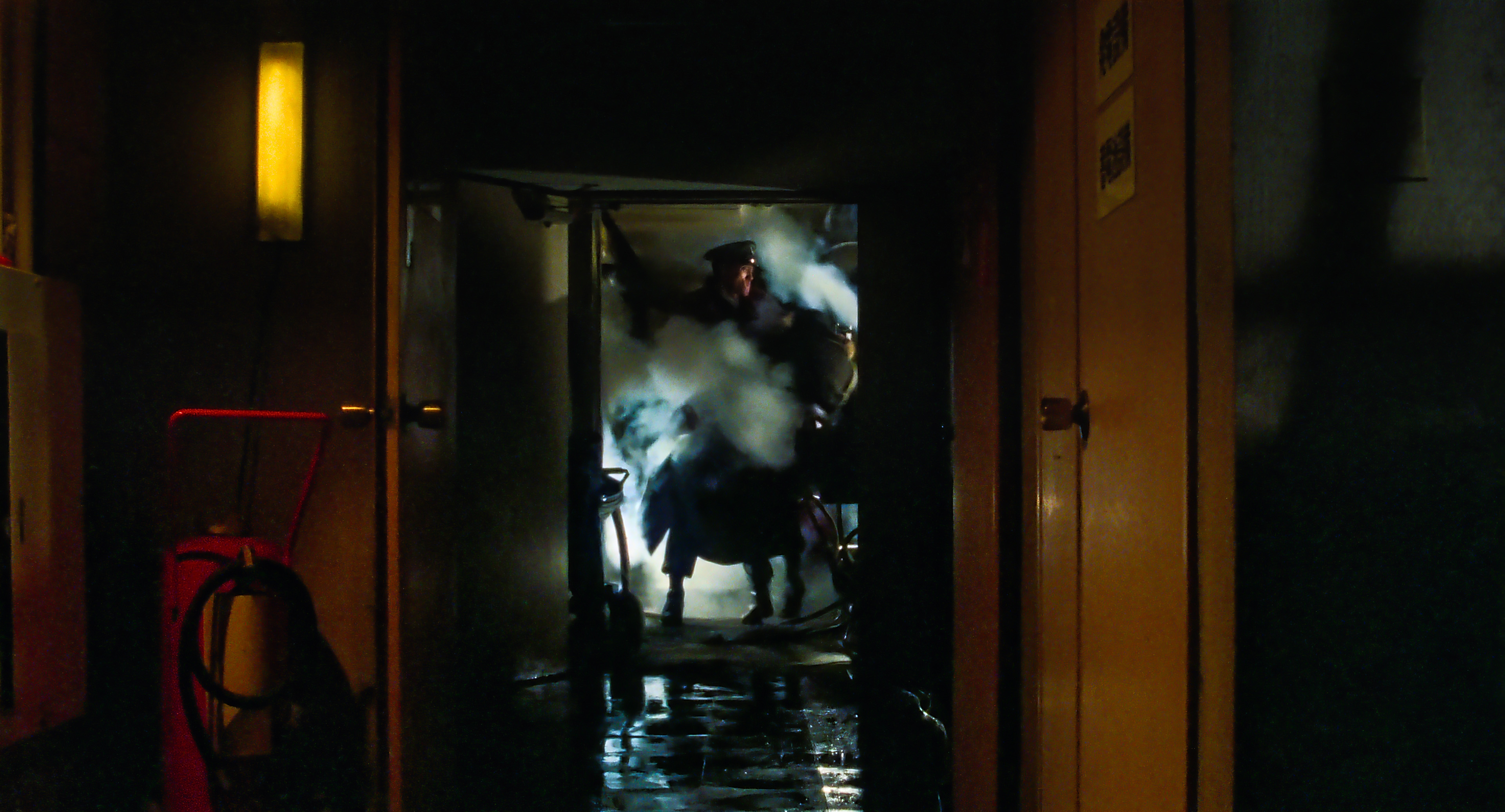
The Guard From Underground (地獄の警備員, Kiyoshi Kurosawa, 1992)

Ever feel like your job is trying to kill you? Released at the tail end of the Bubble era, Kiyoshi Kurosawa’s The Guard from Underground (地獄の警備員, Jigoku no Keibin) positions an office building as an industrial hell complete with a demon living in the basement but grimly suggests it’s just one of many hazards to be aware of for a woman in the corporate environment. Then again, the hellish guard himself has a sorrowful look in his eyes that speaks of true loneliness and might evoke pity if only in the fatalistic inevitability of his office-bound killing spree. 

It has to be said, Akebono Trading should have another look at its hiring procedures through in any case there’s something odd about this building which feels more like an abandoned hospital than a place of business while we might also wonder why we’re seeing signs for cargo depots and engine rooms and staff getting locked in the filing room is apparently not an uncommon occurrence. The new security guard has the same name as a former sumo wrester acquitted of the murders of his stablemate and lover on the grounds of temporary insanity, Fujimaru (Yutaka Matsushige), and is himself a hulking presence, tall but of medium build so who knows if it’s really the same guy or just the office rumour mill going into overdrive.  

Meanwhile, the other new recruit is a refined young woman, Akiko (Makiko Kuno), who’s been brought on as an art expert to help a new division recently diverted into prospecting with art sales to assess what is and isn’t a fair market price for a priceless piece of art. As Akiko admits, she’s not well placed to give that information because her background is in curation so she’s not particularly well versed in the collector market but presumably the job pays a bit better than the museums sector so she’s trying to do her best. Her new boss, Kurume (Ren Osugi), is a bit of a weirdo (like all the other men in the building) and crassly remarks that paintings like women have no value if there’s no buyer while she struggles to understand what the point of her job is. Meanwhile we’re left to wonder if Section 12 is actually a real department at all or a shady enterprise set up to help the enigmatic boss, Hyodo (Hatsunori Hasegawa), improve his investment portfolio which will probably serve him well when the bubble finally bursts. 

It’s tempting to read Fujimaru as a personification of corporate culture slowly picking off the employees and largely doing so by means of the building itself, electrocuting them by forcing their hand on the circuit breaker, bashing one inside a locker, or otherwise using his security guard’s truncheon to bludgeon them to death. To begin with, it seems as if he’s developed a fondness for Akiko and while that may be true in the same way King Kong develops a fondness for Fay Wray, it soon becomes clear that he isn’t in fact trying to protect her by taking out all the skeevy guys but seemingly killing for no reason. He looks a painting of Goya’s Saturn Devouring His Son with fascination, again hinting at his nature as the personification of capitalistic corporatism devouring the employees who might one day overthrow him, yet also lends the guard an eerie, mystical quality suggesting he merely enjoys the act of carnage though he does not actually eat anyone (that we see). More than that he seems almost like Frankenstein’s Monster, somehow lonely in identifying his otherness as he eventually confesses to Akiko remarking that “desolate time” flows through him unlike her “kind”. As he leaves, he pleads not to be forgotten. 

Akiko defeats him by refusing to believe his story and declaring herself disinterested in his truth possibly stood in good stead by the constant necessity of evading the attentions of the men around her such as those of Kurume who starts off giving paternalistic advice about looking after her parents and the preferential savings rates on post office accounts before randomly taking off his trousers. Anticipating his later career, Kurosawa makes the office a place of lurking dread and anxious eeriness only deepened by its industrial aesthetics along with the tiny windows leaking apocalyptic lighting from the oblivious outside world now cut off except for the new/old teletype text and ironic benefits of international time zones. “Traffic’s hell this time of day” a taxi driver chirpily advises, ironically delivering his passenger straight into its fiery depths. 


The Guard From Underground is released in the UK on blu-ray on 25th September courtesy of Third Window Films.

Trailer (English subtitles)
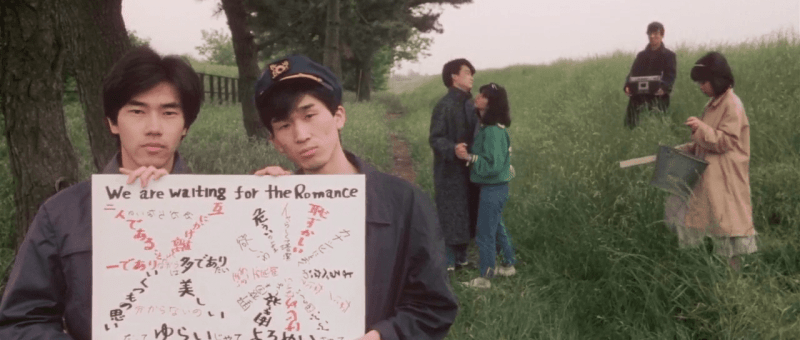
Bumpkin Soup (ドレミファ娘の血は騒ぐ, Kiyoshi Kurosawa, 1985)

Bumpkin soup posterLike many directors of his generation, Kiyoshi Kurosawa began his career in “pink film” – mainstream softcore pornography produced to a strict formula. His debut had been made for Director’s Company, an independent production house which offered creative freedom to young and aspiring filmmakers. He then tried to move into the studio system by directing for Nikkatsu’s Roman Porno, but the film was rejected for not quite living up to the demands of the genre. Bumpkin Soup (ドレミファ娘の血は騒ぐ, Do-re-mi-fa-musume no Chi wa Sawagu, AKA The Excitement of the Do-Re-Mi-Fa Girl) was then purchased from Nikkatsu and released independently as his second film, earning Kurosawa something of a reputation as a contrarian. Though the film contains its fair share of nudity and strange sexual shenanigans, it is easy to see why it did not fit the Roman Porno remit thanks to its bizarrely absurdist tone and often nonsensical French New Wave-inspired post-modernism.

The film begins with the heroine, Akiko (Yoriko Doguchi), walking into a Tokyo university campus in search of her small-town boyfriend, Yoshioka (Kenso Kato). Yoshioka is not, however, where he said he would be – he rarely turns up to lessons and has been absent from the music club he said he had joined for some time. Determined and undaunted, Akiko continues to look for him, encountering various strange people and events including a psychology professor intent on exploring the depths of shame.

After meeting sexually obsessed female student Emi (Usagi Aso), Akiko remarks that the university campus is like a permanent festival, or perhaps an amusement park. It certainly seems to be some sort of continuous orgy as seen though the eyes of simple country girl Akiko who has, after all, only come here in search of lost love. Carrying around a walkman with a tape featuring Yoshioka’s music, she devotes herself to finding her beau but eventually sniffing him out, discovers that he’s not the man she thought he was. Truth be told, Yoshioka does not seem like much of a catch. A randy college student, he has more or less forgotten all about Akiko while he pursues just about everyone else on campus instead of going to lessons.

Latterly, Akiko comes to the realisation that she thought she was looking for an adventure leading to love, but perhaps what she really wanted was love leading to an adventure. She left the country behind, travelled to the city, transgressed borders and entered the university where she was sure she would find answers but has discovered only more questions. Akiko feels herself at odds with her new environment, unable to understand the strange grammar of the university world where people seem to talk mostly about themselves. She does, however, seem strangely taken with the befuddled professor Hirayama (Juzo Itami) whose attempts to explore the nature of shame are derailed by the “shamelessness” of the modern student.

Hirayama’s big idea is that shame is all a sham. That the custom of hiding the parts of the body we have been taught to be ashamed of is a kind of deception in itself. He hopes that in the future people will live “nakedly” without feeling the need to hide anything at all, or at least that it will be impossible to tell from the outside which parts of themselves someone might be ashamed of. In order to pursue his theories, the professor is currently engaged in experiments to provoke an “extreme shame mutation” – something which his students later undertake alone but are unable to fulfil because their subject, Emi, appears to get off on the very things they considered shameful and embarrassing which, in turn, turns them all on. So in one way a very successful experiment, but in another not. In any case, Hirayama comes to the conclusion that only Akiko, with her innocent country ways, will be capable of showing him true shame which is how she eventually becomes mixed up in his “research”.

Most obviously inspired by mid-career Godard, Kurosawa adopts a post-modern, absurdist approach satirising left-wing student politics and youthful intensity while inserting random moments of song and dance along with explicit (and often odd) sexual  content that was likely still not quite enough to make it worthy of the Roman Porno name. A strange subplot pits the psychology student against a gang of mute performance artists led by a girl banging a bucket with a stick, which eventually leads to the act of nihilistic revolution which closes the film with a lullaby sung by a girl wielding a gun. What does it all mean? That shame is just a tool of social oppression, that one should make one’s own decisions without blindly following “thinkers”, that young people destroy themselves in pointless acts of revolution? Who can say, perhaps it isn’t very important but Kurosawa certainly has his fun while exploring the innocence/experience divide.