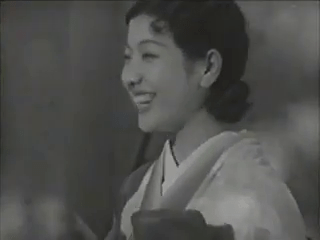
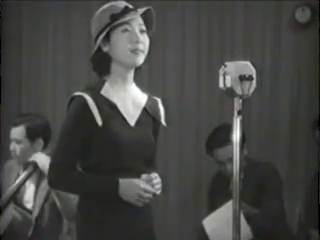
Radio Queen (ラヂオの女王, Shigeo Yagura, 1935)

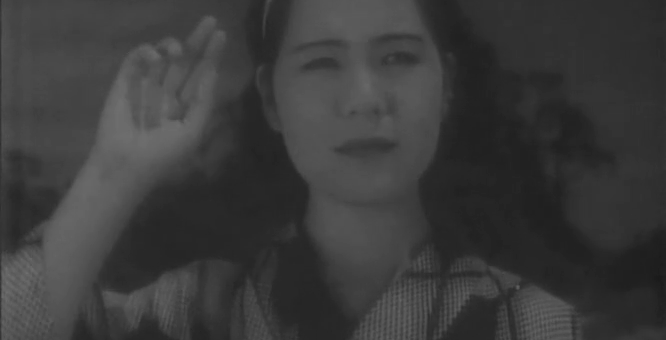
The conflict between warring neighbours of differing dispositions deepens when their children want to get married in Shigeo Yagura’s modernising comedy, Radio Queen (ラヂオの女王, Radio no Oujo). Against a backdrop of rising militarism, the film explores a generational shift in a new world increasingly dominated by mass media that quite literally speaks to the young not only through the newly established ubiquity of wireless radio but the talkie too leaving the old somewhat left behind confused by the rapid motion of progress.

In fact, the film opens with Kawamura, owner of a factory that makes aeroplanes that can’t fly, being woken up by his neighbours performing radio taiso callisthenics exercises. Kawamura dislikes radio on a conceptual level, though his dislike of it may also have a slightly subversive quality given the underlying element of coercive conformity that sees the nation performatively warm up for another day of national unity and hard work towards the growth of the empire. Then again, Kawamura is the film’s most ridiculous character finally giving a speech that he would be proud to sacrifice his son’s life for the nation by getting him to fly one of their biplanes to China as a kind of publicity stunt.

Publicity stunts are, however, a particular talent for Kingo who has very modern ideas about how to make not only his business but that of his father’s neighbour and frenemy Misome a success. Soon to finish university, Kingo plans to marry Misome’s daughter, Kimiko (Sachiko Chiba), who is currently working as a primary school teacher though both father fiercely object to the union. Kingo puts the kibosh on the idea of eloping mainly for practical reasons that they will be unable to support themselves financially on a running start but also for reasons of filial piety which probably do correspond with the censorship demands of the time. One of his ideas for winning over Misobe is to help him make his business of selling cough sweets for stage performers more successful through modern advertising and publicity techniques. Though originally rejecting his ideas, Misobe often takes his advice but pretends it was all his own idea further souring their relationship.

In any case, he wants to Kimiko to marry his chosen suitor, Kyuichi, who is training to become a pharmacist but also struggles with maths and has secretly been embezzling money in contrast to Kingo who is much more organised than his own father and has real business talent. Misome describes Kimiko’s job as a “hobby” and regards it as something she’s doing to keep busy until she gets married, a notion perhaps encouraged by social expectation given that it involves taking care of children which places her in a quasi-maternal position. She could presumably support herself, but the option is never given to her as even she tries to chivvy Kingo along by warning him that if he fails to win her father over she’ll end up married to the pharmacist as if she had no say in it at all. 

In any case, in a rather strange turn of events her singing in the school is heard by a film crew who’ve just had their lead actress pinched by a rival studio. They cast her in the part of a Christian nun who is also a schoolmistress but in contradictory fashion is involved in a romance which scandalises Kimiko and leads her to walk off set refusing to be exploited by the unscrupulous directors insisting that no such thing had been mentioned to her when she agreed to take the job. But it’s this that finally propels her to become the “Radio Queen,” taking a much more wholesome role singing nursery rhymes and reading fairytales for children across the nation through the new medium of the wireless. Kingo does not object to her fame and sees it as a positive sign that may cause his father’s opinion of her to change for the better despite his dislike of the device, though he does later become put out that the demands of her career leave her less time to spend with him.

In that sense, it’s also “modernity” that disrupts their relationship along with changing gender and social roles while there is also a necessarily problematic element of then largely unregulated mass media. An unscrupulous consumerism seems to have taken hold with the foolish Kawamura also addicted to collecting “antiques” many of which are akin to religious relics of an age of modernity. We see a man drop a piece of wood on the floor outside which is later picked up by dealers and sold as a piece of the propeller of the first of ever plane which Misome jokingly offers to buy for Kawamura in the hope his aircraft might actually fly one day. On entering an antiques fair, they’re confronted by an object claimed to be the clasp from Rockerfeller’s wallet echoing some of Misome’s frequent allusions to his success as a self-made man while Kawamura conversely frequently alludes to Mussolini as if making plain his own slightly priggish attachment to militarism. 

Misome concedes that Kingo is a bright and promising young man and objects to him only on the grounds that he is Kawamura’s son and he prefers the pharmacist because he thinks it more advantageous to himself before realising what sort of a man Kyuichi is really is. In the end, they’re both bamboozled by mass media when Kimiko rushes to the airfield where Kingo is about to take off having petulantly agreed to the test flight after arguing with her. As she petitions the already in motion plane, he manages to pull her up into the passenger seat while the radio announcer announces their engagement live on air granting it a new legitimacy neither of the fathers can really argue with. The film ends with them flying off into a blue sky which suggests a victory for youth and freedom even if it seems a little too simple leaving the older generation behind on the ground with only the wireless for comfort.
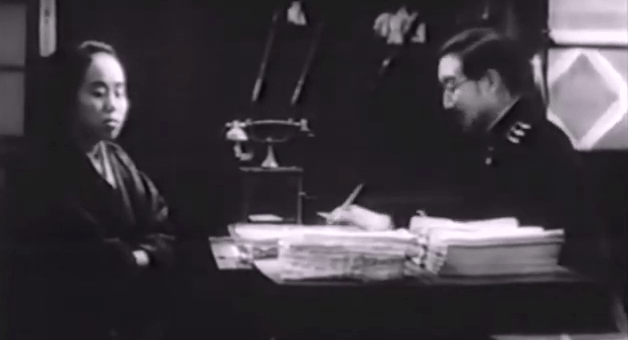
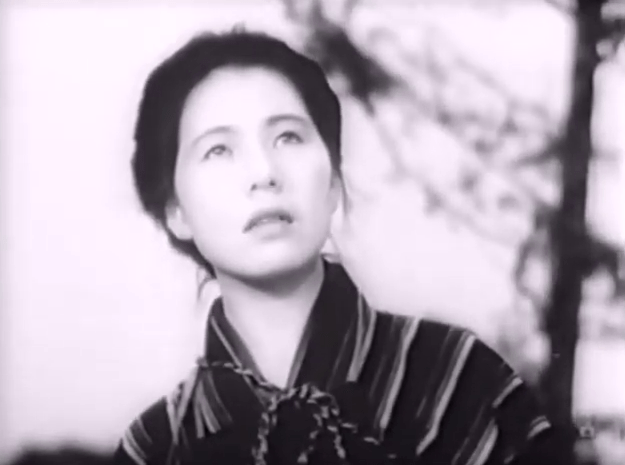
Nightingale (鶯, Shiro Toyoda, 1938)

Set in a quiet northern town, Shiro Toyoda’s Nightingale (鶯, Uguisu) finds the nation still struggling to emerge from the feudal past into the modern era. The film opens with a scene in the local train station, yet we’re also told that it is literally cut off from prosperity because the express train does not stop there and so it is relegated to the status of provincial backwater. Physically trying to flag the train down, the Mayor has been trying to get the town placed on the fast track but has had no luck so far.

The ticket man, who’d been more or less ignoring him, suggests they can’t put the station on the express line because the population of the town is decreasing presumably as young people migrate to the cities in search of work. One of the people waiting there is a man with two sons who tries to get the younger to pretend he’s younger than he is so he won’t have to pay for his ticket, though the ticket man refuses to give him a discount leaving the man with only the option to leave one of the boys behind while the family can no longer survive in the town. He explains that he’s been financially crippled by the medical fees to care for his now late wife and is clearly at his wits end trying to find a way to support his children.

The costs of medical treatment seem to be a direct driver of poverty and crime. Shifting to the local police station, we’re introduced to a man who’s become a serial chicken thief having begun stealing neighbour’s birds to pay for doctors to treat his sickly wife only she eventually left him for another man because he was always away conducting poultry heists so she thought he’d abandoned her due to her illness. His problem is compounded by the fact he had not formally registered their marriage intending to wait until the first child was born leaving him without a leg to stand on.

An official doctor later jokingly complains that he’s losing custom because no one in the area can afford modern medical care so they’re turning to dubious snake oil-style miracle cures proffered by a “fake priest” the police are about to arrest for fraud. Meanwhile, they’ve also arrested a middle-aged woman (Haruko Sugimura) who assists with births for violating the medical practice law. Branded a midwife she is really more of a wise woman who is well respected in the local community as someone who had had many children herself and also offers advice about folk remedies for various illnesses. She never claims to be a doctor and does not regard it as a job, merely as helping people even if she perhaps also enjoys the sense of being needed and important, and is unable to understand how that could ever be a crime. Unlike the priest, she takes no payment and uses her own resources though people sometimes give her small compensatory gifts such as parcels of rice as a thank you. When a woman goes into labour and the “official” midwife is not available, the policeman is unwilling to let her in but hearing the woman’s distress she runs to help her kicking all the policemen out of this very personal female space.

Her confusion bears out that within the general society as people struggle to adjust to a more ordered modernity and the encroachment of urbanity which is what the police themselves represent. Then again, they are presented as being more compassionate certainly than the staff of the railway and seemingly have a duty of pastoral care for the local area which is separate from their role in enforcing the law. A secondary drama that began at the train station involves a young woman who is being sold into sexual slavery by her father against her will. She is eventually rescued by an earnest school teacher who says the sale isn’t valid because she also signed a contract to become a teacher, convincing her father to change his mind with the help of the police who remonstrate with him that it’s wrong to sell your child even if the practice had been somewhat normalised which plays into a propagandistic element about the importance of moving on from “backward” rural practices still mired in the feudal era. The police also have access to a fund which can be used to get the broker out of the way in an effort to stamp out this morally indefensible situation in which parents sell their children into indentured servitude for reasons of poverty. 

They also agree to help an old lady who’s arrived in search of a child she fostered a decade previously who was taken back by her birth mother and sold to a circus. Like the chicken thief, the old woman was caught out by the modern convention of paperwork. She had been led to believe the adoption had been processed and the child placed on her own family register, but was illiterate and therefore easily deceived. The old woman also becomes a victim of the dodgy priest and the disease currently spreading because of his problematic cure-alls which people have turned to out of desperation in their poverty.

But despite the police’s apparent altruism, the arrival of a young woman selling a captive nightingale reveals the irony that she’s come there because it’s the only place anyone has any money. Unfortunately it turns out that capturing a nightingale has also been ruled illegal, even if one of the policeman was interested in buying it if only it could sing, so she’s come to the wrong place and if she doesn’t release it she’ll end up with a fine. The nightingale’s song is later replaced by that of a flute player who had been arrested for being drunk and disorderly having spent some money he was given towards the funeral of his baby on drink. 

The police are in some ways a disruptive influence, trying to bring a new urban order to this rural place which has its own laws and customs often at odds with those of the city. Their efforts tie in to a persistent message of modernising for the good of the nation which was particularly current in the late 1930s though the film is equally sympathetic towards the plight of the rural poor who are not after all being given very much support as the youngsters move to the city leaving the old behind, trapped on the slow line cut off from the benefits of modernity while otherwise expected to simply adapt to new visions of civility in a society still trying to emerge from the feudal past. 


Five Men in a Circus (サーカス五人組, Mikio Naruse, 1935)

“Life is a journey” according to the melancholy heroine of Mikio Naruse’s Five Men in a Circus (サーカス五人組, Circus Goningumi), one of the director’s early anti-comedies in which a collection of itinerant performers find not so much hope for the future as accommodation with despair. Though the Japan of 1935 was not perhaps as straitened as the nation was to become, an all pervasive sense of hopelessness traps these travelling players in perpetual motion, burdened by the unattainability of their dreams as they find themselves continually moving forward while standing still. 

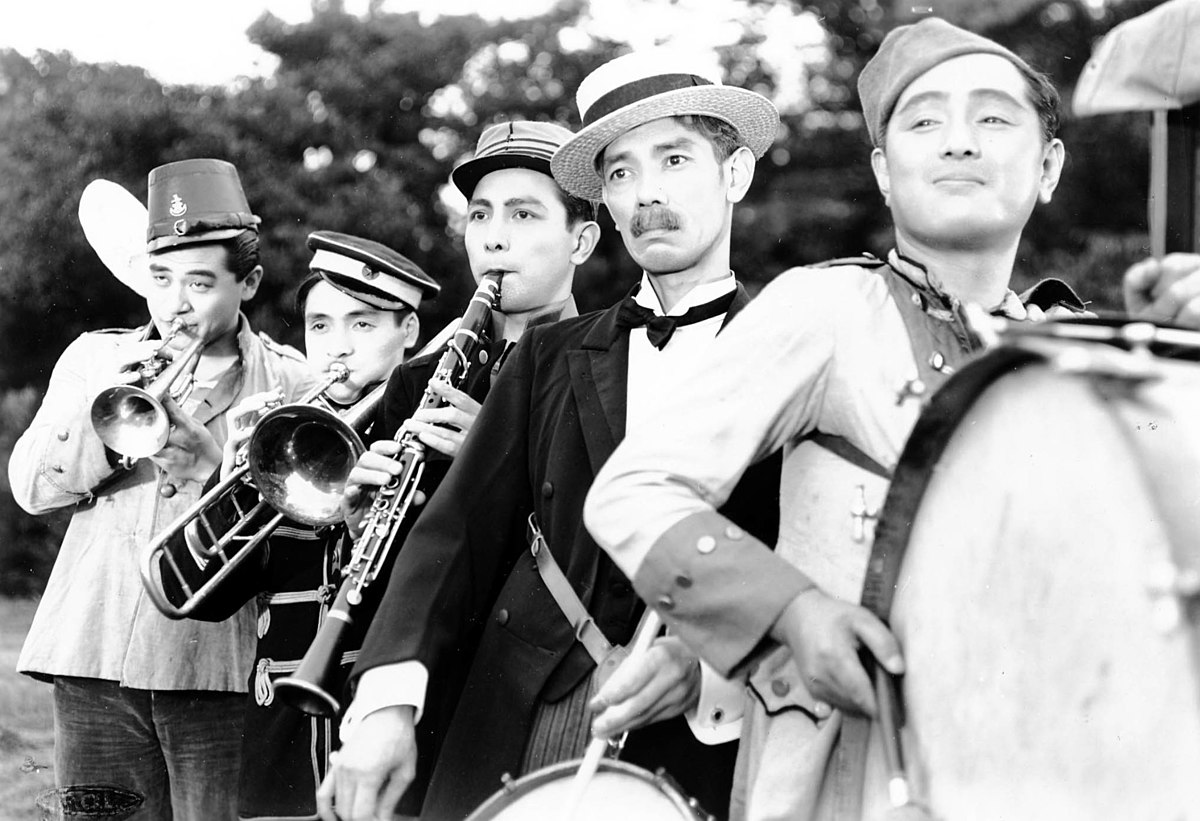
The five men of the title are an itinerant jinta brass band, though to tell the truth not a very good one. They were supposed to be on their way to play at a primary school sports day, only when they get there they’re told the event has been postponed to the following spring. After having wasted the afternoon killing time playing on the monkey bars and children’s slide, they decide to give a little concert anyway, not that anyone’s listening and there’s no real chance of getting paid. It’s in the next town, however, that they make a series of serendipitous meetings connected with a travelling circus which is currently undergoing a crisis as the entire male company has gone on strike against the boss’ tyrannical management style in a subversive dig at rising authoritarianism. 

All things considered, the circus seems to be doing pretty well for itself. It has a sizeable company with several accomplished performers and appears to be drawing good audiences. The boss (Sadao Maruyama) dresses in fancy outfits and there doesn’t seem to be much anxiety over hunger or any sign of the usual worries with which films about itinerant performers are usually concerned, all of which is in direct contrast to the jinta guys whose ragged appearance and habit of pinching yukata from the various inns on their route make plain their relative poverty. “None of us do jinta because we like it” the oldest of the players Seiroku (Ko Mihashi) points out, a woman behind in the bar him echoing that no one becomes a hostess because they like it either. None of these men had a burning desire to be in a band, they simply ended up there and now they can’t get out. Young orphan Kokichi (Heihachiro Okawa), however, dreams of going to Tokyo to study the violin carrying around a record of Western classical music to refresh his soul while worrying that his jinta life is corrupting him.  

Kokichi’s earnestness finds a fan and a mirror in Chiyoko (Masako Tsutsumi), the older daughter of the circus master who claims that she has long since given up hope of a better life even as she continues to dream her small dream of living in an ordinary house with a man she loves. Trapped by filial duty to her cruel father, Chiyoko actively encourages the escape of her younger sister Sumiko (Ryuko Umezono) who is in love with the ringmaster Kunio (Koji Kaga) though their father won’t let them marry. Kunio is also the instigator of the strike which is currently engulfing the circus, placing a strain on Sumiko’s conflicted loyalties as she struggles with her desire to leave the intinerant life behind. 

After the band is taken on as ringers to replace the striking musicians they also find themselves required to perform on stage, with varying degrees of success. Kokichi pleads to be given a chance to perform with a violin, even foregoing his pay as he’s warned the target audience is unlikely to find much to entertain them in a violin recital. His inexpert playing is roundly rejected by the baying mob who quickly begin throwing their rubbish at him until he’s forced to leave the stage in a moment of pure and crushing tragedy. Chiyoko tries to comfort him that she at least enjoyed the performance, but her words fail to cheer him more than superficially. He knows he’ll never go to Tokyo, or be anything more than a jinta player with only false hope to sustain him in the same way that Seiroku realises he’ll never never make peace with his past when he’s slyly conned by a 10-year-old girl he half suspected was the baby he abandoned out of economic desperation following the death of his wife. 

Yet it is in a sense romance that eventually eventually brokers resolution in the eventual implosion of Sumiko’s conflicted desires which cause her to “fall” from the trapeze, a moment of crisis daringly filmed through the use of double exposure superimposing Sumiko’s face over her POV of the men fighting in the ring. This narrowly averted tragedy apparently awakens something in her father who, she tells Kunio, only became cruel when their mother left, forcing him to relent and agree to be nicer to his employees while approving his daughter’s marriage. Yet romance cannot solve everything, and the only other romantic resolution we discover is in the roguish Torakichi (Hiroshi Uruki) who relents and accepts a woman he callously seduced and abandoned but who followed him because of the strength of a woman’s “passion”. Though we can see a connection has arisen between Chiyoko and Kokichi, it is not one which can be fulfilled, fate is pulling them in different directions. Forever a jinta player, he is pulled on to the next gig, the camera pulling back tragically from the bereaved Chiyoko, rooted to the spot as she watches her last hope walk away from her. “Life is a journey” she offers as a note of grim resignation, while knowing she’s going nowhere at all.


A Woman’s Sorrows (女人哀愁, Mikio Naruse, 1937)

Arriving perhaps in a moment preceding a major change, Mikio Naruse’s A Woman’s Sorrows (女人哀愁, Nyonin Aishu) finds itself on one side of a divide in which it is, paradoxically, a woman’s conservatism that is thought a barrier to her marriage. As usual slightly ahead of his times, Naruse doesn’t so much attack the idea of marriage either arranged or love, but subtly arcs out the patriarchal cage the bars of which only become visible to his conflicted heroine after she has wilfully allowed herself to be locked inside. 

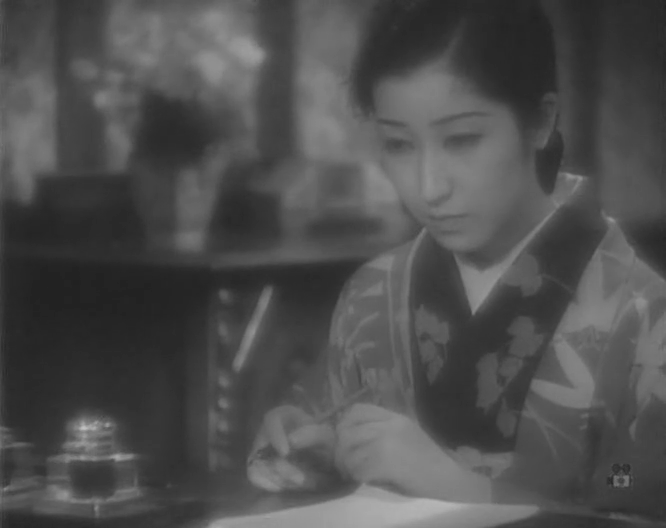
Opening on location, a thriving Tokyo street scene, Naruse introduces us to the “conservative and indecisive” heroine Hiroko (Takako Irie) at her part-time job at a record store. We learn that Hiroko has recently been to an omiai marriage meeting, and that at least according to her friend she has been harbouring a longterm crush on her sensitive, progressive cousin Ryosuke. Hiroko denies having feelings for her cousin claiming that she thinks of him as a brother and that he dislikes her for being too “conservative”. One might think that a truly conservative woman wouldn’t be working in something as modern as selling records, but Hiroko is indeed a kimono-wearing holdout who has almost fully internalised the properness of the patriarchal order. Her indecisiveness, however, perhaps tells us that she isn’t quite as comfortable with it as she seems and is in a sense forcing herself to accept something she thinks she has no power to resist. 

It is also true that Hiroko’s family is poor. Despite confiding to Ryosuke that her husband gave her trouble, failing in one sense at least by dying and leaving his family with debts, Hiroko’s mother is keen that she marry and marry well. Her prospective match Shinichi is from a well to do family and has also offered to pay for the education of Hiroko’s younger brother Masao, so the marriage is undoubtedly financially advantageous if not immediately essential. “Since I cannot marry someone I love, anyone will do” Hiroko silently sighs, resigning herself to a conservative vision of a woman’s life. For his part, Ryosuke rejects Hiroko because he believes her conservatism runs so deep as to lead her to reject love as improper, that love would in fact be a barrier to her marriage which she would feel duty-bound to refuse. 

Hiroko feels that the match is in a sense too good for her, much better than she had a right to expect. Nevertheless, it’s her seeming conservatism that presents a potential problem in that it is assumed that despite working in a record shop she wouldn’t know how to dance in the modern fashion. Far from censorious, Hiroko’s mother is worried that the young girls these days all go to “dance halls” while Hiroko is quiet and demure. As it happens, Hiroko knows how to dance, though perhaps they should have been thinking about the problem from the other side in that men who like going to dance halls don’t necessarily like to go with their wives, and those looking for “conservative” women often do so because they want to lead “modern” lives outside the home. Having agreed to the marriage, Hiroko finds herself an outsider, treated as unwaged maid by her new in-laws who all exclaim how glad they are to have someone so reliable as their new daughter-in-law especially as they’ve recently disowned oldest daughter Yoko (Ranko Sawa) for running off with her lower class fiancé. 

As so often in Naruse’s cinema, modern girl Yoko acts as a mirror for the outwardly conservative Hiroko. Yoko determines to marry for love, but is actually far more conservative than she seems in that she is entirely unwilling to surrender her comfortable middle class life and continues to resent the man she married, Masuda, because he cannot keep her in the manner to which she had become accustomed. Shinichi had warned Yoko about “frivolous” men, an ironic comment seeing as we’d just heard him dismiss a woman he’d been seeing as “just a girlfriend” laying bare his rather misogynistic view of women as a means of passing time, but Masuda is the very opposite of frivolous, serious in his intentions even while Yoko rejects him solely because of his lack of socioeconomic status. Yet like Hiroko Yoko is perhaps herself also conflicted, forcing herself to reject Masuda whom she loves out of a mistaken pride that tells her it would be wrong to suffer for love when she could have done as Hiroko did and married well for a comfortable but emotionally unfulfilling life. 

Unhappy in her marriage, Hiroko claims that she could have put up with being treated as a maid but can’t stand being treated as a doll, believing herself mere decoration in Shinichi’s life. Nevertheless she continues to believe it’s her duty to “manage” as good wife, bearing her sorrow and loneliness gracefully until pushed into a moment of crisis by Yoko’s rather melodramatic love life. Overhearing the family declining to invite her to join their game of mahjong on the grounds she’s too conservative and is perfectly happy with her life of drudgery, Hiroko is stirred by Yoko’s assertion that she’d never be so “submissive” despite the fact that’s exactly what she’s been in leaving Masuda to return to her upper middle class life with the Hories who are not perhaps as grand as they seem with only the one maid and Mrs. Horie’s constant penny pinching. 

Yet the subversive conclusion isn’t so much that Hiroko begins to realise she has choices and agency after all along with the right to leave a marriage that isn’t working, but that she, temporarily at least, rejects marriage itself in favour of independence while Yoko chooses love in defying her family to return to Masuda who, by then, has done something quite foolish in a mistaken attempt to prove himself worthy of her. Rather than leaving Shinichi for Ryosuke, she tells him that she needs time to figure herself out, to “reconstruct my life by myself”, vowing to find out what is the most beautiful thing in the world so that she can see something more important in herself. It’s a startlingly progressive statement for the Japan of 1937 which is edging closer towards a kind of darkness despite the otherwise cheerfully internationalist atmosphere with its Western jazz music and record shops, dance halls, department stores, trains, and telephones, the contradictions of the age symbolised in the Horie’s awkward home with its mix of Western and Japanese furnishings. It turns out, Hiroko is the most “modern” woman of all, who ever would have thought?  


Three Sisters with Maiden Hearts (乙女ごころ三人姉妹, Mikio Naruse, 1935)

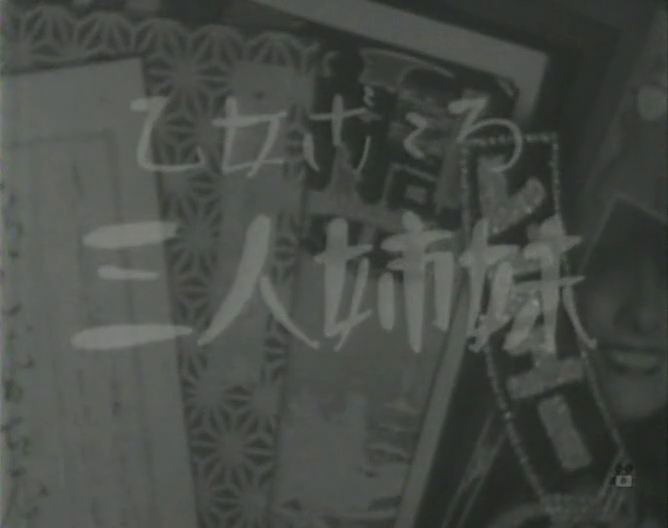
Three sisters with maiden heart title card“From the youngest age, I have thought that the world we live in betrays us” Mikio Naruse is often quoted as saying, and it’s certainly an idea which informs much of his filmmaking. 1935’s Three Sisters with Maiden Hearts (乙女ごころ三人姉妹, Otome-gokoro  Sannin-shimai), adapted from a short story by Yasunari Kawabata, is indeed a tale of the world’s cruelty as its saintly heroine attempts to escape her austere mother’s icy grip through kindness alone but finds her efforts frustrated by the world in which she lives.

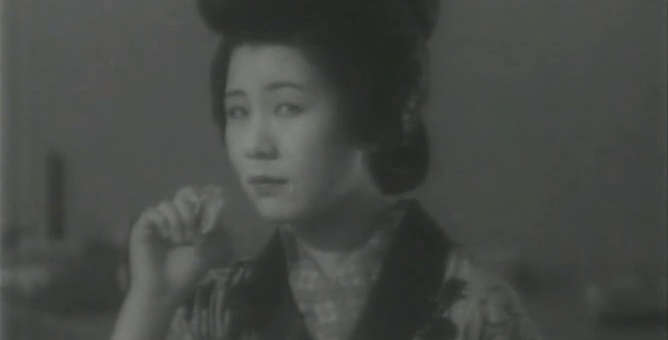
Osome (Masako Tsutsumi) is the middle of three sisters raised by a cold woman (Chitose Hayashi) who forced her daughters to earn their keep by playing the shamisen on the streets of Asakusa. Oldest daughter Oren (Chikako Hosokawa) left the family some time ago after falling in love with a salaryman and hasn’t been heard from since, and while Osome is still expected to ply her trade, youngest daughter Chieko (Ryuko Umezono) has been spared, becoming a “modern girl” currently working as a dancer in a revue. Unbeknownst to her family, Chieko has also got a boyfriend – the handsome and seemingly quite wealthy Aoyama (Heihachiro Okawa) who runs into Osome by chance in the street and offers her a handkerchief to help fix her broken geta. This is not the story of a love triangle, however, so much as cruel fate accidentally bringing the sisters back together through a shared destiny.

While Chieko idly muses that it might have been better if her mother had opted for group suicide (joking with her lover about dying together as was apparently a fad at the time), Osome tearfully asks her to “please accept us as we are” but her pleas largely fall on deaf ears. Having taken in a series of apprentices, Osome’s mother continues to treat them cruelly, berating them for not picking up the shamisen, and insisting on “discipline” when she discovers one of the girls has had the temerity to buy a magazine with some of the money she herself has earned. Osome, in a characteristic act of kindness, insists she bought the magazine as a morale booster only to receive her mother’s scorn. “I put so much effort into raising you, but you still haven’t become people who’ll give an honest day’s work” she complains, commodifying them once again. “You don’t know how much easier it would be to go out and earn money myself”, she adds unconvincingly, telling her daughter she can always leave if she doesn’t like it despite having irritatedly complained about Chieko’s increasingly late return home and the possibility she may leave just like Oren did.

As Osome tells us, she and her sister were forced to play the shamisen in unsavoury Asakusa from only eight years old. As they got older, Osome was worried about the attention Oren seemed to be getting from “rough” men in the streets. Eventually Oren stopped carrying her shamisen at all and fell in with a bad crowd, only escaping when she met her husband Kosugi (Osamu Takizawa). Kosugi, however, is ill with TB and finding it difficult to hold down a job. Increasingly jealous and paranoid, he is afraid Oren will hook up with her old gangster friends and fall back into bad habits. Meanwhile, Osome is still playing her shamisen and putting up with rough treatment from the drunken clientele who sometimes try to manhandle her or make unreasonable requests. An irritated bar owner eventually knocks on a record to drown her out as if signalling her impending obsolesce.

Nevertheless, the older two sisters have largely remained traditional. Oren’s fall into the gangster underworld is signalled by a sighting of her in Western clothes, looking like a well to do young lady as Osome puts it, but once with Kosugi she soon reverts to kimono and fully embraces the role of a conventional housewife supporting her husband with all her strength. Chieko, however, is a “modern girl”, dancing in a nightclub revue and dressing exclusively in Western fashions. Some horrible boys who make a point of singing the rather vulgar song back at the girls through the window yell “modern girl” at her in the street, indicating just how shocking and unconventional her appearance was back in 1935 even in the backstreets of Asakusa. Nevertheless, Chieko appears to have found a satisfying romance with a “modern boy” in Aoyama who dresses in suits and seems to have a bit of money but is undeterred by a possible class difference and just as nice as his potential sister-in-law.

Despite Osome’s attempts to reunite the sisters, fate conspires against her. Oren hooks back up with her lowlife friends who use her in a plot to extort Aoyama while she remains completely unaware that she’s targeting her sister’s young man. Osome tries to tries to stop them but is stabbed by thugs in the process and, figuring out what’s happened, keeps Aoyama and Chieko away from the station where she has arranged to bid Oren goodbye on the last train out of Ueno. Poignantly, Oren seems happy that her sister has found someone nice, saying that she’d have liked to meet him still unaware she already has. The sisters know they likely won’t meet again, and Osome is content only in knowing that in theory at least she has saved the memory of the bond they once shared through preventing Oren’s involvement in the incident with Aoyama from coming to light.

Osome’s kindness is her undoing. Her world betrays her, she is simply too good, too pure-hearted to be able to survive in it. The three sisters struggle to overcome neglectful parenting, but their mother has at least survived if unhappily, suggesting the world is kinder to those whose hearts are colder. Oren and Chieko go their separate ways, into the past (on a train) and the future (by car), but Osome remains stubbornly in the waiting room with only the inevitable awaiting her.