Sunset Sunrise (サンセット・サンライズ, Yoshiyuki Kishi, 2024)

In a way, the 2020 coronavirus pandemic presented a kind of turning point in which it became possible to envision a different kind of future brokered by technological advance in which society was no longer ruled by the dominance of the cities. If people could work remotely from anywhere, then they could easily improve their standard of living by moving to more rural areas for cheaper rents and healthier environments. Assuming the infrastructure was in place to allow them to do so, they could also support and reinvigorate communities struggling with depopulation in which the young have all left for the cities leaving the elderly behind to fend for themselves.

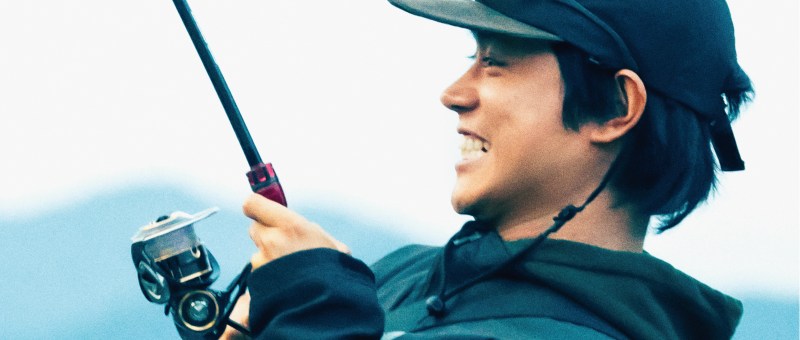
It’s an elegant solution that solves many of the problems of the contemporary society, but change isn’t always as straightforward as it seems as the hero of Yoshiyuki Kishi’s Sunset Sunrise (サンセット・サンライズ) finds out after he jumps at the chance to move into an abandoned house in Tohoku for a fraction of the rent he’d have to pay for a flat in Tokyo if he didn’t still live with his parents. The catch is, however, that houses have souls too and are more than just places to live for those that own or inherit them. Momoka (Mao Inoue), who decides to put her own empty house on the market, has her reasons for not wanting to live there herself nor for selling it completely but renting it out is also emotionally difficult. In the end, she only really does it after being put in charge of the town’s empty house problem at her job working for the council and thinking she should probably start with her own. Not knowing what to charge, it hadn’t really occurred to her someone would be as interested as Shinsaku (Masaki Suda), a fishing enthusiast longing to escape his salaryman life in the city for something a little more traditional in a peaceful rural area. 

Then again, that’s not to say that Shinsaku is a traditionalist and his decision quickly sparks controversy but also attracts the attention of his boss who senses a promising business opportunity. Momoka’s is a slightly special case, but Japan is filled with these so-called “akiya” which might, amid the work from home revolution of the pandemic, now be attractive to young professionals looking for a better environment to start a family. Houses generally start to deteriorate quite quickly when no one lives in them, and it’s true a lot of them need some work doing but it’s an idea that could work out well for everyone. Younger people who can’t find decent living space in the cities would be able to afford larger homes in the country where they would also then be contributing and integrating into the local community to provide support for its elderly residents.

Shinsaku becomes a part of the local community quite quickly and strikes up a friendship with an elderly woman whose children have all moved to Tokyo and rarely visit now that their own children are getting older. They’ve asked her to move to Tokyo with them, but as she points out, it would be the same as them moving back. There’s nothing for her to do there, and she’d have no friends. She’d only feel in the way and that she was getting under her daughter-in-law’s feet. Nevertheless, they fear for her especially as the area is still dealing with the scars of the 2011 earthquake which have left many clinging to a now bygone past. Once Momoka and Shinsaku start working with his boss on the akiya project, they find it hard to convince the inheritors of the houses to agree. Though they won’t live there, they might want to pop back a few times a year just for the memories and somehow can’t bear to part with their childhood or relative’s homes. But Shinsaku points out, it doesn’t necessarily have to be a case of either or and the renovation projects they undertake modernise the houses in a sympathetic way that brings them up to date with modern living yet honours the past even sometimes incorporating some of the previous resident’s furniture and belongings while issuing a caveat that the owners are welcome to visit should they wish to.

Essentially, the idea is a kind of co-existence with the past but also with unresolved trauma such as that presented by the earthquake and the ongoing pandemic. Momoka too is struggling to move on and while a gradual romance seems to arise between herself and Shinsaku, she isn’t sure she can ever let the past go though he makes it clear it’s okay to bring it with her. For his part, despite the initial fears of the early pandemic period and the suspicion of him as an outsider, Shinsaku’s quickly taken in by the community and adapts to a more rural way of life with relative ease though his boss’ big plan is rather undermined by his later insistence that he come back to Tokyo to run the project from the office like a many a contemporary CEO rolling back promises of flexible working environments that make this kind of utopian ideal much harder to materialise. In any case, there’s something quite refreshening in the eventual resolution just to do their own thing, not particularly paying attention to labels or what other people might think, but just doing what makes them happy right now. As an old fisherman’s song says, the sun sets but then it rises again. Scripted by Kankuro Kudo and adapted from a novel by Shuhei Nire, the film has kind of wholesome optimism that is rooted in a sense of continuity but also the potential to start again and make a new life inside the old that is less bound by outdated social norms than brokered by the gentle solidarity between people and a generosity of spirit that allows all to seek happiness in whatever way they choose.


Sunset Sunrise screens in Chicago 22nd March as part of the 19th edition of Asian Pop-Up Cinema.

Trailer (English subtitles)

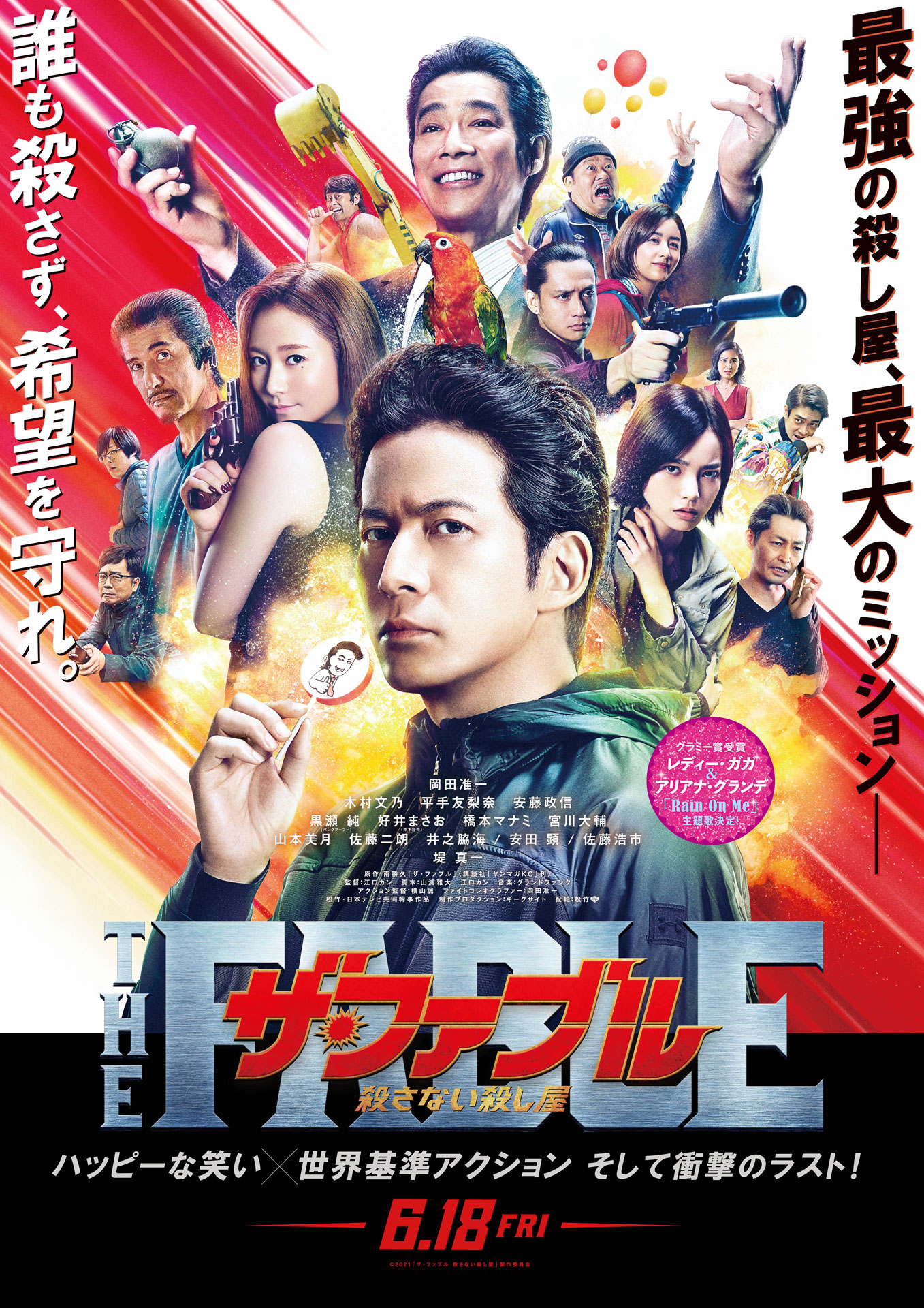
The Fable: A Contract Killer Who Doesn’t Kill (ザ・ファブル 殺さない殺し屋, Kan Eguchi, 2021)

Appearances can be deceptive. A case could be made that everyone is in a sense living undercover, pretending to be something they’re not in order to survive in a conformist society and most do indeed have their secrets even if they’re relatively benign. Others, meanwhile, are on a kind of sabbatical from a life of meticulous violence such as the hero of Kan Eguchi’s sequel to smash hit action comedy The Fable, The Fable: A Contract Killer Who Doesn’t Kill (ザ・ファブル 殺さない殺し屋, The Fable: Korosanai Koroshiya) or like his antagonist living a double life with his apparently genuine concern for the lives of disabled and disadvantaged children balanced by his business of targeting wayward youngsters for the purposes of extortion. 

Some months on from the previous action, “Sato” (Junichi Okada), formerly a top Tokyo assassin known as The Fable, is successfully maintaining his cover hiding out in Osaka as an “ordinary” person with a part-time job in a print and design shop. His cover is almost blown, however, when his colleague Etsuji (Masao Yoshii) is targeted by Utsubo (Shinichi Tsutsumi), ostensibly the leader of a local organisation advocating for the rights of children but also a shady gangster who finances his “philanthropy” by extorting the parents of young people who’ve in someway gone off the rails. Etsuji’s crime is, as was exposed in the previous film, his spy cam habit and in particular his planting of hidden cameras in the home of colleague Misaki (Mizuki Yamamoto) with whom he has an unhealthy obsession stemming from her time as an aspiring idol star. Blaming Misaki for his misfortune, Etsuji turns to violence but is shut down by Sato who risks blowing his cover in order to protect her. Realising he has a previous connection with Utsubo, Sato makes the gang an offer they can’t refuse in order to get Etsuji back but quickly finds himself drawn into another deadly battle with bad guys endangering his still in progress no kill mission. 

Focussed this time much more on action than the fish out of water comedy of Sato’s attempts learn the rules of polite society having been raised in the mountains as a super efficient killing machine, The Fable 2 nevertheless wastes no time in exposing the murkiness of the “normal” world Sato is intended to inhabit. Utsubo is a hit with the local mothers, taken with his smart suit and professionalism as he gives “inspirational” speeches about park safety while making time to converse in sign language with a deaf little girl explaining to another mother that it’s important to “listen to every voice”. As part of his patter he implies his assistant, Hinako (Yurina Hirate), who uses a wheelchair, was injured in a freak park-related accident as a child when in reality she sustained the injury while trapped in the back of a car which veered off a roof after The Fable took out its driver. Vaguely recognising her in the local park, Sato takes an interest out of guilt as the young woman attempts to rebuild her strength in the hope of walking again though that might in itself be contrary to Utsubo’s desires. 

As in the first film, Sato may be a ruthlessly efficient killing machine but at heart he’s still childishly innocent, hoping to help the young woman he unwittingly hurt but also keen not interfere with her ability to help herself. Misunderstanding the situation, Hinako asks Utsubo to lay off Sato, explaining that he gives her confidence as she begins to realise that she can stand alone, as the sometimes uncomfortably ablest metaphor would have it, and no longer needs to be complicit in Utsubo’s nefarious schemes nor need she continue to punish herself in guilt over her traumatic past. While Sato and his handler Yoko (Fumino Kimura) pose as a pair of siblings watched over by their benevolent if absent boss (Koichi Sato), Hinako and underling Suzuki (Masanobu Ando) similarly pose as brother and sister only with the comparatively dubious guidance of Utsubo who affects kindness and generosity while burying problematic youngsters alive in the forest in order to extort money from their “protective” parents. “It’s always the villain who tells the truth” Utsubo explains, insisting that it’s shame and humiliation which build self-esteem in direct contrast to the gently invisible support which seems to have re-activated Hinako’s desire for life.

Sato has at least discovered the benefits of a well functioning and supportive “family” network thanks to the, as we discover, equally handy Yoko, and his still largely oblivious workplace friends. Amping up the action value, Eguchi careers from set piece to set piece culminating in a high octane chase through an apartment block and its eventually unstable scaffolding while making space for slapstick comedy such as two guys trying to move a piano at a very inconvenient moment. A gently wholesome tale of a pure-hearted hitman kicking back against societal hypocrisy while figuring out how to be “normal” in a confusing society, The Fable 2 more than builds on the promise of its predecessor while allowing its hero the space to grow as he begins to adjust to his new and very “ordinary” life.


The Fable: A Contract Killer Who Doesn’t Kill screens on July 7 as part of this year’s Neuchâtel International Fantastic Film Festival (NIFFF)

Original trailer (English subtitles)

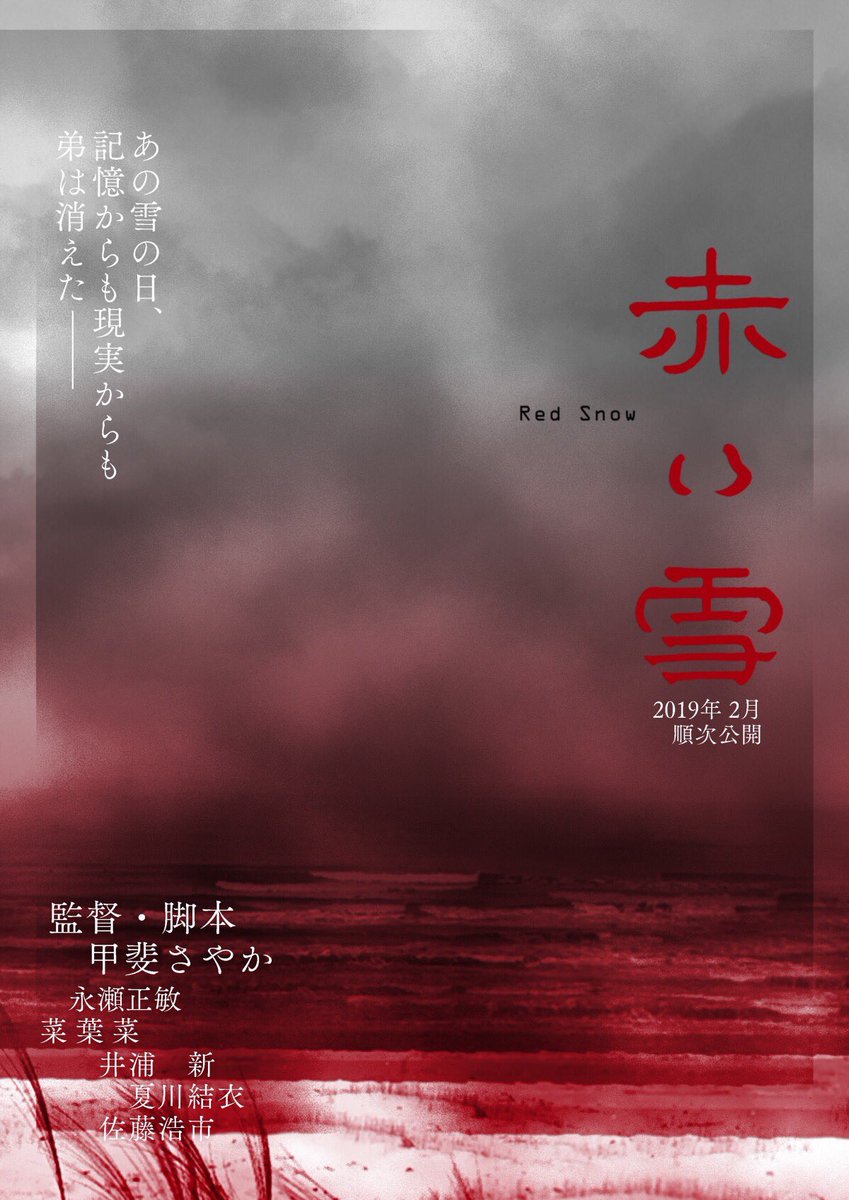
Red Snow (赤い雪, Sayaka Kai, 2019)

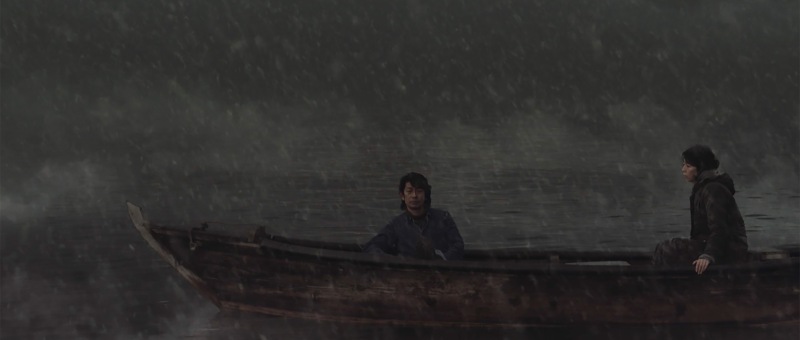
Red Snow poster 2“We’re just pieces of a puzzle” a temporarily deranged woman exclaims to a gloomy seeker after truth in Sayaka Kai’s eerie debut Red Snow (赤い雪, Akai Yuki). Truth, as it turns out is an elusive concept for these variously troubled souls trapped in a purgatorial tailspin on their gloomy island home. When a stranger comes to town intent on unearthing the long buried past, he stirs up deeply repressed emotion and barely concealed anger but finds himself floundering in the maddening snows of a possibly imaginary coastal village. 

30 years previously, a young boy, Takumi, went missing on the way to a friend’s house accompanied by his brother Kazuki who claims he simply disappeared from view in the heavy snow. Sometime later, a child’s remains were found in a burned out building. The prime suspect was a strange woman with a young daughter who escaped the fire in the middle of the night in a suspiciously elegant outfit. Nevertheless, the woman was later exonerated and the truth behind Takumi’s disappearance remained shrouded in mystery.

In the present day, a reporter, Kodachi (Arata Iura), arrives in town with the intention of writing some kind of exposé on the case. He interviews the detective involved and makes contact with Kazuki (Masatoshi Nagase), now a broken middle-aged man who has dedicated his life to perfecting the art of lacquerware. A secondary lead takes him to Sayuri (Nahana) – the daughter of the prime suspect now, in a tragic piece of circularity, an outcast herself and possibly a sex worker in a violent relationship with an older man (Koichi Sato) who may or may not be her pimp.

Each of them has tried to move on from the unresolved tragedy of Takumi’s disappearance, but all appear to have failed. Kazuki dreams of the day his brother vanished right in front of his eyes, seeing a little red jumper lost in the snow but unable to remember anything more. He fears he will never know what happened unless his memory somehow returns, though as his mentor tells him what actually happened and the way you remember it are often different. Waxing philosophical, Kodachi muses that memory is what links the past and future but memory, and therefore life itself, is ambiguous. The “truth” may be unknowable and known at the same time to those who refuse to confront its various contradictions. 

Like the young Sayuri watching through a tiny crack in the wardrobe door where her abusive mother has placed her out of the way of all her “fun”, nobody sees the whole of anything. The young Sayuri morphs into the adult Sayuri and into her mother whom she fears she has become. The only witness to the incident, Sayuri refuses to speak of it though perhaps there’s more kindness in her silence than it first seems even if her unwillingness to remember may also be a kind of self preservation. She too is a victim, but is blamed all the same despite being only a small child powerless to intervene or be held complicit in whatever it is her mother might have done or not done in her quest for survival.

Sayuri remains trapped within the orbit of her now absent mother, herself an outcast in another abusive relationship this time with a sociopathic old man, while Kazuki struggles to accommodate his sense of guilt for something he can’t quite remember. Emotions briefly bubble to the surface, petty resentments and jealousies that pass between all small children but might perhaps have had terrible consequences one snowy night. Sayuri may be right when she insists that they are pieces of a puzzle, each holding tiny fragments of truth that might be assembled into a coherent whole, but also aware that if they did so they may not like the picture that they see.

Eerie and ethereal, the snowy coastal town almost may not exist at all haunted as it is by traumatised souls trapped in a purgatorial cycle of guilt and confusion as they try to piece together the past. Sayaka Kai’s dreamlike, poetic debut is a visually impressive existential mystery in which past and present intertwine leaving our troubled heroes lost in a fog of falling snow unable to access the future through the corrupted pathways of memory.


Red Snow was screened as part of Japan Cuts 2019.

Original trailer (English subtitles)