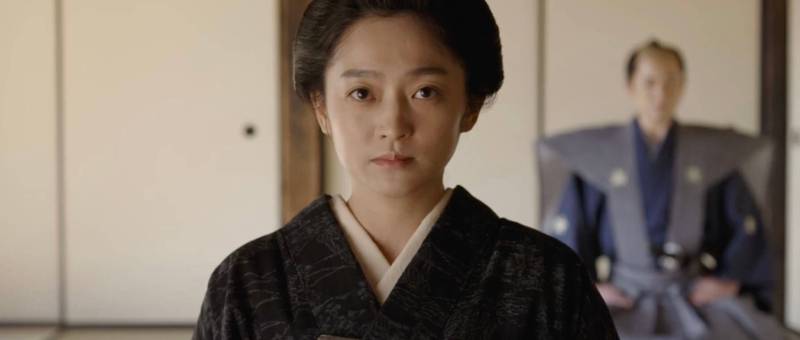

What’s more absurd, that the shogun orders a man to take his own life in atonement for accidentally damaging his favourite bow or that the samurai actually does it without protest? There is something a little uncomfortable about Yuji Kakizaki’s Seppuku: The Sun Goes Down (陽が落ちる, Yo ga Ochiru) as it, unlike many similarly themed samurai dramas, seems to find only nobility in such a senseless death rather than outrage against a word in which a man must die for a careless and inconsequential mistake.
Indeed, the worst outcome Kyuzo envisages is that he’s going to get the sack from his job as a castle guard and his family will suffer both a reputational loss and financial hardship because of it. His wife, Yoshino, is quite prepared for the latter, stating only that they will soon adjust to living more simply. No one seems to be thinking that this is anything other than a minor incident that will soon blow over, which is why it comes as such a shock to Kyuzo’s best friend Denbei that his friend has been ordered to commit seppuku and that he must be the man to deliver the message the next morning. Kyuzo is currently under house arrest, which means that were Denbei to visit him before that, he too would be committing an offence and could end up suffering the same fate. The best thing he can do, as his wife advises, is to go there and sing a song outside conveying the difficult news through poetry while maintaining plausible deniability.
Alternate forms of communication become a kind of theme with Yoshino deciding to fulfil the dreams of her loyal maid, Shige, by teaching her to read and write explaining that one may say in a letter that which they otherwise could not. Shige is from a peasant farming family and on her return to them after Yoshino decides to dismiss her so that she won’t be caught up in it when they deliver her husband’s death warrant which could, in fact, order everyone in the house to die, Shige’s family remark that they can’t understand these “cruel” samurai who are expected to surrender their lives over something so trivial. Yet Shige’s father who is currently bedridden with illness instructs her to go back knowing that it may mean her death because her duty is serve the family she was indebted to right until the very end. Shige even gives her father the comb and money Yoshino had given her to open a restaurant to pay for medical treatment but he won’t take it until she’s fulfilled her duty which rather undercuts any criticism of the samurai code.
Similarly, Yoshino struggles with the decision of whether to live on or take her own life alongside her husband. Her options are now few. She must either return to her birth family, if they agree to take her, or become a Buddhist nun, while their 10-year-old son Komanosuke would ordinarily be sent to his father’s relatives or placed into a temple as a monk. Denbei and his wife’s offer to adopt Komanosuke in the absence of an heir to their clan provides a neat solution, but leaves Yoshino’s fate in the balance now separated from both her son and husband. Only at the very end in her empty house does her resolve break as she cries out against the injustice and absurdity of it all.
Kyuzo, meanwhile, is expected to make his peace with his death having been given prior warning by Denbei and allowed to enjoy one last night with his family. He says that what he fears is “nothingness”, but as Yoshino tells him even if he were to reject his fate by running away he would endure a life of fear and misery on the run before he was caught and executed as a coward and a traitor. Yet what the film finds in his stoicism that takes on an uncomfortably elegiac quality that he is basically doing the right thing by submitting himself to the samurai code as cruel and arbitrary as it might seem to be with its overly enthusiastic magistrate who seems to relish the prospect of seeing Kyzuo’s head on a tray. He first gives Denbei the opportunity to leave out of consideration of their friendship knowing that he cannot accept the offer without incriminating himself, and then insists he be Kyuzo’s second as if to double down on the sadistic cruelty of ending a man’s life to demonstrate a capricious shogun’s power. Dramatising the submission of these people who seem to be good and kind yet caught in this absurd web of honour and power with sadness rather than anger leaves a slightly sour taste in the mouth in its implication that obedience to such an absurd social code constitutes nobility rather than foolishness and that the situation is merely a misfortune that must be quietly endured rather than an outrageous injustice that no one should defend.
Seppuku: The Sun Goes Down screened as part of this year’s Toronto Japanese Film Festival.
 Windows on Worlds