
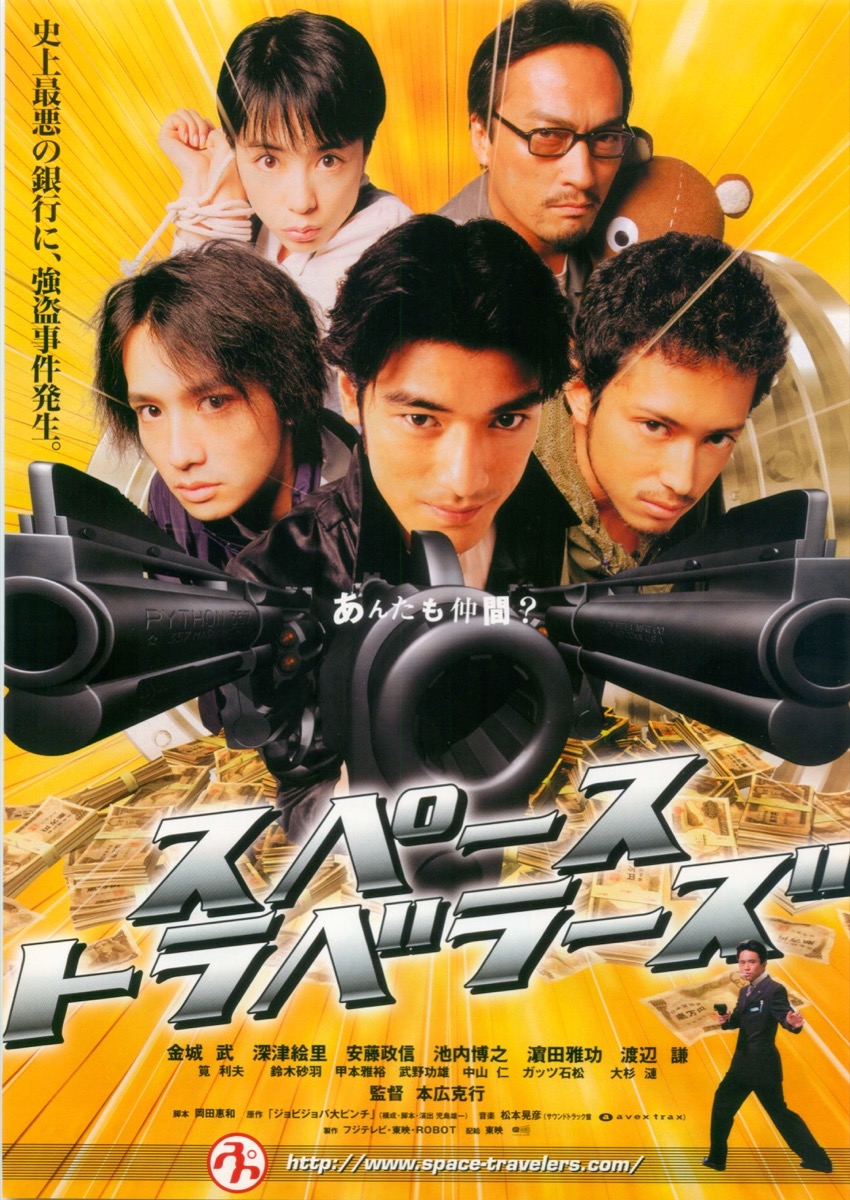
“What are you doing now?” asks a very zeitgeisty set of onscreen titles at the beginning of Katsuyuki Motohiro’s millennial heist comedy, Space Travelers (スペーストラベラーズ). Both hopeful and not, Motoyuki’s cosmic farce takes the sense of anxiety and despair which colour other similarly themed turn of the century movies and turns them into a source of possibility while simultaneously implying that for some paradise may always be out of reach or else relegated to a state of mind. After all, “reality is different from animation”.
The idea of a far off paradise is what drives a trio of orphans (Takeshi Kaneshiro, Masanobu Ando, and Hiroyuki Ikeuchi) to consider armed robbery, planning the slick kind of heist they’ve seen in the movies in which they run into off into the sunset with a bag full of cash after holding a bank to ransom. Of course, it doesn’t quite go to plan leaving the three essentially good-hearted guys with a problem because they weren’t really prepared to harm anyone (two of their three weapons are duds) and they don’t have a plan B. What happens then is somewhat unexpected as a degree of camaraderie begins to arise between the would-be-thieves and the small number of customers and employees trapped in the foyer who then become something of an artificial team trying to overcome the rapidly escalating situation as the police surround the building in the incorrect assumption that the robbery is connected to terrorist action.
What soon becomes apparent is that for the trio the heist is part wish fulfilment fantasy and a last ditch attempt to catapult themselves out of a sense of impossible despair. As they are all orphans, they feel a deeper sense of disconnection from a society which has in itself abandoned them, partly as it turns out hoping to find their long-lost parents in a tropical island paradise known to them only from a faded postcard. For the customers and employees, the robbery is the most exciting thing to happen to them in their entire lives and the proximity to mortal danger soon forces them to wrestle with their personal dissatisfaction. Before the heist took place, bank clerk Midori (Eri Fukatsu) had been planning to attend a party to celebrate her engagement to another employee branded a sleazy creep by most of the other female members of staff with whom he had apparently tried it on on previous occasions. She had agreed to marry him despite her reservations because he had sworn to lay down his life for her if she were ever in danger only to spot him trying to escape on his own via the air conditioning ducts. Being caught up in this bizarre situation forces her to accept she had been leading a “conveyor belt life” out of fear, always picking the safe option rather than take a risk chasing personal happiness even picking a husband solely because he promised her protection.
In the Japan of the 2000s, chasing personal happiness might have seemed like a fools errand trapped in a stagnant economy with no prospect of improvement and only increased risk if you fall from one particular rung on the ladder. Yet the conclusion Midori seems to come to is that the only way of rebelling against this sense of nihilistic frustration is to take the risk and look for the paradise that is waiting for her rather than settle for a disappointing status quo. She learns this partly through her connection with one of the bank robbers who casts each of the hostages as members of his favourite, now cancelled, anime “Space Travelers” created according to an onscreen interview to offer a sense of something tangible to an increasingly disconnected youth that would allow them to experience a full range of emotions (the animated sequences created for the film were later spun off into an OVA of their own). Through their accidental role playing, the hostages each discover the sides of themselves they’d been missing to claim their true identities, Midori learning that she can protect herself, nerdy clerk Shimizu (Masahiro Komoto) overcoming his crippling shyness, a middle-aged electrician flummoxed by modern technology proving that his skills aren’t obsolete, and a feuding couple on the brink of divorce reflecting that they actually do work well as a team.
Even so, not everyone comes out of the situation with new hope for the future with the implication being that some gambles are simply too big or that for some paradise will always lie just out of reach even if Midori remains committed to seeking it out on her own whether she eventually finds it or not. Meanwhile, Motohiro takes potshots at the media reality of the day as a cynical boyband publicity stunt to announce their breakup tour to rake in more cash before announcing a comeback is derailed by the press tripping over themselves to get to the unfolding bank hostage crisis with the police also doing their bit to hog the media spotlight while mistakenly believing a suspicious-looking man who actually is a fugitive terrorist is responsible for the heist. With the world as messed up as it clearly is, the film seems to say, chasing paradise is the least risky thing of all.
Trailers (no subtitles)
 The family drama is a mainstay of Japanese cinema, true, but, it’s a far wider genre than might be assumed. The rays fracture out from Ozu through to
  Windows on Worlds