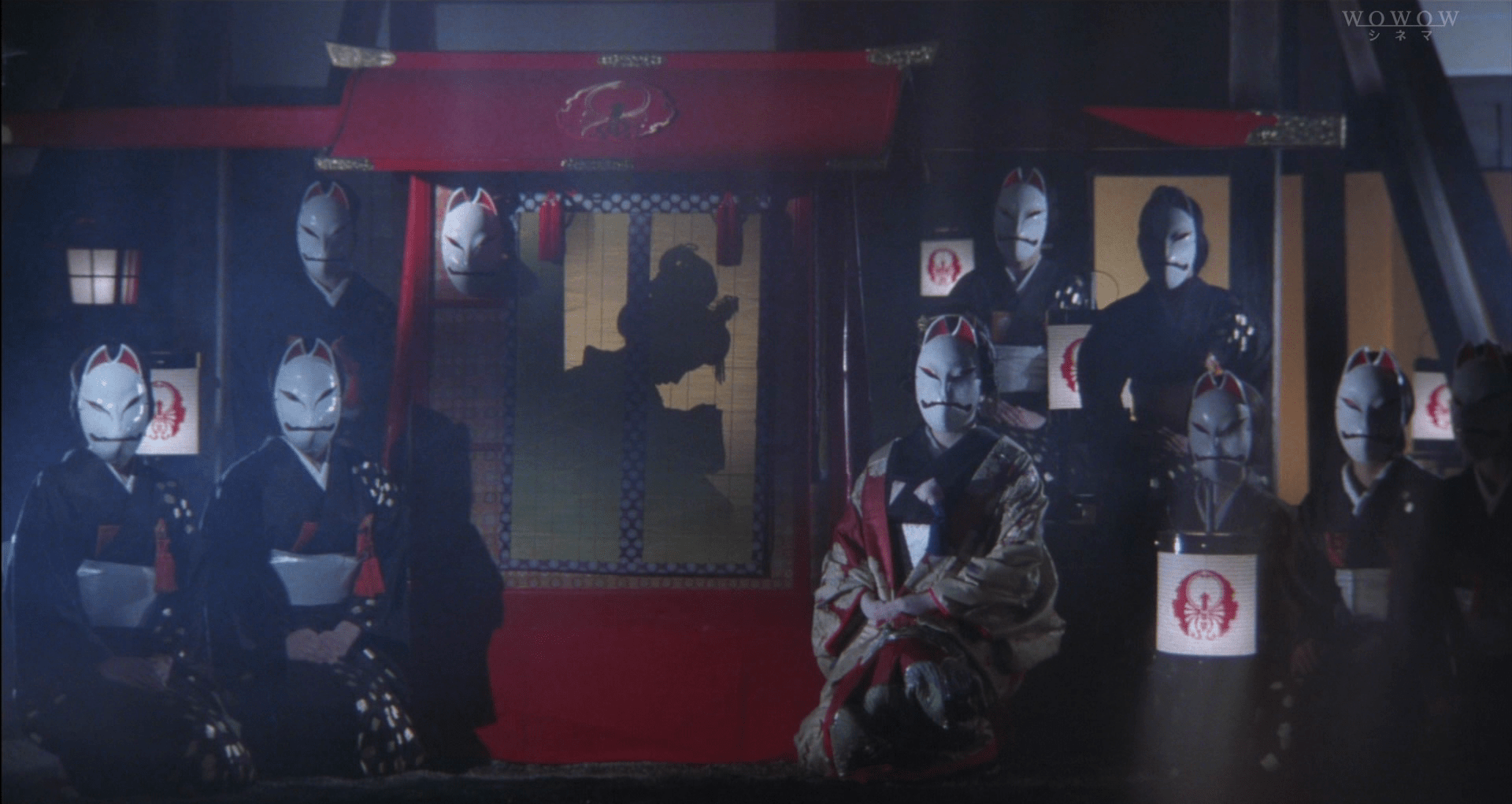
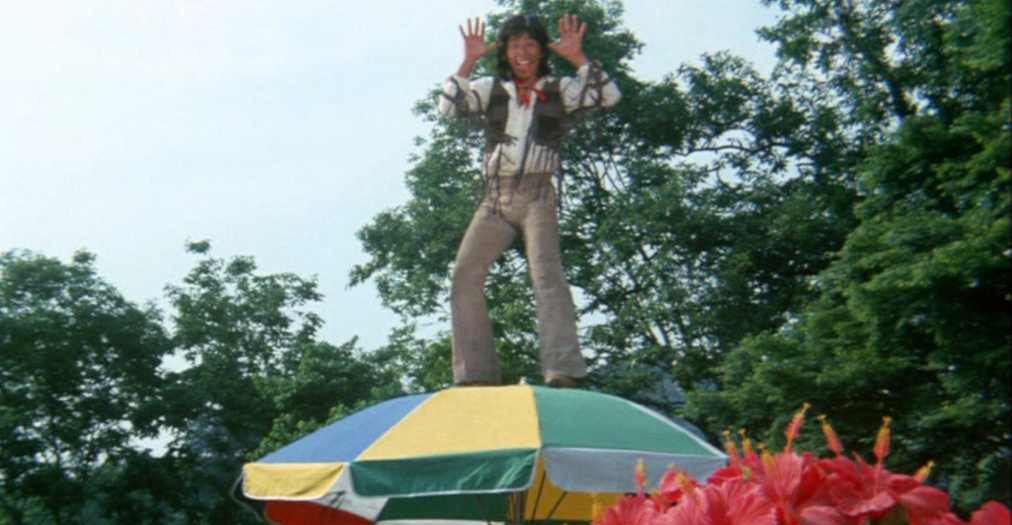
Roaring Fire (吼えろ鉄拳, Norifumi Suzuki, 1981)

If Chiba’s karate films and the Sister Streetfighter series had been influenced by Shaw Brother’s kung fu films, Roaring Fire (吼えろ鉄拳, Hoero Tekken) is an homage to contemporary action and in some senses anticipates Jackie Chan and heroic bloodshed though in other ways harking back to the classic serial with its diamond-themed MacGuffin. A vehicle for rising action star Hiroyuki Sanada, the film reflects a new internationalist Japan but also confronts the toxic legacy of the feudal past in the fall of a once noble house.

Joji (Hiroyuki Sanada) has spent his entire life on a ranch in Texas only to discover from a deathbed confession by the man that he thought was his father that he had been kidnapped as an infant and is actually the son of the wealthy Hinohara family. But on travelling there, he immediately finds himself in the middle of a conspiracy. His twin brother Toru has gone missing after going to London to study ophthalmology in order to cure his sister Chihiro’s (Etsuko Shihomi) eye condition. Though his uncle, Ikki (Mikio Narita), welcomes him with open arms, a weird ventriloquist act by a man called Mr. Magic (Shinichi Chiba) that he’s taken to see suggests that the plane crash his parents died in may not have been an accident and his uncle killed them to take over the family business. 

Ikki is mixed up in the drugs trade with Hong Kong Triads and in keeping with Suzuki’s other films, we once again have a new solution to smuggling in hiding drugs in underripe banana skins. Lured to Ikki’s underground lair which has a large photo of Hitler on the wall and other Nazi memorabilia scattered around, Joji is given the “join us or die” speech, but ultimately manages to escape with some help from Abdullah the Butcher who is working as some kind of bodyguard but apparently takes a liking to Joji and declares they will be the best of friends forever after their initial fight. In any case, we soon realise that Ikki’s purpose in life is feudal revenge in that his mother was a geisha who died young because of her poverty and the nature of her work while staring at the Hinohiras’ giant mansion though his father apparently took no responsibility for him until after his mother died. His only goal in life is to take over the estate and otherwise destroy the rest of the family that never fully accepted him. 

Of course, Joji is in his way, but Joji doesn’t really want this legacy either and only wants to save his sister who turns out to be a kung fu ace despite her blindness but is otherwise unable to escape. In his final confrontation with Ikki, he reclaims the name of the man who raised him, Hibiki, and rejects that of Hinohara as if symbolically refusing his feudal inheritance. Mr Magic, really an Interpol agent, makes an executive decision to let him go which is also a representative authority figure setting him, and the younger generation, free from the feudal legacy to live a more international life. 

Nevertheless, Suzuki fills the film with a series of high-impact action sequences and extreme stunt work such as a crazy bus chase through Hong Kong which predates that in Police Story by a few years. The shuttles back and forth between Hong Kong and Japan, but it’s clear here that Ikki and his weird Nazi cohorts are the villains rather than the Hong Kong gangsters who really just exist and otherwise only factor into the story because of their desire for Queen of Sheba diamond that Joji’s birth father hid before he died so Ikki wouldn’t get his hands on it. A possibly poor taste allusion to the holocaust aside, Suzuki sticks to the plucky teen adventure format in which Joji gets into fights with the local guys and is quickly befriended by Chihiro’s teenage friends who all hang out at the mansion, rather than opt for a gloomy sense of paranoia and conspiracy even as Joji finds himself at the centre of a Hamlet-esque plot in which his uncle has usurped the throne and he must return to set it right. Yet rather than restoring the existing order, Joji effectively resets it by ending the family’s influence and then moving on into a freer existence shorn of filial responsibilities. 


Trailer (no subtitles)
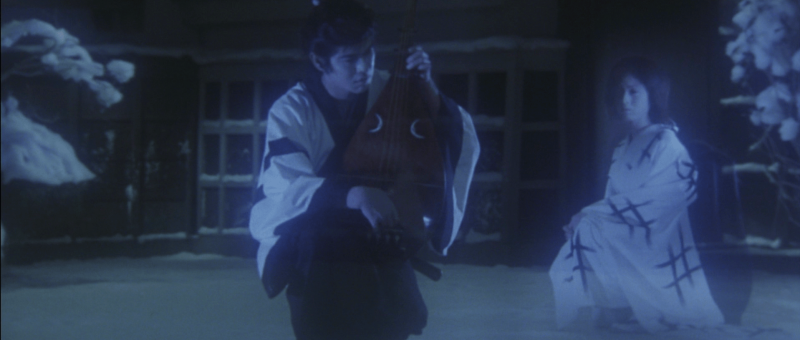
Crest of Betrayal (忠臣蔵外伝 四谷怪談, Kinji Fukasaku, 1994)

“I was trying to reform our times!” cries a man about to abandon his revolution at the moment of its inception. “The times have reformed us” his friend retorts, rejecting him for his self-interested cowardice before seconds later deciding to follow his example. Largely remembered for his contemporary jitsuroku gangster pictures, Kinji Fukasaku’s tale of rising individualism amid political turbulence and economic instability Crest of Betrayal (忠臣蔵外伝 四谷怪談, Chushingura Gaiden: Yotsuya Kaidan) hints at a perceived moral collapse in contemporary post-Bubble Japan defined by a sense of nihilistic impossibility in marrying the classic ghost story Yotsuya Kaidan with the noble tragedy of the 47 Ronin. 

The action opens the very concrete date of 14th March 1702 which as an early title card reminds us is at the close of the Genroku era which had been regarded as a “golden age” but its appearance of affluence had in fact been semi-engineered by the shogunate’s unwise decision to continue debasing the currency which later led to an inflation crisis (sounding familiar?). Meanwhile, in the samurai world Tsunayoshi, the fifth Tokugawa shogun, has deposed 38 Daimyo creating 40,000 masterless samurai each vying either for new positions as retainers in other clans or some other way to survive in a manner which befits their station. 

The 14th March, 1702 is a significant date in terms of the narrative in that it marks the first anniversary of the death of Lord Asano who was ordered to commit seppuku after offending another lord, Kira Kozuke-no-Suke Yoshinaka (Takahiro Tamura), leaving his house ruined and his retainers masterless. Samurai code dictates they seek revenge, but leader Oishi (Masahiko Tsugawa) suggests they bide their time leaving him and the clan open to accusations of cowardice or betrayal, mocked by peasants at the memorial service while Oishi decries their appetite for samurai drama. Enter Iemon Tamiya (Koichi Sato), antihero of the classic Yotsuya Kaidan, who had apparently joined the clan only two months before it was dissolved after years as a wandering ronin biwa player and alone has the courage to ask him if he truly has no appetite for vengeance moments after Oishi has scandalised his men by pointing out that it was Asano’s “short-temperedness” which destroyed their clan. His only answer is that it cannot be now, they must wait a year in order to prove their internal resolve. 

In marrying the two classic tales, Fukasaku directly contrasts the sublimation of the individual self into the samurai code as in the internecine nobility of the 47 ronin avenging the death of their lord knowing their own must shortly follow, and the self-serving individualism of (in this case) conflicted opportunist Iemon. Iemon has indeed been reformed by his times, becoming a thieving murderer out of desperation and misplaced filial piety after he and his father were forced into a life as itinerant biwa players on the dissolution of their clan. In most versions of the classic tale, Iemon is an ambitious sociopath who tricks his way into marrying up but loses interest in new wife Oiwa after she bears his child, later doing them both in to marry the daughter of a wealthy merchant who took a liking to him in a market square. Here, Oume (Keiko Oginome) is taken with him after he hacks the sword-bearing hand off an aggressor but unbeknownst to Iemon her father is a retainer of his sworn enemy leaving him with a double conflict, while Oiwa is a lowly bath house sex worker pregnant with a child he does not truly believe is his. 

The radical samurai had wanted to “reform our corrupt times”, but Iemon like his friend who drops out of the movement after being taken on as a successor to a hatamoto and becoming a direct retainer to the shogunate, comes to the conclusion that the times cannot be reformed and he must conform to them. If he chooses Oume, he betrays his loyalty to his lord by uniting with his rival to further his own prospects, a decision many will understand it is perhaps little more than leaving one firm for a better job at another, but it’s also an unforgivable subversion of the samurai code which drives him deeper even than the class conflict which sometimes informs his choices in Yotsuya Kaidan into a hellish spiral of greed and immorality. “The world hates your type” Oishi reminds him, “they’ll kill you, like a snake. Can you live fighting with the world for the rest of your life?” He asks, pitying Iemon for his self-destructive decision to turn away from “justice” for personal gain knowing that he will never reconcile himself to his choices nor will the world approve them. 

Yet as in Yotsuya Kaidan it’s not so much his latent sense of guilt that does for him as Oiwa’s curse, her ghost with its face ruined by his transgression taking its otherworldly revenge though interestingly only indirectly against him even as she provokes Iemon into destroying his chances for the secure, comfortable life he’d chosen for himself. The 47 ronin, meanwhile, continue with their righteous mission even if it’s a stretch to insist that their vengeance serves the cause of justice or is even intended to “reform these corrupt times”. Those corrupt times, Fukasaku seems to argue, forged a man like Iemon rather than the toxic masculinity, personal insecurity, or innate sociopathy which are generally ascribed to him to explain his dark deeds, and so these corrupt times of post-Bubble insecurity might create more like him. Finding the director in a noticeably expressionistic mood, opening with an ominous storm and climaxing in an unexpected, supernatural blizzard, Crest of Betrayal adopts a register of high theatricality and an etherial air of mystery culminating in a beautifully executed series of ghost effects overlaid with a watery filter but ends on a note of hopeful ambiguity in which Oiwa’s curse has perhaps been healed even if Iemon finds himself condemned, a wandering samurai for all eternity. 


Original trailer (no subtitles)